When learning Chinese, mastering radicals is essential for recognizing and remembering characters more efficiently. One of the commonly encountered radicals in everyday vocabulary is Radical 112 (石). Not only does it appear frequently, but it also forms part of many practical Chinese characters.
In this article, we will explore Radical 112 in Chinese and examine common vocabulary containing this radical, helping you learn Chinese systematically and effectively.
What Is Radical 112 in Chinese?
Radical 112 (石 – shí) is part of the 214 Chinese radicals and is typically used to represent objects related to stone, minerals, or hard, solid materials.
This radical is highly visual, making it easier for learners to associate and remember. In character construction, Radical 112 can appear independently or combine with other components to form characters with extended meanings related to strength, solidity, or stability.
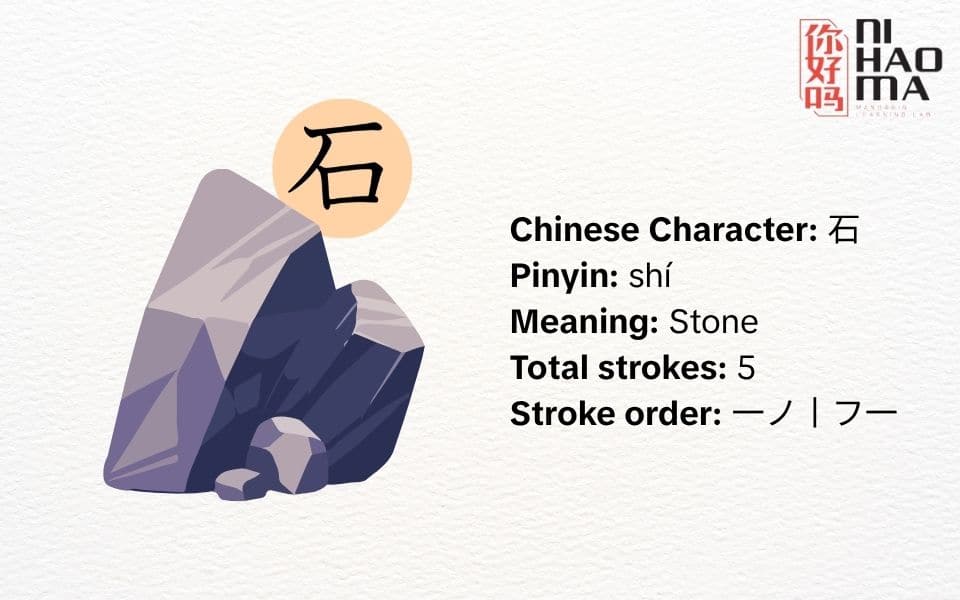
Historically, Radical 112 originated as a simple pictograph, resembling a rock beneath a cliff (the top part resembles the Chinese radical 27 – 厂). When functioning as a component in compound characters, it usually appears on the left side (as a side radical) or at the bottom, serving as a semantic indicator.
According to the Kangxi Dictionary, nearly 500 Chinese characters fall under Radical 112. In modern life, it frequently appears across multiple domains. In science and industry, words such as 石油 (shíyóu – petroleum), 磁石 (císhí – magnet), and 矿石 (kuàngshí – ore) use this radical to denote key resources or materials.
How to Write Radical 112
Radical 112 consists of 5 strokes. The proper stroke order is as follows:
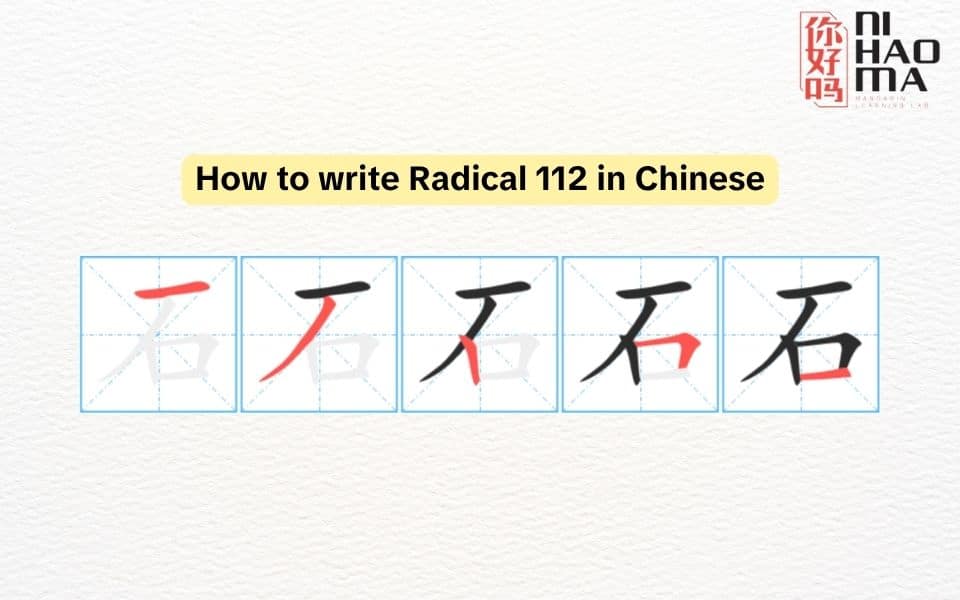
| Stroke order | Name | Description |
|---|---|---|
| 1 | Horizontal (一) | Draw a short horizontal line from left to right at the top. |
| 2 | Left-falling (丿) | From near the middle of the top line, draw a slanting stroke down to the left. |
| 3 | Vertical (丨) | Draw a vertical line from top to bottom, slightly right of center, cutting through the middle. |
| 4 | Horizontal-turn (𠃍) | Start with a short horizontal line to the right, then bend down at a right angle. |
| 5 | Horizontal (一) | Finish with a horizontal line at the bottom, forming a solid base. |
Vocabulary Containing Radical 112
Radical 112 has a strong semantic function in Chinese. In modern usage, it can appear as an independent word or as part of compound words that carry expanded meanings. Here are some commonly used words with Radical 112:
| Vocabulary | Pinyin | Meaning |
|---|---|---|
| 砂 | shā | sand |
| 破 | pò | break, smash |
| 硬 | yìng | hard, firm |
| 确 | què | certain, sure |
| 碎 | suì | shattered, broken into pieces |
| 碰 | pèng | bump into, collide, touch |
| 磨 | mó | grind, mill |
| 砖 | zhuān | brick |
| 砌 | qì | build (a wall), lay bricks |
| 碗 | wǎn | bowl |
| 确认 | quèrèn | confirm, verify |
| 破坏 | pòhuài | destroy, damage |
| 破门 | pòtmén | break open a door |
| 碎片 | suìpiàn | fragment, shard |
| 碎石 | suìshí | gravel, small stones |
| 碰到 | pèngdào | run into, encounter |
| 碰见 | pèngjiàn | meet by chance, come across |
| 磨刀 | módāo | sharpen a knife |
| 磨练 | móliàn | train, temper oneself |
| 砖头 | zhuāntou | brick |
| 砌墙 | qìqiáng | build a wall |
| 硬币 | yìngbì | coin |
| 硬件 | yìngjiàn | hardware (computer) |
| 确实 | quèshí | indeed, really |
| 确定 | quèdìng | determine, be sure |
| 确保 | quèbǎo | ensure, guarantee |
| 碰面 | pèngmiàn | meet someone |
| 磨合 | móhé | adapt, harmonize (after interaction or friction) |
| 碎裂 | suìliè | crack, fracture, break apart |
| 石头 | shítou | stone, rock |
| 石油 | shíyóu | petroleum, oil |
| 石灰 | shíhuī | lime (calcium oxide) |
| 石子 | shízǐ | small stone, pebble |
| 石桥 | shíqiáo | stone bridge |
| 石路 | shílù | stone road |
| 矿石 | kuàngshí | ore |
| 硬水 | yìngshuǐ | hard water |
| 破产 | pòchǎn | bankruptcy |
| 破旧 | pòjiù | old and worn |
| 碎布 | suìbù | scrap fabric |
| 碰伤 | pèngshāng | bump and injure |
| 磨损 | mósǔn | wear, abrasion |
| 磨平 | mópíng | grind flat |
| 砖块 | zhuānkuài | brick block |
| 砌砖 | qìzhuān | lay bricks |
| 硬度 | yìngdù | hardness |
| 确切 | quèqiè | precise, exact |
Example Dialogues Using Radical 112
Practical dialogues help learners understand context and usage naturally. Here are examples with vocabulary containing Radical 112:
Dialogue 1
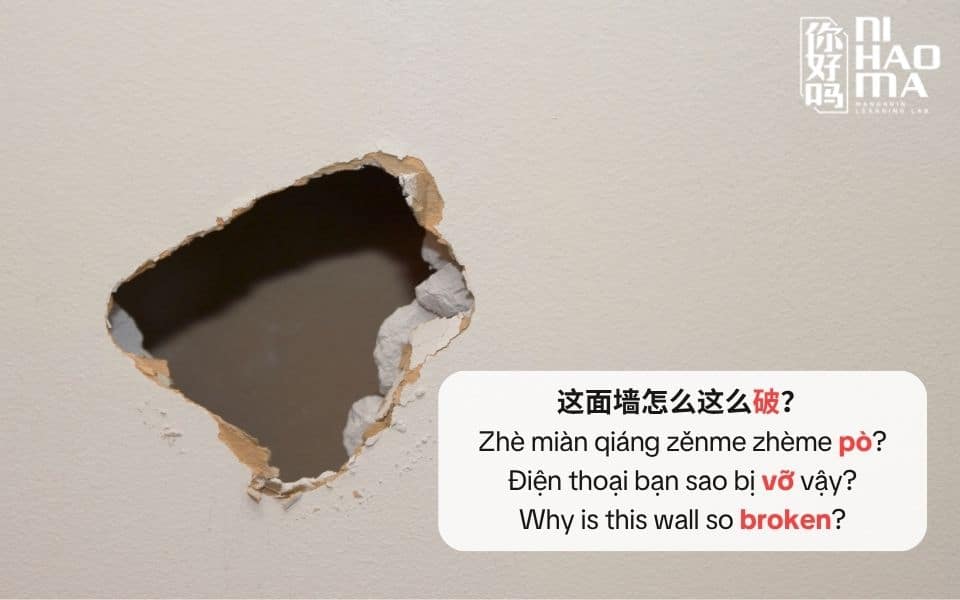
A: 这面墙怎么这么破?
Zhè miàn qiáng zěnme zhème pò?
→ Why is this wall so broken?
B: 是啊,有些砖头已经碎了。
Shì a, yǒuxiē zhuāntou yǐjīng suì le.
→ Yes, some bricks are already broken.
A: 我们要不要自己砌墙?
Wǒmen yào bú yào zìjǐ qì qiáng?
→ Should we rebuild the wall ourselves?
B: 不太容易吧。
Bú tài róngyì ba.
→ It won’t be easy.
A: 那我们找人来修吧。
Nà wǒmen zhǎo rén lái xiū ba.
→ Let’s hire someone to repair it.
B: 好的,这样更安全。
Hǎo de, zhèyàng gèng ānquán.
→ That’s safer.
Dialogue 2
A: 你最近工作怎么样?
Nǐ zuìjìn gōngzuò zěnme yàng?
→ How’s your work lately?
B: 挺忙的,不过确实学到了很多。
Tǐng máng de, búguò quèshí xuédào le hěn duō.
→ Quite busy, but I’ve definitely learned a lot.
A: 那你确定要继续做吗?
Nà nǐ quèdìng yào jìxù zuò ma?
→ Are you sure you want to continue?
B: 我觉得可以再磨练一下自己。
Wǒ juéde kěyǐ zài móliàn yíxià zìjǐ.
→ I think I should train myself further.
A: 说得对,这对以后有帮助。
Shuō de duì, zhè duì yǐhòu yǒu bāngzhù.
→ True, this will help in the future.
B: 希望如此吧。
Xīwàng rúcǐ ba.
→ Hopefully so.
Dialogue 3
A: 你的手机怎么破了?
Nǐ de shǒujī zěnme pò le?
→ Why is your phone broken?
B: 不小心掉在地上了。
Bù xiǎoxīn diào zài dìshàng le.
→ I accidentally dropped it on the floor.
A: 屏幕是不是全碎了?
Píngmù shì bú shì quán suì le?
→ Is the screen completely shattered?
B: 对,修起来可能很贵。
Duì, xiū qǐlái kěnéng hěn guì.
→ Yes, repairing it might be very expensive.
A: 我帮你打电话。
Wǒ bāng nǐ dǎ diànhuà.
→ I’ll help you make a call.
B: 谢谢你。
Xièxie nǐ.
→ Thank you.
Conclusion
Radical 112 in Chinese carries rich meanings related to stone, minerals, and hardness. By studying this radical systematically, you can approach Chinese characters with greater confidence and accuracy. Hope that Ni Hao Ma has provided you with useful information, and don’t forget to check out more interesting articles about Chinese radicals in the future!