
In the Chinese writing system, radicals play an essential role in helping learners understand the structure and meaning of characters. By learning the meaning, stroke order, and vocabulary associated with a radical, students can remember characters more easily and even infer the meaning of unfamiliar words.
So, what is radical 116 in Chinese? In this article, we will explore the meaning of radical 116, how to write it correctly, and common vocabulary examples. Understanding this radical will make learning Chinese characters more visual, logical, and effective.
What Is Radical 116 in Chinese?
Radical 116 (穴 – xué) is the 116th radical in the traditional set of 214 Kangxi radicals used to classify Chinese characters. This radical commonly conveys meanings related to caves, holes, hollow spaces, or shelters.
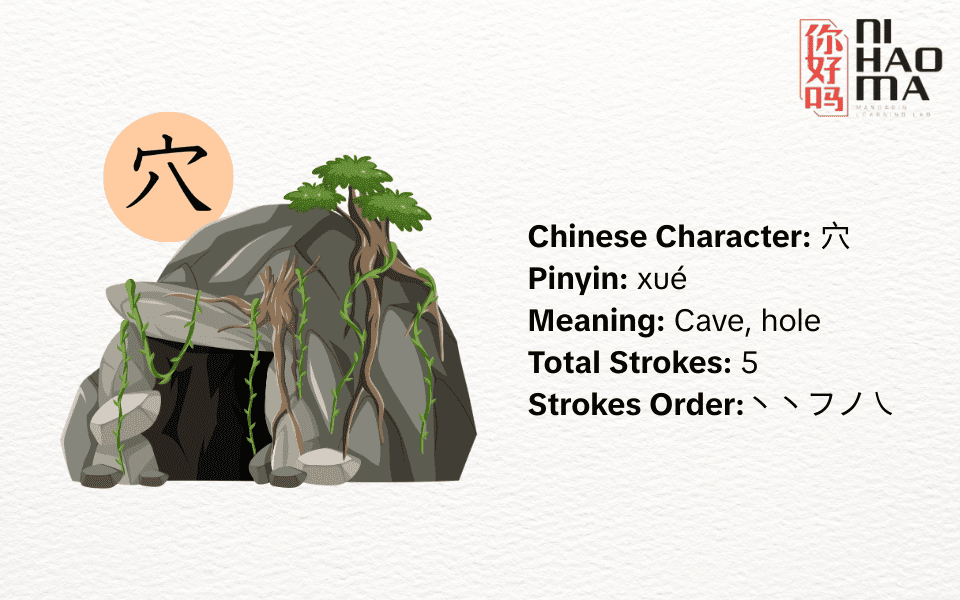
Semantically, the original meaning of 穴 is “a cave” or “a hole.” In ancient times, caves were natural shelters for both humans and animals. The shape of this character reflects that idea. Structurally, it can be analyzed as the combination of 宀 (a roof radical representing a shelter) on top and 八 (eight, suggesting division or an opening) underneath.
When used as an independent character, 穴 refers to a cave, cavity, hole, or a place dug into the ground. Over time, this meaning expanded to include concepts related to empty spaces, gaps, or something located deep inside. Because of its clear visual symbolism, radical 116 often helps learners guess the meaning of characters associated with hollow structures or enclosed spaces.
Read more: The Ultimate List of 214 Chinese Radicals
How to Write Radical 116
Radical 116 contains 5 strokes and is usually written at the top of a character. The correct stroke order is as follows:
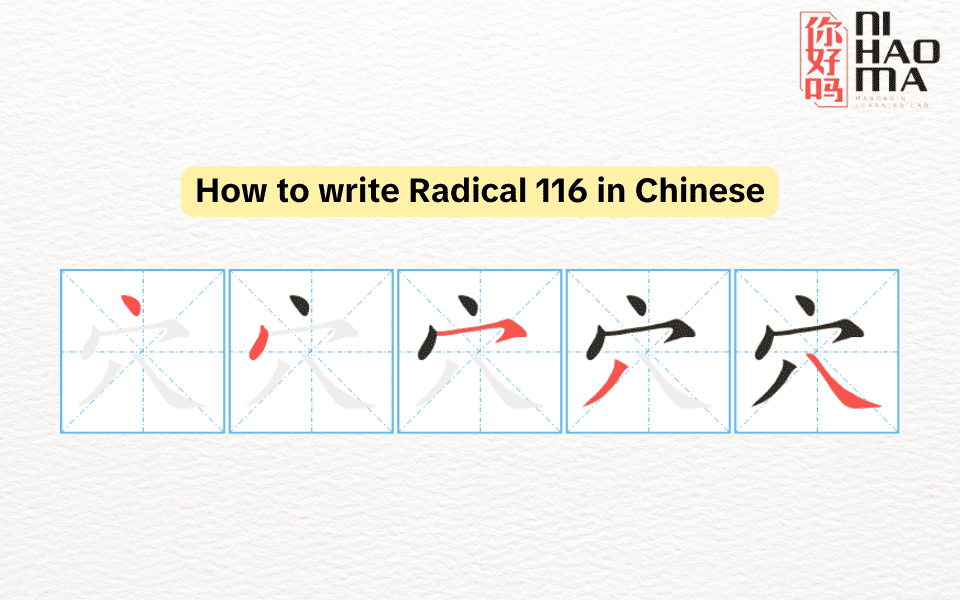
| Stroke Order | Stroke Name | Description |
|---|---|---|
| 1 | Dot (丶) | Start with a small dot in the upper center area. |
| 2 | Dot (丶) | Write a second dot slightly below and to the left. |
| 3 | Horizontal hook (㇇) | Draw a horizontal line from left to right, then curve downward to form a hook. |
| 4 | Left-falling stroke (丿) | Write a diagonal stroke falling toward the lower left, suggesting the inner space of a cave. |
| 5 | Right-falling stroke (㇏) | Finish with a longer right-falling stroke to balance the structure. |
Vocabulary Containing Radical 116 in Chinese
When radical 116 appears in a character, it often functions as a semantic component, providing clues about the meaning. Learning vocabulary containing this radical not only expands your Chinese vocabulary but also helps you better understand how Chinese characters are formed and how their meanings evolve.
Below are some common Chinese words containing radical 116, frequently used in daily communication and study:
| Chinese | Pinyin | Meaning |
|---|---|---|
| 空 | kōng | empty |
| 究 | jiū | to investigate, study |
| 穷 | qióng | exhausted, poor |
| 突 | tū | suddenly |
| 窃 | qiè | to steal secretly |
| 穿 | chuān | to pass through, wear |
| 窗 | chuāng | window |
| 窄 | zhǎi | narrow |
| 窝 | wō | nest, den |
| 窟 | kū | cave |
| 帘 | lián | curtain |
| 窖 | jiào | cellar |
| 窒 | zhì | choke, suffocate |
| 窜 | cuàn | flee |
| 空间 | kōngjiān | space |
| 穴位 | xuéwèi | acupuncture point |
| 有空 | yǒu kòng | to be free |
| 空气 | kōngqì | air |
| 空调 | kōngtiáo | air conditioner |
| 研究 | yánjiū | research |
| 突然 | tūrán | suddenly |
| 突出 | tūchū | prominent |
| 突破 | tūpò | breakthrough |
| 突袭 | tūxí | raid |
| 究竟 | jiūjìng | after all |
| 穷尽 | qióngjìn | to exhaust |
| 穷途 | qióngtú | dead end |
| 穿衣 | chuānyī | to get dressed |
| 穿孔 | chuānkǒng | perforation |
| 穿过 | chuānguò | pass through |
| 穿越 | chuānyuè | cross through |
| 穿透 | chuāntòu | penetrate |
| 窗户 | chuānghu | window |
| 窗口 | chuāngkǒu | window / service counter |
| 窝火 | wōhuǒ | irritated |
| 窝藏 | wōcáng | harbor (criminals) |
| 窝点 | wōdiǎn | hideout |
| 窒息 | zhìxī | suffocation |
| 窜逃 | cuàntáo | escape |
| 狭窄 | xiázhǎi | narrow |
| 窍门 | qiàomén | trick, tip |
Example Dialogues Using Vocabulary with Radical 116
In modern Chinese, many words containing radical 116 appear frequently in everyday conversations. These expressions can be used in common situations such as talking in the office, discussing daily routines, or interacting with friends.
Below are several short dialogues to help you understand how these words are used in real-life contexts.
Example 1
A: 今天办公室有点热,你能打开窗户吗?
Jīntiān bàngōngshì yǒudiǎn rè, nǐ néng dǎkāi chuānghu ma?
The office is a bit hot today. Could you open the window?
B: 好啊,我也觉得空气不太流通。
Hǎo a, wǒ yě juéde kōngqì bú tài liútōng.
Sure. I also feel the air isn’t circulating well.
A: 外面风挺大的,小心别让文件飞走。
Wàimiàn fēng tǐng dà de, xiǎoxīn bié ràng wénjiàn fēizǒu.
The wind outside is strong. Be careful not to let the documents blow away.
B: 没事,我只开一点点。
Méi shì, wǒ zhǐ kāi yìdiǎndiǎn.
It’s okay. I’ll just open it a little.
A: 这样就舒服多了。
Zhèyàng jiù shūfu duō le.
That feels much better.
Example 2
A: 你昨天怎么没来上班?
Nǐ zuótiān zěnme méi lái shàngbān?
Why didn’t you come to work yesterday?
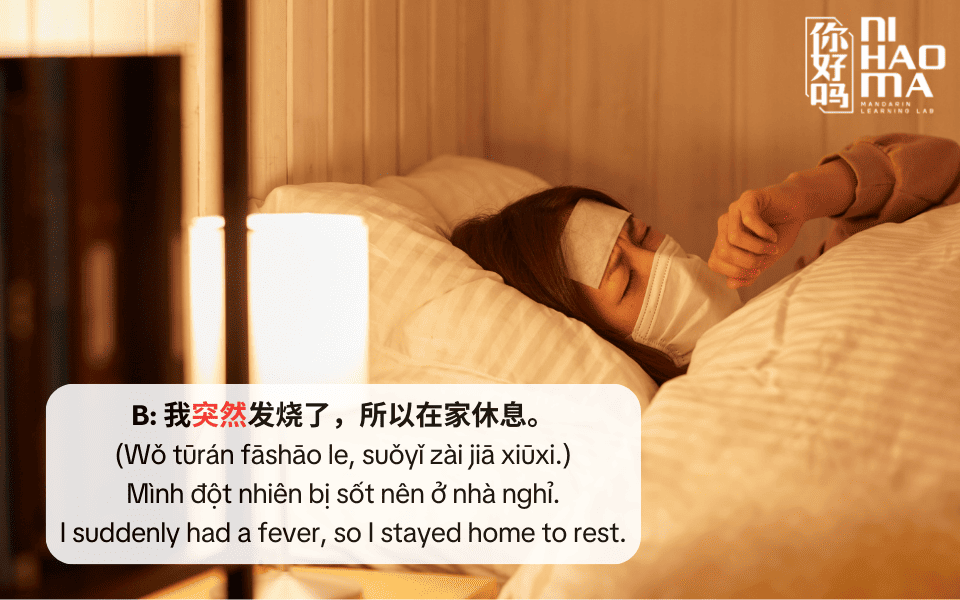
B: 我突然发烧了,所以在家休息。
Wǒ tūrán fāshāo le, suǒyǐ zài jiā xiūxi.
I suddenly had a fever, so I stayed home to rest.
A: 现在好一点了吗?
Xiànzài hǎo yìdiǎn le ma?
Are you feeling better now?
B: 好多了,不过还有一点累。
Hǎo duō le, búguò hái yǒu yìdiǎn lèi.
Much better, but still a bit tired.
A: 那今天别太忙,好好休息。
Nà jīntiān bié tài máng, hǎohǎo xiūxi.
Then don’t work too hard today and get some rest.
Example 3
A: 你怎么还没出门?
Nǐ zěnme hái méi chūmén?
Why haven’t you left yet?
B: 我在找一件衣服穿。
Wǒ zài zhǎo yí jiàn yīfu chuān.
I’m looking for something to wear.
A: 今天天气有点冷,记得穿厚一点。
Jīntiān tiānqì yǒudiǎn lěng, jìde chuān hòu yìdiǎn.
It’s a bit cold today. Remember to wear something warm.
B: 好的,我穿这件外套就走。
Hǎo de, wǒ chuān zhè jiàn wàitào jiù zǒu.
Okay, I’ll put on this coat and leave.
A: 那我们楼下见吧。
Nà wǒmen lóuxià jiàn ba.
Let’s meet downstairs.
Conclusion
In this article, Ni Hao Ma has introduced radical 116 in Chinese, including its meaning, stroke order, vocabulary, and practical examples. Learning Chinese vocabulary through radicals is an effective method because it helps learners recognize the structure of characters, understand semantic clues, and memorize new words more efficiently.
We hope the explanations, vocabulary lists, and dialogues in this guide will help you remember radical 116 more easily and apply it confidently in your Chinese learning journey. Stay tuned for more lessons exploring other Chinese radicals so you can gradually build a strong foundation in Chinese characters and learn the language more effectively.