The Radical 118 in Chinese is one of the earliest-appearing radicals and also among those with a high frequency of use in the Chinese writing system. In this article, we will explore what the Radical 118 in Chinese is, understand its symbolic meanings, learn the correct stroke order, and review common vocabulary that contains this radical.
What Is the Radical 118 in Chinese?
The Bamboo Radical in Chinese (竹 – zhú) is radical 118 in Chinese among the 214 Kangxi radicals. It commonly appears in Chinese characters related to bamboo, reeds, or objects made from bamboo.
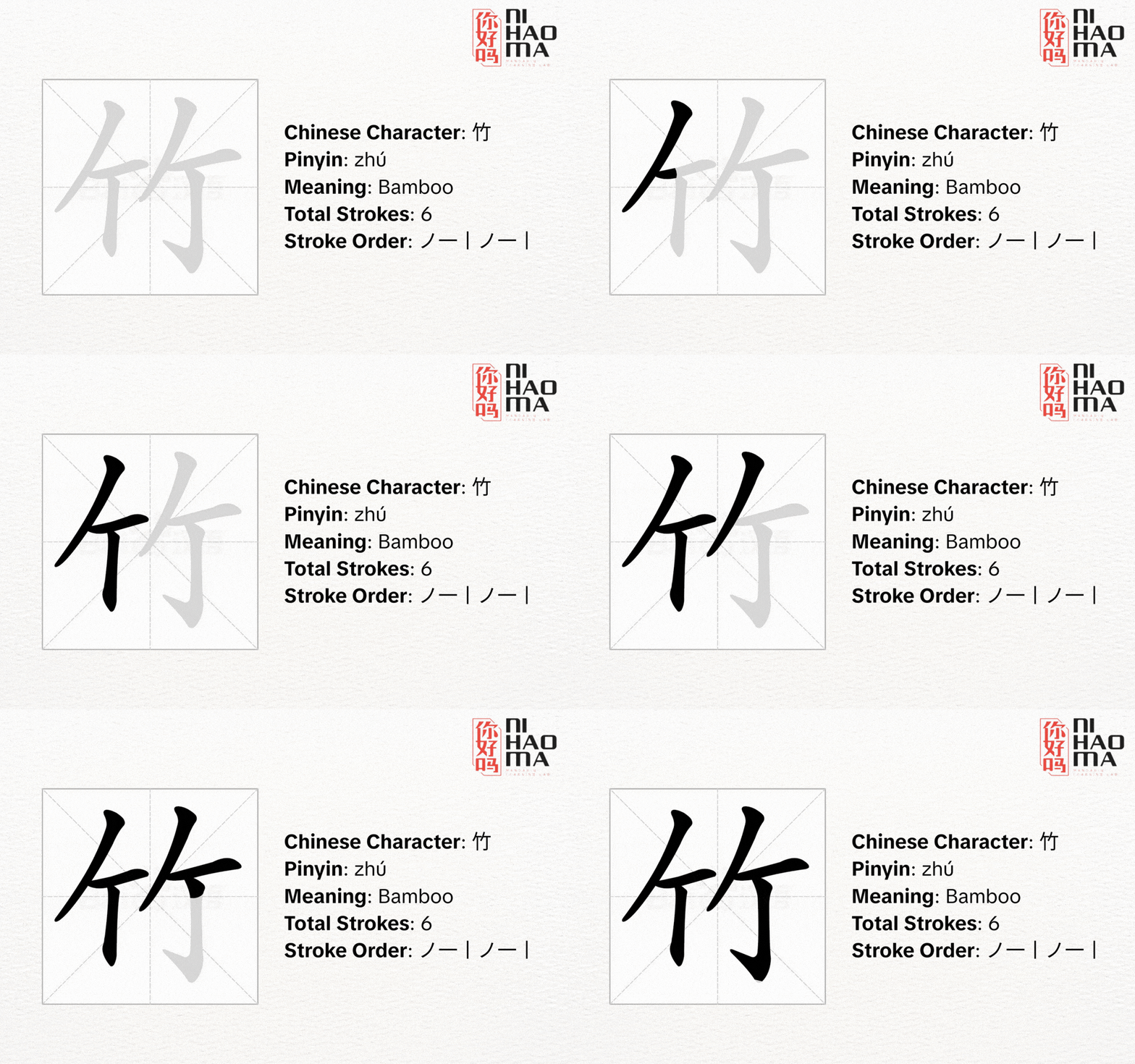
In terms of meaning, the Bamboo Radical does not only represent bamboo as a physical material but also conveys deep symbolic values. In traditional Chinese culture, bamboo symbolizes integrity, resilience, and humility. Bamboo grows straight, is hollow inside, yet remains flexible and difficult to break. Because of these qualities, many Chinese characters containing the Bamboo Radical evoke human virtues, simplicity, or positive spiritual values.
When used as a radical, 竹 is usually written in its variant form ⺮ and placed at the top of a character. According to records in the Kangxi Dictionary, more than 900 Chinese characters are classified under radical 118 in Chinese. When you recognize the Bamboo Radical, you can often infer that the character’s meaning is related to bamboo, tools, everyday objects, or abstract concepts derived from the image of bamboo.
How to write the Radical 118 in Chinese
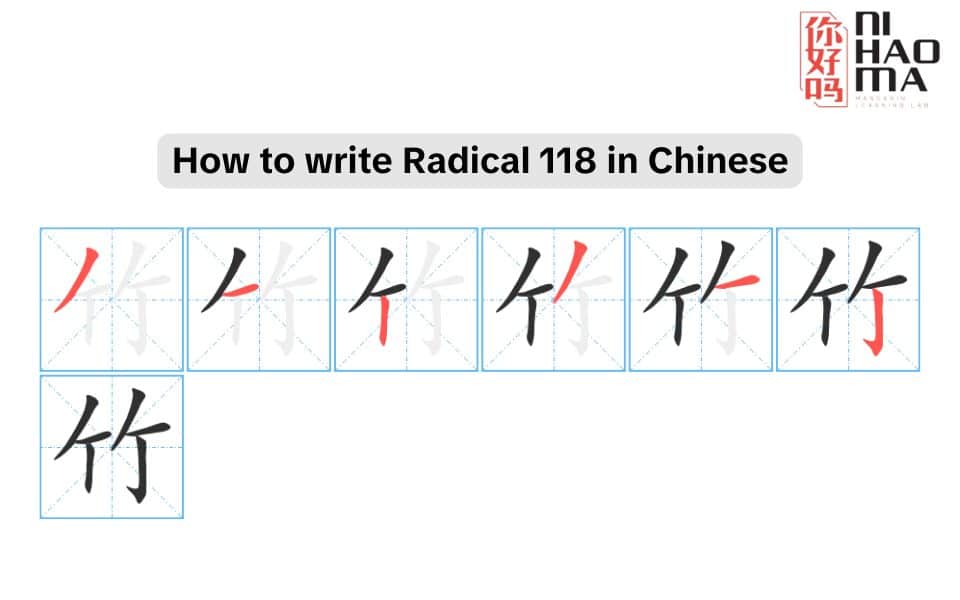
The Radical 118 consists of 6 strokes, written in the following order:
| Stroke Order | Stroke | Description |
|---|---|---|
| 1 | ノ (left-falling stroke) | Written from top to bottom, slightly slanted to the left. |
| 2 | 一 (horizontal stroke) | A short horizontal line starting from the middle of the previous stroke. |
| 3 | 丨 (vertical stroke) | A straight vertical stroke going downward, without a hook. |
| 4 | ノ (left-falling stroke) | Begins on the right side, similar in form to stroke 1. |
| 5 | 一 (horizontal stroke) | A short horizontal line starting from the middle of the previous stroke. |
| 6 | 亅 (vertical hook) | A straight vertical stroke with a small upward hook at the end. |
Vocabulary Containing Radical 118 in Chinese
In the Chinese writing system, radical 118 appears with high frequency and is closely associated with many familiar words in modern daily life. Characters containing radical 118 make up a considerable proportion of commonly used vocabulary, especially at beginner to intermediate HSK levels. Below is a list of popular Chinese words containing radical 118 that learners should know:
| Chinese Character | Pinyin | Meaning |
|---|---|---|
| 竹 | zhú | bamboo |
| 笔 / 筆 | bǐ | pen |
| 笑 | xiào | to laugh |
| 第 | dì | ordinal number |
| 简 / 簡 | jiǎn | simple |
| 答 | dá | to answer |
| 笨 | bèn | clumsy |
| 算 | suàn | to calculate |
| 筷子 | kuàizi | chopsticks |
| 箱 | xiāng | box |
| 符 | fú | symbol |
| 策 | cè | strategy |
| 签 / 簽 | qiān | to sign |
| 管 | guǎn | to manage; pipe |
| 篮 / 籃 | lán | basket |
| 筑 | zhù | to build |
| 筋 | jīn | tendon |
| 等 | děng | to wait |
| 笼 / 籠 | lóng | cage |
| 笛 | dí | flute |
| 箭 | jiàn | arrow |
| 筹 / 籌 | chóu | to prepare; to raise (funds) |
| 符号 | fúhào | symbol |
| 签名 | qiānmíng | signature |
| 答案 | dá’àn | answer |
| 简单 | jiǎndān | simple |
| 策略 | cèlüè | strategy |
| 管理 | guǎnlǐ | management |
| 等待 | děngdài | to wait |
| 算法 | suànfǎ | algorithm |
| 筷 | kuài | chopsticks |
| 篇 | piān | measure word for articles |
| 符合 | fúhé | to conform |
| 箱子 | xiāngzi | box |
| 筑路 | zhùlù | to build a road |
| 筋骨 | jīngǔ | muscles and bones |
| 笔记 | bǐjì | notes |
| 笔试 | bǐshì | written exam |
| 签证 | qiānzhèng | visa |
| 简历 / 簡歷 | jiǎnlì | résumé |
| 管道 | guǎndào | pipeline |
| 筹备 | chóubèi | to prepare |
| 等级 | děngjí | level; rank |
| 算数 | suànshù | arithmetic |
| 笼子 | lóngzi | cage |
| 答应 | dāying | to agree |
| 策划 / 策劃 | cèhuà | to plan |
| 简化 | jiǎnhuà | to simplify |
| 管制 | guǎnzhì | to control |
| 篮球 / 籃球 | lánqiú | basketball |
Sample Dialogues Using Vocabulary with Radical 118
Learning vocabulary that contains radical 118 becomes much more effective when placed in real conversational contexts. Instead of memorizing characters in isolation, learners can better understand usage, nuances, and communication reflexes through familiar situations such as studying, working, or daily life.
Below are some sample dialogues using vocabulary with radical 118 that you can practice at home:
Dialogue 1
A: 你有笔吗?我忘记带了。
Nǐ yǒu bǐ ma? Wǒ wàngjì dài le.
(Do you have a pen? I forgot to bring one.)
B: 有,这支笔给你用吧。
Yǒu, zhè zhī bǐ gěi nǐ yòng ba.
(Yes, you can use this pen.)
A: 谢谢,你在写笔记吗?
Xièxie, nǐ zài xiě bǐjì ma?
(Thanks. Are you taking notes?)
B: 对,老师讲的内容不难,很简单。
Duì, lǎoshī jiǎng de nèiróng bù nán, hěn jiǎndān.
(Yes. What the teacher explained isn’t difficult—very simple.)
A: 那你有答案吗?
Nà nǐ yǒu dá’àn ma?
(Do you have the answers then?)
B: 下课后我发给你。
Xiàkè hòu wǒ fā gěi nǐ.
(I’ll send them to you after class.)

Dialogue 2
A: 筷子放在哪儿了?
Kuàizi fàng zài nǎr le?
(Where are the chopsticks?)
B: 在厨房的箱子里。
Zài chúfáng de xiāngzi lǐ.
(In the box in the kitchen.)
A: 那只鸟还在笼子里吗?
Nà zhī niǎo hái zài lóngzi lǐ ma?
(Is the bird still in the cage?)
B: 在的,不过要等一会儿再喂它。
Zài de, búguò yào děng yíhuìr zài wèi tā.
(Yes, but we need to wait a bit before feeding it.)
A: 好,那我先去准备饭。
Hǎo, nà wǒ xiān qù zhǔnbèi fàn.
(Okay, I’ll go prepare the meal first.)
Dialogue 3
A: 这个项目的策略已经确定了吗?
Zhège xiàngmù de cèlüè yǐjīng quèdìng le ma?
(Has the strategy for this project been finalized?)
B: 还没有,经理正在管理和调整。
Hái méiyǒu, jīnglǐ zhèngzài guǎnlǐ hé tiáozhěng.
(Not yet. The manager is managing and making adjustments.)
A: 那我需要先准备简历吗?
Nà wǒ xūyào xiān zhǔnbèi jiǎnlì ma?
(Do I need to prepare my résumé first?)
B: 需要,明天可能要签名确认。
Xūyào, míngtiān kěnéng yào qiānmíng quèrèn.
(Yes, we may need to sign for confirmation tomorrow.)
A: 好的,我今天就准备好。
Hǎo de, wǒ jīntiān jiù zhǔnbèi hǎo.
(Alright, I’ll get it ready today.)
Conclusion
Through exploring radical 118 in Chinese, it becomes clear that this is not only a fundamental radical in Chinese characters but also a strong reflection of the close relationship between language and traditional Chinese culture. Mastering its meaning, correct stroke order, and the vocabulary built around radical 118 helps learners memorize characters more effectively and infer meanings when encountering new words. Hopefully, Ni Hao Ma has provided you with useful insights—don’t forget to follow the website to discover even more fascinating Chinese radicals.