When you begin learning Chinese, understanding radicals is one of the most effective ways to recognize characters, guess meanings, and expand vocabulary systematically. Radical 119 (米) is a foundational component in the Kangxi system of 214 radicals. Although simple in structure, it appears in many commonly used Chinese characters.
So, what does Radical 119 mean, how is it written, and which words commonly contain it? Let’s explore the details below.
What Is Radical 119 in Chinese?
Radical 119 (米 – mǐ) is the 119th radical in the traditional Kangxi radical system. Its core meaning is rice or grain. In addition to functioning as a radical, 米 is also an independent Chinese character that can stand alone as a complete word.
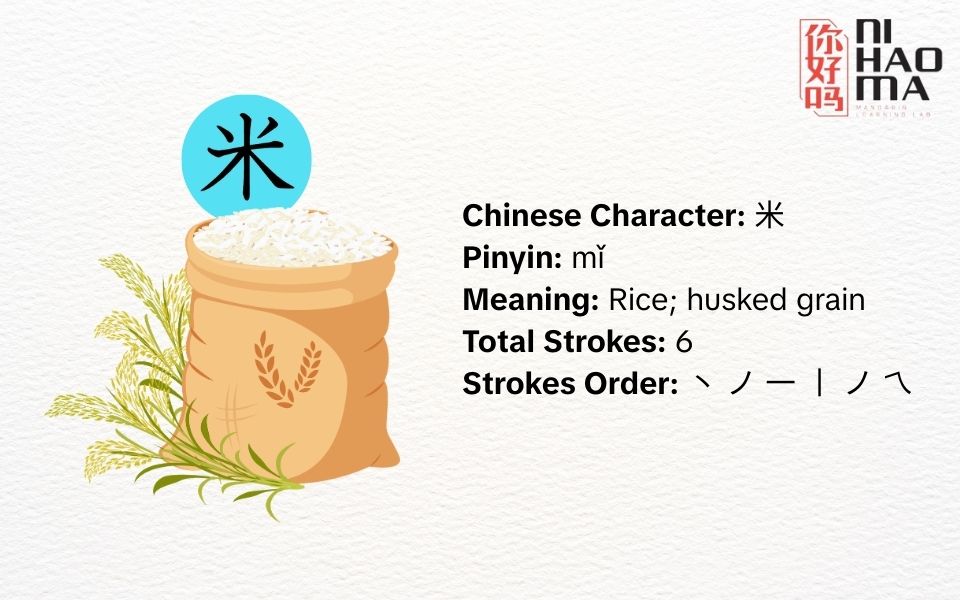
From a structural perspective, the character 米 is composed of six strokes and visually represents grains of rice scattered from a rice plant. Over time, as Chinese characters evolved and were standardized, 米 gradually took on its modern regular script (kaishu) form while still preserving its original pictographic meaning. This evolution highlights a key feature of the Chinese writing system: the integration of visual form and semantic meaning to convey ideas effectively.
When functioning as a component, radical 119 commonly appears on the left side or at the top of a character. It typically suggests meanings related to grain, food, or products derived from cereals. For example, in 粉 (fěn, flour/powder), 糖 (táng, sugar), and 粮 (liáng, grain; food supplies), radical 119 signals a connection to grains, processing, or refined natural ingredients. Recognizing radical 119 helps learners identify semantic patterns and expand vocabulary more efficiently.
- Chinese Character: 米
- Pinyin: mǐ
- Meaning: rice; husked grain
- Total Strokes: 6
- Stroke Order: 丶 ノ 一 丨 ノ 乀
How to Write Radical 119 in Chinese
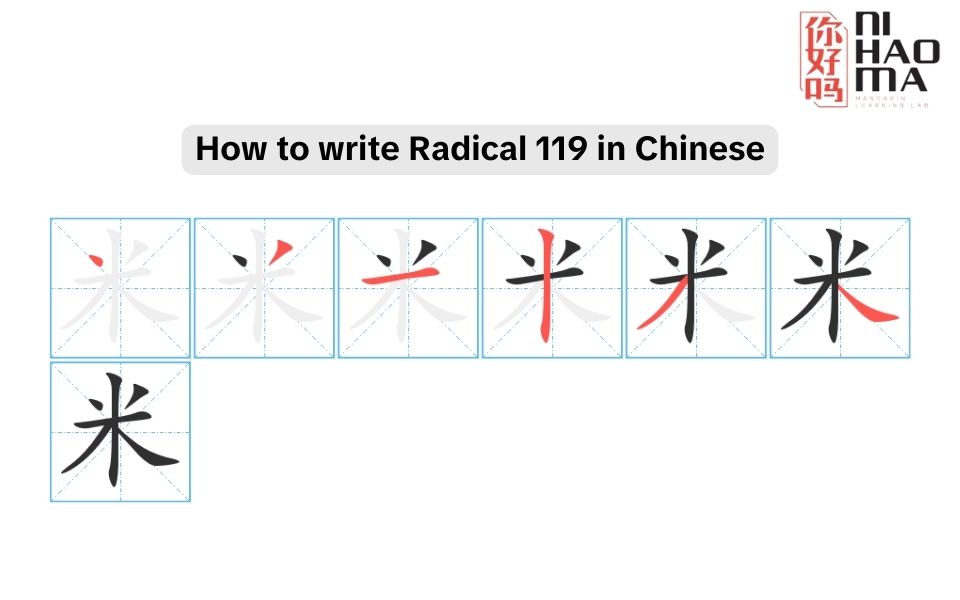
Radical 119 consists of 6 strokes written in the following order:
| Stroke Order | Stroke | Description |
|---|---|---|
| 1 | 丶 (Dot) | A small dot at the upper left, written from top to bottom with a slight rightward slant. |
| 2 | ノ (Left-falling stroke) | A short left-falling stroke at the upper right, moving downward to the left. |
| 3 | 一 (Horizontal stroke) | A short horizontal line written from left to right beneath the two upper strokes. |
| 4 | 丨 (Vertical stroke) | A vertical line drawn from top to bottom, passing through the center of the horizontal stroke. |
| 5 | ノ (Left-falling stroke) | A longer left-falling stroke starting from the intersection of the vertical and horizontal strokes. |
| 6 | 乀 (Right-falling stroke) | A right-falling stroke beginning at the same intersection point, slanting downward to the right. |
Vocabulary with Radical 119 in Chinese
Below is a list of common Chinese vocabulary containing radical 119 (米). Most of these characters are related to rice, grains, food, or products processed from cereals. Learning characters by radical helps you recognize semantic patterns, expand vocabulary systematically, and improve retention.
| Chinese Character | Pinyin | Meaning |
|---|---|---|
| 米 | mǐ | rice |
| 粉 | fěn | flour; powder |
| 粒 | lì | grain; particle |
| 粗 | cū | coarse; rough |
| 糖 | táng | sugar |
| 精 | jīng | essence; refined; pure |
| 粥 | zhōu | porridge |
| 粮 | liáng | grain; food supply |
| 糕 | gāo | cake |
| 糕点 | gāodiǎn | pastry |
| 糊 | hú | paste; glue |
| 糟 | zāo | dregs; residue |
| 糠 | kāng | bran |
| 糙 | cāo | brown rice; coarse |
| 糯 | nuò | glutinous (sticky rice) |
| 粘 | zhān | sticky; to stick |
| 粪 | fèn | manure |
| 粉末 | fěnmò | powder |
| 粮食 | liángshi | food grains |
| 粉丝 | fěnsī | vermicelli; fan (slang) |
| 粽 | zòng | rice dumpling (zongzi) |
| 粥店 | zhōudiàn | porridge shop |
| 糖果 | tángguǒ | candy |
| 糖水 | tángshuǐ | syrup |
| 精华 | jīnghuá | essence |
| 精神 | jīngshén | spirit; energy |
| 精力 | jīnglì | energy; vitality |
| 精选 | jīngxuǎn | carefully selected |
| 精致 | jīngzhì | delicate; refined |
| 粉笔 | fěnbǐ | chalk |
| 粉碎 | fěnsuì | to crush |
| 粉尘 | fěnchén | dust |
| 粮仓 | liángcāng | granary |
| 糖醋 | tángcù | sweet and sour |
| 糕饼 | gāobǐng | pastry |
| 粘贴 | zhāntiē | to paste; to stick |
| 粗心 | cūxīn | careless |
| 粗糙 | cūcāo | rough |
| 精密 | jīngmì | precise |
| 精通 | jīngtōng | proficient |
| 精简 | jīngjiǎn | streamlined |
| 精确 | jīngquè | accurate |
| 糊涂 | hútu | confused |
| 糖分 | tángfèn | sugar content |
| 米饭 | mǐfàn | cooked rice |
| 米粉 | mǐfěn | rice noodles |
Sample Dialogues Using Radical 119 Vocabulary
Practicing vocabulary in real-life conversations makes it easier to remember and apply new words naturally. Below are short sample dialogues featuring words that contain radical 119.
Dialogue 1
A: 今天中午你想吃什么?
(Jīntiān zhōngwǔ nǐ xiǎng chī shénme?)
What would you like to eat for lunch?
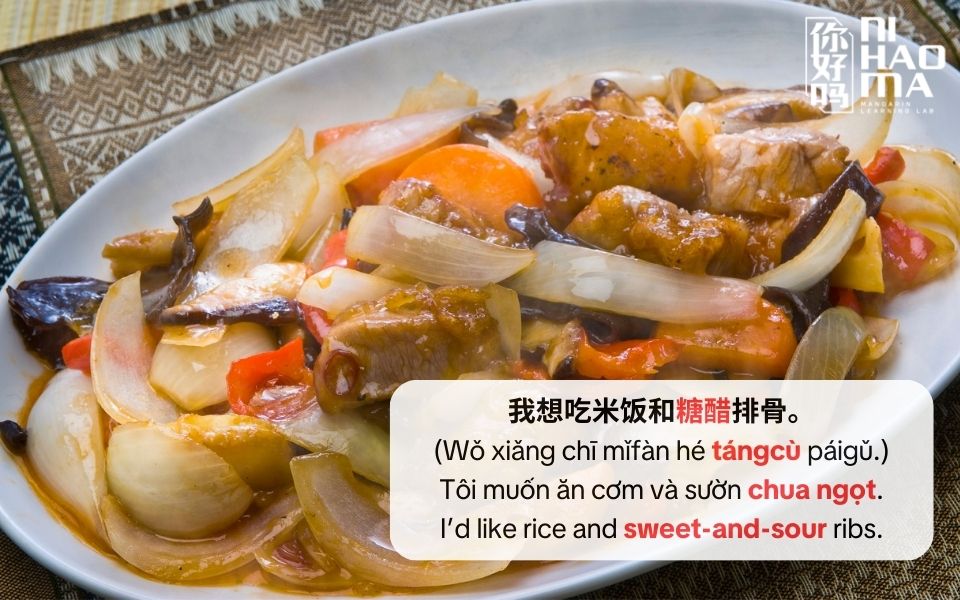
B: 我想吃米饭和糖醋排骨。
(Wǒ xiǎng chī mǐfàn hé tángcù páigǔ.)
I’d like rice and sweet-and-sour ribs.
A: 要不要来一碗汤或者米粉?
(Yào bú yào lái yì wǎn tāng huòzhě mǐfěn?)
Would you like a bowl of soup or rice noodles?
B: 不用了,我最近在控制糖分。
(Bù yòng le, wǒ zuìjìn zài kòngzhì tángfèn.)
No thanks, I’m controlling my sugar intake lately.
Dialogue 2
A: 超市的粮食区在几楼?
(Chāoshì de liángshí qū zài jǐ lóu?)
Which floor is the grain section in the supermarket?
B: 在二楼,你可以买米、面粉和粉丝。
(Zài èr lóu, nǐ kěyǐ mǎi mǐ, miànfěn hé fěnsī.)
It’s on the second floor. You can buy rice, flour, and vermicelli there.
A: 这里的糕点看起来很精致。
(Zhèlǐ de gāodiǎn kàn qǐlái hěn jīngzhì.)
The pastries here look very delicate.
B: 对,而且价格不贵。
(Duì, érqiě jiàgé bú guì.)
Yes, and they’re not expensive.
Dialogue 3
A: 你今天看起来很有精神。
(Nǐ jīntiān kàn qǐlái hěn yǒu jīngshén.)
You look very energetic today.
B: 因为昨晚睡得很好,所以精力充沛。
(Yīnwèi zuówǎn shuì de hěn hǎo, suǒyǐ jīnglì chōngpèi.)
I slept well last night, so I’m full of energy.
A: 这个报告需要很精确的数据。
(Zhège bàogào xūyào hěn jīngquè de shùjù.)
This report requires very accurate data.
B: 放心吧,我已经仔细检查过了。
(Fàngxīn ba, wǒ yǐjīng zǐxì jiǎnchá guò le.)
Don’t worry, I’ve already checked it carefully.
Conclusion
Radical 119 (米) is a commonly used component in Chinese characters and appears in many words related to food, daily life, and even abstract concepts such as energy and precision. By mastering its meaning, structure, and related vocabulary, you can build a stronger foundation in Chinese and learn characters more efficiently.
Ni Hao Ma hopes this guide has provided you with clear and practical insights into radical 119. Stay connected for more educational content designed to make your Chinese learning journey easier and more effective.