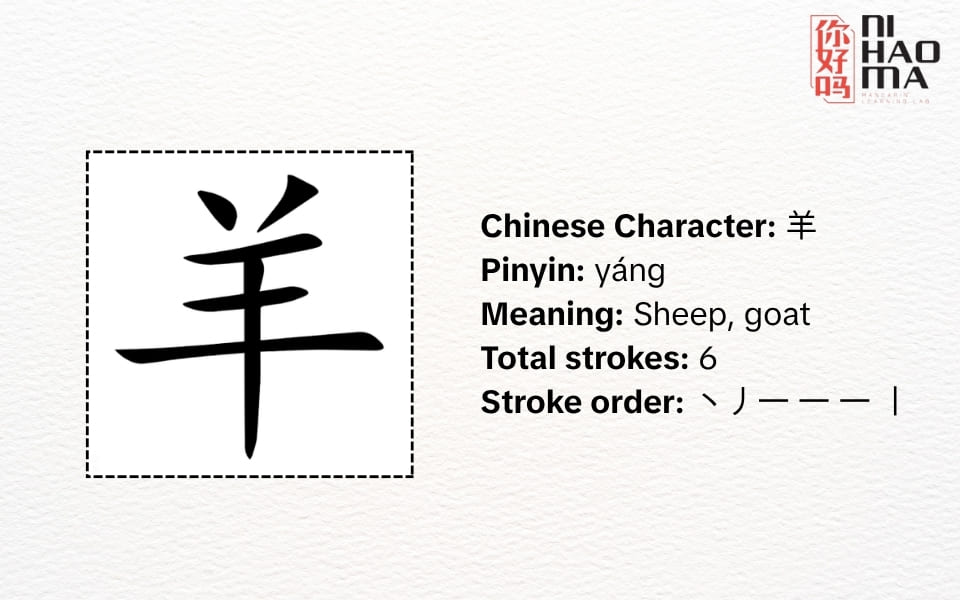
Radical 123 in Chinese, 羊 (yáng), is a distinctive Chinese character radical associated with the image of a goat or sheep. It appears in many familiar Chinese characters and words, making it a useful radical for Chinese learners to recognize.
But what is the history and meaning behind Radical 123 in Chinese? How can understanding this radical help you learn Chinese vocabulary and communicate more naturally? Let’s explore its meaning, stroke order, vocabulary, and practical usage in this guide.
What Is Radical 123 in Chinese?
Radical 123 in Chinese (羊 – yáng) is the 123rd radical among the 214 traditional Chinese radicals. Its basic meaning is “goat” or “sheep.” 羊 can function not only as a radical but also as an independent Chinese character.
The original form of 羊 depicted a frontal view of a goat or sheep’s head, with two curved horns at the top. As Chinese writing evolved over time, this original pictographic form was gradually simplified into the modern character 羊.
In ancient Chinese society, goats and sheep were gentle grazing animals that provided significant economic value through their meat, milk, wool, and skin. Because of their practical importance, the image of a goat or sheep became associated with ideas such as abundance, beauty, goodness, and kindness.
Radical 123 in Chinese also carries cultural and symbolic significance in traditional Chinese thought. For example, the character 祥 (xiáng), meaning “auspicious” or “peaceful,” is made up of 示, associated with ritual offerings, and 羊. In ancient rituals, goats and sheep were sometimes used as sacred sacrificial animals.
Understanding these cultural associations can make it easier for learners to recognize and remember unfamiliar Chinese characters. It can also make learning Chinese characters more interesting by showing how their forms and meanings developed over time.
How to Write Radical 123 in Chinese
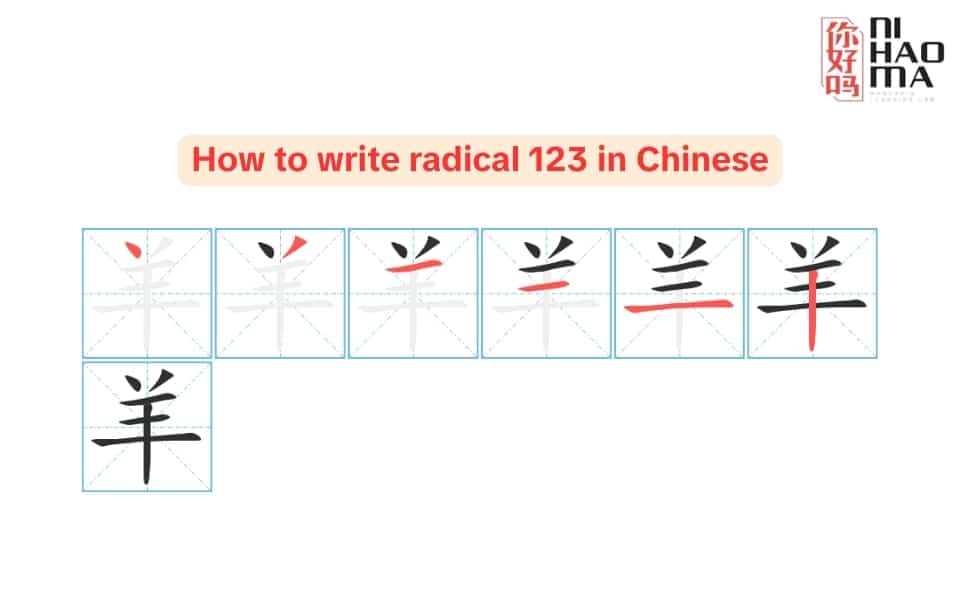
The character 羊 (yáng) consists of 6 strokes. Its basic stroke order is as follows:
| Stroke Order | Stroke Name | How to Write |
|---|---|---|
| 1 | 丶 (Dot) | Write a dot at the upper-left area. |
| 2 | 丿 (Left-falling stroke) | Write a left-falling stroke next to the first stroke, moving downward. |
| 3 | 一 (Horizontal stroke) | Write a short horizontal stroke underneath the first two strokes, leaving appropriate spacing. |
| 4 | 一 (Horizontal stroke) | Write the second horizontal stroke, parallel to the first and slightly shorter. |
| 5 | 一 (Horizontal stroke) | Write the third horizontal stroke parallel to the previous one, approximately as long as the first horizontal stroke. |
| 6 | 丨 (Vertical stroke) | Write a vertical stroke starting from the middle of the first horizontal stroke and passing through all three horizontal strokes. |
Learning the correct stroke order for 羊 is helpful because it allows you to write the character more naturally and recognize it more easily when it appears as part of a more complex Chinese character.
Chinese Vocabulary Containing Radical 123
Radical 123 in Chinese does not only appear in characters directly related to goats and sheep. The component 羊 can also be found in many Chinese characters and words with a wide range of meanings.
Learning vocabulary that contains familiar radicals can help Chinese learners expand their vocabulary while making Chinese characters easier to recognize and remember through their structure.
Here are some common Chinese words and characters containing 羊 or the 羊 component, together with their pinyin and English meanings:
| Chinese | Pinyin | Meaning |
|---|---|---|
| 羊 | yáng | Goat; sheep |
| 羊肉 | yángròu | Goat/mutton; sheep meat |
| 羊毛 | yángmáo | Wool; sheep’s wool |
| 羊奶 | yángnǎi | Goat’s milk |
| 羊皮 | yángpí | Goatskin; sheepskin |
| 羊群 | yángqún | Flock of sheep/goats |
| 山羊 | shānyáng | Goat; mountain goat |
| 绵羊 | miányáng | Sheep |
| 公羊 | gōngyáng | Ram; male goat |
| 母羊 | mǔyáng | Ewe; female goat |
| 小羊 | xiǎoyáng | Lamb; young goat |
| 羚羊 | língyáng | Antelope |
| 美 | měi | Beautiful; good |
| 美好 | měihǎo | Beautiful; wonderful; good |
| 美丽 | měilì | Beautiful |
| 美味 | měiwèi | Delicious; tasty |
| 美食 | měishí | Delicious food; cuisine |
| 美满 | měimǎn | Happy; fulfilling; complete |
| 美观 | měiguān | Attractive; aesthetically pleasing |
| 美学 | měixué | Aesthetics |
| 美人 | měirén | Beautiful person; beauty |
| 美术 | měishù | Fine arts |
| 善 | shàn | Good; kind; virtuous |
| 善良 | shànliáng | Kind; kind-hearted |
| 善意 | shànyì | Goodwill; good intentions |
| 慈善 | císhàn | Charity; charitable |
| 人群 | rénqún | Crowd; group of people |
| 群众 | qúnzhòng | The masses; general public |
| 祥和 | xiánghé | Peaceful; harmonious |
| 海洋 | hǎiyáng | Ocean |
| 洋气 | yángqì | Stylish; modern; Western-looking |
| 样 | yàng | Form; type; pattern |
| 样子 | yàngzi | Appearance; look; manner |
| 样品 | yàngpǐn | Sample; product sample |
| 氧气 | yǎngqì | Oxygen |
| 鲜 | xiān | Fresh; fresh and delicious |
| 新鲜 | xīnxiān | Fresh |
| 鲜美 | xiānměi | Fresh and delicious |
| 鲜明 | xiānmíng | Distinctive; clear; vivid |
| 海鲜 | hǎixiān | Seafood |
| 鲜活 | xiānhuó | Fresh and alive; live |
| 修养 | xiūyǎng | Self-cultivation; personal refinement |
| 模样 | múyàng | Appearance; look |
| 详细 | xiángxì | Detailed; thorough |
| 详情 | xiángqíng | Details; detailed information |
Important Note About Radical 123
Not every Chinese character containing the 羊 component has a meaning directly related to goats or sheep.
In Chinese characters, 羊 may function as a traditional radical or as a structural component. Depending on the character, it may contribute to the meaning of the character, while in other cases it can be part of a phonetic component in a phono-semantic character.
Therefore, recognizing 羊 can provide useful clues when learning Chinese characters, but learners should not assume that every character containing this component has a direct connection with goats or sheep.
Chinese Conversations Using Vocabulary with Radical 123
Knowing the meaning of individual Chinese characters is only the first step. To use Chinese naturally, learners also need to practice vocabulary in complete sentences and everyday situations.
When you encounter a new word in context, it becomes easier to remember its meaning, usage, nuances, and common word combinations. Below are three short Chinese conversations featuring vocabulary containing Radical 123 in Chinese, covering familiar everyday situations.
Conversation 1
A: 你今天穿的裙子真美丽!
Nǐ jīntiān chuān de qúnzi zhēn měilì!
The dress you’re wearing today is really beautiful!
B: 谢谢!我也觉得这个颜色很美。
Xièxie! Wǒ yě juéde zhège yánsè hěn měi.
Thank you! I also think this color is beautiful.
A: 而且这个设计很美观,看起来很大方。
Érqiě zhège shèjì hěn měiguān, kàn qǐlái hěn dàfang.
And the design is very attractive. It looks elegant, too.
B: 是吗?这是我朋友推荐的品牌。
Shì ma? Zhè shì wǒ péngyou tuījiàn de pǐnpái.
Really? This is a brand my friend recommended.
A: 很适合你。
Hěn shìhé nǐ.
It suits you very well.
Conversation 2
A: 服务员,请给我们来一份羊肉串。
Fúwùyuán, qǐng gěi wǒmen lái yí fèn yángròuchuàn.
Waiter, we’d like an order of grilled lamb skewers, please.
B: 这里的羊肉新鲜吗?
Zhèlǐ de yángròu xīnxiān ma?
Is the lamb here fresh?
A: 放心吧,今天的肉很新鲜。
Fàngxīn ba, jīntiān de ròu hěn xīnxiān.
Don’t worry. Today’s meat is very fresh.
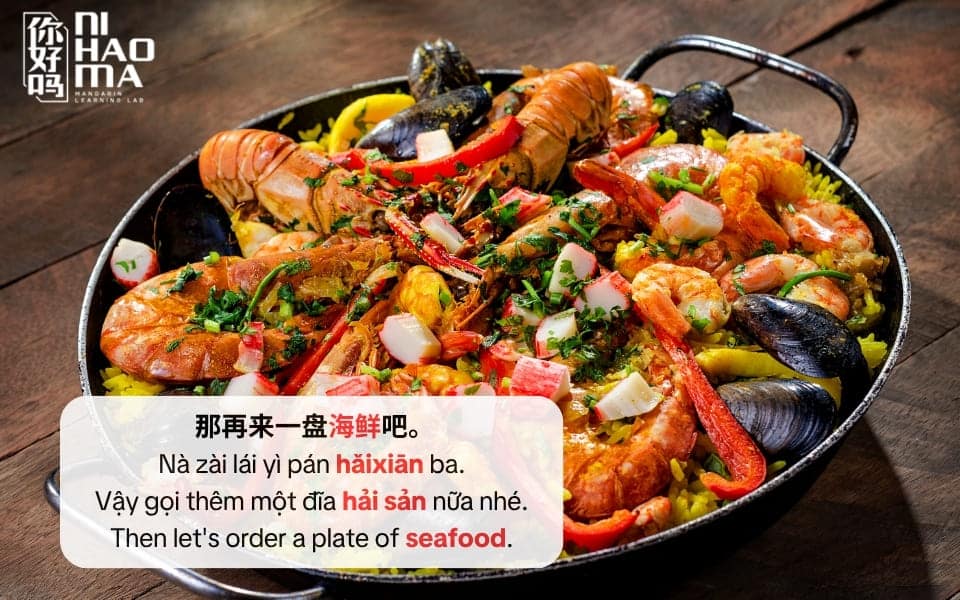
B: 那再来一盘海鲜吧。
Nà zài lái yì pán hǎixiān ba.
Then let’s order a plate of seafood, too.
A: 好的,我听说这里的海鲜特别鲜美。
Hǎo de, wǒ tīngshuō zhèlǐ de hǎixiān tèbié xiānměi.
Sure. I heard the seafood here is especially fresh and delicious.
B: 太好了,今天一定要好好吃一顿!
Tài hǎo le, jīntiān yídìng yào hǎohāo chī yí dùn!
Great! We definitely have to enjoy a good meal today!
Conversation 3
A: 你看过这个活动的介绍了吗?
Nǐ kàn guo zhège huódòng de jièshào le ma?
Have you read the introduction to this event?
B: 看过了,但是我还想了解一下详情。
Kàn guo le, dànshì wǒ hái xiǎng liǎojiě yíxià xiángqíng.
Yes, but I’d still like to learn more about the details.
A: 我给你发一份详细的活动安排吧。
Wǒ gěi nǐ fā yí fèn xiángxì de huódòng ānpái ba.
I’ll send you a detailed schedule for the event.
B: 好啊,谢谢!这样我就比较清楚了。
Hǎo a, xièxie! Zhèyàng wǒ jiù bǐjiào qīngchu le.
Sure, thank you! That will make things much clearer for me.
A: 如果还有问题,我可以再给你详解。
Rúguǒ hái yǒu wèntí, wǒ kěyǐ zài gěi nǐ xiángjiě.
If you have any other questions, I can explain them in more detail.
B: 太好了,这样准备起来就方便多了。
Tài hǎo le, zhèyàng zhǔnbèi qǐlái jiù fāngbiàn duō le.
That’s great! This will make preparing much easier.
Conclusion
In this guide, we explored Radical 123 in Chinese (羊), including its meaning, cultural background, stroke order, and common vocabulary. Remember that a Chinese radical does not always determine the meaning of an entire character. However, learning radicals can help you recognize character structures, identify patterns, and build stronger vocabulary-learning strategies.
By studying one radical at a time, you can gradually begin to see Chinese characters differently. Instead of viewing them as difficult symbols that need to be memorized individually, you can start recognizing the structures and patterns behind them.
If you want to build a solid foundation in Chinese instead of simply memorizing isolated vocabulary, Ni Hao Ma can help you learn through a structured Chinese learning pathway. Start your Chinese learning journey with Ni Hao Ma today!