Radical 33 is one of the basic Chinese radicals and appears in many Chinese characters and vocabulary words. So, what is radical 33 in Chinese? What does it represent, and how can you use vocabulary containing this radical in everyday communication? Let’s explore it in detail with Ni Hao Ma in the article below!
What Is Radical 33 in Chinese?
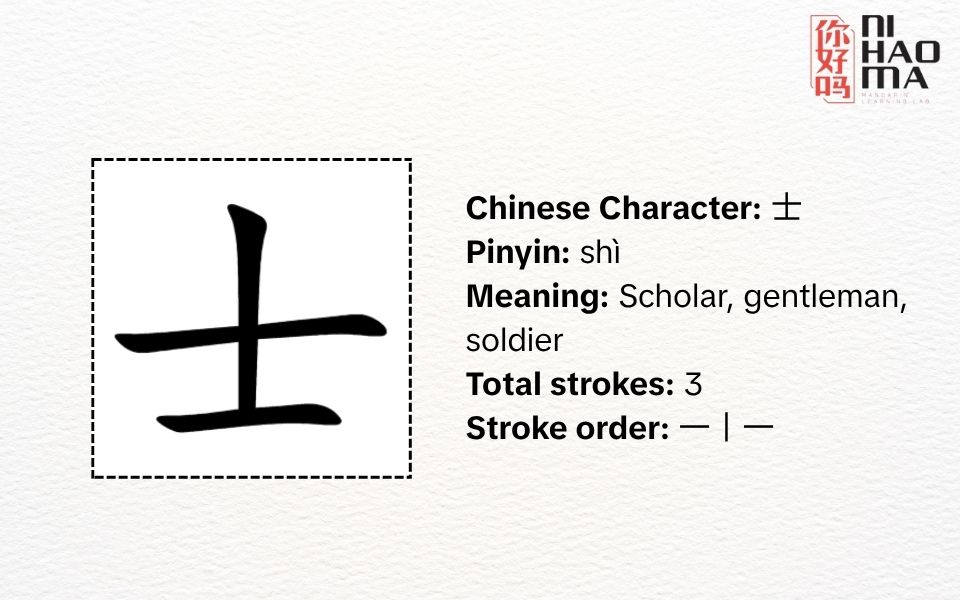
Radical 33 in Chinese (士 – shì) is the 33rd radical among the 214 traditional Chinese radicals. It is commonly associated with educated people, scholars, intellectuals, people of virtue, and certain social or professional titles.
In ancient China, the character 士 was used to refer to scholars, educated men, officials, or talented and skilled members of society. Examples include scholars and officials, as well as terms related to soldiers and professional titles.
As a result, when 士 appears as a component of a Chinese character, it may be associated with concepts such as people, knowledge, personal qualities, strength, professional titles, or academic degrees.
For example:
- 博士 (bóshì) – PhD; doctorate
- 硕士 (shuòshì) – master’s degree
- 学士 (xuéshì) – bachelor’s degree
How to Write Radical 33 in Chinese
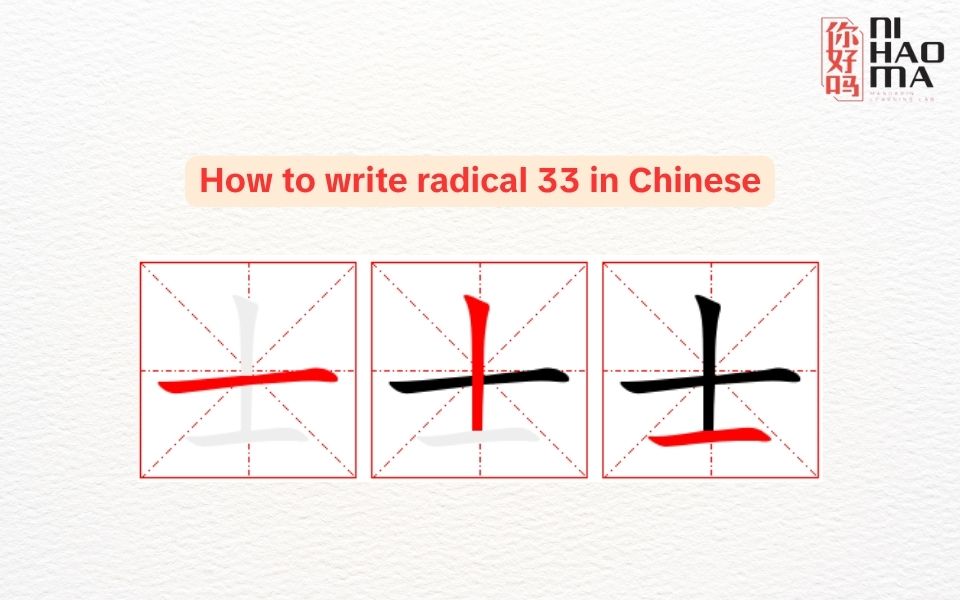
Radical 33 (士) consists of three simple strokes:
| Stroke Order | Stroke Name | Description |
|---|---|---|
| 1 | 一 (horizontal stroke) | Write the top horizontal stroke from left to right. |
| 2 | 丨 (vertical stroke) | Write the vertical stroke down the center, crossing the horizontal stroke around its middle. |
| 3 | 一 (horizontal stroke) | Write the bottom horizontal stroke from left to right. It is shorter than the top horizontal stroke. |
How to Distinguish Radical 33 (士) from Radical 32 (土)
Radical 32 (土) and radical 33 (士) are easy to confuse because their strokes look very similar. However, there is a simple rule that can help you tell them apart:
- Radical 33 (士): The top horizontal stroke is longer than the bottom horizontal stroke.
- Radical 32 (土): The bottom horizontal stroke is longer than the top horizontal stroke.
You can think of 士 as resembling a person standing upright, with the longer top horizontal stroke suggesting the shoulders. In contrast, 土 has a wider bottom stroke, creating an image associated with solid ground or earth.
Remembering the difference in the length of the two horizontal strokes is one of the easiest ways to distinguish these two radicals when reading and writing Chinese characters.
Chinese Vocabulary Containing Radical 33
Once you understand the shape and meaning of radical 33 in Chinese, the next step is to apply this knowledge to practical vocabulary. Learning radicals through vocabulary not only helps you recognize Chinese characters but also allows you to understand how these characters are used in everyday communication, study, and work.
Below are some common Chinese words containing 士 or characters associated with this component, ranging from basic to more advanced vocabulary:
| Chinese | Pinyin | Meaning |
|---|---|---|
| 士兵 | shìbīng | soldier |
| 士气 | shìqì | morale; fighting spirit |
| 士官 | shìguān | non-commissioned officer |
| 护士 | hùshi | nurse |
| 勇士 | yǒngshì | brave warrior; hero |
| 战士 | zhànshì | soldier; fighter |
| 武士 | wǔshì | warrior; samurai |
| 烈士 | lièshì | martyr |
| 壮士 | zhuàngshì | brave man; warrior |
| 博士 | bóshì | PhD; doctorate |
| 硕士 | shuòshì | master’s degree |
| 学士 | xuéshì | bachelor’s degree |
| 士人 | shìrén | scholar; educated person |
| 壮大 | zhuàngdà | to grow stronger; to expand |
| 强壮 | qiángzhuàng | strong; robust |
| 壮观 | zhuàngguān | spectacular; magnificent |
| 壮丽 | zhuànglì | magnificent; grand |
| 壮烈 | zhuàngliè | heroic; valiant |
| 壮年 | zhuàngnián | prime of life |
| 壮志 | zhuàngzhì | ambition; great aspiration |
| 志向 | zhìxiàng | aspiration; ambition |
| 志愿 | zhìyuàn | wish; aspiration; volunteer |
| 意志 | yìzhì | willpower; determination |
| 立志 | lìzhì | to set one’s goal; to aspire to |
| 志气 | zhìqì | ambition; spirit |
| 同志 | tóngzhì | comrade; colleague |
| 标志 | biāozhì | sign; symbol; logo |
| 杂志 | zázhì | magazine |
| 喜欢 | xǐhuan | to like |
| 喜事 | xǐshì | happy occasion |
| 喜讯 | xǐxùn | good news |
| 惊喜 | jīngxǐ | pleasant surprise |
| 喜剧 | xǐjù | comedy |
| 喜爱 | xǐ’ài | to love; to like |
| 喜气 | xǐqì | festive atmosphere |
| 喜酒 | xǐjiǔ | wine served at a wedding or celebration |
| 喜糖 | xǐtáng | wedding candy |
| 吉利 | jílì | lucky; auspicious |
| 吉日 | jírì | auspicious day |
| 吉凶 | jíxiōng | good or bad fortune |
| 吉祥 | jíxiáng | auspicious; lucky |
| 大吉 | dàjí | very auspicious; great luck |
| 吉他 | jítā | guitar |
| 贝壳 | bèiké | seashell |
| 声音 | shēngyīn | sound; voice |
| 声明 | shēngmíng | statement; declaration |
| 寿命 | shòumìng | lifespan; life expectancy |
| 长寿 | chángshòu | longevity; long life |
| 寿礼 | shòulǐ | birthday gift for an elderly person |
| 寿宴 | shòuyàn | birthday banquet; longevity celebration |
| 寿面 | shòumiàn | longevity noodles |
| 茶壶 | cháhú | teapot |
Note: Not every character or word in the table contains 士 as the exact radical. Some contain related components or characters historically associated with the same form. For learners, it is therefore useful to distinguish between a character’s official radical and a visual component appearing within the character.
Chinese Dialogues Using Vocabulary Related to Radical 33
Learning vocabulary individually can help you recognize Chinese characters, but putting words into sentences makes them easier to remember and helps you understand how they are used naturally.
With radical 33 in Chinese, you can start with familiar topics such as education, academic degrees, career goals, and personal aspirations.
Dialogue 1
A: 听说你已经拿到硕士学位了,恭喜你!
Tīngshuō nǐ yǐjīng ná dào shuòshì xuéwèi le, gōngxǐ nǐ!
I heard that you have received your master’s degree. Congratulations!
B: 谢谢!为了这个学位,我准备了很长时间。
Xièxie! Wèile zhège xuéwèi, wǒ zhǔnbèi le hěn cháng shíjiān.
Thank you! I spent a long time preparing for this degree.
A: 接下来你打算继续读博士吗?
Jiēxiàlái nǐ dǎsuàn jìxù dú bóshì ma?
Are you planning to continue studying for a PhD?
B: 暂时不会,我想先积累一些工作经验。
Zànshí bú huì, wǒ xiǎng xiān jīlěi yìxiē gōngzuò jīngyàn.
Not for now. I want to gain some work experience first.
Dialogue 2
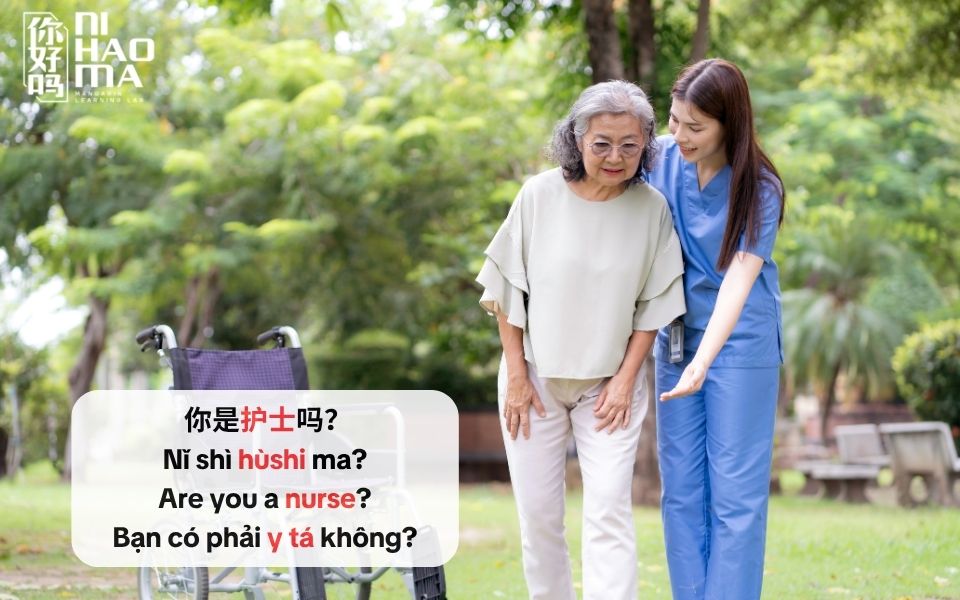
A: 你是护士吗?
Nǐ shì hùshi ma?
Are you a nurse?
B: 是的,我在医院工作。
Shì de, wǒ zài yīyuàn gōngzuò.
Yes, I work at a hospital.
A: 当护士辛苦吗?
Dāng hùshi xīnkǔ ma?
Is it difficult to work as a nurse?
B: 有时候很辛苦,但是我很喜欢这份工作。
Yǒu shíhou hěn xīnkǔ, dànshì wǒ hěn xǐhuan zhè fèn gōngzuò.
Sometimes it is quite demanding, but I really like this job.
Dialogue 3
A: 你觉得这份工作怎么样?
Nǐ juéde zhè fèn gōngzuò zěnmeyàng?
What do you think about this job?
B: 虽然工作很辛苦,但是我很喜欢。
Suīrán gōngzuò hěn xīnkǔ, dànshì wǒ hěn xǐhuan.
Although the work is quite demanding, I really enjoy it.
A: 你有什么长期的志向吗?
Nǐ yǒu shénme chángqī de zhìxiàng ma?
Do you have any long-term aspirations?
B: 我希望成为这个领域的专家。
Wǒ xīwàng chéngwéi zhège lǐngyù de zhuānjiā.
I hope to become an expert in this field.
A: 只要坚持,你一定可以做到。
Zhǐyào jiānchí, nǐ yídìng kěyǐ zuòdào.
As long as you persevere, you can definitely achieve it.
B: 谢谢,我会坚持下去。
Xièxie, wǒ huì jiānchí xiàqù.
Thank you. I will keep going.
Conclusion
Understanding the structure and meaning of radical 33 in Chinese can help you recognize Chinese characters more accurately and provide a useful foundation for learning related vocabulary. By studying radicals together with vocabulary, sentence examples, and dialogues, you can gradually improve both character recognition and practical Chinese communication skills.
If you are looking for a structured Chinese learning environment with a clear curriculum and dedicated instructors, contact Ni Hao Ma Chinese Center. At Ni Hao Ma, you can unlock your language-learning potential and develop your listening, speaking, reading, and writing skills with greater confidence.