The Radical 100 is a familiar component in many modern Chinese characters. If you want to learn more about Radical 100 in Chinese, this guide from Ni Hao Ma will help you understand its meaning, writing order, origins, and a useful collection of Chinese vocabulary containing this radical that you can apply in everyday communication.
What Is Radical 100 in Chinese?
Radical 100 in Chinese (生 – shēng) is the [100th Chinese radical] in the traditional system of 214 Kangxi radicals. It consists of 5 strokes and carries core meanings related to being born, life, living, growth, and development.
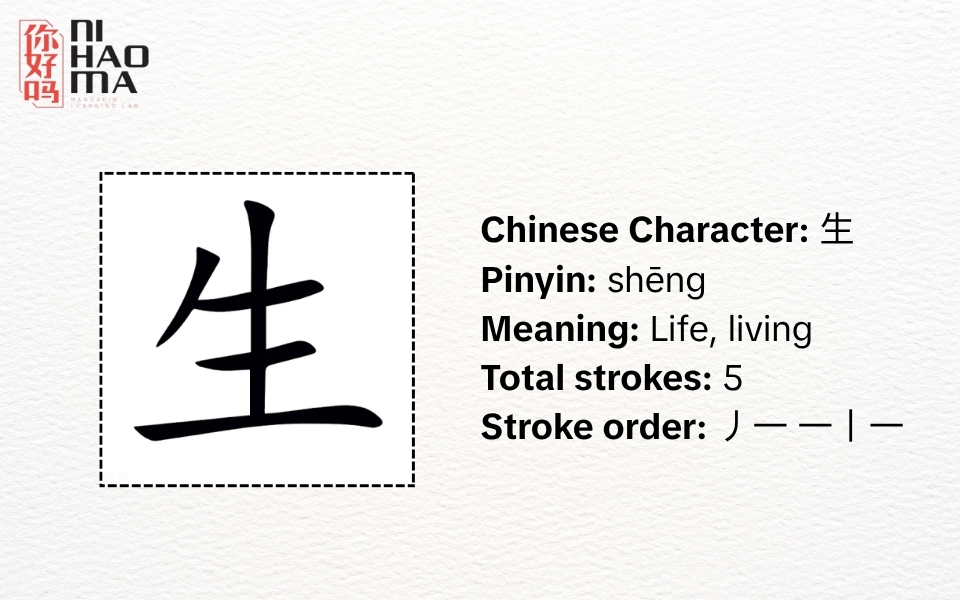
From an etymological perspective, 生 is a pictographic character that developed from imagery associated with a plant sprouting from the ground. This image conveys the idea of growth and new life. Its original meaning also helps explain the extended meanings associated with Radical 100, including being born, growing, existing, producing, and developing.
In Chinese character formation, 生 can appear as an independent character or as a component within other characters. For Chinese learners, understanding Radical 100 is useful not only for memorizing a Chinese radical but also for building vocabulary in a more systematic way.
How to Write Radical 100 in Chinese
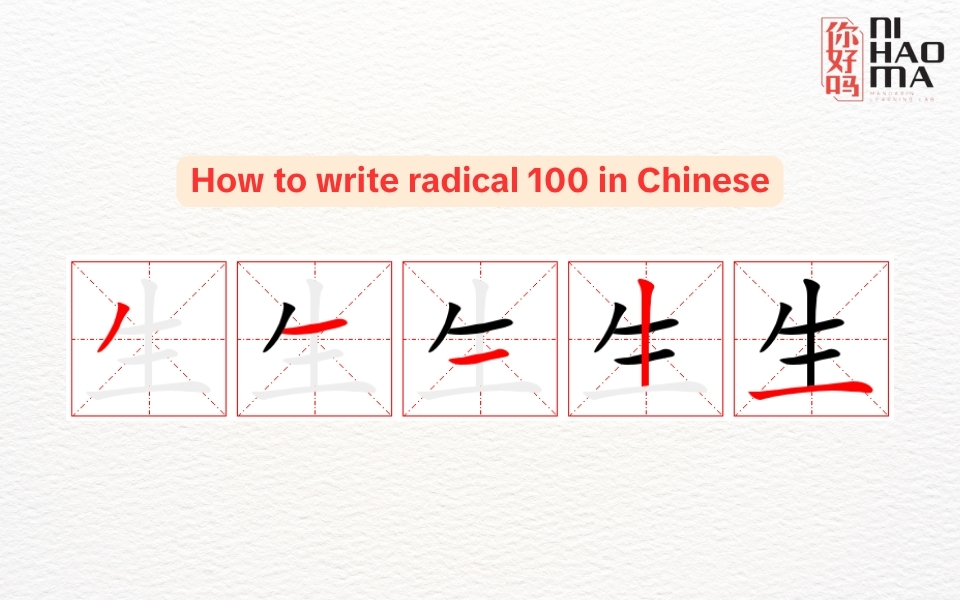
Radical 100 in Chinese consists of 5 strokes and is written in the following order:
| Stroke Order | Stroke Name | Description |
|---|---|---|
| 1 | 丿 (left-falling stroke) | Start from the upper-left and make a light diagonal stroke downward to the left. |
| 2 | 一 (horizontal stroke) | Start around the middle of the first stroke and draw a horizontal line from left to right. |
| 3 | 一 (horizontal stroke) | Draw the second horizontal stroke parallel to the first, making it slightly shorter. |
| 4 | 丨 (vertical stroke) | Draw a vertical stroke through the two horizontal strokes above it. |
| 5 | 一 (horizontal stroke) | Finish with the bottom horizontal stroke. This is the longest horizontal stroke and gives the character its overall balance. |
Chinese Vocabulary Containing Radical 100
The character 生 appears in many familiar Chinese characters and everyday vocabulary. Learning words that contain 生 can help Chinese learners expand their vocabulary while also making it easier to recognize Chinese character structures when reading and writing. Below is a collection of commonly used two-character Chinese words containing 生 or characters that include 生 as a component.
| Chinese | Pinyin | Meaning |
|---|---|---|
| 生活 | shēnghuó | life; daily life; living |
| 生命 | shēngmìng | life; existence |
| 生日 | shēngrì | birthday |
| 学生 | xuéshēng | student |
| 医生 | yīshēng | doctor |
| 生病 | shēngbìng | to get sick; to be ill |
| 生气 | shēngqì | to get angry |
| 生意 | shēngyi | business |
| 生物 | shēngwù | living organism; biology |
| 生产 | shēngchǎn | production; to produce |
| 发生 | fāshēng | to happen; to occur |
| 出生 | chūshēng | to be born; birth |
| 生长 | shēngzhǎng | to grow; growth |
| 生存 | shēngcún | to survive; survival |
| 生动 | shēngdòng | vivid; lively |
| 生效 | shēngxiào | to take effect |
| 生涯 | shēngyá | career; life journey |
| 生理 | shēnglǐ | physiological; physiology |
| 生鲜 | shēngxiān | fresh food; fresh produce |
| 人生 | rénshēng | life; one’s life journey |
| 先生 | xiānsheng | Mr.; gentleman; husband |
| 生前 | shēngqián | during one’s lifetime; while alive |
| 生死 | shēngsǐ | life and death |
| 生词 | shēngcí | new word; vocabulary word |
| 生菜 | shēngcài | lettuce; raw vegetables |
| 生火 | shēnghuǒ | to light a fire |
| 生肉 | shēngròu | raw meat |
| 生鱼 | shēngyú | raw fish |
| 生蛋 | shēngdàn | to lay eggs |
| 生育 | shēngyù | childbirth; reproduction |
| 生成 | shēngchéng | to generate; to form; to produce |
| 性格 | xìnggé | personality; character |
| 性别 | xìngbié | gender; sex |
| 性质 | xìngzhì | nature; property; characteristic |
| 性能 | xìngnéng | performance; functionality |
| 性命 | xìngmìng | life; one’s life |
| 性情 | xìngqíng | temperament; disposition |
| 姓名 | xìngmíng | full name |
| 姓氏 | xìngshì | surname; family name |
| 明星 | míngxīng | celebrity; star |
| 星星 | xīngxing | star |
| 星期 | xīngqī | week; day of the week |
| 星球 | xīngqiú | planet; celestial body |
| 星座 | xīngzuò | constellation; zodiac sign |
| 卫星 | wèixīng | satellite |
| 行星 | xíngxīng | planet |
| 恒星 | héngxīng | fixed star; star |
| 流星 | liúxīng | meteor; shooting star |
| 星河 | xīnghé | Milky Way; galaxy |
| 星级 | xīngjí | star rating; star level |
| 星际 | xīngjì | interstellar |
| 星系 | xīngxì | galaxy; star system |
| 今生 | jīnshēng | this life; present life |
| 前生 | qiánshēng | previous life; former life |
| 来生 | láishēng | next life; afterlife |
| 陌生 | mòshēng | unfamiliar; strange |
| 生机 | shēngjī | vitality; signs of life |
| 生计 | shēngjì | livelihood; means of making a living |
| 生育 | shēngyù | childbirth; to give birth |
Dialogue Using Vocabulary Containing Radical 100
To help learners remember Radical 100 and understand how its vocabulary is used in real-life contexts, the following section introduces several short dialogues featuring common words containing 生. These examples allow learners to review pronunciation and meaning while seeing how the vocabulary is naturally used in everyday Chinese conversations.
Dialogue 1
A: 李明,这周末是你的生日,你有什么打算吗?
Lǐ Míng, zhè zhōumò shì nǐ de shēngrì, nǐ yǒu shénme dǎsuàn ma?
Li Ming, it’s your birthday this weekend. Do you have any plans?
B: 我打算邀请几个朋友来家里聚聚,一起做饭聊天。
Wǒ dǎsuàn yāoqǐng jǐ gè péngyǒu lái jiālǐ jùjù, yīqǐ zuò fàn liáotiān.
I’m planning to invite a few friends over to my place to hang out, cook, and chat together.
A: 那太好了!祝你生日快乐,祝你新的一年生活越来越好!
Nà tài hǎo le! Zhù nǐ shēngrì kuàilè, zhù nǐ xīn de yī nián shēnghuó yuè lái yuè hǎo!
That’s great! Happy birthday! I hope your life gets better and better in the coming year!
B: 谢谢你!到时候你一定要来啊,我准备做你最喜欢吃的菜。
Xièxiè nǐ! Dào shíhòu nǐ yīdìng yào lái a, wǒ zhǔnbèi zuò nǐ zuì xǐhuān chī de cài.
Thank you! You definitely have to come. I’ll make your favorite dishes.
A: 没问题,我一定准时到,顺便给你带一份特别的生日礼物。
Méi wèntí, wǒ yídìng zhǔnshí dào, shùnbiàn gěi nǐ dài yī fèn tèbié de shēngrì lǐwù.
No problem. I’ll definitely be there on time, and I’ll bring you a special birthday present.
Dialogue 2
A: 你今天看起来脸色不太好,是不是生病了?
Nǐ jīntiān kàn qǐlái liǎnsè bù tài hǎo, shì bú shì shēngbìng le?
You don’t look very well today. Are you sick?
B: 我觉得头发昏,喉咙也很痛,可能昨晚发烧了。
Wǒ juéde tóu fā hūn, hóulóng yě hěn tòng, kěnéng zuówǎn fāshāo le.
I feel dizzy, and my throat hurts too. I may have had a fever last night.
A: 你得赶紧去医院看医生,不能一直硬撑着。
Nǐ děi gǎnjǐn qù yīyuàn kàn yīshēng, bùnéng yìzhí yìng chēng zhe.
You should go to the hospital and see a doctor as soon as possible. You shouldn’t keep forcing yourself to carry on.
B: 我想先喝点热水休息一下,如果下午还不舒服再去。
Wǒ xiǎng xiān hē diǎn rèshuǐ xiūxi yíxià, rúguǒ xiàwǔ hái bù shūfu zài qù.
I want to drink some hot water and rest for a while first. If I still don’t feel well this afternoon, I’ll go.
A: 生命最重要,我现在就陪你去医院排号挂号吧。
Shēngmìng zuì zhòngyào, wǒ xiànzài jiù péi nǐ qù yīyuàn pái hào guàhào ba.
Your life and health are the most important. I’ll go with you to the hospital and help you register now.

Conclusion
Radical 100 in Chinese (生) is the 100th radical in the traditional system of 214 Kangxi radicals and carries familiar meanings related to birth, life, growth, and development. The character 生 can stand independently and also appears as a component in many Chinese characters and commonly used words. Learning its meaning and role in Chinese character formation can help learners recognize characters more easily, build vocabulary systematically, and develop a deeper understanding of how Chinese characters are formed.
When learning Chinese through radicals, it is helpful to combine character recognition, pinyin, meaning, and contextual usage rather than memorizing individual characters in isolation. We hope this guide from Ni Hao Ma helps you better understand Radical 100 and gives you a practical way to expand your Chinese vocabulary. Keep exploring our Chinese learning resources to discover more useful radicals and vocabulary!