When learning Chinese characters, understanding radicals is one of the most effective ways to grasp how characters are formed and what they mean. Radicals help learners recognize patterns in Chinese writing and make it easier to memorize new characters.
So, what is radical 125 in Chinese, what does it mean, how is it written, and which common words contain it? In this article, Ni Hao Ma will guide you through the meaning, stroke order, and practical examples of this important Chinese radical.
What Is Radical 125 in Chinese?
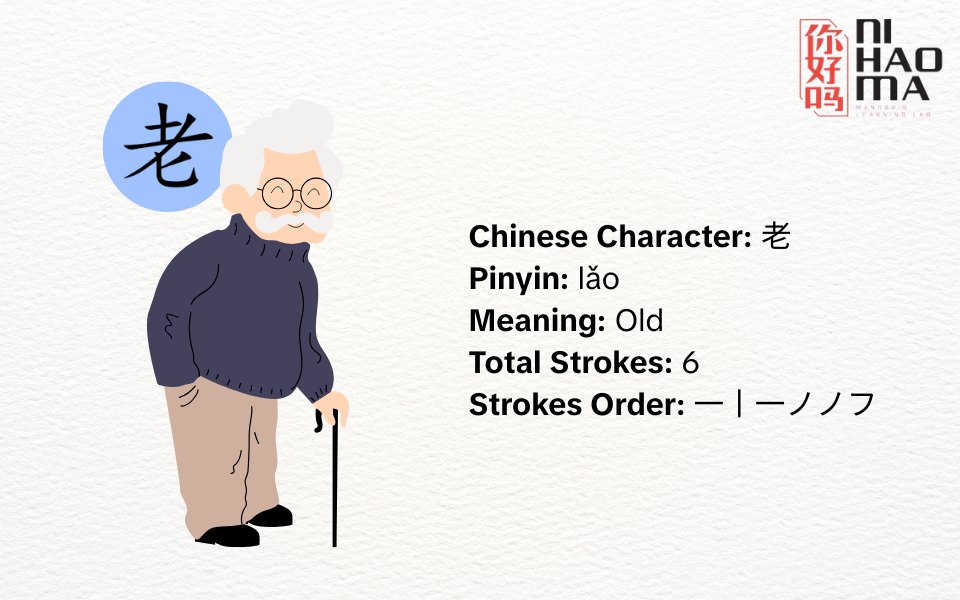
Radical 125 (老 – lǎo), is the 125th radical among the 214 Kangxi radicals. Its original meaning is old, aged, long-standing, or experienced.
From a historical perspective, the character 老 originated as a pictographic character in ancient Chinese scripts. Its early form is believed to depict an elderly person leaning on a walking stick, symbolizing age, wisdom, and life experience.
In modern Chinese, 老 is also widely used in everyday communication. When placed before nouns, it often conveys the meaning of “long-time,” “familiar,” or “old”. For example, 老朋友 (lǎo péngyǒu – old friend), 老地方 (lǎo dìfang – a familiar or usual place).
Additionally, 老 can be used before a person’s surname to express familiarity, closeness, or long-standing acquaintance. This form of address is common among friends or colleagues. Examples: 老王 (Lǎo Wáng – Mr. Wang), 老李 (Lǎo Lǐ – Mr. Li). In these contexts, 老 does not literally mean “old,” but rather reflects a friendly and natural way of addressing someone in daily conversation.
How to Write Radical 125 in Chinese
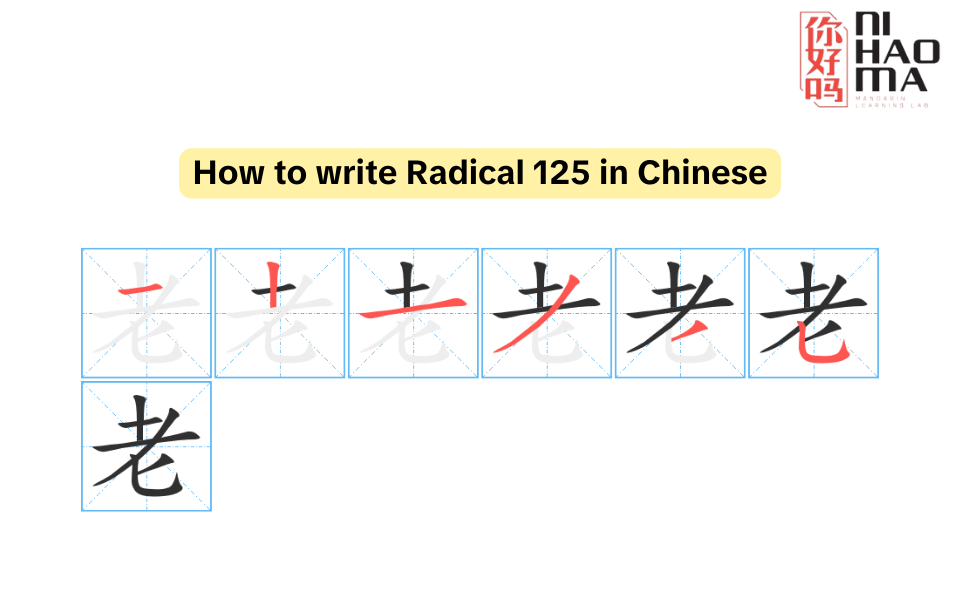
Radical 125 (老) consists of 6 strokes. The correct stroke order is as follows:
| Stroke Order | Stroke Name | Description |
|---|---|---|
| 1 | 一 (Horizontal stroke) | Start with a short horizontal line from left to right at the top. |
| 2 | 丨 (Vertical stroke) | Draw a vertical line downward through the center. |
| 3 | 一 (Horizontal stroke) | Add another horizontal line beneath the vertical stroke to form the upper structure. |
| 4 | ノ (Left-falling stroke) | Draw a diagonal stroke down toward the left. |
| 5 | ノ (Left-falling stroke) | Add another left-falling stroke extending downward. |
| 6 | フ (Hooked stroke) | Finish with a bending stroke with a slight hook to the right. |
When radical 125 appears as the top component of another character, the lower part 匕 is usually omitted, leaving the abbreviated form 耂. In this position, the radical often hints at meanings related to age, longevity, experience, or respect for elders.
Vocabulary Containing Radical 125 in Chinese
In modern Chinese, many words containing 老 appear frequently in everyday communication. These words can refer to family relationships, professions, social roles, or long-standing objects and traditions.
Radical 125 can appear independently as the character 老 or combine with other radicals to form new characters. Below are some common vocabulary examples containing radical 125:
| Chinese Character | Pinyin | Meaning |
|---|---|---|
| 老 | lǎo | old, aged |
| 考 | kǎo | test, examine |
| 者 | zhě | person, one who… |
| 孝 | xiào | filial piety |
| 教 | jiào | teach, education |
| 煮 | zhǔ | cook, boil |
| 耆 | qí | elderly person (60+) |
| 耋 | dié | elderly person (70–80) |
| 老师 | lǎoshī | teacher |
| 老人 | lǎorén | elderly person |
| 老板 | lǎobǎn | boss |
| 老公 | lǎogōng | husband |
| 老婆 | lǎopó | wife |
| 老乡 | lǎoxiāng | fellow townsman |
| 老家 | lǎojiā | hometown |
| 老兵 | lǎobīng | veteran |
| 老练 | lǎoliàn | experienced |
| 老化 | lǎohuà | aging |
| 老实 | lǎoshi | honest |
| 考试 | kǎoshì | exam |
| 考生 | kǎoshēng | exam candidate |
| 考场 | kǎochǎng | examination room |
| 考官 | kǎoguān | examiner |
| 考证 | kǎozhèng | textual research |
| 考察 | kǎochá | investigation |
| 考研 | kǎoyán | postgraduate entrance exam |
| 考题 | kǎotí | exam question |
| 考核 | kǎohé | assessment |
| 考勤 | kǎoqín | attendance check |
| 作者 | zuòzhě | author |
| 读者 | dúzhě | reader |
| 记者 | jìzhě | journalist |
| 学者 | xuézhě | scholar |
| 患者 | huànzhě | patient |
| 孝顺 | xiàoshùn | filial |
| 孝心 | xiàoxīn | filial devotion |
| 孝道 | xiàodào | filial piety |
| 教学 | jiàoxué | teaching |
| 教室 | jiàoshì | classroom |
| 教师 | jiàoshī | teacher |
| 教育 | jiàoyù | education |
| 教练 | jiàoliàn | coach |
| 教授 | jiàoshòu | professor |
| 煮饭 | zhǔfàn | cook rice |
| 煮水 | zhǔshuǐ | boil water |
| 教学楼 | jiàoxuélóu | teaching building |
Conversation Examples Using Words with Radical 125
In modern Chinese, many words containing 老 or characters with the component 耂 appear frequently in daily life. These terms are commonly used in work, education, family conversations, and social interactions.
Below are some short dialogue examples showing how these words are used naturally in real situations.
Example 1
A: 今天老板什么时候来公司?
Jīntiān lǎobǎn shénme shíhou lái gōngsī?
When will the boss come to the office today?
B: 他上午有个会议,可能下午才到。
Tā shàngwǔ yǒu gè huìyì, kěnéng xiàwǔ cái dào.
He has a meeting in the morning, so he might arrive in the afternoon.
A: 那我们先把报告准备好吧。
Nà wǒmen xiān bǎ bàogào zhǔnbèi hǎo ba.
Then let’s prepare the report first.
B: 对,不然老板来了就来不及了。
Duì, bùrán lǎobǎn lái le jiù láibují le.
Right, otherwise it’ll be too late when the boss arrives.
A: 好,我现在就去整理资料。
Hǎo, wǒ xiànzài jiù qù zhěnglǐ zīliào.
Okay, I’ll organize the documents now.

Example 2
A: 这个周末你有空吗?
Zhège zhōumò nǐ yǒu kòng ma?
Are you free this weekend?
B: 应该有一点时间,怎么了?
Yīnggāi yǒu yìdiǎn shíjiān, zěnme le?
I should have some time. What’s up?
A: 我们去老地方吃饭吧。
Wǒmen qù lǎo dìfang chīfàn ba.
Let’s go eat at our usual place.
B: 好啊,我很久没见那些老朋友了。
Hǎo a, wǒ hěn jiǔ méi jiàn nàxiē lǎo péngyou le.
Sounds good. I haven’t seen those old friends for a long time.
A: 那我等下在群里通知大家。
Nà wǒ děngxià zài qún lǐ tōngzhī dàjiā.
Then I’ll notify everyone in the group chat later.
Example 3
A: 明天是不是有考试?
Míngtiān shì bú shì yǒu kǎoshì?
Is there an exam tomorrow?
B: 对,是中文老师安排的。
Duì, shì Zhōngwén lǎoshī ānpái de.
Yes, the Chinese teacher arranged it.
A: 你复习了吗?
Nǐ fùxí le ma?
Have you reviewed the material?
B: 还没有,我打算晚上再看一遍。
Hái méiyǒu, wǒ dǎsuàn wǎnshang zài kàn yí biàn.
Not yet. I plan to review it again tonight.
A: 那我们一起复习吧。
Nà wǒmen yìqǐ fùxí ba.
Then let’s study together.
Conclusion
Through this article, you now have a clearer understanding of radical 125 in Chinese, including its meaning, historical origin, stroke order, and common vocabulary. Learning Chinese characters through radicals is an effective strategy because it helps learners recognize character structures, infer meanings, and memorize new words more easily.
Hopefully, the explanations, vocabulary examples, and dialogues above will help you better understand radical 125 and apply it effectively when studying Chinese characters. Ni Hao Ma hopes this guide makes your Chinese learning journey easier, more structured, and more enjoyable.