Radical 132 in Chinese is a commonly encountered radical that frequently appears in words related to writing, characters, and language. So, what exactly is radical 132, what does it mean, and in which vocabulary does it typically appear? This article will help you better understand its characteristics, usage, and practical examples – making your Chinese learning journey easier and more effective.
What Is Radical 132 in Chinese?
Radical 132 (自 – zì) is the 132nd radical in the traditional list of 214 Kangxi radicals. Its original meaning is “self” or “oneself.”
In Chinese characters, radical 132 often functions as a semantic component, conveying meanings related to the individual, personal identity, or self-initiated actions. Therefore, characters containing this radical typically suggest ideas such as self-awareness, independence, or personal involvement in an action.
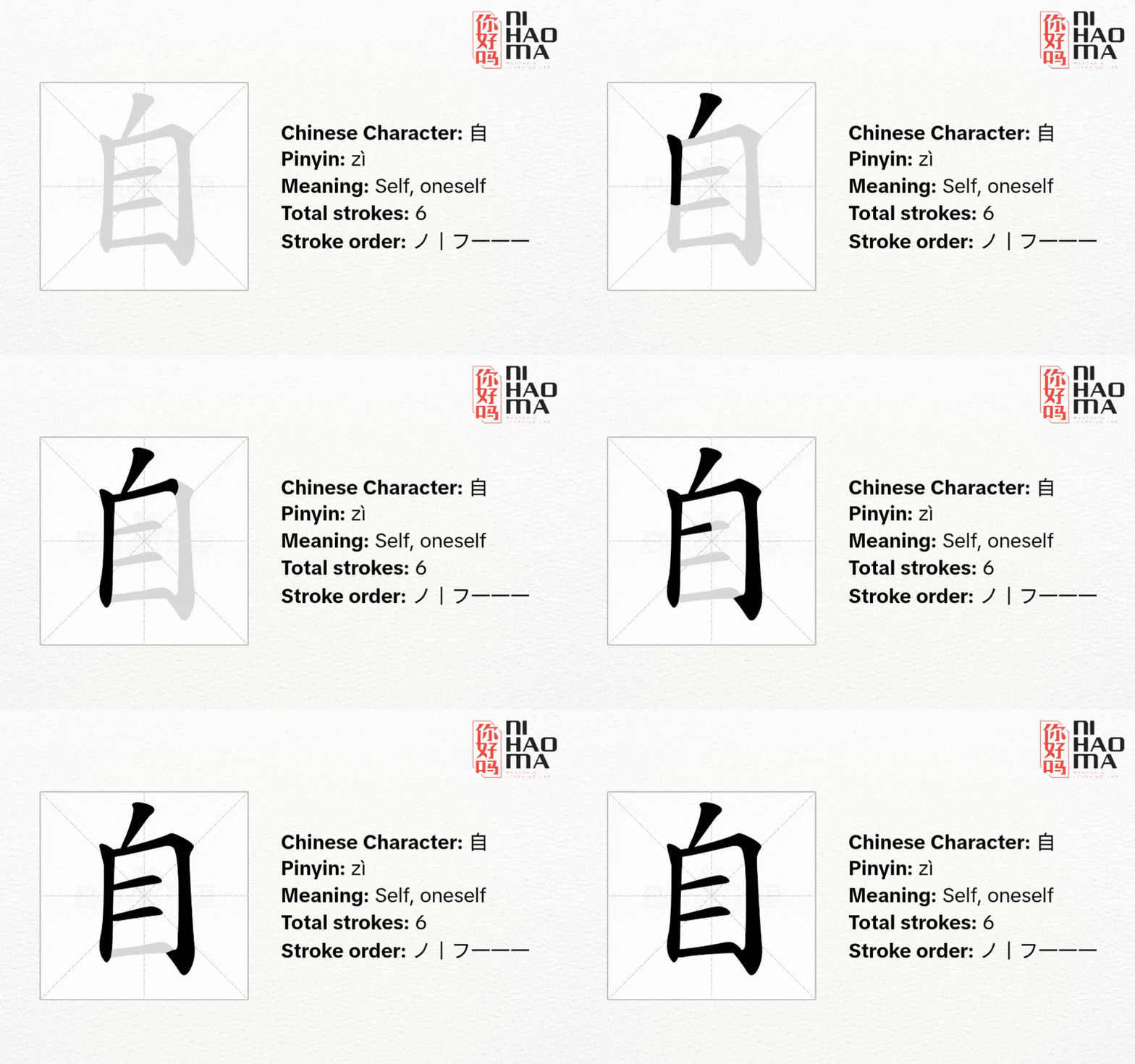
Structurally, 自 is an independent radical that can stand alone as a complete character. It also appears as a component in many other characters. When used within compound characters, it may retain its original form or undergo slight modifications to fit the overall structure.
According to modern linguistic statistics (such as Chinese character frequency databases from Peking University), the character 自 is among the most frequently used in modern Chinese. This is because it forms many fundamental and commonly used words, including:
- 自己 (zìjǐ): oneself
- 自然 (zìrán): nature
- 自由 (zìyóu): freedom
- 自行车 (zìxíngchē): bicycle
How to Write Radical 132
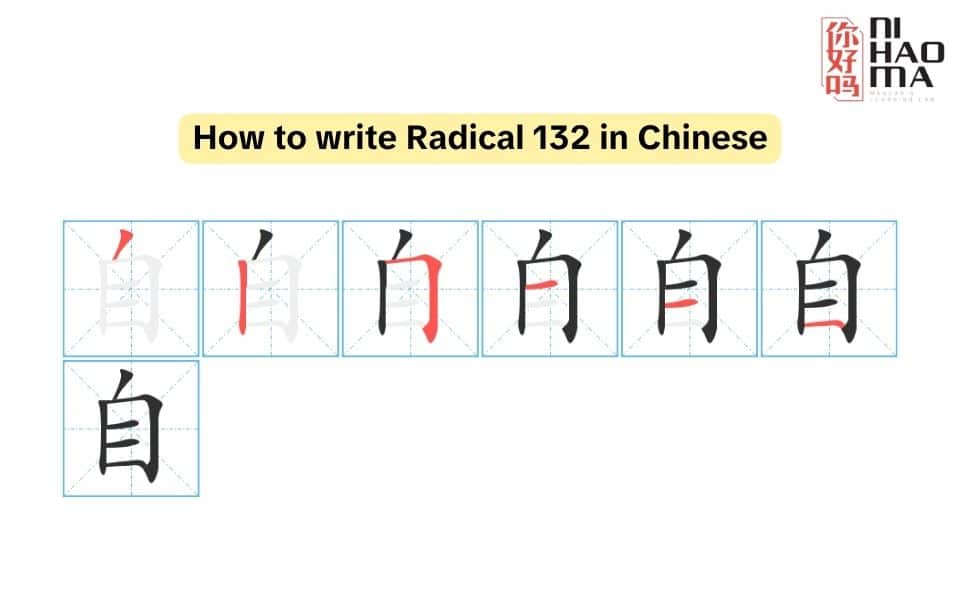
Radical 132 consists of 6 basic strokes, written in the following order:
| Stroke Order | Stroke Name | Description |
|---|---|---|
| 1 | Left-falling stroke (ノ) | Start from the upper right and draw a diagonal stroke down to the left. This stroke is slightly curved and forms the opening of the character. |
| 2 | Vertical stroke (丨) | Draw a straight vertical line downward, slightly positioned to the left of the first stroke, forming part of the outer frame. |
| 3 | Horizontal turning stroke (フ) | Begin at the top, draw a horizontal line, then turn downward to create the outer enclosing frame. |
| 4 | Horizontal stroke (一) | Draw a short horizontal line inside the upper part of the frame (around one-third of the height). |
| 5 | Horizontal stroke (一) | Draw a second horizontal line in the middle area (around two-thirds of the height). |
| 6 | Horizontal stroke (一) | Draw the final horizontal stroke at the bottom to complete the structure. |
Common Vocabulary with Radical 132
In Chinese, vocabulary containing radical 132 (自 – zì) is extremely common and carries a wide range of meanings. Based on its core meaning of “self,” this radical contributes to words related to personal actions, emotions, internal states, and individual traits.
Learning these words not only expands your vocabulary but also helps you infer the meaning of new words more easily and improves overall language retention. Here are some of the most common words containing radical 132:
| Chinese | Pinyin | Meaning |
|---|---|---|
| 自己 | zìjǐ | oneself |
| 自大 | zìdà | arrogant |
| 自然 | zìrán | natural |
| 自在 | zìzài | comfortable, at ease |
| 自由 | zìyóu | freedom |
| 自动 | zìdòng | automatic |
| 自学 | zìxué | self-study |
| 自信 | zìxìn | confident |
| 自觉 | zìjué | self-aware |
| 自愿 | zìyuàn | voluntary |
| 自立 | zìlì | independent |
| 自尊 | zìzūn | self-respect |
| 自私 | zìsī | selfish |
| 自豪 | zìháo | proud |
| 自满 | zìmǎn | self-satisfied |
| 自责 | zìzé | self-blame |
| 自卫 | zìwèi | self-defense |
| 自首 | zìshǒu | surrender oneself |
| 自问 | zìwèn | ask oneself |
| 自行 | zìxíng | by oneself |
| 自发 | zìfā | spontaneous |
| 自述 | zìshù | self-narration |
| 自传 | zìzhuàn | autobiography |
| 自爱 | zì’ài | self-love |
| 自强 | zìqiáng | self-improvement |
| 媳妇 | xífù | wife |
| 休息 | xiūxī | rest |
| 鼻子 | bízi | nose |
| 咱们 | zánmen | we/us |
| 利息 | lìxī | interest (finance) |
| 出息 | chūxi | future prospects |
| 信息 | xìnxī | information |
Sample Conversations Using Radical 132 Vocabulary
To effectively remember and use vocabulary with radical 132, placing them in real-life conversations is highly beneficial. The dialogues below demonstrate how these words are naturally used in daily communication.
Conversation 1
A: 最近工作怎么样?
(Zuìjìn gōngzuò zěnme yàng?)
How is work lately?
B: 还不错,我对自己越来越自信了。
(Hái búcuò, wǒ duì zìjǐ yuèláiyuè zìxìn le.)
Pretty good. I’m becoming more confident in myself.
A: 为什么会有这种变化?
(Wèishénme huì yǒu zhè zhǒng biànhuà?)
What caused this change?
B: 因为我学会了自我管理,也更了解自己的优点。
(Yīnwèi wǒ xuéhuì le zìwǒ guǎnlǐ, yě gèng liǎojiě zìjǐ de yōudiǎn.)
Because I’ve learned self-management and understand my strengths better.
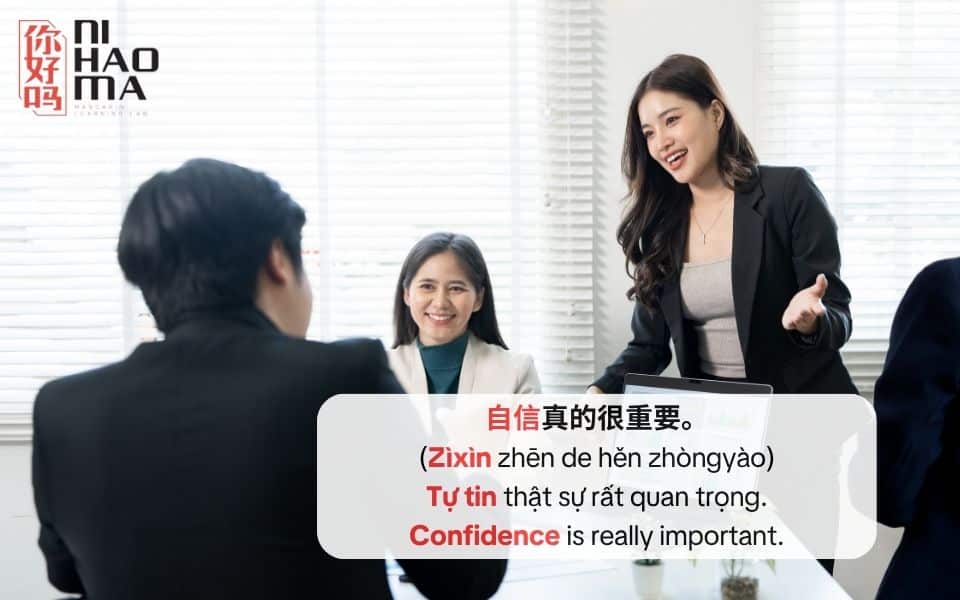
A: 听起来很好,自信真的很重要。
(Tīng qǐlái hěn hǎo, zìxìn zhēn de hěn zhòngyào.)
That sounds great. Confidence is really important.
B: 对,只有相信自己才能做好事情。
(Duì, zhǐyǒu xiāngxìn zìjǐ cái néng zuò hǎo shìqíng.)
Exactly. Only by believing in yourself can you do things well.
Conversation 2
A: 你感冒了吗?一直在擦鼻子。
(Nǐ gǎnmào le ma? Yīzhí zài cā bízi.)
Do you have a cold? You keep wiping your nose.
B: 是啊,鼻子不太舒服,嗅觉也变差了。
(Shì a, bízi bú tài shūfu, xiùjué yě biàn chà le.)
Yes, my nose feels uncomfortable, and my sense of smell has worsened.
A: 那你要多休息,别太累了。
(Nà nǐ yào duō xiūxí, bié tài lèi le.)
You should get more rest and not overwork yourself.
B: 我知道,但最近事情太多,没办法完全放松自己。
(Wǒ zhīdào, dàn zuìjìn shìqíng tài duō, méi bànfǎ wánquán fàngsōng zìjǐ.)
I know, but I’ve been too busy to fully relax.
A: 身体是自己的,还是要多注意。
(Shēntǐ shì zìjǐ de, háishi yào duō zhùyì.)
Your health is yours—you should take care of it.
B: 谢谢你提醒,我会好好照顾自己的。
(Xièxie nǐ tíxǐng, wǒ huì hǎohǎo zhàogù zìjǐ de.)
Thanks for reminding me. I’ll take better care of myself.
Conversation 3
A: 你最近在学什么新技能吗?
(Nǐ zuìjìn zài xué shénme xīn jìnéng ma?)
Are you learning any new skills?
B: 我在自学设计,希望以后能做相关工作。
(Wǒ zài zìxué shèjì, xīwàng yǐhòu néng zuò xiāngguān gōngzuò.)
I’m teaching myself design and hope to work in this field.
A: 自学不容易吧?
(Zìxué bù róngyì ba?)
Self-learning isn’t easy, right?
B: 是的,一开始很难,但我一直鼓励自己坚持下去。
(Shì de, yī kāishǐ hěn nán, dàn wǒ yìzhí gǔlì zìjǐ jiānchí xiàqù.)
Yes, it was difficult at first, but I kept encouraging myself to continue.
A: 那你现在感觉怎么样?
(Nà nǐ xiànzài gǎnjué zěnme yàng?)
How do you feel now?
B: 我觉得自己进步很大,也越来越有自信了。
(Wǒ juéde zìjǐ jìnbù hěn dà, yě yuèláiyuè yǒu zìxìn le.)
I think I’ve improved a lot and become more confident.
Conclusion
In summary, radical 132 in Chinese is an essential component in Chinese characters, appearing in many commonly used words with strong practical value. Understanding its origin, structure, and related vocabulary can significantly improve your ability to recognize characters, infer meanings, and communicate effectively in Chinese.
By mastering radical 132, you not only enhance your vocabulary but also build a solid foundation for exploring other Chinese radicals. Hopefully, the knowledge and examples in this article by Ni Hao Ma will boost your confidence and motivation as you continue your Chinese learning journey.