In the Chinese writing system, radicals do more than help you look up characters in a dictionary. They also provide valuable clues about meaning and structure. Radical 142 is one of the 214 traditional Kangxi radicals and frequently appears in characters related to insects, small creatures, and biological life.
However, the semantic range of radical 142 extends far beyond literal insects. In modern Chinese, it also appears in scientific terms, metaphorical expressions, and everyday vocabulary.
So what exactly is radical 142? What is its origin, how is it written, and which common words contain it? This guide explains its meaning, structure, stroke order, and practical vocabulary examples to help you learn Chinese characters more logically and effectively.
What Is Radical 142 in Chinese?
Radical 142 (虫 – chóng) is the 142nd radical in the traditional Kangxi system of 214 radicals. Its original meaning refers to insects, worms, or small creeping creatures.
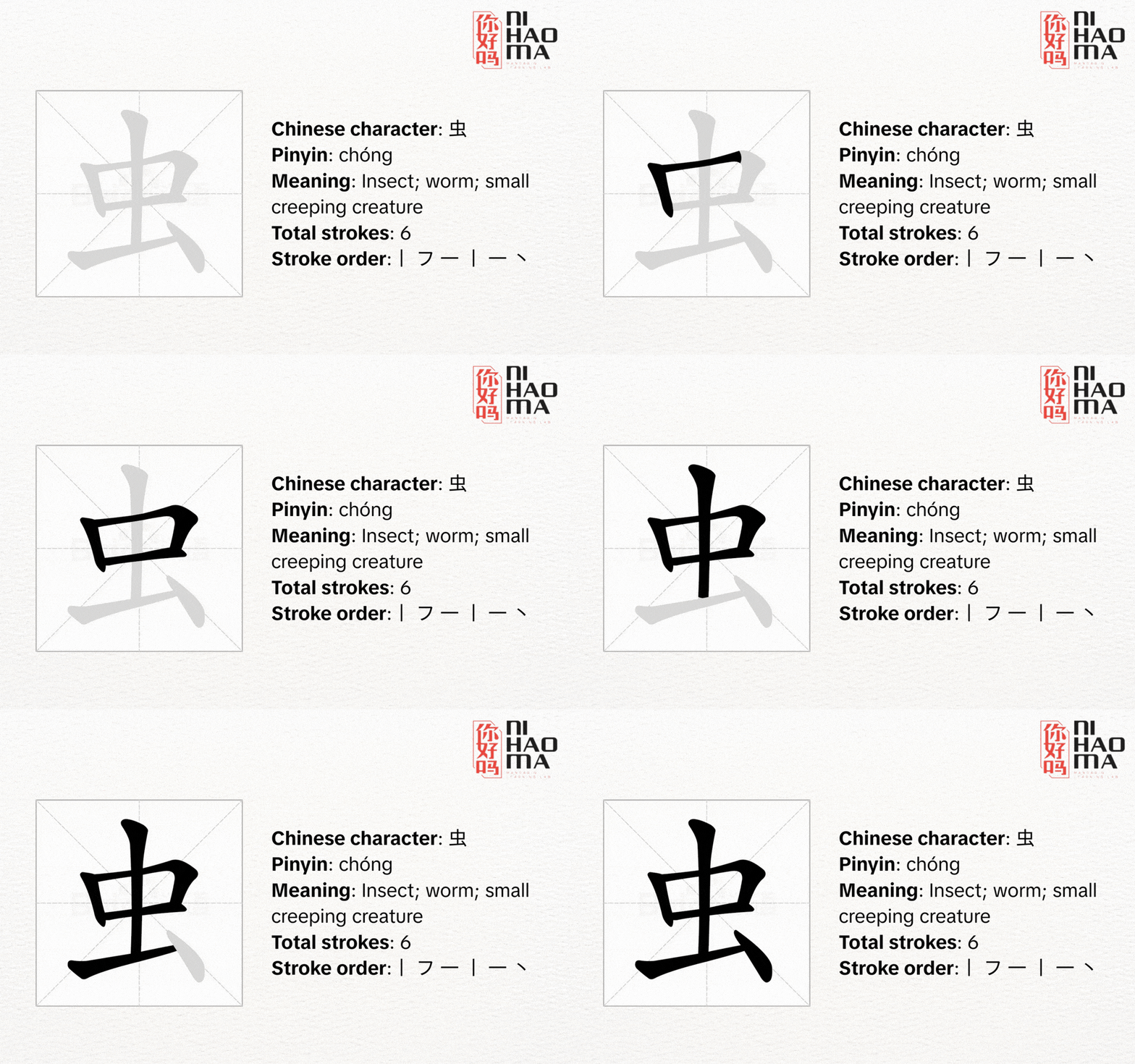
Archaeological evidence shows that the ancient form of 虫 was a pictograph resembling a snake with a raised head and curved body. Over time, its meaning expanded to represent insects, reptiles, and various small living organisms.
Examples:
- 蚂蚁 (mǎyǐ) – ant
- 蜜蜂 (mìfēng) – bee
- 蛇 (shé) – snake
When radical 142 appears in a Chinese character, it typically serves as the semantic component, indicating that the word is related to small creatures, insects, or biological life. The remaining part of the character often functions as the phonetic component, suggesting pronunciation. Beyond literal meanings, radical 142 is also used metaphorically in modern Chinese vocabulary.
How to Write Radical 142
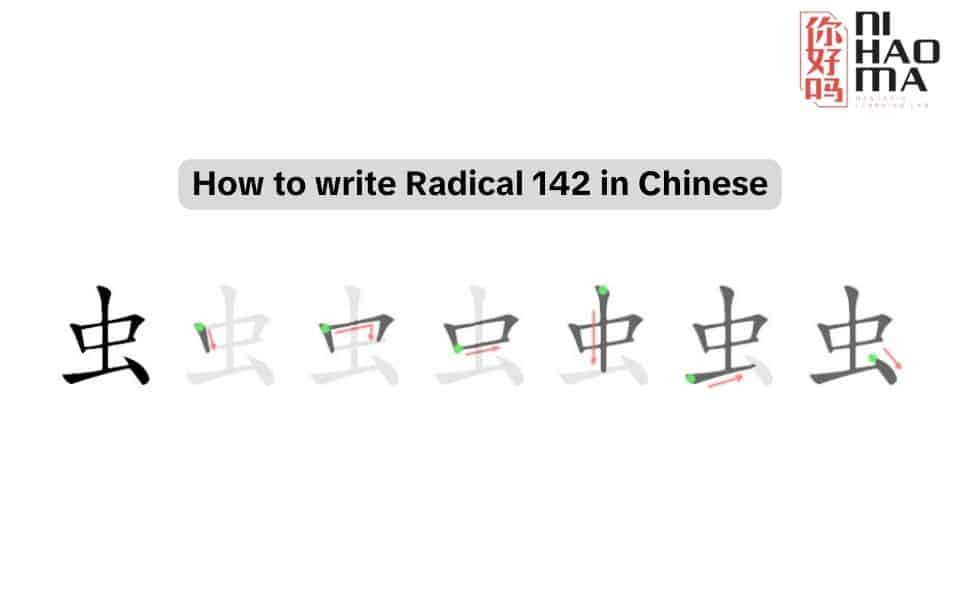
Radical 142 consists of 6 strokes, written in the following order:
| Stroke Order | Stroke Name | Writing Description |
|---|---|---|
| 1 | Vertical stroke (丨) | A short vertical line on the left, written from top to bottom. |
| 2 | Horizontal turning stroke (𠃍) | A horizontal stroke that bends downward from the top of the left vertical stroke. |
| 3 | Horizontal stroke (一) | Draw a horizontal line to close the middle section, forming a shape similar to a rectangle. |
| 4 | Vertical stroke (丨) | Draw a straight vertical line in the center of the rectangle, extending downward. |
| 5 | Horizontal stroke (一) | Draw a horizontal line across the lower part, passing beneath the vertical stroke. |
| 6 | Dot (丶) | Add a small dot at the end of the lower right horizontal stroke. |
Vocabulary Containing Radical 142
In the Chinese character system, radical 142 (虫) appears very frequently in two-character compounds, forming a rich group of vocabulary with both literal and extended meanings. These words span fields such as nature, medicine, science, technology, and daily life.
| Chinese | Pinyin | Meaning |
|---|---|---|
| 虫 | chóng | Insect |
| 蚂蚁 | mǎyǐ | Ant |
| 蚊子 | wénzi | Mosquito |
| 苍蝇 | cāngying | Fly |
| 蜜蜂 | mìfēng | Bee |
| 蝴蝶 | húdié | Butterfly |
| 蛇 | shé | Snake |
| 蜘蛛 | zhīzhū | Spider |
| 蚯蚓 | qiūyǐn | Earthworm |
| 蝉 | chán | Cicada |
| 蚊 | wén | Mosquito |
| 蚁 | yǐ | Ant |
| 蜂 | fēng | Bee |
| 蝇 | yíng | Fly |
| 蚕 | cán | Silkworm |
| 蛙 | wā | Frog |
| 蟹 | xiè | Crab |
| 虾 | xiā | Shrimp |
| 蛋 | dàn | Egg |
| 蜻蜓 | qīngtíng | Dragonfly |
| 蝙蝠 | biānfú | Bat |
| 蟑螂 | zhāngláng | Cockroach |
| 蛀虫 | zhùchóng | Wood-boring insect |
| 蝗虫 | huángchóng | Locust |
| 蚜虫 | yáchóng | Aphid |
| 蜈蚣 | wúgōng | Centipede |
| 螃蟹 | pángxiè | Crab |
| 蛐蛐 | qūqu | Cricket |
| 蜥蜴 | xīyì | Lizard |
| 蝌蚪 | kēdǒu | Tadpole |
| 蟋蟀 | xīshuài | Cricket |
| 蜘蛛网 | zhīzhūwǎng | Spider web |
| 蛇毒 | shédú | Snake venom |
| 蝎子 | xiēzi | Scorpion |
| 蜗牛 | wōniú | Snail |
| 蛤蟆 | háma | Toad |
| 蟒蛇 | mǎngshé | Python |
| 书虫 | shūchóng | Bookworm |
| 蛀牙 | zhùyá | Tooth decay |
| 蜜月 | mìyuè | Honeymoon |
| 虫草 | chóngcǎo | Cordyceps |
| 彩虹 | cǎihóng | Rainbow |
| 蜡烛 | làzhú | Candle |
| 糊涂 | hútu | Confused |
| 萤幕 | yíngmù | Screen (electronic display) |
| 蜕变 | tuìbiàn | Transformation |
| 懒虫 | lǎnchóng | Lazy person |
| 蚁民 | yǐmín | Common people (metaphorical) |
| 萤光 | yíngguāng | Fluorescent light |
| 螺旋 | luóxuán | Spiral |
Sample Dialogues Using Radical 142 Vocabulary
When learning Chinese characters, memorization becomes easier when vocabulary is placed in context rather than studied in isolation. One of the most effective ways to retain new words is through real-life conversational practice.
Below are sample dialogues containing vocabulary with radical 142 to help you expand your word bank and improve natural communication skills.
Dialogue 1
A: 最近流感又严重了,你听说了吗?
Zuìjìn liúgǎn yòu yánzhòng le, nǐ tīngshuō le ma?
Recently the flu has become serious again. Have you heard?
B: 听说了,好像是一种新的病毒在传播。
Tīngshuō le, hǎoxiàng shì yī zhǒng xīn de bìngdú zài chuánbō.
Yes, it seems a new virus is spreading.
A: 医生说要注意卫生,不然病毒很容易通过空气传播。
Yīshēng shuō yào zhùyì wèishēng, bùrán bìngdú hěn róngyì tōngguò kōngqì chuánbō.
Doctors say we must pay attention to hygiene; otherwise, the virus spreads easily through the air.
B: 有时候感觉它像蚊子一样,让人防不胜防。
Yǒu shíhou gǎnjué tā xiàng wénzi yīyàng, ràng rén fáng bù shèng fáng.
Sometimes it feels like mosquitoes — impossible to fully guard against.
A: 所以增强免疫力才是关键。
Suǒyǐ zēngqiáng miǎnyìlì cái shì guānjiàn.
So strengthening immunity is the key.

Dialogue 2
A: 你最近怎么不出来聚会?
(Nǐ zuìjìn zěnme bù chūlái jùhuì?)
Why haven’t you come out to gatherings lately?
B: 我快考试了,每天都在图书馆复习,已经变成书虫了。
(Wǒ kuài kǎoshì le, měitiān dōu zài túshūguǎn fùxí, yǐjīng biànchéng shūchóng le.)
My exams are coming up. I study at the library every day I’ve become a bookworm.
A: 哈哈,小心别变成懒虫,只学习不运动。
(Hāhā, xiǎoxīn bié biànchéng lǎnchóng, zhǐ xuéxí bù yùndòng.)
Haha, be careful not to become lazy — studying without exercising.
B: 不会的,我每天都会去操场跑步。
(Bú huì de, wǒ měitiān dōu huì qù cāochǎng pǎobù.)
No worries, I run on the track every day.
A: 那就好,加油。
(Nà jiù hǎo, jiāyóu.)
That’s good. Keep it up!
Dialogue 3
A: 最近工作压力太大了,我感觉精力被慢慢蚕食。
Zuìjìn gōngzuò yālì tài dà le, wǒ gǎnjué jīnglì bèi mànmàn cánshí.
Work pressure has been overwhelming lately. I feel like my energy is gradually being consumed.
B: 是不是项目太多了?
Shì bú shì xiàngmù tài duō le?
Are there too many projects?
A: 对,每天加班到很晚,身体都快垮了。
Duì, měitiān jiābān dào hěn wǎn, shēntǐ dōu kuài kuǎ le.
Yes, I work overtime every night. My body is nearly exhausted.
B: 这样下去不行,你要注意休息,不然健康会出问题。
Zhèyàng xiàqù bù xíng, nǐ yào zhùyì xiūxi, bùrán jiànkāng huì chū wèntí.
This can’t continue. You need to rest, or your health will suffer.
Conclusion
Radical 142 (虫) is not merely an “insect radical.” It opens the door to a wide and interconnected vocabulary system in Chinese. When you learn Chinese characters through radicals, you are not memorizing isolated symbols – you are building a structured network connecting form, sound, and meaning.
Radical 142 clearly demonstrates how a single component can expand your vocabulary across multiple fields. By mastering radical 142, you gain a stronger foundation for exploring the broader and fascinating Chinese character system.