Radical 145 in Chinese is a component closely associated with clothing, outward appearance, and even abstract concepts related to a person’s role and identity in society. In the following content, you will gain a comprehensive understanding of the origin and meaning of radical 145, learn how to write it with the correct modern Chinese stroke order, and explore a list of common vocabulary containing radical 145 that frequently appears in study materials and everyday communication.
What Is Radical 145 in Chinese?
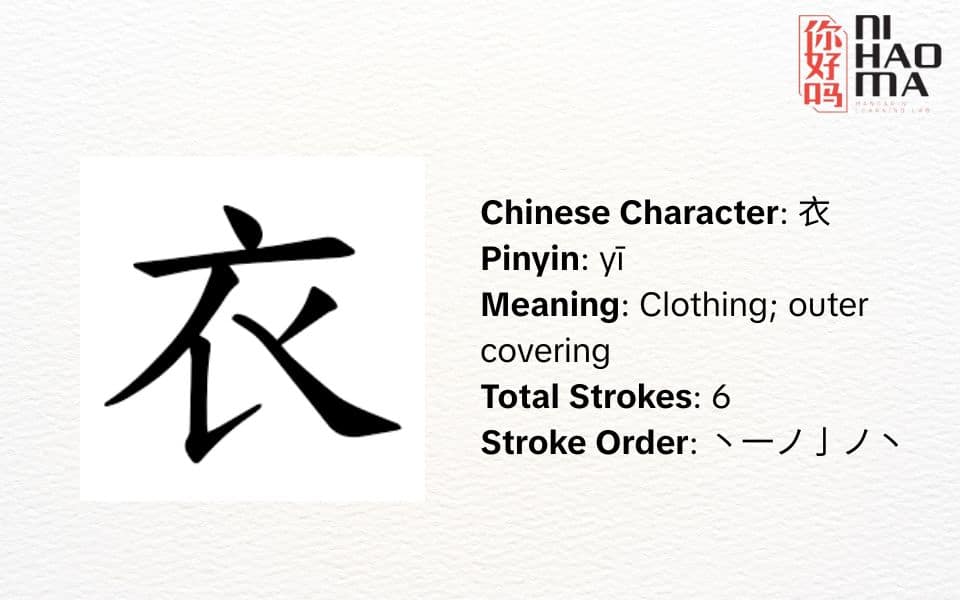
Radical 145 in Chinese (衣 – yī) is a Chinese character component that originally means clothes or garments.
In terms of meaning, radical 145 represents everything related to clothing, apparel, fabric, and the idea of covering or appearance. It is also considered one of the radicals with a very high level of usage. According to statistics from modern Chinese dictionaries, more than 600 Chinese characters are formed using radical 145 or its variant forms, highlighting its importance in the writing system.
In East Asian culture, “衣” does not merely refer to clothing, but also plays a vital role in the concept of “rituals, attire, and music” (衣冠礼乐), which symbolizes civilization, social order, and cultural identity. As a result, many Chinese characters containing radical 145 convey not only literal meanings related to clothing, but also deeper implications such as social status, etiquette, and lifestyle.
How to Write Radical 145 in Chinese
In the formation and writing of Chinese characters, radical 145 appears in two main forms, depending on its position within a character:
- Full form (衣): This form can stand alone as an independent character or appear at the bottom (for example, 装 zhuāng – clothing, to dress) or in an enclosing position (for example, 衰 shuāi – decline, weaken) in more complex characters.
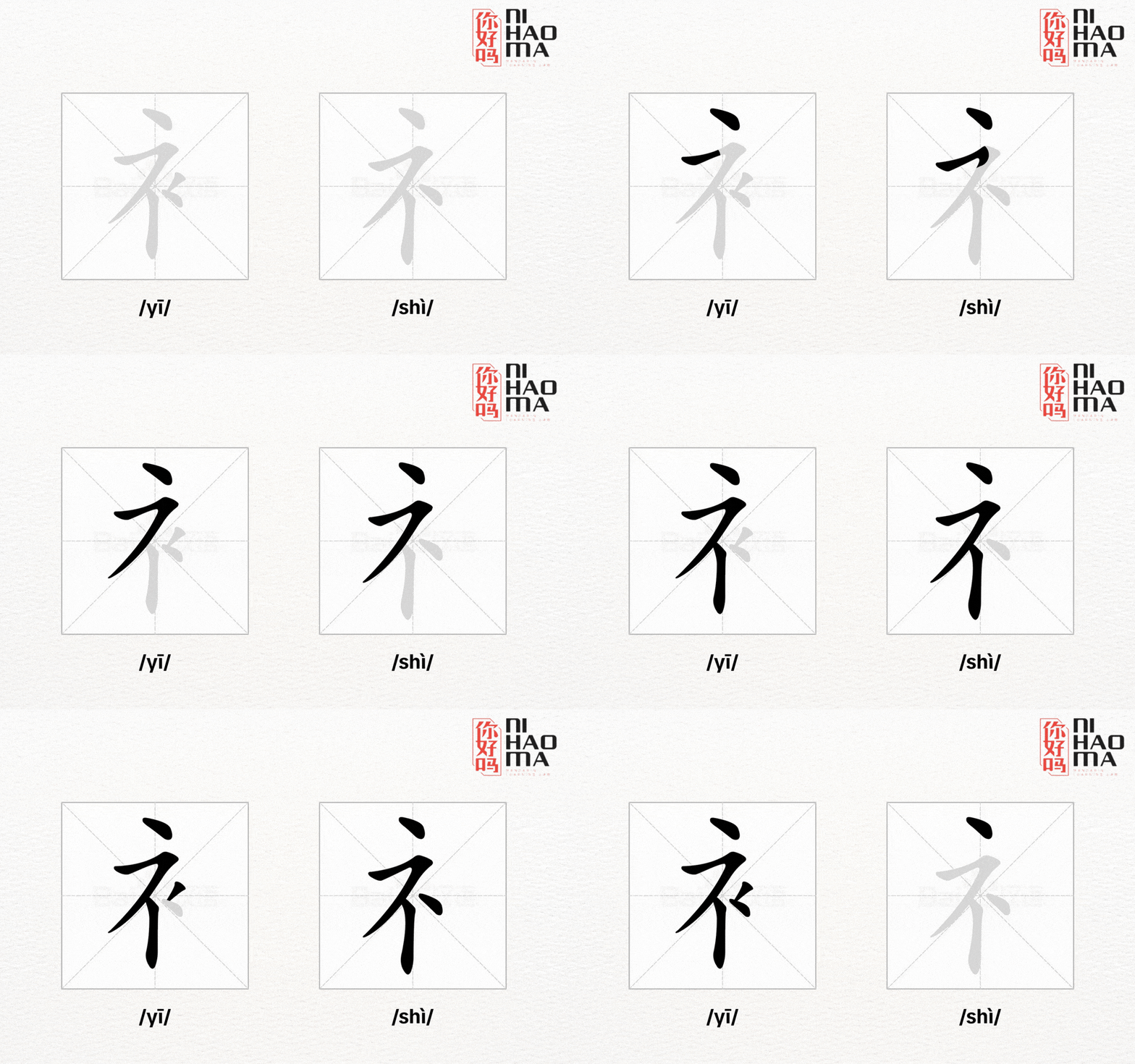
- Variant form (衤): Often called the standing form of radical 145, this variant appears on the left side of characters when combined with other components.
The full form of radical 145 is written with six strokes, following this standard stroke order:
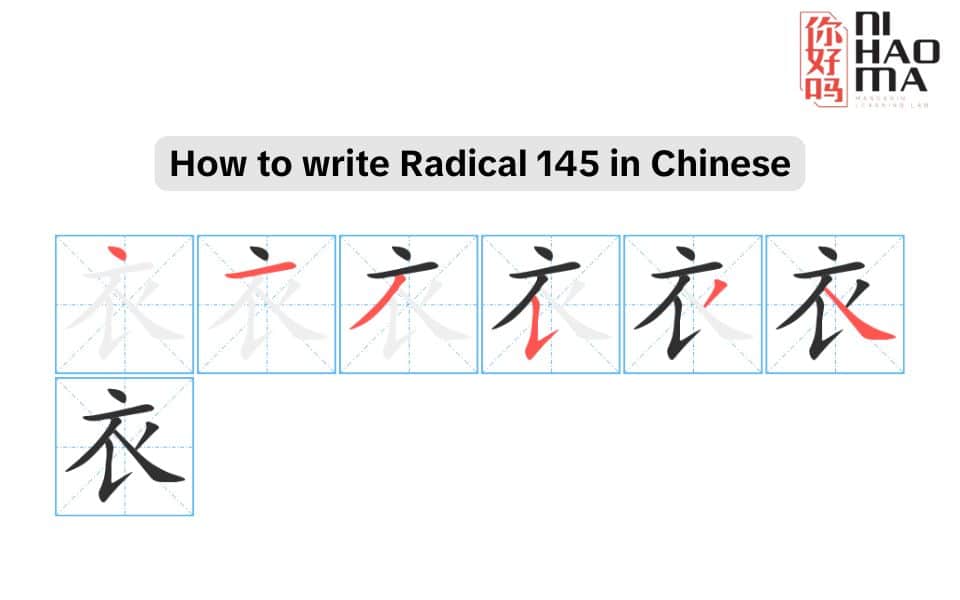
| Stroke order | Stroke Name | Description |
|---|---|---|
| 1 | 丶(Dot) | A small dot written from top to bottom, placed near the upper center of the character. |
| 2 | 一(Horizontal stroke) | A short horizontal line written from left to right, directly below the dot. |
| 3 | ノ(Left-falling stroke) | A left-slanting stroke written from top to bottom, slightly angled to the left. |
| 4 | 亅 (Vertical hook) | A vertical stroke with a hook, starting below the previous stroke and forming the left structure of the character. |
| 5 | ノ(Left-falling stroke) | A longer diagonal stroke slanting downward to the left, creating the visual impression of a flowing garment. |
| 6 | 丶(Dot) | The final dot, written from top to bottom and placed slightly lower on the right side. |
How to Distinguish Radical 145 (衤) and the Radical 113 (礻)
In the Chinese writing system, confusing radicals with similar shapes is very common — especially for beginners. Distinguishing radical 145 (衤) and the spirit radical (礻) is considered one of the biggest challenges, because their visual forms look almost identical at first glance.
However, when you focus on stroke structure and semantic logic, the differences become clear and easy to remember.
- Radical 145 (衤- yī): Has two right-falling strokes on the right side (a total of 5 strokes). Characters containing radical 145 are usually related to clothing, garments, attire, or outward appearance.
- Radical 113 (礻- shì): Has only one right-falling stroke on the right side (a total of 4 strokes). Characters with this radical are typically associated with beliefs, rituals, worship, or spirituality.
Vocabulary Containing Radical 145 in Chinese
In modern Chinese, many words containing radical 145 are used with high frequency in everyday life — especially in topics such as shopping, fashion, fabric, and outward appearance. Below is a list of common vocabulary with radical 145 that you can easily apply in daily communication:
| Chinese Character | Pinyin | Meaning |
|---|---|---|
| 衣 | yī | Clothes |
| 衣服 | yīfu | Clothing |
| 裤 | kù | Pants |
| 裙 | qún | Skirt |
| 袖 | xiù | Sleeve |
| 装 | zhuāng | Clothing; to dress |
| 装饰 | zhuāngshì | Decoration |
| 裁 | cái | To tailor; to cut |
| 裁缝 | cáifeng | Tailor |
| 衬 | chèn | Lining; undershirt |
| 衬衫 | chènyī | Shirt |
| 袍 | páo | Robe |
| 裸 | luǒ | Naked; uncovered |
| 裤子 | kùzi | Pants |
| 褂 | guà | Light jacket |
| 褐 | hè | Brown; brown garment |
| 襟 | jīn | Lapel |
| 褥 | rù | Mattress; quilt |
| 褪 | tuì | To fade (clothes) |
| 襄 | xiāng | To assist; help |
| 裹 | guǒ | To wrap |
| 装扮 | zhuāngbàn | Style of dress |
| 装修 | zhuāngxiū | Renovation; decoration |
| 裁剪 | cáijiǎn | Tailoring; cutting |
| 袜 | wà | Sock |
| 袜子 | wàzi | Pair of socks |
| 裘 | qiú | Fur coat |
| 褶 | zhě | Pleat |
| 裙子 | qúnzi | Skirt |
| 裤腿 | kùtuǐ | Pant leg |
| 袄 | ǎo | Padded jacket |
| 褶皱 | zhězhòu | Wrinkles |
| 襜 | chān | Apron |
| 衣领 | yīlǐng | Collar |
| 衣袖 | yīxiù | Sleeve |
| 衣柜 | yīguì | Wardrobe |
| 衣架 | yījià | Clothes hanger |
| 衣料 | yīliào | Fabric material |
| 衣着 | yīzhuó | Way of dressing |
| 衣物 | yīwù | Clothing items |
| 衣襟 | yījīn | Front of a garment |
| 裙摆 | qúnbǎi | Skirt hem |
| 裁衣 | cáiyī | To make clothes |
| 褴 | lán | Ragged; worn |
| 褴褛 | lánlǚ | Tattered |
| 袒 | tǎn | To bare; expose |
| 裔 | yì | Descendant |
| 襦 | rú | Short jacket |
| 襟怀 | jīnhuái | Mindset; aspiration |
Sample Dialogues Using Vocabulary with Radical 145 in Chinese
Learning vocabulary that contains radical 145 (衣) through dialogues helps learners remember real-life usage contexts, instead of memorizing isolated meanings. According to research on Context-based Learning conducted by the University of Cambridge (2020), exposure to vocabulary through conversations can increase long-term retention by approximately 40 – 50% compared to learning from word lists alone.
Below are several sample dialogues using vocabulary with radical 145 in Chinese that you can practice at home:
Dialogue 1
A: 这件衣服很好看,你试过了吗?
Zhè jiàn yīfu hěn hǎokàn, nǐ shì guò le ma?
(This outfit looks really nice. Have you tried it on yet?)
B: 试过了,但是衣袖有点长。
Shì guò le, dànshì yīxiù yǒudiǎn cháng.
(I tried it, but the sleeves are a bit long.)
A: 可以改一下,裁缝就在那边。
Kěyǐ gǎi yíxià, cáifeng jiù zài nàbiān.
(It can be altered; the tailor is right over there.)
B: 好的,那我就买这套衣着。
Hǎo de, nà wǒ jiù mǎi zhè tào yīzhuó.
(Alright, then I’ll buy this outfit.)

Dialogue 2
A: 你今天的装扮很特别。
Nǐ jīntiān de zhuāngbàn hěn tèbié.
(Your outfit today looks very special.)
B: 是吗?我比较喜欢简单的衣着。
Shì ma? Wǒ bǐjiào xǐhuān jiǎndān de yīzhuó.
(Really? I prefer a simple style of dressing.)
A: 这件外套的衣料看起来很舒服。
Zhè jiàn wàitào de yīliào kàn qǐlái hěn shūfu.
(The fabric of this coat looks very comfortable.)
B: 对,穿起来也不热。
Duì, chuān qǐlái yě bú rè.
(Yes, and it’s not hot to wear either.)
Dialogue 3
A: 天气变冷了,你换季了吗?
Tiānqì biàn lěng le, nǐ huànjì le ma?
(The weather is getting colder. Have you changed your clothes for the season?)
B: 还没有,我的衣柜太满了。
Hái méiyǒu, wǒ de yīguì tài mǎn le.
(Not yet, my wardrobe is too full.)
A: 可以先整理一下夏天的衣物。
Kěyǐ xiān zhěnglǐ yíxià xiàtiān de yīwù.
(You can start by organizing your summer clothes.)
B: 对,把不用的收起来。
Duì, bǎ bú yòng de shōu qǐlái.
(Right, put away the ones you don’t use.)
A: 冬天的外套记得用好一点的衣架。
Dōngtiān de wàitào jìde yòng hǎo yìdiǎn de yījià.
(Remember to use better hangers for winter coats.)
B: 这样衣服就不容易变形了。
Zhèyàng yīfu jiù bù róngyì biànxíng le.
(This way, the clothes won’t lose their shape easily.)
Conclusion
Mastering the meaning, correct stroke order, and vocabulary system related to radical 145 helps learners recognize Chinese characters faster, infer meanings more accurately, and retain vocabulary more effectively over the long term. This article by Ni Hao Ma has introduced what radical 145 is in Chinese, how to write it, and common vocabulary associated with it. Hopefully, you’ve gained useful insights—don’t forget to save this article so you can revisit it whenever needed.