When learning Chinese, mastering radicals is essential for understanding how characters are structured and what they mean. Among them, radical 146 in Chinese is one of the most unique and potentially confusing components due to its multiple forms and visual similarities.
So, what is radical 146 in Chinese, how is it written, and which common words contain it? In this article, we will explore its meaning, origin, variants, stroke order, and practical vocabulary, helping you build a clearer and more systematic understanding of Chinese characters.
What Is Radical 146 in Chinese?
Radical 146, written as 襾 (yà), is the 146th radical in the traditional set of 214 Kangxi radicals. Its core meaning relates to covering, enclosing, or spreading over something.
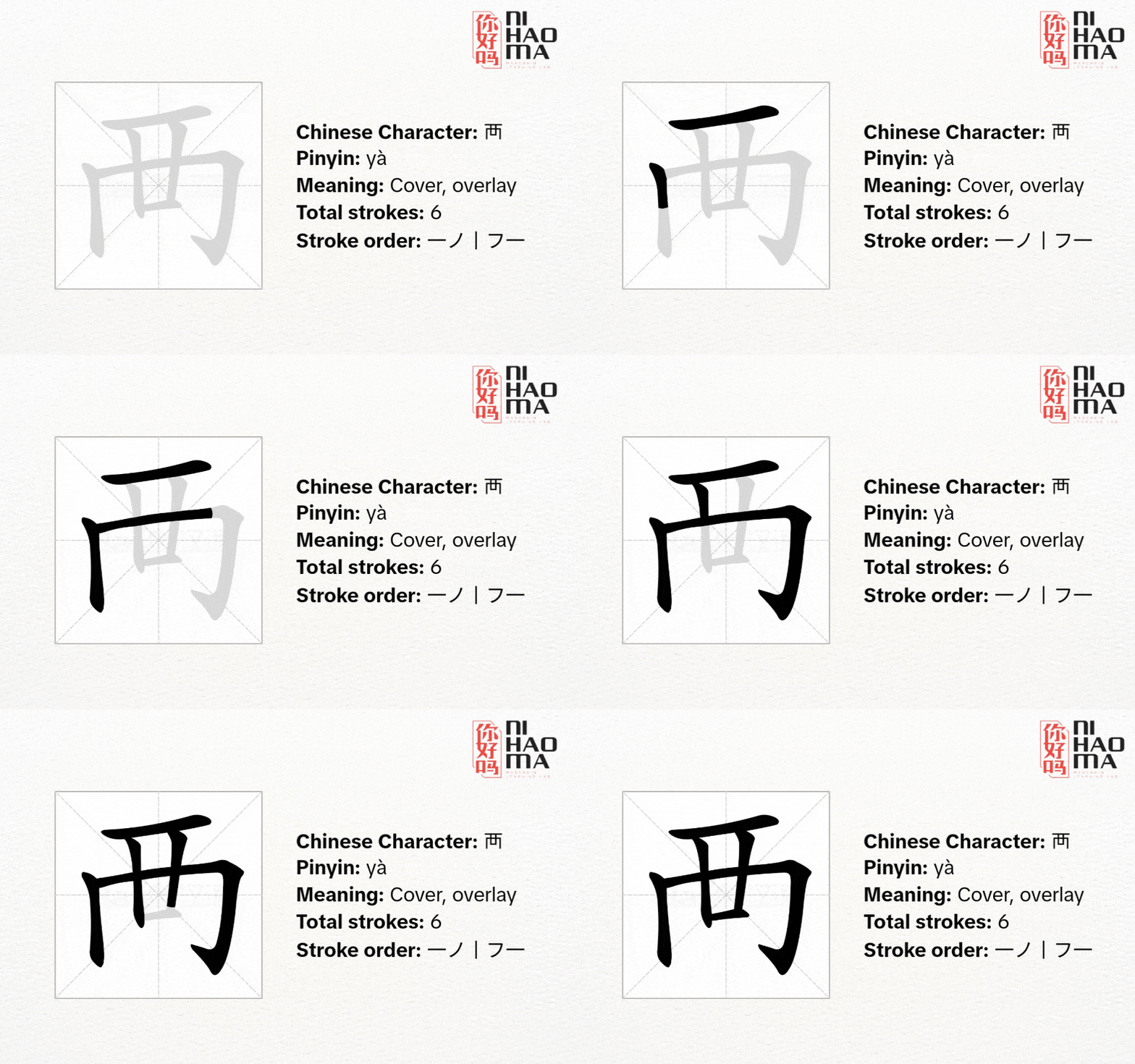
In terms of origin, radical 146 evolved from ancient pictographic forms, representing an object covering something from above, similar to a roof or protective layer. Over time, as Chinese characters developed from oracle bone script to modern standard script, its curved shapes were gradually simplified into more structured and angular strokes.
In modern linguistic usage, the original form 襾 rarely appears independently. However, its derived forms and variants are much more common, making this radical more relevant than it may initially seem.
Variants of Radical 146 in Chinese
Radical 146 is known for its notable structural variations, which often cause confusion among learners.
Variant 覀
The most common variant is 覀, which typically appears at the top of a character. In this position, it acts like a covering “lid”, enclosing the components below.
Compared to the original form 襾 (6 strokes), the variant 覀 is simplified to 5 strokes, making it easier to write and more visually balanced.
This form appears in many familiar characters, such as:
- 要 (yào) – need, important
- 栗 (lì) – chestnut
- 贾 (jiǎ) – trade, merchant
However, learners often confuse 覀 with 西 (xī – west) due to their similar appearance.
The Character 西
In traditional Chinese dictionaries, 西 (west) is often classified under radical 146. However, this classification is not based on shared origin but rather on a phenomenon known as a homoglyph—characters that look similar but have different origins.
In reality, 西 is not historically derived from 襾, but due to their visual similarity, lexicographers grouped them together to make dictionary lookup easier.
How to Write Radical 146
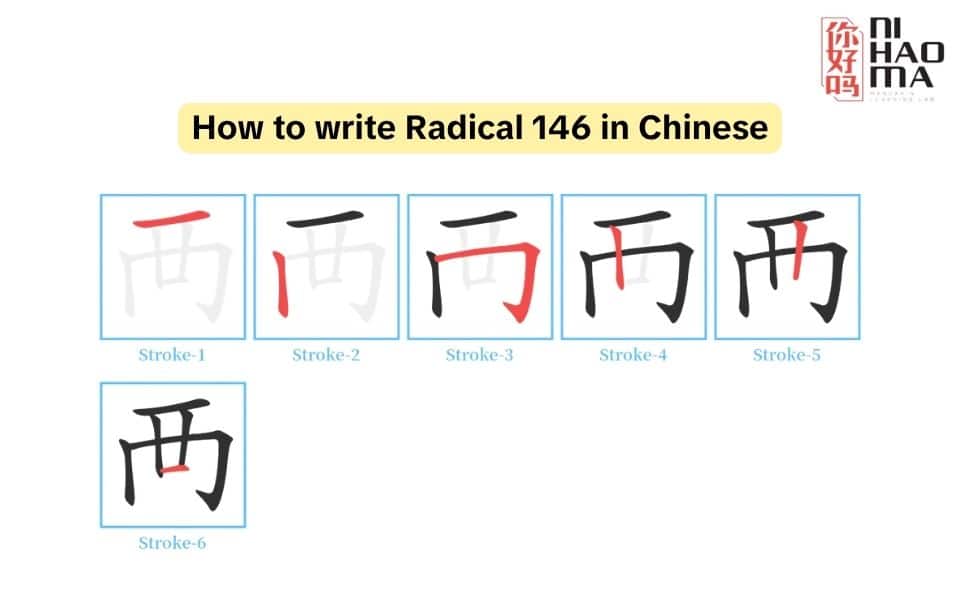
Radical 146 (襾) consists of 6 strokes, written in the following order:
| Stroke Order | Stroke Name | Description |
|---|---|---|
| 1 | Horizontal (一) | Draw a top horizontal line from left to right. |
| 2 | Vertical (丨) | Add a short vertical stroke downward on the left side. |
| 3 | Horizontal hook (フ) | Draw a horizontal stroke that bends downward from the left vertical. |
| 4 | Vertical (丨) | Draw a slightly left-leaning vertical line from the top horizontal. |
| 5 | Vertical (丨) | Draw another vertical line, slightly right-leaning. |
| 6 | Horizontal (一) | Finish with a short horizontal stroke connecting the two vertical lines in the middle. |
Common Vocabulary with Radical 146
Radical 146 (襾 / 西) appears in many commonly used Chinese words, especially those related to directions, needs, and everyday concepts like tickets and documents. Learning these words will help you expand your vocabulary systematically and recognize characters more efficiently.
Here are some common examples:
| Chinese | Pinyin | Meaning |
|---|---|---|
| 西 | xī | west |
| 要 | yào | need, want |
| 覆 | fù | cover |
| 覃 | tán/qín | extensive |
| 西方 | xī fāng | the West |
| 西安 | Xī’ān | Xi’an (city name) |
| 西瓜 | xī guā | watermelon |
| 西装 | xī zhuāng | suit |
| 西医 | xī yī | Western medicine |
| 西药 | xī yào | Western medicine (drugs) |
| 西餐 | xī cān | Western food |
| 西边 | xī biān | west side |
| 西南 | xī nán | southwest |
| 西北 | xī běi | northwest |
| 西欧 | xī ōu | Western Europe |
| 西亚 | xī yà | Western Asia |
| 需要 | xū yào | need |
| 重要 | zhòng yào | important |
| 不要 | bú yào | don’t |
| 要求 | yāo qiú | request |
| 要素 | yào sù | element |
| 要领 | yào lǐng | key point |
| 要紧 | yào jǐn | important |
| 要好 | yào hǎo | close (relationship) |
| 要不 | yào bù | otherwise |
| 覆盖 | fù gài | cover |
| 票据 | piào jù | receipt |
| 发票 | fā piào | invoice |
| 彩票 | cǎi piào | lottery ticket |
| 车票 | chē piào | ticket |
| 机票 | jī piào | plane ticket |
| 选票 | xuǎn piào | ballot |
| 投票 | tóu piào | vote |
| 支票 | zhī piào | check |
| 钞票 | chāo piào | banknote |
| 股票 | gǔ piào | stock |
| 东西 | dōng xi | things, objects |
Example Dialogues Using Radical 146 Vocabulary
To better remember vocabulary containing radical 146, it’s helpful to place them in real-life contexts. The following dialogues demonstrate how these words are used in everyday situations such as asking for directions, purchasing tickets, and discussing work.
Dialogue 1
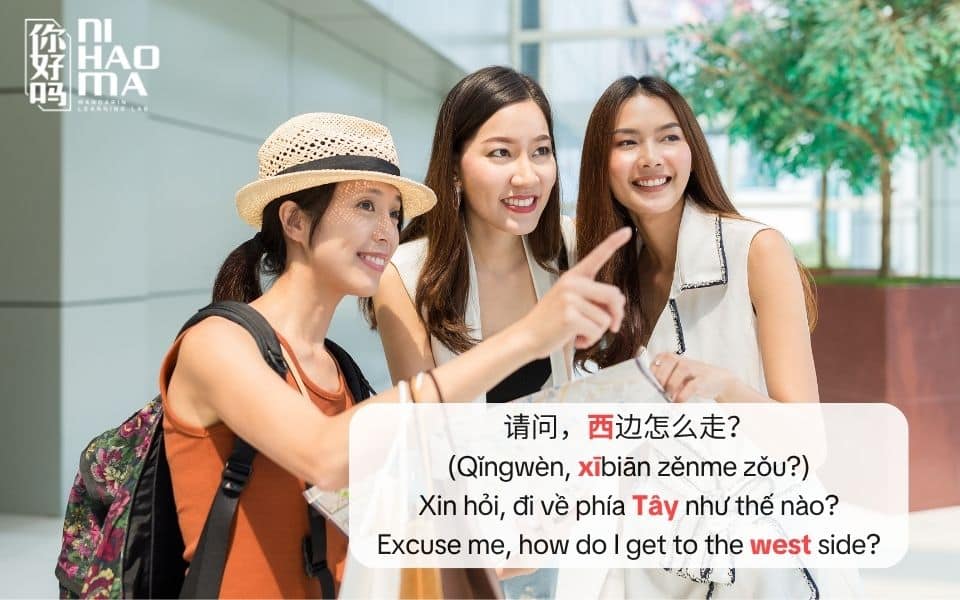
A: 请问,西边怎么走?
(Qǐngwèn, xībiān zěnme zǒu?)
Excuse me, how do I get to the west side?
B: 一直走,然后往西拐。
(Yìzhí zǒu, ránhòu wǎng xī guǎi.)
Go straight, then turn west.
A: 那边有什么地方?
(Nà biān yǒu shénme dìfang?)
What’s over there?
B: 有一个西餐厅,还有商场。
(Yǒu yí gè xīcāntīng, hái yǒu shāngchǎng.)
There’s a Western restaurant and a shopping mall.
A: 好的,谢谢你!
(Hǎo de, xièxie nǐ!)
Okay, thank you!
B: 不客气!
(Bú kèqi!)
You’re welcome!
Dialogue 2
A: 你好,我要两张机票。
(Nǐ hǎo, wǒ yào liǎng zhāng jīpiào.)
Hello, I’d like to buy two plane tickets.
B: 请问要去哪里?
(Qǐngwèn yào qù nǎlǐ?)
Where would you like to go?
A: 去西安。
(Qù Xī’ān.)
To Xi’an.
B: 好的,一共一千元。
(Hǎo de, yígòng yì qiān yuán.)
Okay, the total is 1,000 yuan.
A: 可以开发票吗?
(Kěyǐ kāi fāpiào ma?)
Can I get an invoice?
B: 可以的。
(Kěyǐ de.)
Of course.
Dialogue 3
A: 这个项目很重要。
(Zhège xiàngmù hěn zhòngyào.)
This project is very important.
B: 我知道,我们需要更多时间。
(Wǒ zhīdào, wǒmen xūyào gèng duō shíjiān.)
I know, we need more time.
A: 客户有什么要求?
(Kèhù yǒu shénme yāoqiú?)
What are the client’s requirements?
B: 他们要质量,也要速度。
(Tāmen yào zhìliàng, yě yào sùdù.)
They want both quality and speed.
A: 那我们要加快进度了。
(Nà wǒmen yào jiākuài jìndù le.)
Then we need to speed up the progress.
B: 好的,我马上安排。
(Hǎo de, wǒ mǎshàng ānpái.)
Okay, I’ll arrange it right away.
Conclusion
Understanding the origin, stroke order, and variants of this radical will help you memorize Chinese characters more logically. Learning what radical 146 in Chinese is not only helps you interpret the meaning of many characters but also gives insight into the concept of homoglyphs in Chinese writing.
Hopefully, through this article by Ni Hao Ma, you now have a solid grasp of the structure, core meaning, and commonly used vocabulary related to radical 146. Start building the habit of learning vocabulary through radicals today, and mastering Chinese characters will become much easier and more effective.