
When learning Chinese characters, mastering radicals plays a crucial role in understanding both character structure and meaning. Radicals act as semantic building blocks that help learners recognize patterns and infer meanings more easily. One radical that appears very frequently but is often overlooked is radical 162. So what is radical 162 in Chinese, what does it mean, how is it written, and which common characters contain this radical?
What is Radical 162 in Chinese?
Radical 162 in Chinese (辶 – chuò) in the Kangxi system of 214 Chinese radicals is commonly associated with meanings related to movement, walking, traveling, distance, direction, or paths.
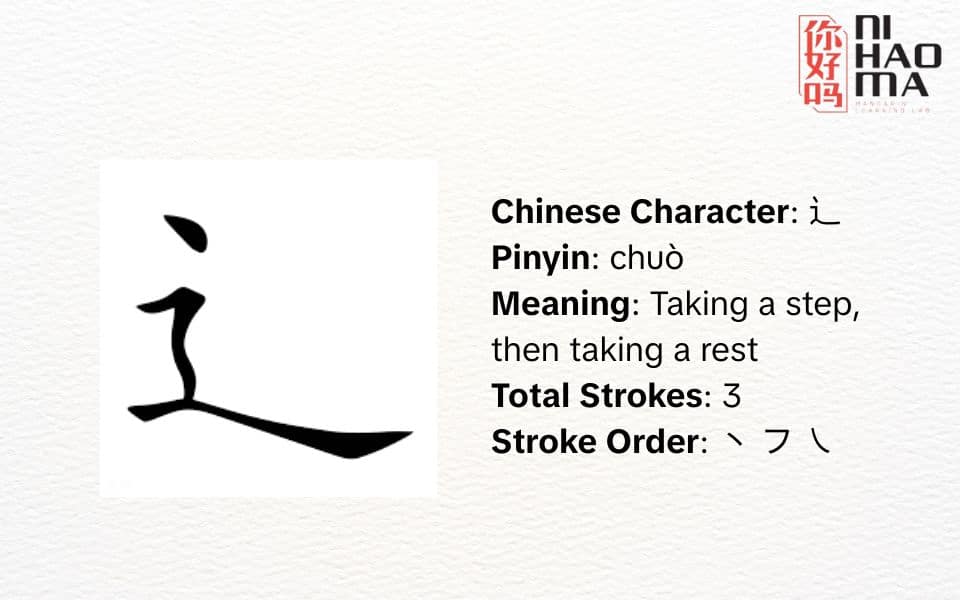
In terms of origin, radical 162 comes from ancient pictographic forms found in oracle bone script and bronze inscriptions, where it visually represented a person walking along a road. Over time, through the process of simplification and standardization, its traditional form 辵 was gradually reduced to the modern form 辶.
Despite this simplification, the radical has retained its core semantic function. Thanks to this strong visual and semantic association, characters that include radical 162 usually relate to movement, travel, distance, or direction, making it easier for learners to guess the meaning of unfamiliar characters based on the radical alone.
How to Write Radical 162 in Chinese
In modern Chinese writing, radical 162 consists of three main strokes, written in the following order:
| Stroke Order | Stroke Name | Description |
|---|---|---|
| 1 | Dot stroke (丶) | Write a small dot at the top. Pay attention to balance so it aligns well with the components written below later. |
| 2 | Horizontal-turn stroke (㇇) | Write a short horizontal line, then turn downward and curve slightly, resembling a stylized “3” or a gentle “~” shape. |
| 3 | Long curved downward stroke (㇏) | Draw a long sweeping stroke from left to right, curving slightly downward to visually support the components above. |
Position of Radical 162 in Chinese Characters
In Chinese characters, radical 162 (辶) has a relatively fixed position and almost always appears on the right side or the lower-right part of a character. Unlike many radicals that are placed on the left, radical 162 has a distinctive “long trailing” shape, so it is usually positioned to the right to maintain visual balance within the overall character structure.
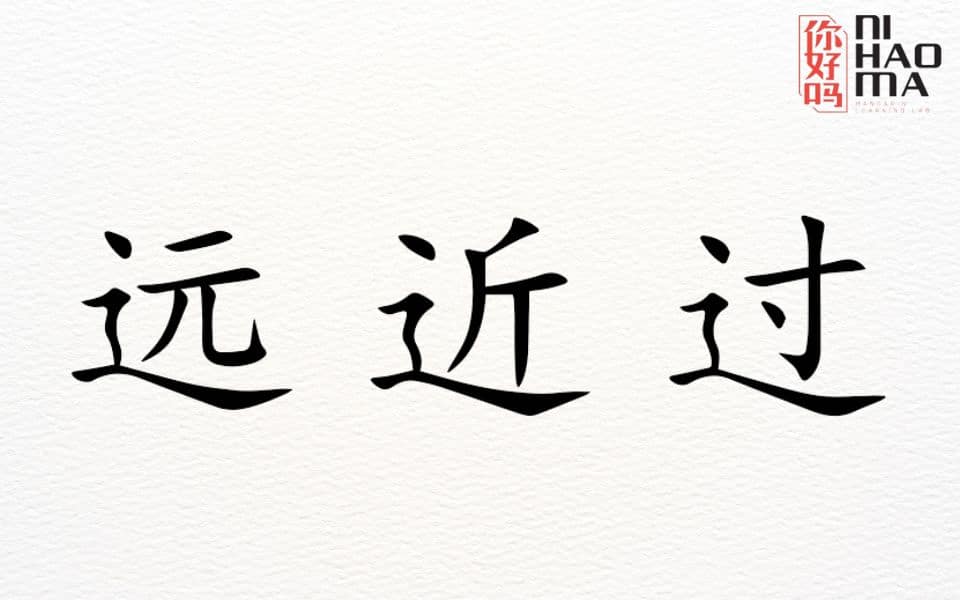
From a structural perspective, radical 162 typically combines with another component on the left that provides the phonetic cue, forming characters that convey meaning through the radical and pronunciation through the phonetic element. For example:
- 这 (zhè – this) → radical 162 appears on the right, suggesting the idea of “coming/going”
- 近 (jìn – near) → radical 162 on the right, indicating distance
- 过 (guò – to pass) → radical 162 at the lower right, expressing the action of “passing through”
Vocabulary Containing Radical 162 in Chinese
In Chinese learning, studying vocabulary through radicals is considered a systematic and effective approach, allowing learners to memorize faster and understand the internal logic of characters. Radical 162 (辶) is a high-frequency radical closely associated with familiar concepts such as movement, travel, direction, and distance.
Below are some common vocabulary items containing radical 162 that are widely used in daily communication.
| Chinese Character | Pinyin | Meaning |
|---|---|---|
| 这 | zhè | this |
| 那 | nà | that |
| 过 | guò | to pass |
| 还 | hái / huán | still / to return |
| 进 | jìn | to enter |
| 近 | jìn | near |
| 远 | yuǎn | far |
| 迟 | chí | late |
| 送 | sòng | to send, to escort |
| 选 | xuǎn | to choose |
| 逃 | táo | to escape |
| 退 | tuì | to retreat |
| 追 | zhuī | to chase |
| 迷 | mí | lost, confused |
| 造 | zào | to create |
| 途 | tú | route, path |
| 通 | tōng | to pass through |
| 逛 | guàng | to stroll |
| 速 | sù | speed, fast |
| 递 | dì | to deliver |
| 迫 | pò | to force |
| 违 | wéi | to violate |
| 逐 | zhú | to pursue |
| 逗 | dòu | to tease |
| 适 | shì | suitable |
| 逆 | nì | reverse |
| 迈 | mài | to step |
| 返 | fǎn | to return |
| 迎 | yíng | to welcome |
| 进步 | jìnbù | progress |
| 运动 | yùndòng | movement, exercise |
| 遗憾 | yíhàn | regret |
| 过去 | guòqù | the past |
| 道路 | dàolù | road |
| 运输 | yùnshū | transportation |
| 迁移 | qiānyí | to relocate |
| 迅速 | xùnsù | rapid |
| 合适 | héshì | appropriate |
| 追求 | zhuīqiú | to pursue |
| 逃避 | táobì | to avoid |
| 返回 | fǎnhuí | to return |
| 进入 | jìnrù | to enter |
| 远离 | yuǎnlí | to stay away from |
| 近来 | jìnlái | recently |
| 通过 | tōngguò | through |
| 送达 | sòngdá | to deliver |
| 退步 | tuìbù | to regress |
Sample Dialogues Using Vocabulary with Radical 162 in Chinese
To help learners remember and effectively use vocabulary containing radical 162 (辶), placing these words in real-life conversational contexts is a highly effective learning method. Instead of memorizing individual words in isolation, dialogue-based examples show how vocabulary with radical 162 is naturally used in everyday communication, making it easier to understand, retain, and apply.
Dialogue 1
A: 请问,这里离银行远吗?
(Qǐngwèn, zhèlǐ lí yínháng yuǎn ma?)
→ Excuse me, is the bank far from here?
B: 不远,往前走就能看到。
(Bù yuǎn, wǎng qián zǒu jiù néng kàndào.)
→ Not far. Walk straight ahead and you’ll see it.
A: 需要过马路吗?
(Xūyào guò mǎlù ma?)
→ Do I need to cross the road?
B: 需要,过了马路再往右走。
(Xūyào, guò le mǎlù zài wǎng yòu zǒu.)
→ Yes. Cross the road, then turn right.
A: 好的,谢谢你。
(Hǎo de, xièxie nǐ.)
→ Okay, thank you.

Dialogue 2
A: 你怎么又迟到了?
(Nǐ zěnme yòu chídào le?)
→ Why are you late again?
B: 路上太堵,我来得比较慢。
(Lùshang tài dǔ, wǒ lái de bǐjiào màn.)
→ The road was very crowded, so I arrived slowly.
A: 你不是住得很近吗?
(Nǐ bú shì zhù de hěn jìn ma?)
→ Don’t you live very close?
B: 是很近,但是今天出了点问题。
(Shì hěn jìn, dànshì jīntiān chū le diǎn wèntí.)
→ Yes, it’s close, but there was a small problem today.
A: 下次早点出门吧。
(Xià cì zǎodiǎn chūmén ba.)
→ Leave earlier next time.
Dialogue 3
A: 周末你打算去哪里?
(Zhōumò nǐ dǎsuàn qù nǎlǐ?)
→ Where are you planning to go this weekend?
B: 我想去郊外走走。
(Wǒ xiǎng qù jiāowài zǒuzǒu.)
→ I want to go for a walk in the suburbs.
A: 那里离市中心远吗?
(Nàlǐ lí shìzhōngxīn yuǎn ma?)
→ Is it far from the city center?
B: 不太远,坐车很快就到。
(Bú tài yuǎn, zuò chē hěn kuài jiù dào.)
→ Not very far. You can get there quickly by car.
A: 我可以送你一起去。
(Wǒ kěyǐ sòng nǐ yìqǐ qù.)
→ I can give you a ride and go together.
Conclusion
Understanding the meaning, correct stroke order, and positional patterns of radicals allows learners to gain deeper insight into the structure of Chinese characters. This approach makes vocabulary learning more logical, efficient, and long-lasting, rather than relying on rote memorization.
This article by Ni Hao Ma has helped you understand what radical 162 is, how it is written, and how common characters and vocabulary containing radical 162 are used in context. Hopefully, you have found this information useful—and don’t forget to explore more fascinating Chinese radicals in future lessons.