
Among the 214 Kangxi radicals, radical 26 is relatively simple in form yet often confusing for beginners. So what exactly is radical 26, what does it mean, and how is it written correctly? This guide explains its definition, historical origin, stroke order, and how to distinguish it from similar-looking radicals – helping you build a stronger foundation in Chinese character learning.
What Is Radical 26 in Chinese?
Radical 26 (卩) is the 26th radical in the traditional system of 214 Chinese radicals. It commonly conveys meanings related to joints, sections, seasonal divisions, ritual propriety, restraint, or formality.
From a historical perspective, 卩 originated as a pictograph in oracle bone script and bronze inscriptions. It depicted a person kneeling. In ancient Chinese society, kneeling symbolized ritual behavior, respect, obedience, and submission to authority.
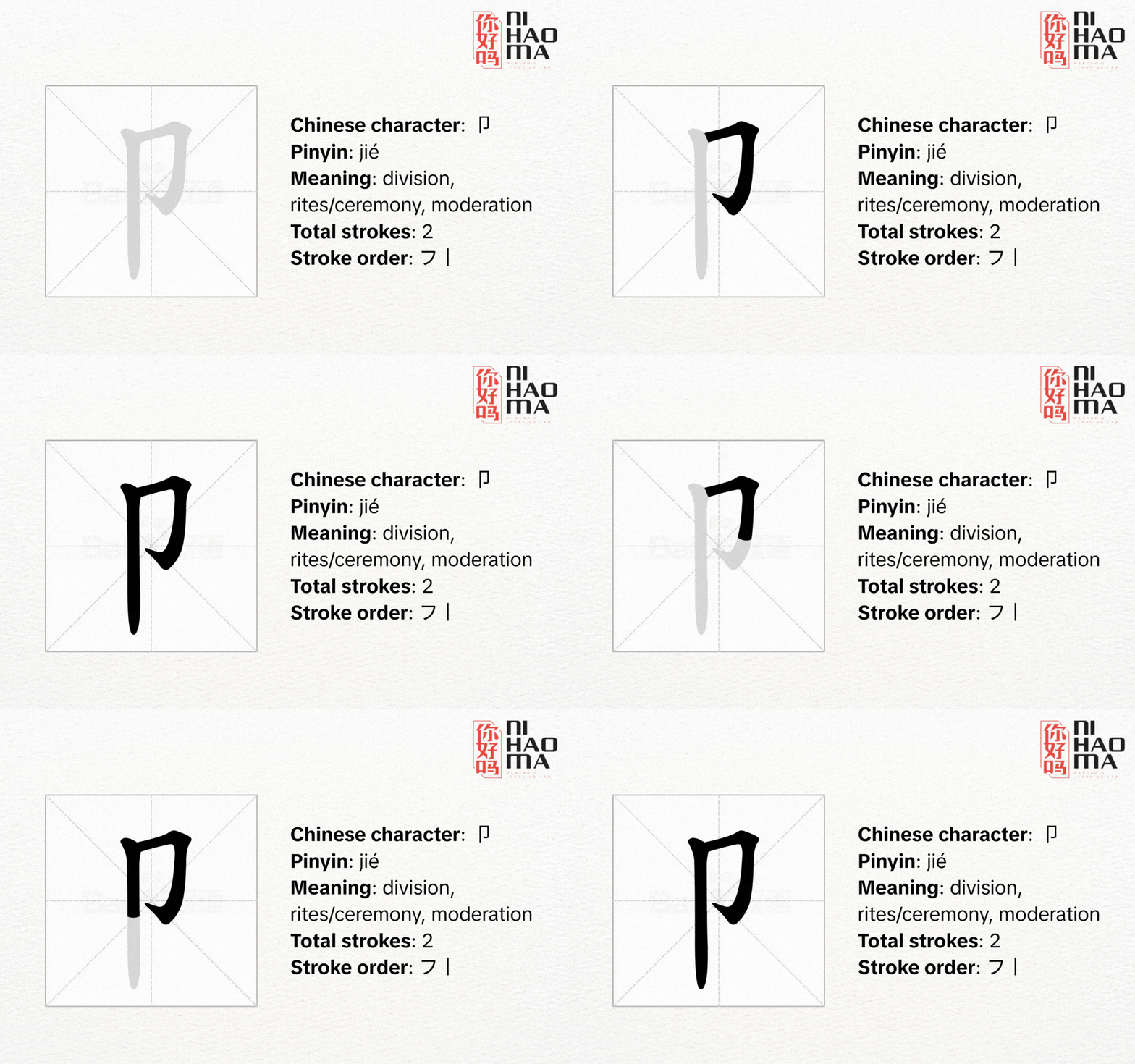
Because of this origin, many characters containing radical 26 are connected – directly or indirectly – to ideas such as:
- Orders or authority
- Rituals and ceremony
- Formal conduct
- Regulated divisions or moderation
Over time, the original pictographic meaning became more abstract. In many modern characters, the visual connection to “kneeling” is no longer obvious. However, understanding this origin helps learners memorize characters logically rather than treating them as isolated symbols.
How to Write Radical 26 Correctly
Radical 26 consists of only two strokes and is written as follows:
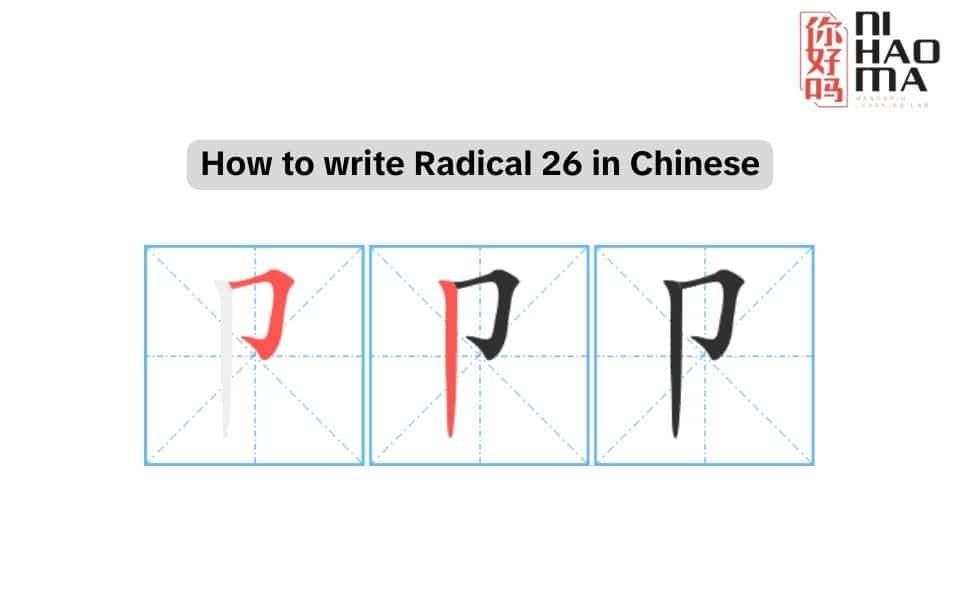
| Stroke Order | Stroke Name | Writing Description | Writing Tips |
|---|---|---|---|
| 1 | 𠃌 (horizontal turning stroke) | Start with a short horizontal line from left to right, then turn downward to form a slightly curved vertical stroke leaning gently to the left. | The turning point should be smooth rather than sharply angled; keep the length moderate for overall balance. |
| 2 | 丨 (vertical stroke) | Draw a straight vertical line from top to bottom, positioned slightly to the right of the first stroke. | The vertical stroke should be firm and straight, and slightly longer than the upper turning stroke to create visual stability. |
How to Distinguish Radical 26 from Similar Radicals
In the Chinese radical system, some radicals have very similar shapes, which can easily confuse learners at first glance. Many people mistake radical 26 (卩) for the two 阝 forms because they share comparable curved and vertical strokes.
However, you can distinguish these three radicals by observing their basic structural features:
- Radical 26 (卩): Consists of only two strokes—a turning downward stroke and a straight vertical stroke. Its meaning is often associated with division, ritual propriety, or seasonal segments.
- Radical 阜 (阝 – appears on the left side): The right component resembles the number “3.” It is commonly related to vocabulary describing elevated landforms, steep terrain, or large natural features.
- Radical 邑 (阝 – appears on the right side): The right component also resembles the number “3.” It is typically connected to administrative units, cities, or human-made regional divisions.
Vocabulary with Radical 26 in Chinese
When learning Chinese characters, studying vocabulary by radicals helps you remember words faster and understand their structure more deeply. With radical 26 (卩), many characters are historically associated with ideas such as authority, ritual behavior, division, restraint, or formal actions.
Below is a list of common Chinese words containing radical 26, along with their pinyin and meanings to support your learning and daily communication.
| Chinese | Pinyin | Meaning |
|---|---|---|
| 印刷 | yìnshuā | printing |
| 印象 | yìnxiàng | impression |
| 打印 | dǎyìn | to print |
| 复印 | fùyìn | to photocopy |
| 印章 | yìnzhāng | seal, stamp |
| 印度 | Yìndù | India |
| 印证 | yìnzhèng | to verify, confirm |
| 手印 | shǒuyìn | fingerprint, handprint |
| 脚印 | jiǎoyìn | footprint |
| 即使 | jíshǐ | even if |
| 立即 | lìjí | immediately |
| 即将 | jíjiāng | about to |
| 即刻 | jíkè | at once |
| 即位 | jíwèi | to ascend the throne |
| 即日 | jírì | within the day |
| 即兴 | jíxìng | impromptu |
| 即席 | jíxí | on the spot |
| 节目 | jiémù | program, performance |
| 叩头 | kòutóu | to kowtow |
| 欢迎 | huānyíng | to welcome |
| 退却 | tuìquè | to retreat |
| 冷却 | lěngquè | to cool down |
| 忘却 | wàngquè | to forget |
| 推却 | tuīquè | to decline |
| 谢却 | xièquè | to refuse politely |
| 却步 | quèbù | to hesitate |
| 节日 | jiérì | festival, holiday |
| 春节 | Chūnjié | Spring Festival (Chinese New Year) |
| 节食 | jiéshí | to diet |
| 聊天 | liáotiān | to chat |
| 却是 | quèshì | indeed; unexpectedly |
| 卸货 | xièhuò | to unload goods |
| 卸下 | xièxià | to remove |
| 卸任 | xièrèn | to leave office |
| 装卸 | zhuāngxiè | loading and unloading |
| 拆卸 | chāixiè | to dismantle |
| 卸妆 | xièzhuāng | to remove makeup |
| 卸载 | xièzài | to uninstall |
| 卸车 | xièchē | to unload from a vehicle |
| 抑郁 | yìyù | depressed |
| 节制 | jiézhì | moderation |
| 情节 | qíngjié | plot; storyline |
| 卫生 | wèishēng | hygiene |
Sample Dialogues with Radical 26 Vocabulary
Practicing vocabulary in real-life conversations improves retention and helps you understand natural usage. Since many characters containing radical 26 relate to formality, authority, or structured situations, they frequently appear in both daily speech and formal contexts.
Below are three example dialogues for home practice:
Dialogue 1
A: 快到春节了,你有什么计划?
(Kuài dào Chūnjié le, nǐ yǒu shénme jìhuà?)
The Spring Festival is coming soon. Do you have any plans?
B: 我打算回老家跟家人一起过节。
(Wǒ dǎsuàn huí lǎojiā gēn jiārén yìqǐ guò jié.)
I plan to return to my hometown and celebrate with my family.
A: 每年春节你们都会团聚吗?
(Měinián Chūnjié nǐmen dōu huì tuánjù ma?)
Do you gather together every year?
B: 对,这是我们最重要的节日。
(Duì, zhè shì wǒmen zuì zhòngyào de jiérì.)
Yes, it’s our most important holiday.
A: 听起来很热闹,我也想体验一下。
(Tīng qǐlái hěn rènào, wǒ yě xiǎng tǐyàn yíxià.)
That sounds lively. I’d love to experience it someday.
Dialogue 2
A: 老师为什么这么严肃?
(Lǎoshī wèishénme zhème yánsù?)
Why does the teacher look so serious?
B: 因为有人没做作业。
(Yīnwèi yǒurén méi zuò zuòyè.)
Because someone didn’t do their homework.
A: 老师说什么了吗?
(Lǎoshī shuō shénme le ma?)
Did the teacher say anything?
B: 老师命令我们今天必须交作业。
(Lǎoshī mìnglìng wǒmen jīntiān bìxū jiāo zuòyè.)
The teacher ordered us to submit it today.
A: 那我们快点完成吧。
(Nà wǒmen kuài diǎn wánchéng ba.)
Then let’s finish it quickly.
Dialogue 3
A: 你听说了吗?那条山路很危险。
(Nǐ tīng shuō le ma? Nà tiáo shānlù hěn wēixiǎn.)
Have you heard? That mountain road is dangerous.
B: 为什么危险?发生什么事了?
(Wèishénme wēixiǎn? Fāshēng shénme shì le?)
Why is it dangerous? What happened?
A: 昨天下大雨,路很滑。
(Zuótiān xià dàyǔ, lù hěn huá.)
It rained heavily yesterday, and the road is slippery.
B: 那我们还是别走那条路了。
(Nà wǒmen háishi bié zǒu nà tiáo lù le.)
Then we’d better avoid that road.
A: 对,安全最重要。
(Duì, ānquán zuì zhòngyào.)
Yes, safety comes first.
Conclusion
Understanding radical 26 (卩) helps you recognize character structures more quickly and make logical meaning connections when encountering new vocabulary. As you continue learning, you’ll notice how radicals provide semantic clues that make Chinese characters less intimidating and more systematic.
By mastering the meaning, stroke structure, and practical examples of characters containing radical 26, your Chinese learning process becomes more structured and efficient. Keep exploring radicals one by one, and you’ll steadily build a stronger foundation in reading and writing Chinese.