In the system of 214 Chinese radicals, each radical carries its own meaning and helps learners remember and understand the structure of Chinese characters. Radical 37 is one of the most basic and frequently used radicals, appearing in many common Chinese characters.
Understanding radical 37 can help learners recognize character components, infer meanings, and build vocabulary more effectively. In this article, we will explore what radical 37 is, its meaning, how to write it correctly, and common vocabulary that contains this radical.
What Is Radical 37 in Chinese?
Radical 37 (大 – dà) is the 37th radical in the traditional list of 214 Kangxi radicals used to categorize Chinese characters in dictionaries. Its original meaning is “big,” “great,” or “large.”
From a pictographic perspective, the character 大 resembles the shape of a person standing with arms and legs spread wide. In ancient Chinese thinking, humans were considered the most significant beings, so the image of a person stretching outward symbolized greatness, largeness, and expansion.
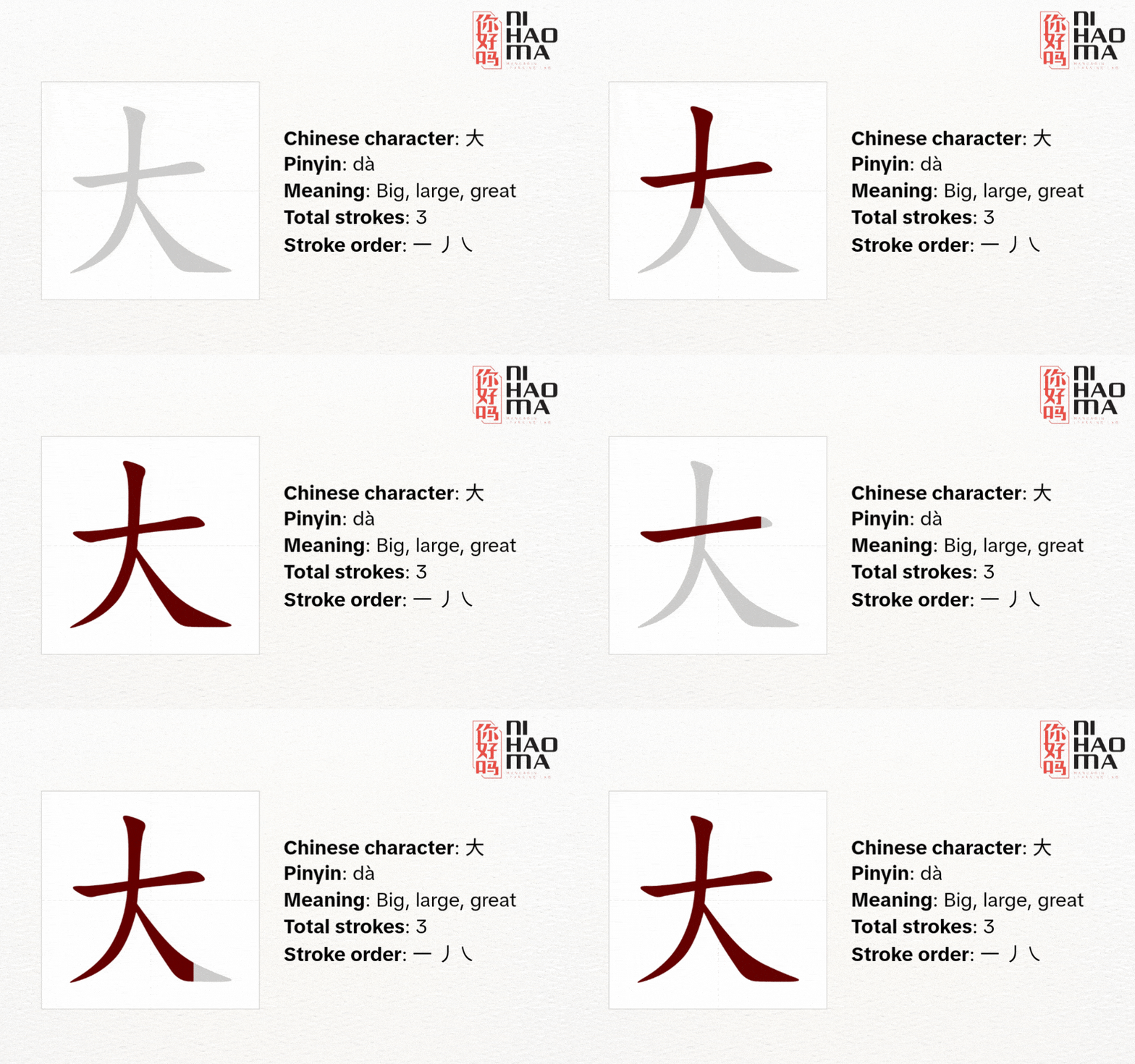
Characters that contain radical 37 often relate to ideas such as:
- size or magnitude
- degree or intensity
- human actions or states
Radical 37 can appear as a standalone character or combine with other radicals and components to form new characters.
- Chinese character: 大
- Pinyin: dà
- Meaning: big, large, great
- Number of strokes: 3
How to Write Radical 37
Radical 37 consists of 3 strokes. Writing the strokes in the correct order is important for proper Chinese handwriting and character structure.
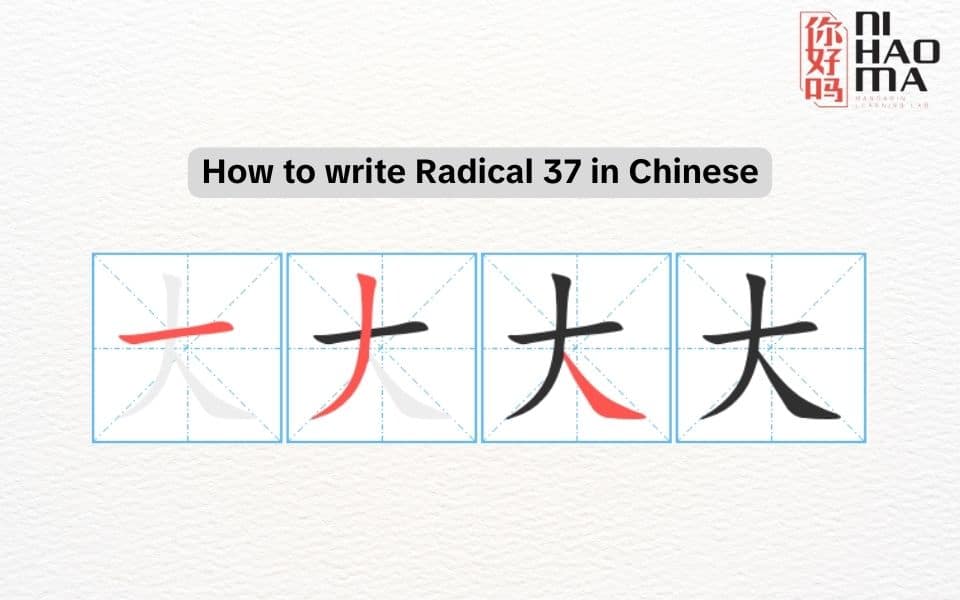
| Stroke Order | Stroke | Description |
|---|---|---|
| 1 | 一 (horizontal stroke) | Write a horizontal line from left to right at the top of the character. This stroke forms the upper frame. |
| 2 | 丿 (left-falling stroke) | Starting near the center of the horizontal stroke, draw a diagonal line downward to the left. This stroke is slightly curved. |
| 3 | ㇏ (right-falling stroke) | From near the center again, draw a diagonal line downward to the right. The final stroke is usually longer and slightly heavier. |
Vocabulary Containing Radical 37
Radical 37 appears in many Chinese characters and often suggests meanings related to size, importance, intensity, or human-related actions. Learning vocabulary through radicals helps learners recognize patterns and remember characters more easily.
Below are some common Chinese characters and words that contain radical 37:
| Chinese | Pinyin | Meaning |
|---|---|---|
| 天 | tiān | sky, heaven |
| 太 | tài | too, very |
| 夫 | fū | man, husband |
| 央 | yāng | center |
| 夭 | yāo | young, short-lived |
| 夸 | kuā | to boast |
| 夯 | hāng | to ram, tamp |
| 夷 | yí | barbarian; to level |
| 奴 | nú | slave |
| 奶 | nǎi | milk |
| 奋 | fèn | to strive, uplifted |
| 奔 | bēn | to run quickly |
| 奈 | nài | to cope with |
| 奉 | fèng | to offer respectfully |
| 契 | qì | contract; carve |
| 奏 | zòu | to present (to a ruler) |
| 奖 | jiǎng | reward |
| 奢 | shē | luxurious |
| 奥 | ào | profound, mysterious |
| 奇 | qí | strange, unusual |
| 奠 | diàn | to establish; memorial offering |
| 奚 | xī | why |
| 奕 | yì | grand; elegant |
| 奂 | huàn | bright; magnificent |
| 奄 | yǎn | to cover |
Common words containing radical 37:
| Chinese | Pinyin | Meaning |
|---|---|---|
| 天气 | tiānqì | weather |
| 大家 | dàjiā | everyone |
| 太阳 | tàiyáng | the sun |
| 奢侈 | shēchǐ | luxury |
| 失败 | shībài | failure |
| 失望 | shīwàng | disappointment |
| 失业 | shīyè | unemployment |
| 中央 | zhōngyāng | central |
| 因为 | yīnwèi | because |
| 因素 | yīnsù | factor |
| 奇怪 | qíguài | strange |
| 奇迹 | qíjì | miracle |
| 奋斗 | fèndòu | to strive |
| 兴奋 | xīngfèn | excited |
| 奉献 | fèngxiàn | dedication |
| 奖励 | jiǎnglì | reward |
| 夸奖 | kuājiǎng | praise |
| 夸张 | kuāzhāng | exaggeration |
| 大概 | dàgài | approximately |
Sample Dialogues Using Vocabulary with Radical 37
Many everyday Chinese words are formed from characters that include radical 37 or relate to the ideas of size, importance, or strength. Learning vocabulary through dialogues helps learners understand how these words are used in real conversations.
Dialogue 1
A: 你现在在哪所大学学习?
Nǐ xiànzài zài nǎ suǒ dàxué xuéxí?
Which university are you studying at now?
B: 我在河内大学学习中文专业。
Wǒ zài Hénèi dàxué xuéxí Zhōngwén zhuānyè.
I study Chinese at Hanoi University.
A: 大学生活怎么样?
Dàxué shēnghuó zěnmeyàng?
How is university life?
B: 很有意思,而且大家都很努力学习。
Hěn yǒu yìsi, érqiě dàjiā dōu hěn nǔlì xuéxí.
It’s very interesting, and everyone studies very hard.
A: 希望你以后能找到好工作。
Xīwàng nǐ yǐhòu néng zhǎodào hǎo gōngzuò.
I hope you can find a good job in the future.

Dialogue 2
A: 你最近为什么每天都学习到很晚?
Nǐ zuìjìn wèishénme měitiān dōu xuéxí dào hěn wǎn?
Why have you been studying late every day recently?
B: 因为我要为考试努力奋斗。
Yīnwèi wǒ yào wèi kǎoshì nǔlì fèndòu.
Because I need to work hard for the exam.
A: 这么努力一定会成功的。
Zhème nǔlì yídìng huì chénggōng de.
With that effort, you will definitely succeed.
B: 希望老师能给我一些奖励。
Xīwàng lǎoshī néng gěi wǒ yìxiē jiǎnglì.
I hope the teacher will give me a reward.
A: 加油,我相信你可以做到。
Jiāyóu, wǒ xiāngxìn nǐ kěyǐ zuòdào.
Keep going, I believe you can do it.
Dialogue 3
A: 今天下午我们一起去公园跑步吧。
Jīntiān xiàwǔ wǒmen yìqǐ qù gōngyuán pǎobù ba.
Let’s go running in the park this afternoon.
B: 好啊,我很喜欢奔跑。
Hǎo a, wǒ hěn xǐhuān bēnpǎo.
Sure, I really like running.
A: 听说你跑得很快。
Tīngshuō nǐ pǎo de hěn kuài.
I heard you run very fast.
B: 因为我每天都训练。
Yīnwèi wǒ měitiān dōu xùnliàn.
Because I train every day.
A: 那今天我们一起比赛吧!
Nà jīntiān wǒmen yìqǐ bǐsài ba!
Then let’s have a race today!
Conclusion
Through this guide from Ni Hao Ma, radical 37 is one of the fundamental radicals in the Chinese writing system. With its original meaning of “big,” “great,” or “large,” it appears in many common Chinese characters and words.
By learning the meaning, correct stroke order, and vocabulary related to radical 37, learners can more easily recognize Chinese characters, understand their structure, and expand their vocabulary. Mastering radicals like radical 37 is an effective way to build a strong foundation in Chinese character learning and improve reading comprehension in Mandarin.