
Radical 46 (山) is one of the most recognizable and frequently used radicals in Chinese characters. It appears in a wide range of everyday vocabulary and plays an important role in helping learners understand character structure and meaning. In this article, we will explore what radical 46 means, its historical origins, how to write it correctly, and common words that contain it. By understanding this radical in depth, you can improve character recognition, retention, and vocabulary expansion in a systematic way.
What Is Radical 46 in Chinese?
Radical 46 (山) is the 46th radical in the traditional system of 214 Kangxi radicals. Its core meaning is “mountain,” “hill,” or elevated landform. Characters containing radical 46 often relate to nature, geography, terrain, or symbolic concepts derived from mountains.
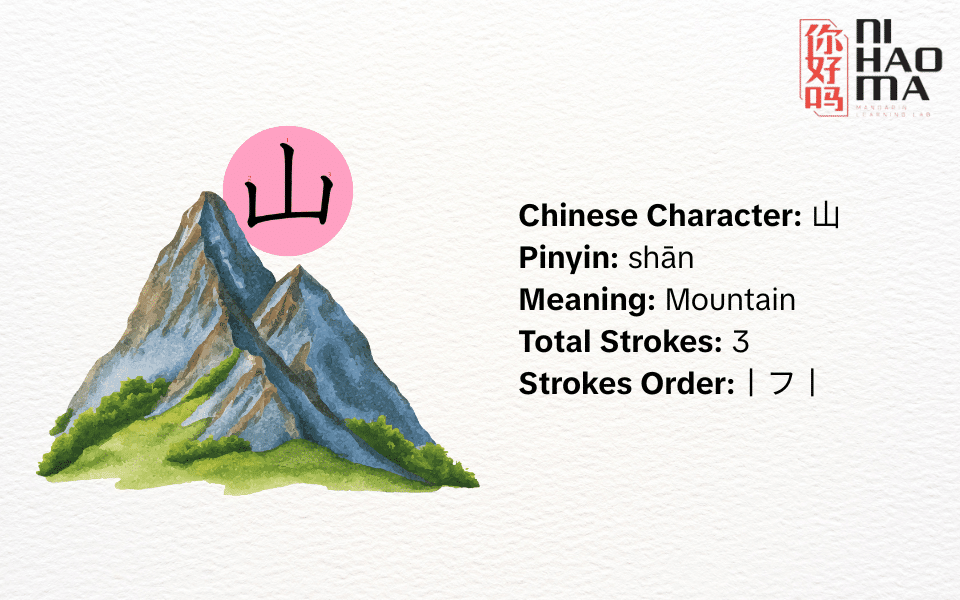
Historically, 山 originated as a pictograph in oracle bone script. Its earliest form visually resembled three mountain peaks, clearly representing the uneven contours of mountain ranges. Although the character has been simplified over time, it still preserves the distinctive three-peak structure.
In East Asian culture, mountains symbolize strength, stability, endurance, and permanence. As a result, many Chinese characters that include radical 46 convey ideas associated with height, firmness, grandeur, or natural landscapes such as cliffs, valleys, and ridges.
How to Write Radical 46 (山)
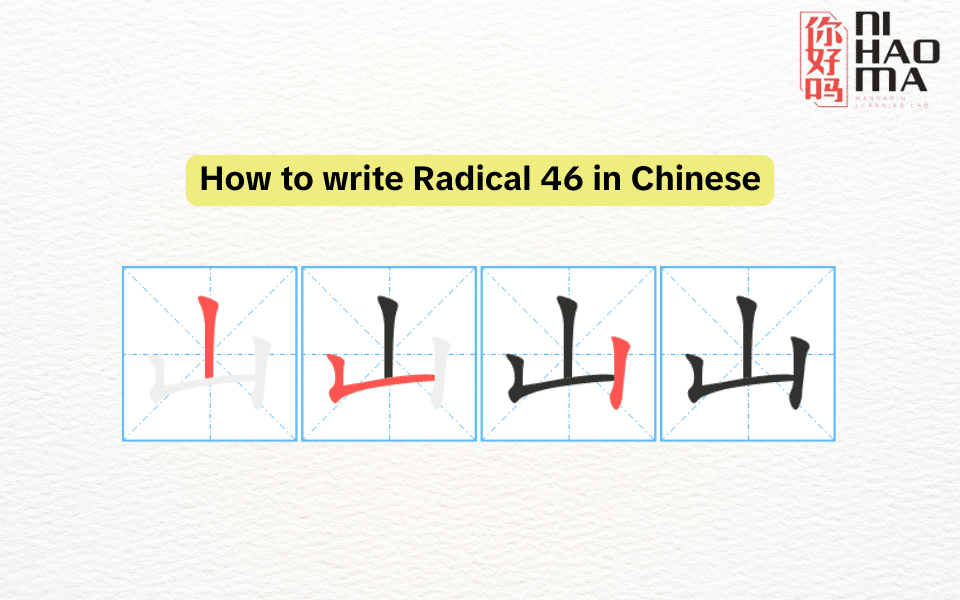
Radical 46 consists of 3 strokes. The correct stroke order is as follows:
| Stroke Order | Stroke Name | Description |
|---|---|---|
| 1 | 丨 (Vertical stroke) | Write the vertical line in the center from top to bottom. |
| 2 | フ (Turning stroke) | Start from the upper left, move downward, then turn slightly to the right to form the base. |
| 3 | 丨 (Short vertical stroke) | Write a shorter vertical line on the right side, ending at the base of the second stroke. |
Common Vocabulary Containing Radical 46
Radical 46 does not only mean “mountain” in a literal sense. It also evokes ideas of elevation, steepness, ruggedness, and grandeur. Learning vocabulary grouped by radical can help students build connections between form and meaning.
Below are common Chinese words containing radical 46:
| Chinese | Pinyin | Meaning |
|---|---|---|
| 山 | shān | Mountain |
| 岩 | yán | Cliff |
| 岛 | dǎo | Island |
| 峰 | fēng | Peak |
| 岭 | lǐng | Mountain range |
| 岗 | gǎng | Hill |
| 峡 | xiá | Gorge |
| 岸 | àn | Shore, bank |
| 崖 | yá | Cliff |
| 峻 | jùn | Steep |
| 崎岖 | qí qū | Rugged |
| 崇拜 | chóng bài | Worship |
| 对峙 | duì zhì | Confront |
| 峰会 | fēng huì | Summit (conference) |
| 岩石 | yán shí | Rock |
| 岛屿 | dǎo yǔ | Archipelago |
| 巍峨 | wēi é | Magnificent, towering |
| 山脉 | shān mài | Mountain range |
| 山谷 | shān gǔ | Valley |
| 山洞 | shān dòng | Cave |
| 山顶 | shān dǐng | Mountain top |
| 山羊 | shān yáng | Mountain goat |
| 山茶 | shān chá | Camellia |
| 巅峰 | diān fēng | Peak (figurative) |
| 崩塌 | bēng tā | Collapse |
Sample Dialogues Using Vocabulary with Radical 46
When studying characters that contain radical 46, many learners focus only on memorizing meanings. However, applying them in real communication is equally important. The following short dialogues help reinforce vocabulary while improving speaking and listening skills.
Dialogue 1
A: 这个周末我们去爬山吧!
(Zhège zhōumò wǒmen qù páshān ba!)
Let’s go hiking this weekend!
B: 好啊!你想去哪座山?
(Hǎo a! Nǐ xiǎng qù nǎ zuò shān?)
Sure! Which mountain do you want to go to?
A: 我想去黄山,听说风景特别美。
(Wǒ xiǎng qù Huángshān, tīng shuō fēngjǐng tèbié měi.)
I want to visit Huangshan. I heard the scenery is beautiful.
B: 对,那里的山顶可以看到日出。
(Duì, nàlǐ de shāndǐng kěyǐ kàndào rìchū.)
Yes, you can see the sunrise from the mountaintop there.
Dialogue 2
A: 你的家乡在哪里?
(Nǐ de jiāxiāng zài nǎlǐ?)
Where is your hometown?
B: 我的家乡在一个山区,四面都是大山。
(Wǒ de jiāxiāng zài yí gè shānqū, sìmiàn dōu shì dà shān.)
My hometown is in a mountainous area, surrounded by mountains.
A: 那里的环境怎么样?
(Nàlǐ de huánjìng zěnmeyàng?)
What is the environment like?
B: 空气很新鲜,还有很多山林和小溪。
(Kōngqì hěn xīnxiān, hái yǒu hěn duō shānlín hé xiǎoxī.)
The air is fresh, and there are many forests and small streams.
Dialogue 3
A: 你觉得中国的地形有什么特点?
(Nǐ juéde Zhōngguó de dìxíng yǒu shénme tèdiǎn?)
What do you think are the characteristics of China’s terrain?
B: 中国有很多高山,比如泰山和华山。
(Zhōngguó yǒu hěn duō gāoshān, bǐrú Tài Shān hé Huà Shān.)
China has many high mountains, such as Mount Tai and Mount Hua.
A: 我听说泰山在中国文化中很重要。
(Wǒ tīng shuō Tài Shān zài Zhōngguó wénhuà zhōng hěn zhòngyào.)
I’ve heard Mount Tai is very important in Chinese culture.
B: 是的,自古以来人们就常去那里登山祈福。
(Shì de, zìgǔ yǐlái rénmen jiù cháng qù nàlǐ dēngshān qífú.)
Yes, since ancient times, people have climbed it to pray for blessings.
Conclusion
Radical 46 in Chinese is a fundamental component within the traditional system of 214 Kangxi radicals. It carries rich symbolic meaning related to mountains, terrain, and stability in East Asian culture. This article by Ni Hao Ma has introduced its stroke order, core meaning, and common vocabulary containing Radical 46. We hope this guide has provided you with useful insights, and be sure to stay tuned for upcoming lessons on other Chinese radicals.