In the Chinese writing system, each radical carries its own meaning and plays an important role in the structure and memorization of characters. Among them, radical 5 is a distinctive component that appears in several familiar Chinese characters.
In this article, we will explore what radical 5 is in Chinese, its meaning, the correct stroke order, and some common characters and vocabulary that contain this radical to help improve your Chinese character learning.
What Is Radical 5 in Chinese?
Radical 5 (乙 – yǐ) is the fifth radical in the Kangxi system of 214 Chinese radicals. This radical consists of a single curved stroke and often symbolizes a bending or flexible movement.
Although it is formed by only one stroke, radical 5 visually resembles a young sprout emerging from the ground. The curved shape does not represent weakness; instead, it symbolizes vitality and resilience, as a seedling pushes through layers of soil and obstacles to reach the light.
In the system of the Ten Heavenly Stems, 乙 (yǐ) holds the second position, following 甲 (jiǎ). While 甲 represents the moment when a seed begins to germinate, radical 5 represents the next stage, when the sprout has already emerged and, though still soft, possesses a strong ability to adapt and grow.
How to Write Radical 5 in Chinese
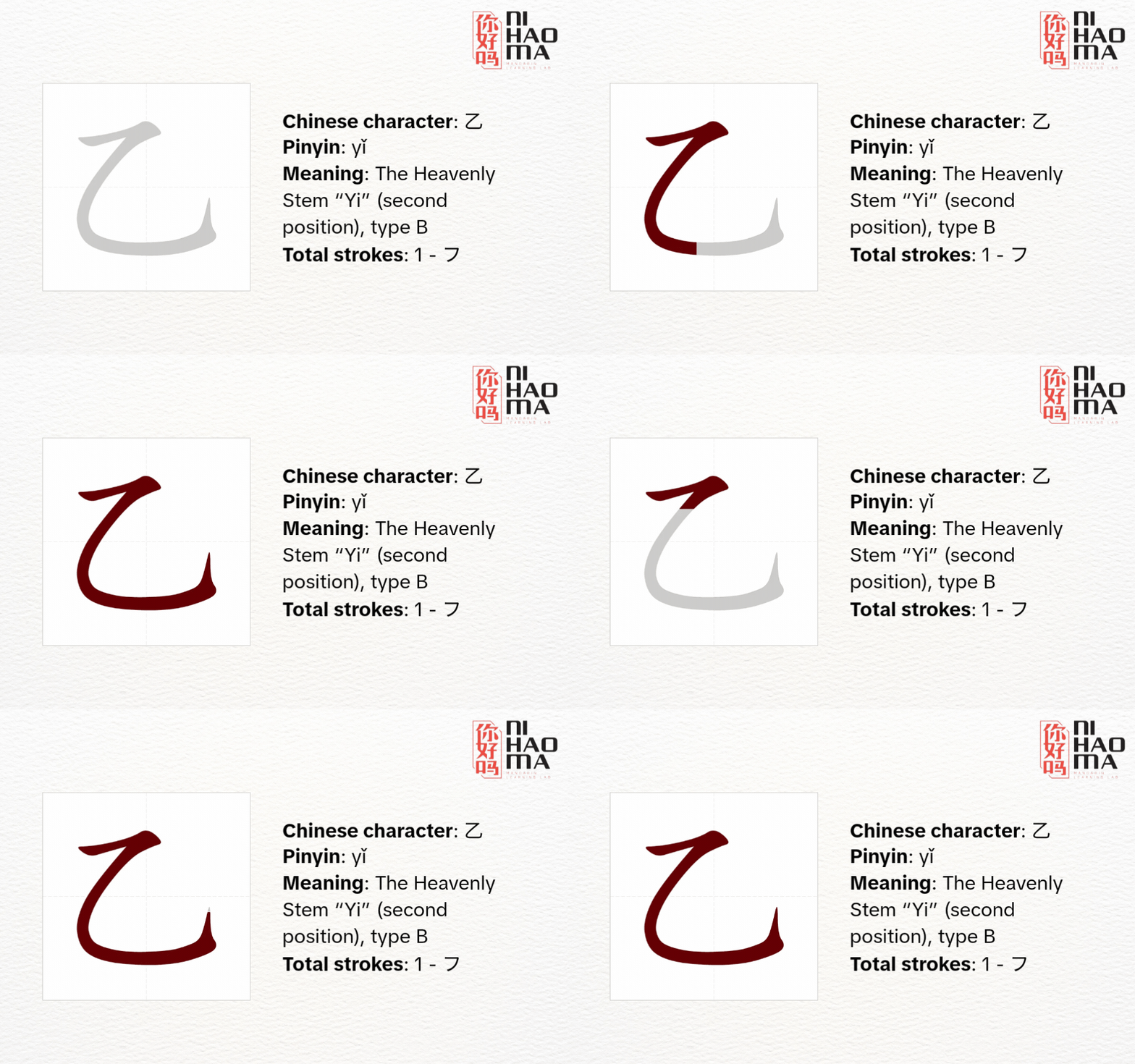
Radical 5 (乙) is considered one of the simplest Chinese radicals because it consists of only one stroke. However, writing it correctly still requires attention to the direction and curvature of the stroke.
You can imagine the stroke of radical 5 as a soft curved hook or a gently flowing stream. The stroke should be written continuously in a single movement, without breaking it into separate parts.
Start with a short horizontal movement from left to right, then curve slightly downward and to the left before finishing with a small upward hook to the right. Maintaining a smooth and natural curve is the key to writing this radical correctly.
Vocabulary Containing Radical 5 in Chinese
When learning Chinese characters, understanding the radicals that make up a character can make vocabulary much easier to remember. Radical 5, despite its simple structure, appears in many commonly used characters.
Learning vocabulary that contains radical 5 not only helps you recognize characters more quickly, but also allows you to expand your vocabulary systematically. Below are some common Chinese characters and words that include radical 5.
| Chinese | Pinyin | Meaning |
|---|---|---|
| 也 | yě | also |
| 习 | xí | practice, learn |
| 买 | mǎi | buy |
| 书 | shū | book |
| 乡 | xiāng | hometown |
| 乱 | luàn | messy, chaotic |
| 乞 | qǐ | beg |
| 乳 | rǔ | milk |
| 乙 | yǐ | the second Heavenly Stem |
| 亿 | yì | one hundred million |
Common words:
| Word | Pinyin | Meaning |
|---|---|---|
| 习惯 | xí guàn | habit |
| 学习 | xué xí | study |
| 练习 | liàn xí | practice |
| 自习 | zì xí | self-study |
| 习题 | xí tí | exercise (practice questions) |
| 买东西 | mǎi dōngxi | buy things |
| 买菜 | mǎi cài | buy vegetables |
| 买单 | mǎi dān | pay the bill |
| 买票 | mǎi piào | buy tickets |
| 书店 | shū diàn | bookstore |
| 书包 | shū bāo | schoolbag |
| 看书 | kàn shū | read books |
| 书架 | shū jià | bookshelf |
| 乡下 | xiāng xià | countryside |
| 乡村 | xiāng cūn | rural area |
| 家乡 | jiā xiāng | hometown |
| 乡亲 | xiāng qīn | fellow villagers |
| 乱说 | luàn shuō | talk nonsense |
| 乱跑 | luàn pǎo | run around |
| 乱想 | luàn xiǎng | think randomly |
| 不乱 | bù luàn | not messy |
| 乙方 | yǐ fāng | Party B (in a contract) |
| 乙级 | yǐ jí | Grade B |
| 乾坤 | qiánkūn | the universe |
| 回忆 | huí yì | recollection |
| 记忆 | jì yì | memory |
| 艺术 | yì shù | art |
| 艺人 | yì rén | artist, performer |
| 也许 | yě xǔ | perhaps |
Sample Conversations Using Radical 5 Vocabulary
When learning Chinese characters, vocabulary becomes easier to remember when it is placed in real communication contexts. Many words containing radical 5 (乙) frequently appear in everyday conversations.
The short dialogues below will help you understand how these words are used while also improving your natural Chinese speaking skills.
Conversation 1
A: 你每天都学习汉语吗?
(Nǐ měitiān dōu xuéxí Hànyǔ ma?)
Do you study Chinese every day?
B: 是的,我每天也练习写汉字。
(Shì de, wǒ měitiān yě liànxí xiě Hànzì.)
Yes, I also practice writing Chinese characters every day.
A: 学习的时候会不会觉得很乱?
(Xuéxí de shíhou huì bú huì juéde hěn luàn?)
Do you feel confused when studying?
B: 有一点,不过多练习就好了。
(Yǒu yìdiǎn, búguò duō liànxí jiù hǎo le.)
A little, but it gets better with more practice.
A: 对,坚持学习很重要。
(Duì, jiānchí xuéxí hěn zhòngyào.)
Yes, consistency is very important.
Conversation 2
A: 你还记得小时候的事情吗?
(Nǐ hái jìde xiǎoshíhou de shìqing ma?)
Do you remember things from your childhood?
B: 当然记得,那些回忆很美好。
(Dāngrán jìde, nàxiē huíyì hěn měihǎo.)
Of course. Those memories are wonderful.
A: 我也常常回忆以前的生活。
(Wǒ yě chángcháng huíyì yǐqián de shēnghuó.)
I also often recall my past life.
B: 有时候想起来,感觉时间过得很快。
(Yǒushíhou xiǎng qǐlái, gǎnjué shíjiān guò de hěn kuài.)
Sometimes when I think about it, time feels like it passed very quickly.
A: 是啊,那些都是珍贵的记忆。
(Shì a, nàxiē dōu shì zhēnguì de jìyì.)
Yes, those are precious memories.
Conversation 3
A: 你喜欢艺术吗?
(Nǐ xǐhuān yìshù ma?)
Do you like art?
B: 喜欢,我觉得艺术很有意思。
(Xǐhuān, wǒ juéde yìshù hěn yǒu yìsi.)
Yes, I think art is very interesting.
A: 你会画画吗?
(Nǐ huì huàhuà ma?)
Can you draw?
B: 也许画得不太好,不过我很喜欢。
(Yěxǔ huà de bú tài hǎo, búguò wǒ hěn xǐhuān.)
Maybe I’m not very good at it, but I really enjoy it.
A: 没关系,艺术最重要的是表达自己。
(Méi guānxi, yìshù zuì zhòngyào de shì biǎodá zìjǐ.)
That’s okay. The most important thing about art is expressing yourself.
Conclusion
Although radical 5 has a very simple structure, it appears in many common Chinese characters and plays an important role in forming vocabulary. Understanding its meaning, structure, and usage can help learners recognize characters faster and build vocabulary more effectively.
Hopefully, through this article from Ni Hao Ma, you now have a clearer understanding of radical 5 in Chinese, allowing you to improve your ability to read, write, and use Chinese characters in both study and everyday communication.