Radical 53 is one of the more commonly used Chinese radicals and is closely associated with characters related to houses, roofs, and human living spaces. In this article, we’ll explore the meaning of radical 53, how to write it correctly, and common vocabulary that contains this radical—so you can learn Chinese characters in a more structured and effective way.
What is Radical 53 in Chinese?
Radical 53 in Chinese is written as 广 (guǎng/yǎn). It is the 53rd radical out of the 214 Kangxi radicals, and its original meaning refers to a wide shelter, a large house, or a building with an open structure.
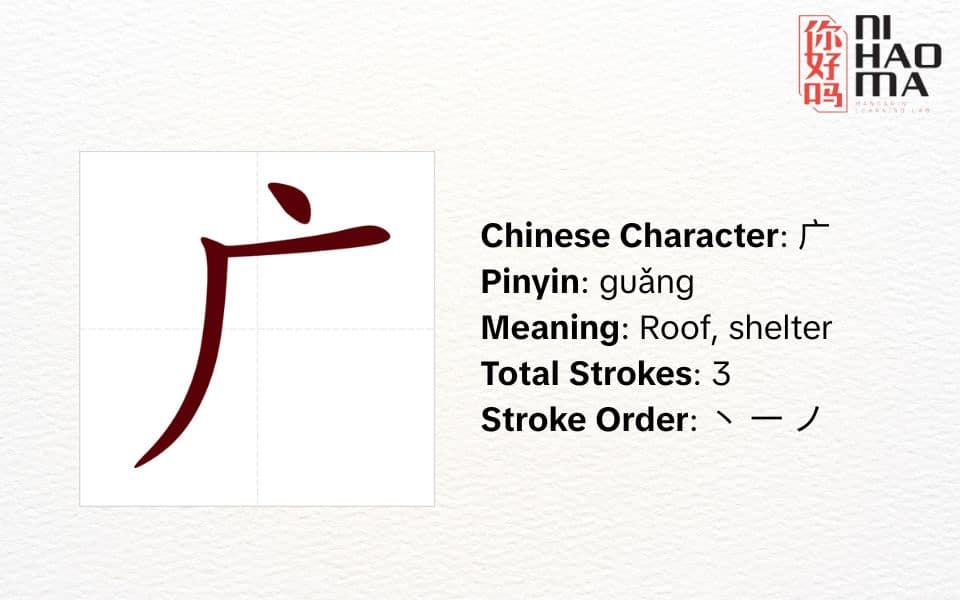
In ancient Chinese script, the shape of 广 resembles a slanted roof with a spacious area underneath. It was often used to describe large buildings, public structures, or socially functional architecture. As a result, characters containing radical 53 are frequently related to buildings, shops, institutions, or public places, such as 店 (diàn – shop), 座 (zuò – building, seat), and 府 (fǔ – government office or residence).
How to Write Radical 53 in Chinese
Radical 53 (广) is made up of three strokes, written in the following order:
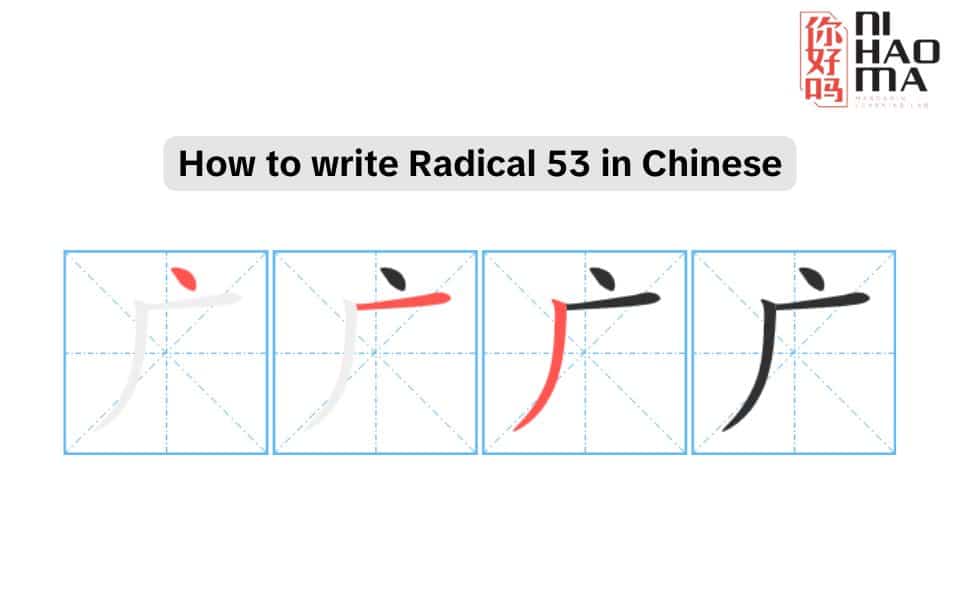
| Stroke Order | Stroke Name | How to Write |
|---|---|---|
| 1 | 丶 (Dot) | Write a small dot from top to bottom |
| 2 | 一 (Horizontal) | Draw a horizontal line from left to right beneath the dot |
| 3 | ノ (Left-falling) | From the left end of the horizontal line, write a left-falling stroke |
The Difference Between Radical 53 and Radical 40
Both radical 53 (广) and the roof radical 宀 (mián) are related to houses and living spaces in Chinese characters, but they differ clearly in meaning and visual symbolism.
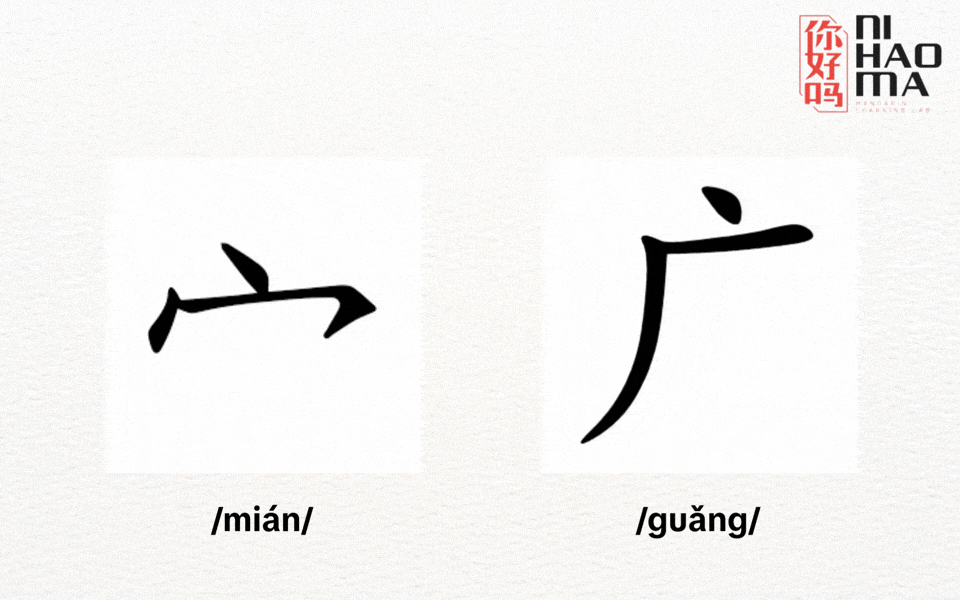
The roof radical 宀 represents a fully enclosed roof with walls on both sides, symbolizing private space, family life, and protection. In contrast, radical 53 depicts an open-sided roof or veranda leaning against a mountainside, symbolizing wide, open, or public spaces. Visually, 宀 has two “legs” enclosing the space below, while 广 has only one “leg” on the left, giving it a more open and spacious feel.
Because of this difference, 宀 often appears in characters related to home and safety, such as 家 (jiā – home) and 安 (ān – peace, safety). Meanwhile, radical 53 is commonly found in characters describing large buildings or functional spaces, such as 店 (shop), 库 (warehouse), and 府 (official residence).
Vocabulary with Radical 53 in Chinese
According to major Chinese dictionaries, radical 53 (广) is among the radicals with a high frequency in commonly used vocabulary, especially at beginner to intermediate levels. In the next section, we’ll explore popular words that contain radical 53, along with tips on how to recognize them and learn them effectively — so you can apply them naturally in everyday communication.
| Chinese Character | Pinyin | Meaning |
|---|---|---|
| 广 | guǎng | Wide, broad |
| 店 | diàn | Shop, store |
| 府 | fǔ | Government office, residence |
| 座 | zuò | Building; seat |
| 床 | chuáng | Bed |
| 庭 | tíng | Courtyard; hall |
| 庙 | miào | Temple, shrine |
| 库 | kù | Warehouse |
| 序 | xù | Order; preface |
| 庄 | zhuāng | Village; manor |
| 底 | dǐ | Bottom; base |
| 应 | yīng | Should; respond |
| 度 | dù | Degree; extent |
| 废 | fèi | Abandon; waste |
| 康 | kāng | Healthy |
| 庸 | yōng | Ordinary; mediocre |
| 廉 | lián | Honest; incorrupt |
| 廊 | láng | Corridor |
| 庞 | páng | Huge; enormous |
| 广场 | guǎngchǎng | Public square |
| 广告 | guǎnggào | Advertisement |
| 广播 | guǎngbō | Broadcasting |
| 广泛 | guǎngfàn | Extensive; widespread |
| 广阔 | guǎngkuò | Vast; broad |
| 广州 | Guǎngzhōu | Guangzhou |
| 起床 | qǐ chuáng | Get up (from bed) |
| 仓库 | cāngkù | Warehouse |
| 庭院 | tíngyuàn | Courtyard; garden |
| 库存 | kùcún | Inventory |
| 序号 | xùhào | Serial number |
| 庄园 | zhuāngyuán | Manor; estate |
| 厨房 | chúfáng | Kitchen |
| 应用 | yìngyòng | Application; apply |
| 度假 | dùjià | Go on vacation |
| 国庆 | guóqìng | National Day |
| 康复 | kāngfù | Recovery |
| 平庸 | píngyōng | Mediocre |
| 座位 | zuòwèi | Seat |
| 走廊 | zǒuláng | Hallway |
| 商店 | shāngdiàn | Shop; store |
| 饭店 | fàndiàn | Restaurant; hotel |
| 政府 | zhèngfǔ | Government |
| 废物 | fèiwù | Waste; trash |
| 态度 | tàidù | Attitude |
| 家庭 | jiātíng | Family |
| 制度 | zhìdù | System; institution |
| 程度 | chéngdù | Level; degree |
| 廉洁 | liánjié | Honest; clean |
| 反应 | fǎnyìng | Reaction |
Sample Dialogues Using Vocabulary with Radical 53
When vocabulary is placed in real communication contexts, learners not only understand the meaning more clearly but also learn how to use the words naturally in daily life. Below are sample dialogues featuring words with radical 53, built around familiar situations such as asking for directions, talking about work, and describing living spaces. These dialogues are suitable for beginner to intermediate learners and are easy to apply in real conversations.
Dialogue 1
A: 这个广场真大,你是第一次来吗?
Zhège guǎngchǎng zhēn dà, nǐ shì dì yī cì lái ma?
(This square is really big. Is this your first time here?)
B: 对,我想找那座商场。
Duì, wǒ xiǎng zhǎo nà zuò shāngchǎng.
(Yes, I’m looking for that shopping mall.)
A: 商场旁边有很多店,很好逛。
Shāngchǎng pángbiān yǒu hěn duō diàn, hěn hǎo guàng.
(There are many shops next to the mall—it’s great for shopping.)
B: 太好了,谢谢你!
Tài hǎo le, xièxie nǐ!
(That’s great, thank you!)

Dialogue 2
A: 你们公司最近在做什么项目?
Nǐmen gōngsī zuìjìn zài zuò shénme xiàngmù?
(What project is your company working on recently?)
B: 我们在做一个新的广告方案。
Wǒmen zài zuò yí gè xīn de guǎnggào fāng’àn.
(We’re working on a new advertising plan.)
A: 这个方案的影响大吗?
Zhège fāng’àn de yǐngxiǎng dà ma?
(Does this plan have a big impact?)
B: 很广泛,而且可以应用在很多平台。
Hěn guǎngfàn, érqiě kěyǐ yìngyòng zài hěn duō píngtái.
(It’s very wide-reaching and can be applied across many platforms.)
A: 听起来不错!
Tīng qǐlái búcuò!
(Sounds great!)

Dialogue 3
A: 你现在住在哪里?
Nǐ xiànzài zhù zài nǎlǐ?
(Where do you live now?)
B: 我住在一套有庭院的房子里。
Wǒ zhù zài yí tào yǒu tíngyuàn de fángzi lǐ.
(I live in a house with a courtyard.)
A: 听起来很舒服,房大吗?
Tīng qǐlái hěn shūfu, fáng dà ma?
(That sounds comfortable. Is the house big?)
B: 不算大,但床很舒服。
Bú suàn dà, dàn chuáng hěn shūfu.
(It’s not very big, but the bed is very comfortable.)
A: 那就够了。
Nà jiù gòu le.
(That’s good enough then.)
Conclusion
Radical 53 (广) is a Chinese radical with clear cultural and semantic meaning, closely connected to buildings, structures, and wide or public spaces. By understanding its meaning, practicing correct stroke order, and applying vocabulary through real-life dialogues, learners can steadily improve their reading, writing, and communication skills in Chinese.
We hope Ni Hao Ma has provided you useful knowlegde and don’t forget to look forward to exploring more Chinese radicals in our upcoming lessons!