
Radical 77 in Chinese (止) is one of the basic radicals and appears quite frequently in everyday Chinese characters. Understanding radical 77 helps learners grasp word meanings more easily, improves long-term memory, and supports writing characters correctly and systematically. This article introduces what radical 77 is, its meaning and origin, how to write it properly, and common information learners should know when encountering this radical.
What is Radical 77 in Chinese?
Radical 77 (止) is the 77th radical in the traditional Kangxi system of 214 Chinese radicals. Historically, 止 originated as a pictographic character representing a human foot, symbolizing the act of walking.
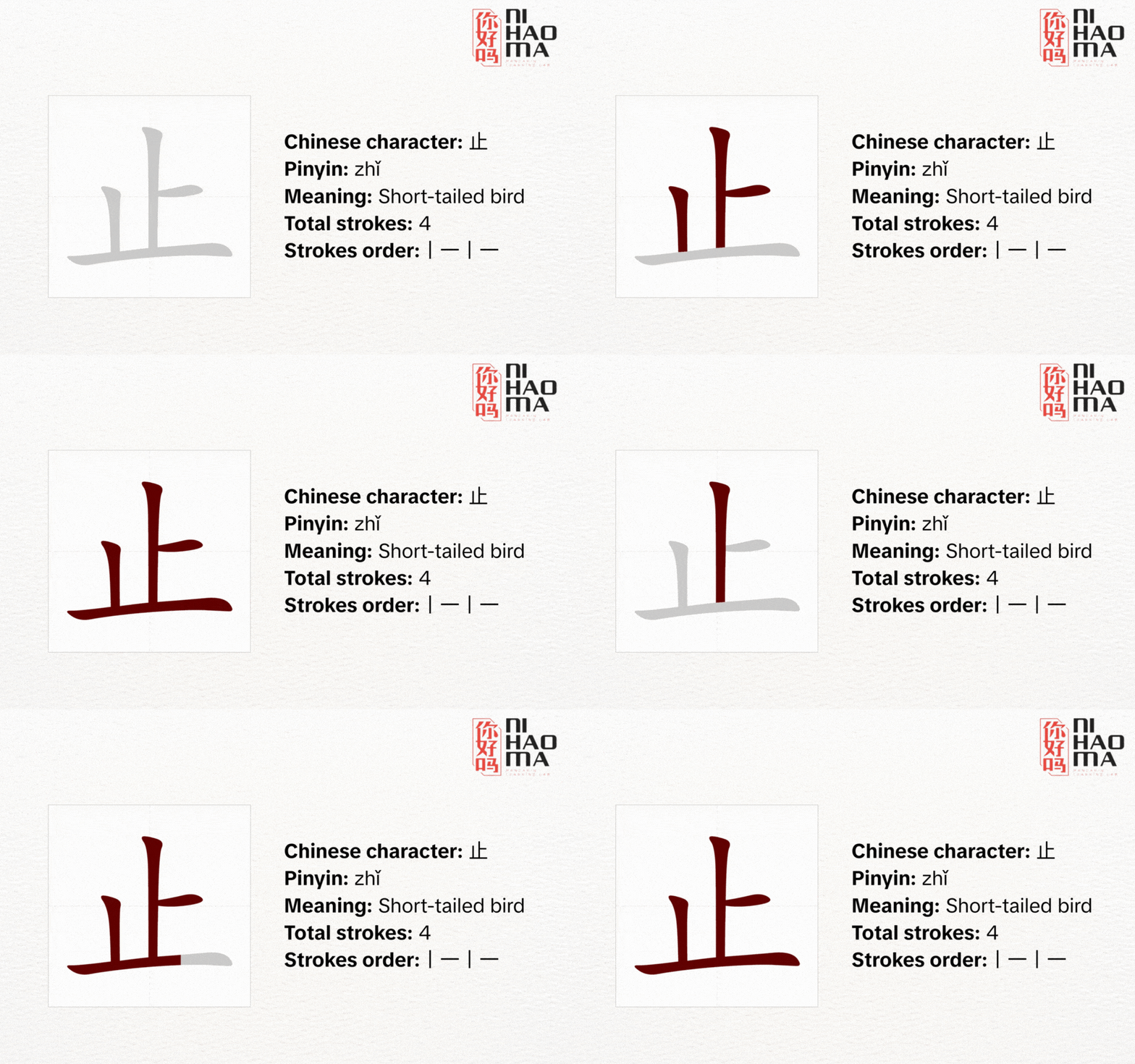
In terms of meaning, radical 77 often serves as a semantic indicator in characters related to stopping, fixed positions, direction, or human movement. When it appears in a character, it helps learners associate the word with ideas such as “standing still,” “controlled movement,” or “prevention,” which in turn makes it easier to infer the overall meaning of unfamiliar characters.
- Chinese character: 止
- Pinyin: zhǐ
- Meaning: to stop, to pause, to cease
- Total strokes: 4
- Stroke order: 丨一丨一
The Origin of Radical 77 in Chinese
In the earliest form of Chinese writing, known as oracle bone script (used more than 3,000 years ago), the shape of 止 closely resembled a human foot placed on the ground. When people walk, the most visible and distinctive part of the movement is the foot. For this reason, ancient people used this image to represent the act of moving or walking. In its original sense, what we now call radical 77 simply meant a footstep or to walk.
Over time, the meaning of this character evolved in a very natural and logical way. When a person stops walking, the foot no longer moves forward and remains still. From this idea, the meaning of 止 gradually shifted from “walking” to “stopping” or “ceasing.” This is similar to how we understand the word “stop” today—quite literally, it means not taking another step. Although the meaning changed, the visual form of the foot was preserved in the character, maintaining a clear link to its original imagery.
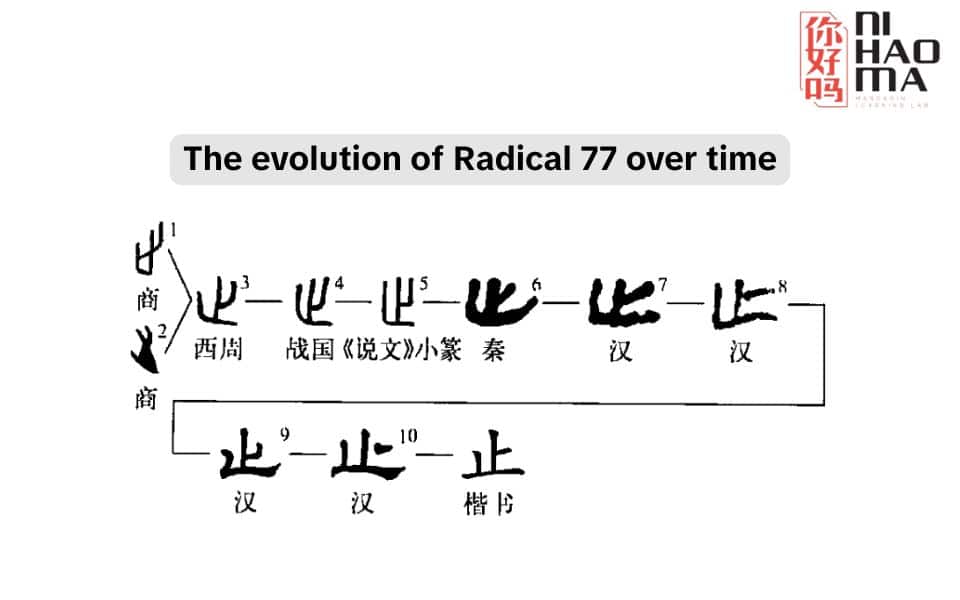
As radical 77 became a formal radical used in character formation, it continued to appear in many Chinese characters related to stopping, control, movement, direction, and correctness. For example, 步 means “step” or “to walk,” clearly reflecting the foot origin; 停止 means “to stop”; 禁止 means “to prohibit”; and 正, meaning “correct,” is often interpreted as “moving in the right direction.” Because of these consistent semantic connections, radical 77 helps learners infer the general meaning of unfamiliar characters, even when encountering them for the first time.
How to Write Radical 77 in Chinese
Radical 77 consists of four strokes, written in the following order:
| Stroke order | Stroke name | Writing description |
|---|---|---|
| 1 | Vertical stroke (丨) | Write a straight vertical line from top to bottom, slightly tapering at the end. Keep the stroke firm and balanced. |
| 2 | Horizontal stroke (一) | Draw a horizontal line from left to right, starting from the upper part of the first vertical stroke, with moderate length. |
| 3 | Vertical stroke (丨) | Write the second vertical stroke parallel to the first one, starting below the horizontal stroke and extending straight downward. |
| 4 | Horizontal stroke (一) | Finish with a horizontal stroke at the bottom, longer than the second stroke to create visual stability. |
Vocabulary Related to Radical 77 in Chinese
Radical 77 in Chinese (止) is an important radical that appears in a large number of commonly used characters and words. It is closely associated with ideas such as stopping, walking, position, direction, and correctness. Ranked as radical number 77 in the Kangxi radical system, it serves as a building component for hundreds of Chinese characters, highlighting both its high frequency and strong practical value in real-life language use.
Below are some of the most common vocabulary items containing radical 77, ranging from single characters to compound words:
| Chinese | Pinyin | Meaning |
|---|---|---|
| 止 | zhǐ | To stop, to block |
| 正 | zhèng | Correct, straight, accurate |
| 此 | cǐ | This, here |
| 步 | bù | Step, pace |
| 武 | wǔ | Martial arts, military |
| 歪 | wāi | Crooked, slanted (不 + 正) |
| 歧 | qí | Fork in the road, divergence |
| 趾 | zhǐ | Toe |
| 涩 | sè | Astringent, rough, not smooth |
| 肯 | kěn | To agree, to be willing |
| 企 | qǐ | To stand on tiptoe, to look forward to |
| 历 | lì | To experience; history |
| 归 | guī | To return |
| 延 | yán | To extend, to prolong |
| 走 | zǒu | To walk, to run |
| 停止 | tíngzhǐ | To stop, to cease |
| 正确 | zhèngquè | Correct, accurate |
| 此时 | cǐshí | At this moment, now |
| 跑步 | pǎobù | To run, jogging |
| 武器 | wǔqì | Weapon |
| 阻止 | zǔzhǐ | To prevent, to stop |
| 正常 | zhèngcháng | Normal |
| 因此 | yīncǐ | Therefore, thus |
| 进步 | jìnbù | Progress, improvement |
| 武术 | wǔshù | Martial arts |
| 禁止 | jìnzhǐ | To prohibit |
| 正在 | zhèngzài | In the process of (doing something) |
| 彼此 | bǐcǐ | Each other |
| 脚步 | jiǎobù | Footsteps |
| 威武 | wēiwǔ | Mighty, imposing |
| 截止 | jiézhǐ | Deadline |
| 正直 | zhèngzhí | Upright, honest |
| 到此 | dàocǐ | Up to this point; here |
| 散步 | sànbù | To take a walk |
| 动武 | dòngwǔ | To use force |
| 制止 | zhìzhǐ | To restrain, to put a stop to |
| 正好 | zhènghǎo | Just right, coincidentally |
| 特此 | tècǐ | Hereby (formal notice) |
| 步伐 | bùfá | Pace, stride |
| 文武 | wénwǔ | Civil and military |
| 休止 | xiūzhǐ | To pause, to suspend |
| 正式 | zhèngshì | Official, formal |
| 此外 | cǐwài | In addition, besides |
| 退步 | tuìbù | To regress |
| 比武 | bǐwǔ | Martial arts competition |
| 举止 | jǔzhǐ | Manner, behavior |
| 正月 | zhēngyuè | The first lunar month |
| 从此 | cóngcǐ | From then on |
| 跨步 | kuàbù | To stride |
| 止步 | zhǐbù | To stop walking; to halt |
Sample Dialogues Using Vocabulary with Radical 77 in Chinese
To clearly understand how radical 77 is used in real-life situations, it is essential to see it applied in practical communication contexts. Below are several sample dialogues featuring vocabulary that contains radical 77, which you can use for reference and practice.
Dialogue 1
A: 老师,现在可以停止讨论吗?
Lǎoshī, xiànzài kěyǐ tíngzhǐ tǎolùn ma?
(Teacher, may we stop the discussion now?)
B: 不行,大家正在讨论重要的问题。
Bù xíng, dàjiā zhèngzài tǎolùn zhòngyào de wèntí.
(No, everyone is discussing an important issue.)
A: 可是有些同学说话太吵了。
Kěshì yǒuxiē tóngxué shuōhuà tài chǎo le.
(But some students are being too noisy.)
B: 我会制止他们,请你再等一下。
Wǒ huì zhìzhǐ tāmen, qǐng nǐ zài děng yíxià.
(I will stop them. Please wait a moment.)
A: 好的,谢谢老师。
Hǎo de, xièxie lǎoshī.
(Okay, thank you, teacher.)
Dialogue 2
A: 为什么大家都停下来了?
Wèishénme dàjiā dōu tíng xiàlái le?
(Why has everyone stopped?)
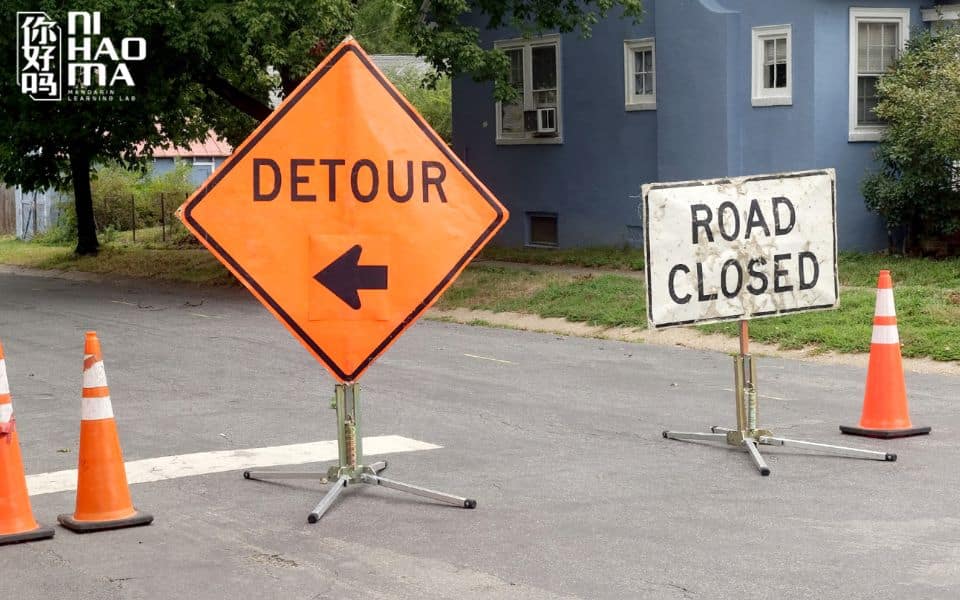
B: 你没看到吗?这里禁止进入。
Nǐ méi kàn dào ma? Zhèlǐ jìnzhǐ jìnrù.
(Didn’t you see it? Entry is prohibited here.)
A: 原来如此,那我们只能止步于此了。
Yuánlái rúcǐ, nà wǒmen zhǐnéng zhǐbù yú cǐ le.
(I see. Then we can only stop here.)
B: 是的,此地正在施工。
Shì de, cǐdì zhèngzài shīgōng.
(Yes, this area is under construction.)
A: 那我们换一条路走吧。
Nà wǒmen huàn yì tiáo lù zǒu ba.
(Then let’s take another route.)
Dialogue 3
A: 你怎么受伤了?
Nǐ zěnme shòushāng le?
(How did you get injured?)
B: 不小心割到手了,一直在流血。
Bù xiǎoxīn gē dào shǒu le, yìzhí zài liúxuè.
(I accidentally cut my hand, and it keeps bleeding.)
A: 我先帮你止血,再给你吃点止痛药。
Wǒ xiān bāng nǐ zhǐxuè, zài gěi nǐ chī diǎn zhǐtòng yào.
(I’ll help stop the bleeding first, then give you some painkillers.)
B: 这样可以防止感染吗?
Zhèyàng kěyǐ fángzhǐ gǎnrǎn ma?
(Will this help prevent infection?)
A: 可以,但最好还是去医院看看。
Kěyǐ, dàn zuì hǎo háishi qù yīyuàn kànkan.
(Yes, but it’s best to go to the hospital.)
Summary
From its pictographic origins to its modern meanings, radical 77 clearly demonstrates the logical structure behind Chinese character formation. Through real-life vocabulary and dialogues, learners can see how this radical connects ideas of stopping, movement, control, and correctness in everyday language. We hope this article from Ni Hao Ma has given you a clear and accessible understanding of radical 77. To explore more Chinese radicals and deepen your learning, be sure to follow and look forward to our upcoming lessons.