
Mastering Chinese radicals is one of the most effective ways to accelerate character recognition and deepen your understanding of vocabulary. So, what exactly is radical 87, what does it mean, and how is it written? In this guide, you’ll explore the meaning of radical 87 in Chinese, learn its correct stroke order, and discover common vocabulary that contains this component – helping you read, write, and use Chinese characters more confidently.
What Is Radical 87 in Chinese?
Radical 87 (爪, zhǎo) is one of the 214 traditional Chinese radicals. It commonly appears in characters related to claws, hands, or grasping actions.
In terms of meaning, radical 87 conveys actions such as grabbing, holding, catching, or manipulating with the hand. Because it is highly pictographic, learners can easily associate it with real-life hand movements, making it easier to remember characters that include this radical.
Interestingly, radical 87 also appears in more abstract characters such as 爱 (ài – love). In this case, the top component 爫 no longer directly means “claw,” but instead contributes to a symbolic idea of holding or cherishing something emotionally. This reflects how Chinese characters often evolve from concrete actions (physical hand movements) to abstract meanings (emotions and states).
How to Write Radical 87 in Chinese
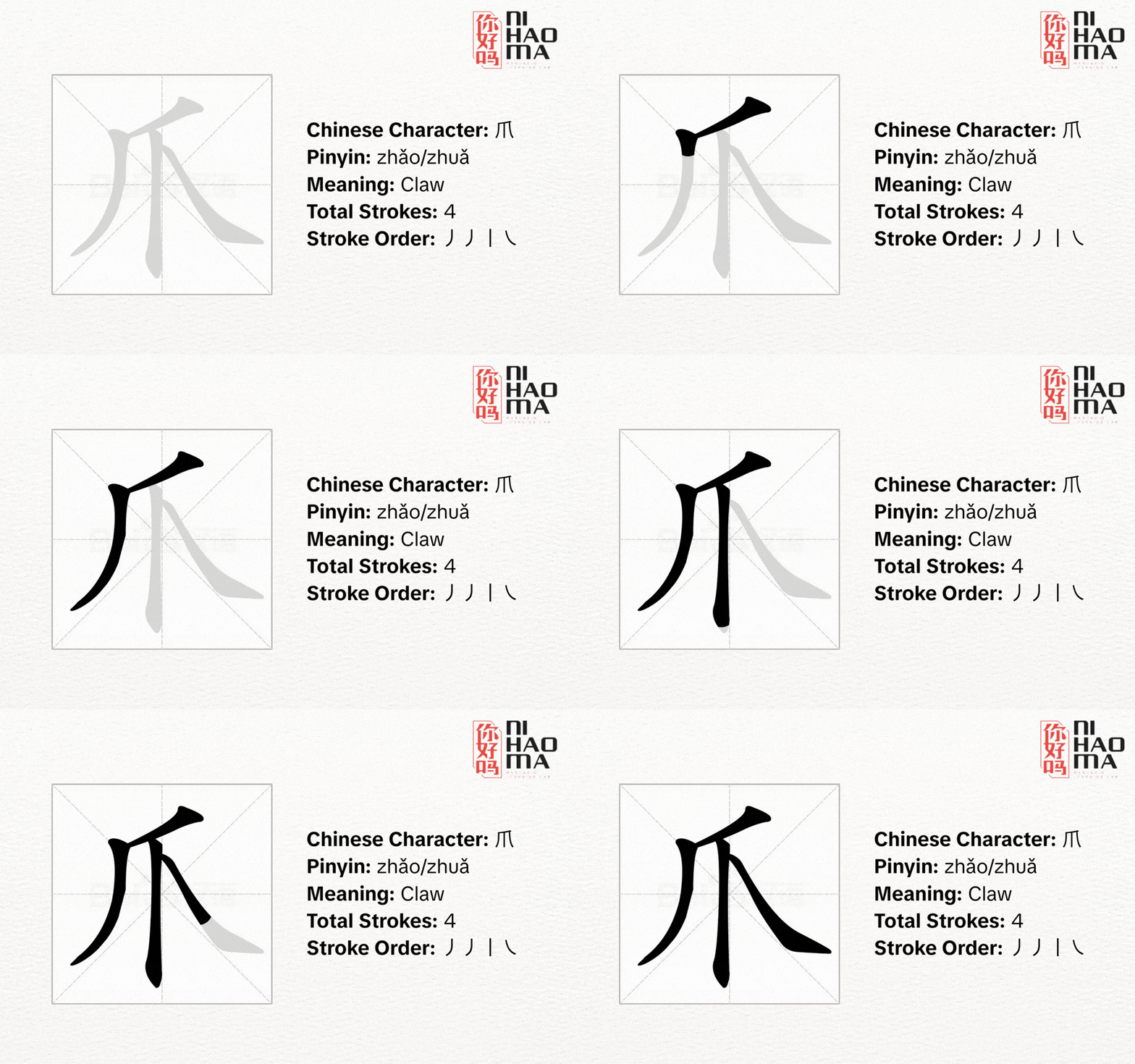
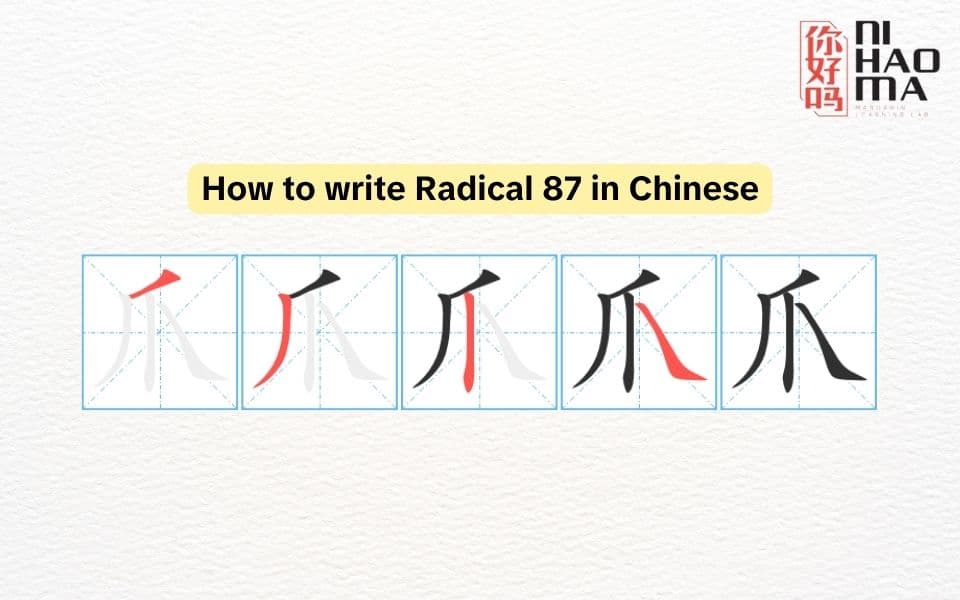
Radical 87 (爪) consists of 4 strokes and follows a specific stroke order:
| Stroke Order | Stroke Name | Description |
|---|---|---|
| 1 | Left-falling stroke (丿) | Start slightly to the upper right, then write a short stroke slanting down to the left |
| 2 | Left-falling stroke (丿) | Continue with another left-falling stroke from near the end of the first stroke |
| 3 | Vertical stroke (丨) | Draw a straight vertical line near the center, extending downward to balance the structure |
| 4 | Right-falling stroke (㇏) | Finish with a right-falling stroke from top to bottom on the right side |
When used as a component, radical 87 often changes form and appears at the top of a character. In this position (typically in a top-bottom structure), 爪 becomes 爫, with shorter lower strokes to make room for other components.
For example, the character 采 (cǎi – to pick, collect) is composed of radical 87 (爫) and radical 75 (木). You can clearly see how the radical is compressed to fit above the lower component.
Vocabulary with Radical 87 in Chinese
In modern Chinese, radical 87 (爪) appears in many commonly used characters and words:
| Chinese | Pinyin | Meaning |
|---|---|---|
| 爪 | zhǎo | claw |
| 瓜 | guā | melon |
| 抓 | zhuā | to grab |
| 爬 | pá | to climb |
| 采 | cǎi | to pick |
| 受 | shòu | to receive |
| 爱 | ài | love |
| 抓住 | zhuā zhù | to catch / capture |
| 抓紧 | zhuā jǐn | to make use of / seize (time) |
| 抓人 | zhuā rén | to arrest |
| 爪牙 | zhǎo yá | henchman (figurative) |
| 爬山 | pá shān | to climb a mountain |
| 爬楼 | pá lóu | to climb stairs |
| 爬坡 | pá pō | to go uphill |
| 采摘 | cǎi zhāi | to pick (fruit) |
| 采购 | cǎi gòu | to purchase |
| 采用 | cǎi yòng | to adopt |
| 采访 | cǎi fǎng | to interview |
| 采光 | cǎi guāng | natural lighting (architecture) |
| 采集 | cǎi jí | to collect |
| 接受 | jiē shòu | to accept |
| 受到 | shòu dào | to receive |
| 妥当 | tuǒ dàng | appropriate |
| 妥协 | tuǒ xié | compromise |
| 爵位 | jué wèi | title (nobility) |
| 风采 | fēng cǎi | demeanor |
| 受伤 | shòu shāng | injured |
| 受气 | shòu qì | to be bullied |
| 受苦 | shòu kǔ | to suffer |
| 受骗 | shòu piàn | to be deceived |
| 爱好 | ài hào | hobby |
| 爱人 | ài rén | spouse/lover |
| 爱情 | ài qíng | love |
| 可爱 | kě ài | cute |
| 爱心 | ài xīn | kindness |
| 爱护 | ài hù | to care for |
| 瓜子 | guā zǐ | melon seeds |
| 西瓜 | xī guā | watermelon |
| 南瓜 | nán guā | pumpkin |
| 木瓜 | mù guā | papaya |
Sample Dialogues Using Radical 87 in Chinese
Radical 87 (爪/爫) commonly appears in Chinese vocabulary related to actions such as grabbing, holding, catching, as well as animal features like claws. Learning words that contain radical 87 through real-life dialogues helps learners memorize faster, understand context clearly, and apply vocabulary more naturally in daily communication.
Below are 3 simple and beginner-friendly dialogues you can use to practice at home:
Dialogue 1
A: 你家这只猫好可爱啊,它叫什么名字?
(Nǐ jiā zhè zhī māo hǎo kě’ài a, tā jiào shénme míngzì?)
→ Your cat is so cute! What’s its name?
B: 它叫小白,今年两岁了。
(Tā jiào Xiǎo Bái, jīnnián liǎng suì le.)
→ Its name is Xiaobai. It’s two years old.
A: 它看起来很温顺,会抓人吗?
(Tā kàn qǐlái hěn wēnshùn, huì zhuā rén ma?)
→ It looks gentle. Does it scratch people?
B: 一般不会,不过你摸它的时候要小心它的爪子。
(Yìbān bú huì, búguò nǐ mō tā de shíhou yào xiǎoxīn tā de zhuǎzi.)
→ Usually not, but be careful of its claws when you pet it.
A: 它的爪子看起来很小,很可爱。
(Tā de zhuǎzi kàn qǐlái hěn xiǎo, hěn kě’ài.)
→ Its claws look small and adorable.
B: 是啊,不过抓到你还是会疼的。
(Shì a, búguò zhuā dào nǐ hái shì huì téng de.)
→ Yes, but it still hurts if it scratches you.

Dialogue 2
A: 最近公司有一个去国外工作的机会,你知道吗?
(Zuìjìn gōngsī yǒu yí gè qù guówài gōngzuò de jīhuì, nǐ zhīdào ma?)
→ There’s an opportunity to work abroad recently. Did you hear?
B: 我听说了,但竞争好像很激烈。
(Wǒ tīng shuō le, dàn jìngzhēng hǎoxiàng hěn jīliè.)
→ I heard about it, but the competition seems intense.
A: 机会难得,你应该试一试。
(Jīhuì nándé, nǐ yīnggāi shì yí shì.)
→ It’s a rare opportunity. You should try.
B: 我也这么想,可是有点担心自己不够好。
(Wǒ yě zhème xiǎng, kěshì yǒudiǎn dānxīn zìjǐ bú gòu hǎo.)
→ I think so too, but I’m worried I’m not good enough.
A: 不试怎么知道?你要抓住这个机会。
(Bù shì zěnme zhīdào? Nǐ yào zhuā zhù zhège jīhuì.)
→ You won’t know unless you try. You should seize this opportunity.
B: 你说得对,我决定报名参加。
(Nǐ shuō de duì, wǒ juédìng bàomíng cānjiā.)
→ You’re right. I’ve decided to apply.
Dialogue 3
A: 昨天晚上小区好像发生了偷窃,你听说了吗?
(Zuótiān wǎnshang xiǎoqū hǎoxiàng fāshēng le tōuqiè, nǐ tīng shuō le ma?)
→ There was a theft in our neighborhood last night. Did you hear?
B: 听说了,好像有人看到小偷了。
(Tīng shuō le, hǎoxiàng yǒu rén kàn dào xiǎotōu le.)
→ Yes, I heard someone saw the thief.
A: 那他被抓了吗?
(Nà tā bèi zhuā le ma?)
→ Was he caught?
B: 被警察抓住了,现在已经送去派出所了。
(Bèi jǐngchá zhuā zhù le, xiànzài yǐjīng sòng qù pàichūsuǒ le.)
→ Yes, the police caught him and took him to the station.
A: 太好了,不然大家都会很担心。
(Tài hǎo le, bùrán dàjiā dōu huì hěn dānxīn.)
→ That’s great, otherwise everyone would be worried.
B: 是啊,现在小区安全多了。
(Shì a, xiànzài xiǎoqū ānquán duō le.)
→ Yes, it’s much safer now.
Conclusion
This guide by Ni Hao Ma has helped you better understand radical 87 in Chinese, including its meaning, correct stroke order, and commonly used vocabulary. By mastering radicals like this, learners can significantly improve character recognition, expand vocabulary, and communicate more effectively.
We hope this article has provided useful insights. Don’t forget to bookmark it so you can review and reinforce your knowledge whenever needed!