The radical 102 is one of the most important components in Chinese characters and appears in many commonly used forms. In this article, we will explore what the radical 102 means, how to write it correctly, useful memory tips and the most common example characters to help you master this radical efficiently.
What Is the Radical 102 in Chinese?
The “Field” radical in Chinese (田 – tián) is the radical 102 in the Kangxi radical system. Its shape resembles a plot of farmland divided into four sections. The radical can appear as part of a character or function as a standalone character.
Radical 102 frequently appears in Chinese characters related to agriculture, land, farming activities, geography, or concepts connected to territory and boundaries. Because farmland played a central role in traditional Chinese life and agricultural culture, this radical carries strong symbolic meaning and is widely used in the writing system.
When the Field radical combines with other radicals, it often conveys meanings related to:
- Agriculture, land, cultivation
- Regions, areas, territories
- Units within villages or settlements
- Structures with a square or framed shape
- Concepts associated with soil, fields, and production
For example, the character 男 (nán – “male”) is formed by combining the Field radical (田 – tián) with the Strength radical (力 – lì), reflecting the ancient belief that agricultural labor was the responsibility of men.
How to Write the Radical 102
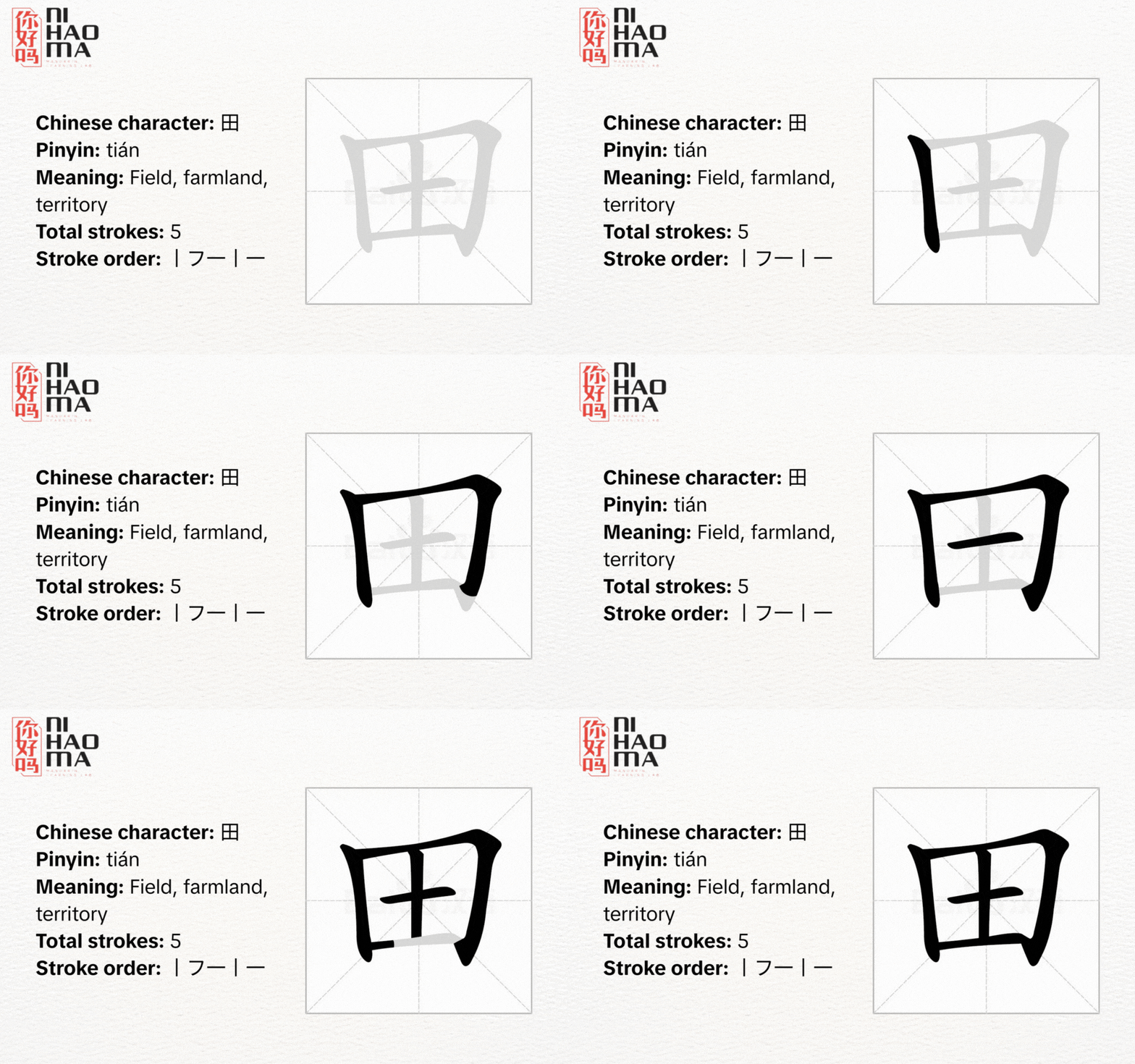
The Chinese radical 102 (田) is written with 5 basic strokes following this standard stroke order:
| Stroke Order | Stroke Name | Description |
|---|---|---|
| 1 | Vertical (丨) | Draw a downward vertical line on the left side to form the left boundary. |
| 2 | Hook (フ) | Start from the top of the first stroke, write a horizontal line, then bend downward. |
| 3 | Horizontal (一) | Add a short horizontal line across the middle from left to right. |
| 4 | Vertical (丨) | Draw a vertical line in the center from top to bottom. |
| 5 | Horizontal (一) | Finish with a bottom horizontal line from left to right to close the square. |
Position of the Radical 102 in Chinese Characters
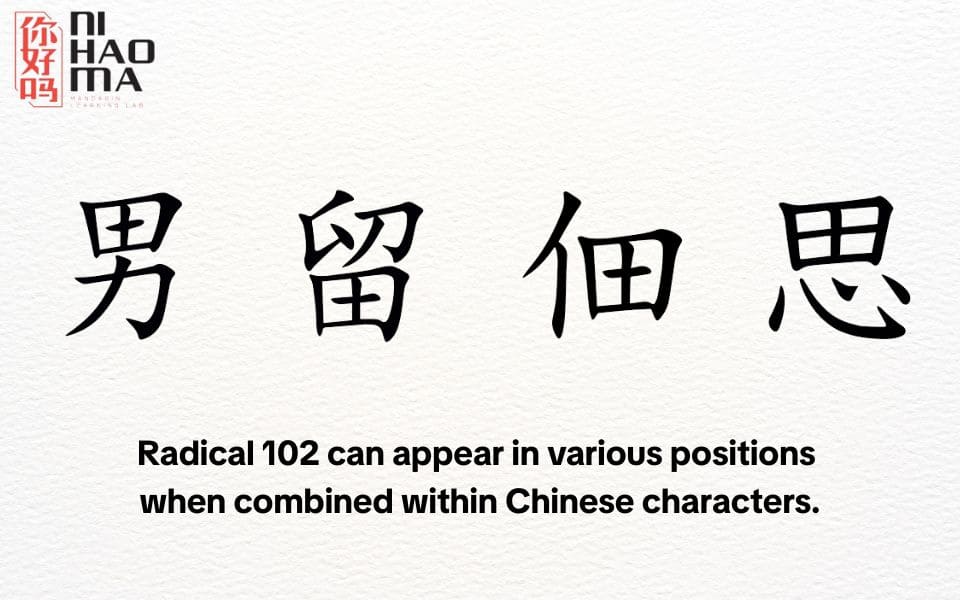
Radical 102 appears in many Chinese characters of various meaning groups. Depending on the character, this radical may appear at the top, bottom, left, right, or stand alone. Understanding these positions helps learners remember character structure and meaning more effectively.
- Radical 102 Standing Alone: When independent, radical 102 retains its original meaning: field or farmland. It also appears in vocabulary related to land. Examples: 田 (tián – field), 田地 (tiándì – farmland), 田园 (tiányuán – countryside; rural area).
- Radical 102 at the Top: This is one of the most common positions for radical 102. Examples: 男 (nán – male), 界 (jiè – boundary; border), 胃 (wèi – stomach).
- Radical 102 at the Bottom: In some characters, the radical appears below other components. Examples: 留 (liú – to stay; remain), 苗 (miáo – seedling; sprout).
- Radical 102 on the Left or Right: In these positions, radical 102 may serve a semantic or phonetic function. Examples: 佃 (tián – tenant farmer).
50 Common Chinese Words Containing Radical 102
Radical 102 (田) is one of the most visually recognizable components in the Chinese radical system. As mentioned earlier, radical 102 does not change its form when combined with other components, and it can appear in many different positions within a character.
In modern Chinese, many frequently used words contain radical 102, including the following:
| Chinese Character | Pinyin | Meaning |
|---|---|---|
| 田 | tián | Field; farmland |
| 福 | fú | Blessing; happiness |
| 富 | fù | Wealth; abundance |
| 男 | nán | Male; man |
| 界 | jiè | Boundary; world |
| 留 | liú | To stay; retain |
| 思 | sī | To think; thought |
| 苗 | miáo | Seedling; sprout |
| 甲 | jiǎ | Shell; armor; carapace |
| 画 / 畫 | huà | To draw; painting |
| 细 | xì | Fine; delicate |
| 申 | shēn | Shen hour (traditional time period) |
| 由 | yóu | From; due to; because |
| 亩 | mǔ | Mu (land measurement unit) |
| 畏 | wèi | Fear; awe |
| 胃 | wèi | Stomach |
| 雷 | léi | Thunder |
| 略 | lüè | Outline; strategy |
| 累 | lèi | Tired; exhausted |
| 畸 | jī | Unusual; abnormal |
| 畦 | qí | Plot of land; garden bed |
| 畔 | pàn | Edge of a field/river; beside |
| 备 | bèi | To prepare |
| 佃 | tián | Tenant farmer |
| 疆 | jiāng | Border; frontier |
| 畜 | chù / xù | Livestock (xù); to raise animals (chù) |
| 甸 | diàn | Suburb; open land |
| 畴 | chóu | Field; category; domain |
| Chinese | Pinyin | Meaning |
|---|---|---|
| 男人 | nán rén | Man |
| 世界 | shì jiè | World |
| 田家 | tián jiā | Farm household |
| 田地 | tián dì | Farmland |
| 田园 | tián yuán | Countryside; rural area |
| 农田 | nóng tián | Agricultural fields |
| 田庄 | tián zhuāng | Estate; farmland manor |
| 稻田 | dào tián | Rice field |
| 梯田 | tī tián | Terraced fields |
| 油田 | yóu tián | Oil field |
| 盐田 | yán tián | Salt field |
| 煤田 | méi tián | Coal field |
| 田鼠 | tián shǔ | Field mouse |
| 田主 | tián zhǔ | Landowner |
| 畫家 / 画家 | huà jiā | Painter; artist |
| 田间 | tián jiān | Farmland area; countryside |
| 田径 | tián jìng | Track and field |
| 留学生 | liú xué shēng | International student |
| 保留 | bǎo liú | To preserve; retain |
| 幸福 | xìng fú | Happiness |
| 画画 | huà huà | To draw; to paint |
| 图案 | tú àn | Pattern; design |
| 战略 | zhàn lüè | Strategy |
| 胃口 | wèi kǒu | Appetite |
| 界限 | jiè xiàn | Limit; boundary |
| 自由 | zì yóu | Freedom |
Sample Conversations Containing Radical 102 in Chinese
Radical 102 in Chinese is one of the most familiar and commonly used radicals in Chinese characters. Not only does it appear independently as the character “田,” but it also occurs in many everyday vocabulary items. Below are several sample dialogues—see how many words containing radical 102 you can identify!
Dialogue 1
A: 下周就是春节了,你准备好回家了吗?
Xià zhōu jiù shì Chūnjié le, nǐ zhǔnbèi hǎo huí jiā le ma?
Next week is the Spring Festival. Have you prepared to go home?
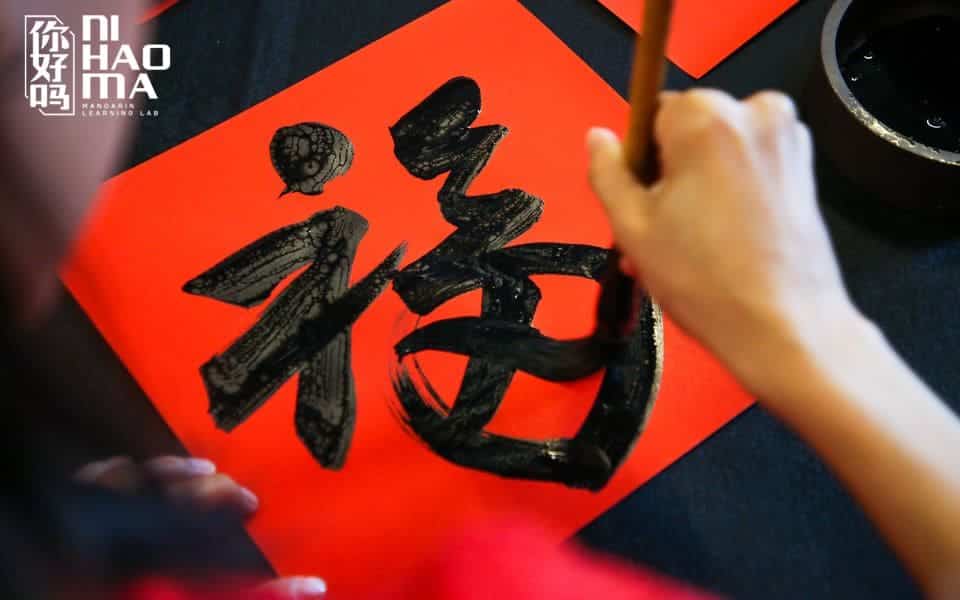
B: 差不多了,我还想再买一个“福”字贴在门上。
Chàbuduō le, wǒ hái xiǎng zài mǎi yí gè “fú” zì tiē zài mén shàng.
Almost done. I also want to buy a “fu” character to stick on the door.
A: 那很好,贴“福”表示新年平安顺利。
Nà hěn hǎo, tiē “fú” biǎoshì xīnnián píng’ān shùnlì.
That’s great. Hanging the “fu” character symbolizes peace and good fortune for the new year.
B: 不过今天听说明天下午会有雷雨。
Búguò jīntiān tīng shuō míngtiān xiàwǔ huì yǒu léiyǔ.
But I heard that there will be thunderstorms tomorrow afternoon.
A: 是啊,天气变化很快,你要注意安全。
Shì a, tiānqì biànhuà hěn kuài, nǐ yào zhùyì ānquán.
Yes, the weather changes quickly. Make sure to stay safe.
Dialogue 2
A: 你最近不是在做新的设计项目吗?进展怎么样?
Nǐ zuìjìn bú shì zài zuò xīn de shèjì xiàngmù ma? Jìnzhǎn zěnmeyàng?
Aren’t you working on a new design project lately? How is it going?
B: 还不错,不过我们团队在讨论产品的使用界限。
Hái búcuò, búguò wǒmen tuánduì zài tǎolùn chǎnpǐn de shǐyòng jièxiàn.
Not bad, but our team is discussing the usage limits of the product.
A: 嗯,这很重要。要是细节处理不好,客户会不满意。
Ńg, zhè hěn zhòngyào. Yàoshi xìjié chǔlǐ bù hǎo, kèhù huì bù mǎnyì.
Yes, that’s very important. If the details aren’t handled well, the client won’t be satisfied.
B: 是的,我还在调整画面布局,希望能留下更好的印象。
Shì de, wǒ hái zài tiáozhěng huàmiàn bùjú, xīwàng néng liúxià gèng hǎo de yìnxiàng.
Right. I’m still adjusting the layout of the visuals, hoping to leave a better impression.

Dialogue 3
A: 你听说了吗?这次考试的毕业标准提高了。
Nǐ tīngshuō le ma? Zhè cì kǎoshì de bìyè biāozhǔn tígāo le.
Did you hear? The graduation requirements for this exam have been raised.
B: 听说了,而且题目也比以前异常地难。
Tīngshuō le, érqiě tímù yě bǐ yǐqián yìcháng de nán.
Yes, and the questions are unusually difficult compared to before.
A: 我班里好几个男生考完都说写不完。
Wǒ bānlǐ hǎo jǐ gè nánshēng kǎowán dōu shuō xiě bù wán.
Several boys in my class said they couldn’t finish writing in time.
B: 我也差点写不完,不过希望还能通过吧。
Wǒ yě chàdiǎn xiě bù wán, búguò xīwàng hái néng tōngguò ba.
I almost couldn’t finish either, but hopefully I’ll still pass.
A: 放心吧,你平时很努力,应该没问题。
Fàngxīn ba, nǐ píngshí hěn nǔlì, yīnggāi méi wèntí.
Don’t worry. You usually work very hard—you should be fine.
Conclusion
Radical 102 is simple in form but highly versatile in Chinese. Once you understand its structure, stroke order, and core meaning, you will find it much easier to infer the meaning of new words and remember characters more effectively. We hope this content from Ni Hao Ma has been helpful – stay tuned for more interesting lessons to come!