When starting to learn Chinese, becoming familiar with radicals is a crucial foundation that helps learners understand the structure and meaning of Chinese characters. Each radical not only has a visual function but also conveys deeper meanings related to objects and phenomena in daily life. Among them, the radical 172 in Chinese, known as the Chui radical 隹 (zhuī), is quite distinctive. It is often associated with images of birds and appears in many commonly used Chinese characters.
So, what exactly is the radical 172 in Chinese, what does it mean, how is it written, and which characters commonly contain it? Let’s explore these questions together in the article below.
What Is the Radical 172 in Chinese?
The radical 172 (隹 – zhuī) is radical number 172 in the system of 214 Kangxi radicals used in Chinese characters. This radical typically appears in characters that describe birds, actions, or concepts indirectly related to birds and natural imagery.
The radical 172 in Chinese is a representative example of how Chinese characters have evolved from concrete visual representations to more abstract meanings. When 隹 appears in complex characters, it does not always directly convey the meaning “bird”.
Therefore, when encountering characters containing the 隹 radical, learners should not focus solely on the modern meaning but instead view it as a “semantic trace” that helps reveal the origin of the character and how ancient people conceptualized the world around them.
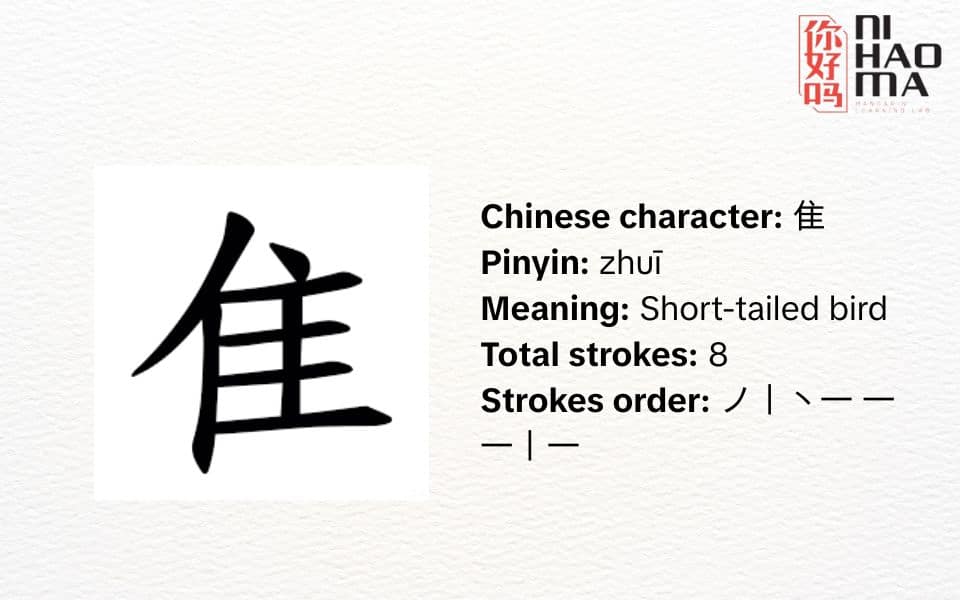
- Chinese character: 隹
- Pinyin: zhuī
- Meaning: Short-tailed bird
- Total strokes: 8
- Stroke components: ノ丨丶一 一 一丨一
How to Write the Radical 172 in Chinese
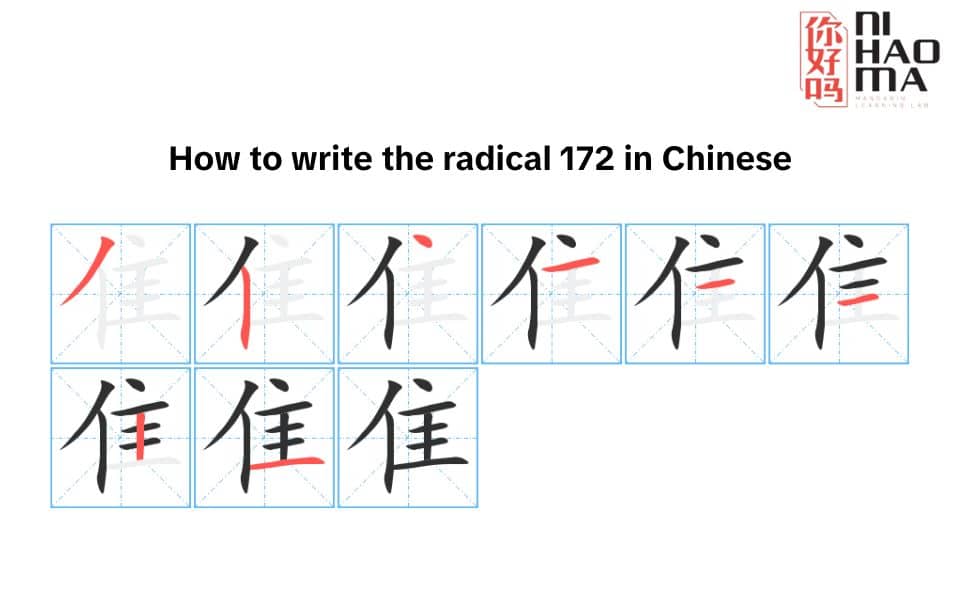
The radical 172 in Chinese consists of 8 strokes and is written in the following order:
| Stroke order | Stroke | Description |
|---|---|---|
| 1 | ノ (Left-falling stroke) | Write a left-falling stroke from the upper left downward |
| 2 | 丨 (Vertical stroke) | Write a straight vertical stroke from top to bottom |
| 3 | 丶 (Dot) | Add a small dot on the right side |
| 4 | 一 (Horizontal stroke) | Write the first horizontal stroke |
| 5 | 一 (Horizontal stroke) | Write the second horizontal stroke |
| 6 | 一 (Horizontal stroke) | Write the third horizontal stroke |
| 7 | 丨 (Vertical stroke) | Draw a vertical stroke passing through the horizontal strokes |
| 8 | 一 (Horizontal stroke) | Finish with the final horizontal stroke |
Vocabulary Containing the Radical 172 in Chinese
Learning vocabulary through radicals not only helps learners remember the written form of characters more easily, but also enables them to better understand the relationship between meaning and character structure. Below are some of the most common Chinese vocabulary items that contain the radical 172 (隹):
| Chinese Character | Pinyin | Meaning |
|---|---|---|
| 隹 | zhuī | short-tailed bird |
| 谁 | shéi | who (used in questions) |
| 集 | jí | to gather, to assemble |
| 雙 / 双 | shuāng | pair, double |
| 难 | nán | difficult |
| 離 / 离 | lí | to leave, to separate |
| 雜 / 杂 | zá | mixed, miscellaneous |
| 雀 | què | sparrow |
| 推 | tuī | to push, infer, delay |
| 准 | zhǔn | to allow, standard |
| 雁 | yàn | wild goose |
| 维 | wéi | to maintain, to hold |
| 雄 | xióng | male, strong |
| 雌 | cí | female |
| 雕 | diāo | eagle; to carve |
| 雇 | gù | to hire |
| 雅 | yǎ | elegant, refined |
| 难道 | nándào | could it be that…?, is it possible that… |
| 雜音 | záyīn | noise, interference |
| 雕刻 | diāokè | carving, engraving |
| 难过 | nánguò | sad, distressed |
| 难受 | nánshòu | uncomfortable |
| 难看 | nánkàn | ugly, unpleasant to look at |
| 难听 | nántīng | unpleasant to hear |
| 集中 | jízhōng | to concentrate |
| 英雄 | yīngxióng | hero |
| 推动 | tuīdòng | to promote, to push forward |
| 准备 | zhǔnbèi | to prepare |
| 思维 | sīwéi | thinking, mindset |
| 焦点 | jiāodiǎn | focus, focal point |
| 焦急 | jiāojí | anxious, worried |
| 标准 | biāozhǔn | standard |
Sample Dialogues Using Vocabulary with the Chui Radical in Chinese
When learning Chinese, memorizing characters becomes easier and more engaging if learners understand the radicals that form the characters and see how they are used in real-life contexts. The Chui radical (隹) is a commonly encountered radical, originally associated with birds and later extended to many abstract meanings in modern Chinese.
This section introduces sample dialogues that use vocabulary containing the Chui radical (隹), helping you not only recognize Chinese characters more effectively but also apply vocabulary naturally in everyday communication.
Dialogue 1
A: 这个项目真的很难,我一个人有点做不完。
Zhège xiàngmù zhēn de hěn nán, wǒ yí gèrén yǒudiǎn zuò bù wán.
→ This project is really difficult. I can’t finish it on my own.
B: 我也觉得不简单,虽然如此,我们还是要想办法。
Wǒ yě juéde bù jiǎndān, suīrán rúcǐ, wǒmen háishi yào xiǎng bànfǎ.
→ I also think it’s not simple. Even so, we still need to find a solution.
A: 那我们先集合团队一起讨论,可以吗?
Nà wǒmen xiān jíhé tuánduì yìqǐ tǎolùn, kěyǐ ma?
→ Then shall we gather the team first and discuss it together?
B: 好主意,人多一点,问题就不那么难了。
Hǎo zhǔyi, rén duō yìdiǎn, wèntí jiù bù nàme nán le.
→ Good idea. With more people, the problem won’t be that difficult.
A: 我马上通知大家,下午两点开会。
Wǒ mǎshàng tōngzhī dàjiā, xiàwǔ liǎng diǎn kāihuì.
→ I’ll inform everyone right away. The meeting will be at 2 p.m.
B: 好的,希望这次能顺利解决。
Hǎo de, xīwàng zhè cì néng shùnlì jiějué.
→ Okay. Hopefully, we can solve it smoothly this time.

Dialogue 2
A: 这门课的内容真的很难,你听得懂吗?
Zhè mén kè de nèiróng zhēn de hěn nán, nǐ tīng de dǒng ma?
→ The content of this course is really difficult. Can you understand it?
B: 一开始不太懂,虽然老师讲得很认真。
Yì kāishǐ bù tài dǒng, suīrán lǎoshī jiǎng de hěn rènzhēn.
→ At first I didn’t understand much, even though the teacher explained carefully.
A: 那我们要不要集合同学一起复习?
Nà wǒmen yào bú yào jíhé tóngxué yìqǐ fùxí?
→ Should we gather our classmates and review together?
B: 好啊,人多一点,问题就没那么难了。
Hǎo a, rén duō yìdiǎn, wèntí jiù méi nàme nán le.
→ Sure. With more people, it won’t be so difficult.
A: 那我去联系大家,周末一起学习。
Nà wǒ qù liánxì dàjiā, zhōumò yìqǐ xuéxí.
→ Then I’ll contact everyone and study together this weekend.
B: 太好了,这样效率一定更高。
Tài hǎo le, zhèyàng xiàolǜ yídìng gèng gāo.
→ That’s great. The efficiency will definitely be higher.

Dialogue 3
A: 公司最近在雇新人,你知道吗?
Gōngsī zuìjìn zài gù xīnrén, nǐ zhīdào ma?
→ The company has been hiring new employees recently. Do you know?
B: 知道,听说要雇员会双语。
Zhīdào, tīngshuō yào gùyuán huì shuāngyǔ.
→ Yes. I heard the employees are required to be bilingual.
A: 要求这么高,竞争应该很难吧。
Yāoqiú zhème gāo, jìngzhēng yīnggāi hěn nán ba.
→ With such high requirements, the competition must be tough.
B: 是的,虽然机会不多,但值得试试。
Shì de, suīrán jīhuì bù duō, dàn zhídé shìshi.
→ Yes. Although there aren’t many opportunities, it’s worth trying.
A: 如果通过了,对职业发展很有帮助。
Rúguǒ tōngguò le, duì zhíyè fāzhǎn hěn yǒu bāngzhù.
→ If you pass, it will be very helpful for your career development.
B: 没错,我也准备投简历。
Méi cuò, wǒ yě zhǔnbèi tóu jiǎnlì.
→ Exactly. I’m also preparing to submit my résumé.
Conclusion
The radical 172 in Chinese (隹) is an important radical that not only carries an original meaning related to birds but also appears widely in many common Chinese characters with extended and abstract meanings. Mastering the meaning, writing method, and usage of characters containing the Chui radical will help learners remember characters more effectively, gain a deeper understanding of character structure, and improve overall reading comprehension. We hope Ni Hao Ma has provided you with useful information, and we look forward to seeing you again in future articles.