Understanding Chinese radicals not only helps you look up words faster in a dictionary, but also supports logical guessing of meanings when you encounter new characters. The radical 62 and radical 97 are basic radicals and appears frequently in everyday vocabulary. So what are they, how is it written, and what are some common characters that contain it? Let’s explore together in the article below.
The radical 62 and radical 97 in Chinese
In the list of 214 Kangxi radicals, there are two radicals that share the same Sino-Vietnamese reading “Qua”, but they are completely different in form and meaning. These are commonly referred to as radical 62 and radical 97.
The radical 62 – 戈 (Weapon)
- Number of strokes: 4
- Stroke order: 一 フ ノ 丶
- Pinyin: gē
- Position in the radical table: Radical 62
- Meaning: A ge (halberd), an ancient weapon
- Examples: 成 (chéng – to succeed / to complete), 战 (zhàn – war / to fight), 伐 (fá – to attack / to conquer)
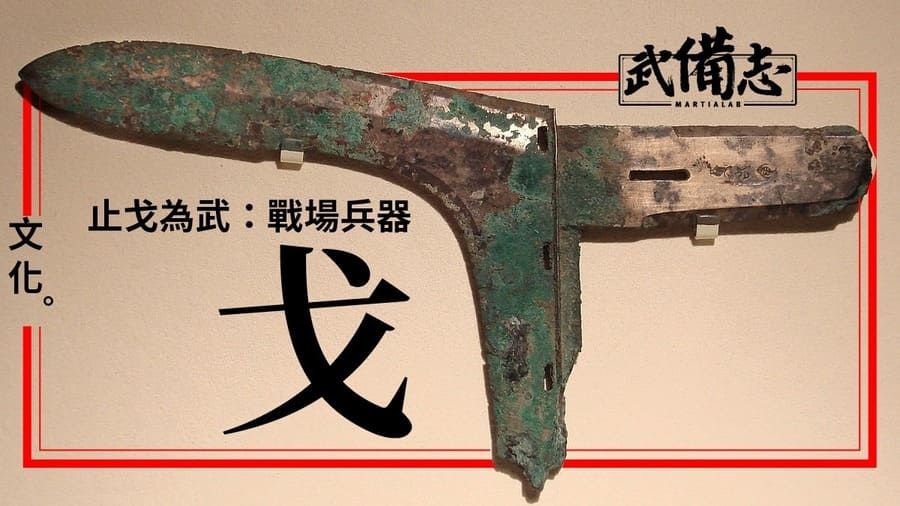
From a historical perspective, unlike spears or lances that are mainly used for thrusting, the “ge” (qua) was designed for hooking, slashing, or knocking enemies off their horses. It served as a primary battlefield weapon during the Shang–Zhou period. In terms of meaning, the Qua radical does not merely denote a type of weapon, but also symbolizes power, protection, and conflict. This meaning is closely associated with radical 62.
The radical 97 – 瓜 (Melon)
- Number of strokes: 5
- Stroke order: ノ ノ フ 丶 乀
- Pinyin: guā
- Position in the radical table: Radical 97
- Meaning: Melon; vining plants with large fruits (such as gourds, squash, and melons)
- Examples: 瓠 (hù – gourd), 瓢 (piáo – ladle), 瓣 (bàn – segment, petal)
In Chinese, the Qua radical (瓜 – guā) is an independent radical in the system of 214 Kangxi radicals, carrying the core meaning of a melon or fruit with an outer rind and inner flesh. Historically, the character 瓜 originated as a pictographic character, appearing very early in oracle bone inscriptions and bronze inscriptions. Its form resembles a melon split lengthwise, clearly showing the outer skin and the inner contents.
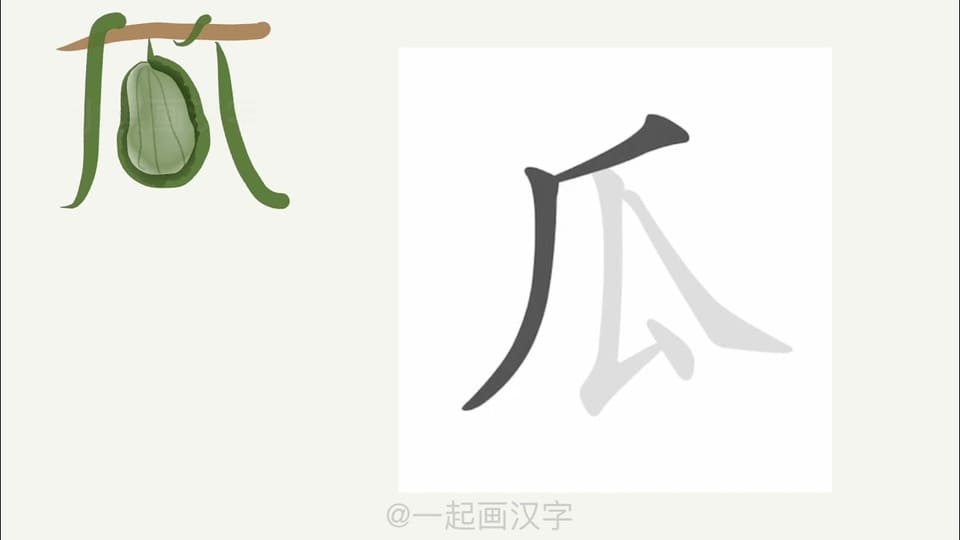
Because of this origin, radical 97 is commonly associated with concepts related to fruits, plants, as well as objects that have an outer covering and an inner structure. When used as a radical in Chinese characters, 瓜 helps learners easily associate form with meaning and logically infer definitions, especially for characters related to fruits or similar shapes.
How to Write the Radical 62 and radical 97 in Chinese
The radical 62 (戈) has 4 strokes, written in the following order:
| Stroke order | Stroke symbol | Stroke name | Description |
|---|---|---|---|
| 1 | 一 | Horizontal stroke | Write a short horizontal line |
| 2 | フ | Hook stroke | Write a downward hook crossing the first stroke, slanting slightly to the right and lifting gently at the end |
| 3 | ノ | Left-falling stroke | Write a left-falling stroke from the middle of the hook |
| 4 | 丶 | Dot stroke | Add a small dot to the left of the top of the hook |
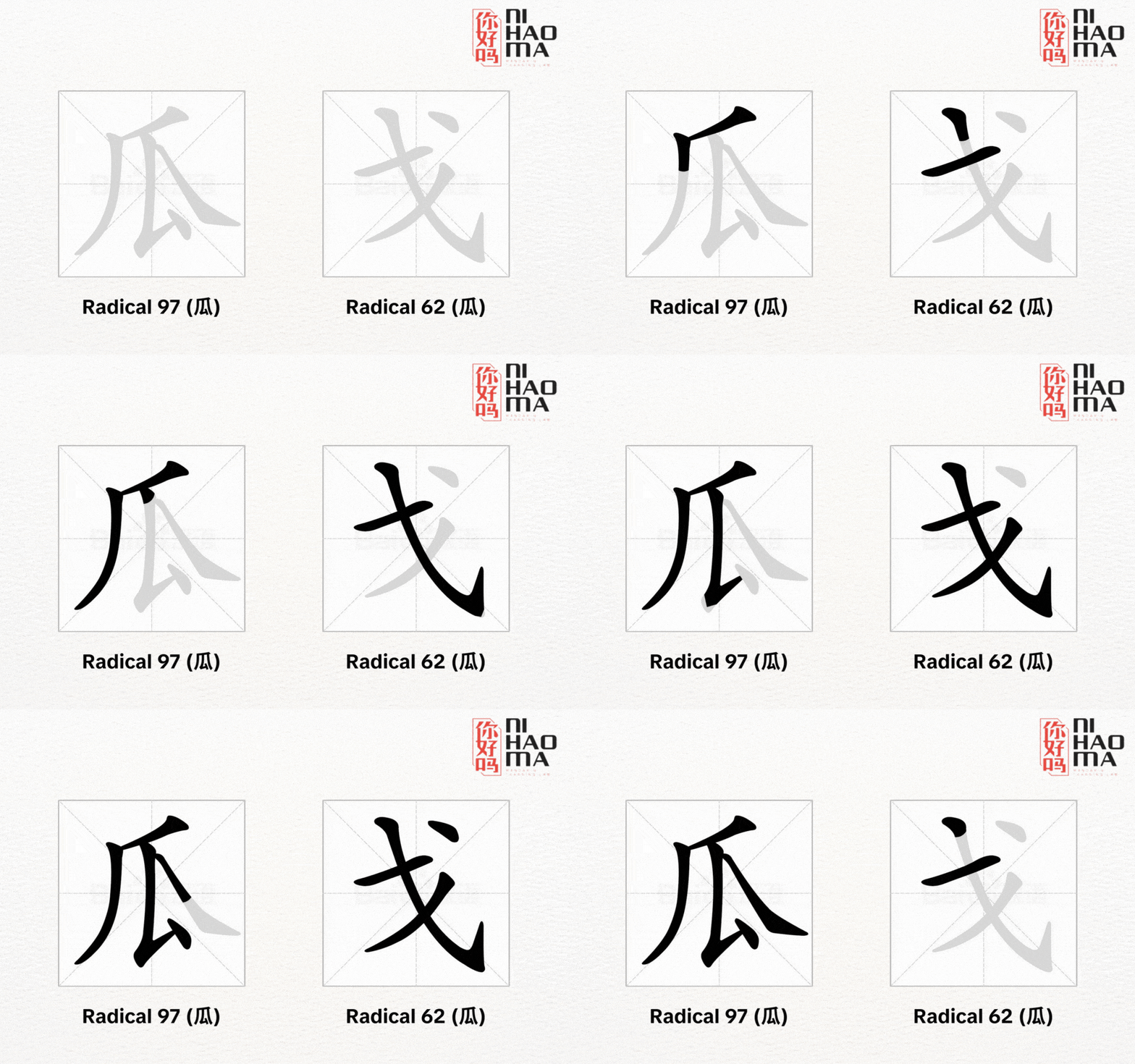
The radical 97 (瓜) has 5 strokes and is written as follows:
| Stroke order | Stroke symbol | Stroke name | Description |
|---|---|---|---|
| 1 | ノ | Left-falling stroke | A long left-falling stroke, moving slightly horizontally to the left |
| 2 | ノ | Left-falling stroke | Write a left-falling stroke from top to bottom |
| 3 | フ | Curved hook | Write a curved hook starting from the middle of the long left-falling stroke |
| 4 | 丶 | Left dot | Add a small dot near the tail of the falling stroke |
| 5 | 乀 | Pressing stroke | Draw a pressing stroke extending from the first horizontal-falling stroke |
Vocabulary Containing the Radical 62 in Chinese
Originating from the image of a long bladed weapon with a horizontal edge used for hooking and slashing, the radical 62 (戈) often appears in Chinese characters that convey meanings related to conflict, violence, warfare, or defense. This semantic association is closely tied to radical 62.
However, over thousands of years of linguistic evolution, the expressive range of radical 62 has expanded significantly. Today, it can also be found in many commonly used characters in daily life, where the original sense of weaponry may be abstracted into ideas such as action, struggle, or decisive movement.
Below are some of the most common Chinese vocabulary items containing the Qua radical (戈) — also known as radical 62:
| Chinese character | Pinyin | Meaning |
|---|---|---|
| 我 | wǒ | I, me |
| 戈 | gē | spear, weapon |
| 战 | zhàn | to fight, battle |
| 成 | chéng | to succeed, success |
| 或 | huò | or |
| 戏 | xì | drama, play |
| 戒 | jiè | to abstain, to guard against |
| 戎 | róng | military, army |
| 戍 | shù | to garrison |
| 戴 | dài | to wear, to put on |
| 越 | yuè | to cross over; Vietnam |
| 城 | chéng | city wall, fortress |
| 感 | gǎn | feeling, to be moved |
| 战争 | zhànzhēng | war |
| 战士 | zhànshì | soldier |
| 战略 | zhànlüè | strategy |
| 战术 | zhànshù | tactics |
| 成功 | chénggōng | success |
| 完成 | wánchéng | to complete |
| 或者 | huòzhě | or |
| 戒指 | jièzhi | ring |
| 戒烟 | jièyān | to quit smoking |
| 戎装 | róngzhuāng | military uniform |
| 戎马 | róngmǎ | warfare |
| 戍边 | shùbiān | to guard the frontier |
| 戏曲 | xìqǔ | traditional opera |
| 戏份 | xìfèn | role importance, screen time |
| 戏言 | xìyán | joke, playful remark |
| 战败 | zhànbài | defeat |
| 战胜 | zhànshèng | victory |
| 战场 | zhànchǎng | battlefield |
| 成果 | chéngguǒ | achievement, result |
| 成就 | chéngjiù | accomplishment |
| 成立 | chénglì | to establish |
| 或许 | huòxǔ | perhaps |
| 戒心 | jièxīn | vigilance |
| 戏弄 | xìnòng | to tease |
| 戍守 | shùshǒu | to stand guard |
| 战线 | zhànxiàn | front line |
| 战火 | zhànhuǒ | flames of war |
| 成名 | chéngmíng | to become famous |
| 成长 | chéngzhǎng | to grow up |
| 或然 | huòrán | accidental, random |
| 戒备 | jièbèi | to be on guard |
| 戏班 | xìbān | opera troupe |
| 戎机 | róngjī | military opportunity |
| 戍卒 | shùzú | garrison soldier |
| 戏文 | xìwén | opera script |
Vocabulary Containing the Radical 97 (瓜)
In the structure of Chinese characters, the radical 97 (瓜) not only classifies plant-related terms, but also appears in many words with metaphorical meanings, symbolizing connection, growth, abundance, or round and full shapes.
| Chinese character | Pinyin | Meaning |
|---|---|---|
| 瓜 | guā | melon, gourd |
| 西瓜 | xīguā | watermelon |
| 木瓜 | mùguā | papaya |
| 南瓜 | nánguā | pumpkin |
| 苦瓜 | kǔguā | bitter melon |
| 冬瓜 | dōngguā | winter melon |
| 黄瓜 | huángguā | cucumber |
| 哈密瓜 | hāmìguā | Hami melon |
| 甜瓜 | tiánguā | sweet melon |
| 丝瓜 | sīguā | loofah |
| 地瓜 | dìguā | sweet potato |
| 瓜子 | guāzǐ | melon seeds |
| 瓜葛 | guāgé | entanglement, connection |
| 瓜分 | guāfēn | to divide up |
| 傻瓜 | shǎguā | fool, idiot |
| 瓢 | piáo | ladle (made from a gourd) |
| 瓣 | bàn | petal, segment |
| 瓤 | ráng | pulp, inner flesh of fruit |
| 瓞 | dié | small melon |
| 瓠 | hù | bottle gourd |
| 狐 | hú | fox |
Sample Dialogues Using the Radical 62 and Radical 97 in Chinese
Learning radicals through isolated words can sometimes make it hard for learners to remember how they are used in real life. That’s why placing Chinese characters into specific communication contexts is an effective way to reinforce memory and practical usage.
Dialogue with Vocabulary Containing the 瓜 Radical
A: 你在看什么?
Nǐ zài kàn shénme?
What are you watching?
B: 我在吃瓜,看这个新闻。
Wǒ zài chīguā, kàn zhège xīnwén.
I’m just following the gossip, watching this news.
A: 又是明星的事吗?
Yòu shì míngxīng de shì ma?
Is it celebrity news again?
B: 对啊,大家都是吃瓜群众。
Duì a, dàjiā dōu shì chīguā qúnzhòng.
Yeah, everyone’s just a bystander watching the drama.

Dialogue with Vocabulary Containing the 戈 Radical
A: 这个任务完成得怎么样了?
Zhège rènwu wánchéng de zěnmeyàng le?
How is this task coming along?
B: 已经完成了一大半,很快就能成功。
Yǐjīng wánchéng le yí dà bàn, hěn kuài jiù néng chénggōng.
More than half is done already; it’ll be successful soon.
A: 过程中遇到困难了吗?
Guòchéng zhōng yùdào kùnnán le ma?
Did you run into any difficulties along the way?
B: 有一点,不过我们一起战胜了。
Yǒu yìdiǎn, bùguò wǒmen yìqǐ zhànshèng le.
A little, but we overcame them together.
A: 那就好,这次一定能取得成果。
Nà jiù hǎo, zhè cì yídìng néng qǔdé chéngguǒ.
That’s great — this time we’ll definitely achieve results.
Conclusion
This article from Ni Hao Ma has explained what the radical 62 (戈) and radical 97 (瓜) in Chinese and clarified the meanings and usage. Learning radicals in a structured way helps you better understand the structure of Chinese characters and remember vocabulary more effectively.
Hopefully, this content has been helpful to you. Stay tuned for more interesting and useful lessons coming soon!