
When learning Chinese, understanding radicals not only makes characters easier to memorize but also helps learners approach the writing system in a more logical way. The Sun radical in Chinese is one of the most frequently used radicals, closely connected to familiar concepts such as light, time, and the sun itself.
So, what exactly is the Sun radical, what does it mean, and how is it written correctly? This article will guide you through the meaning, writing method, and learning value of the Sun radical, helping you use Chinese characters more effectively.
What Is the Sun Radical in Chinese?
The Sun radical in Chinese is 日 (rì), whose original meaning is the sun. It is one of the most basic and important radicals in Chinese characters and is commonly used to form characters related to light, time, dates, and daily cycles.
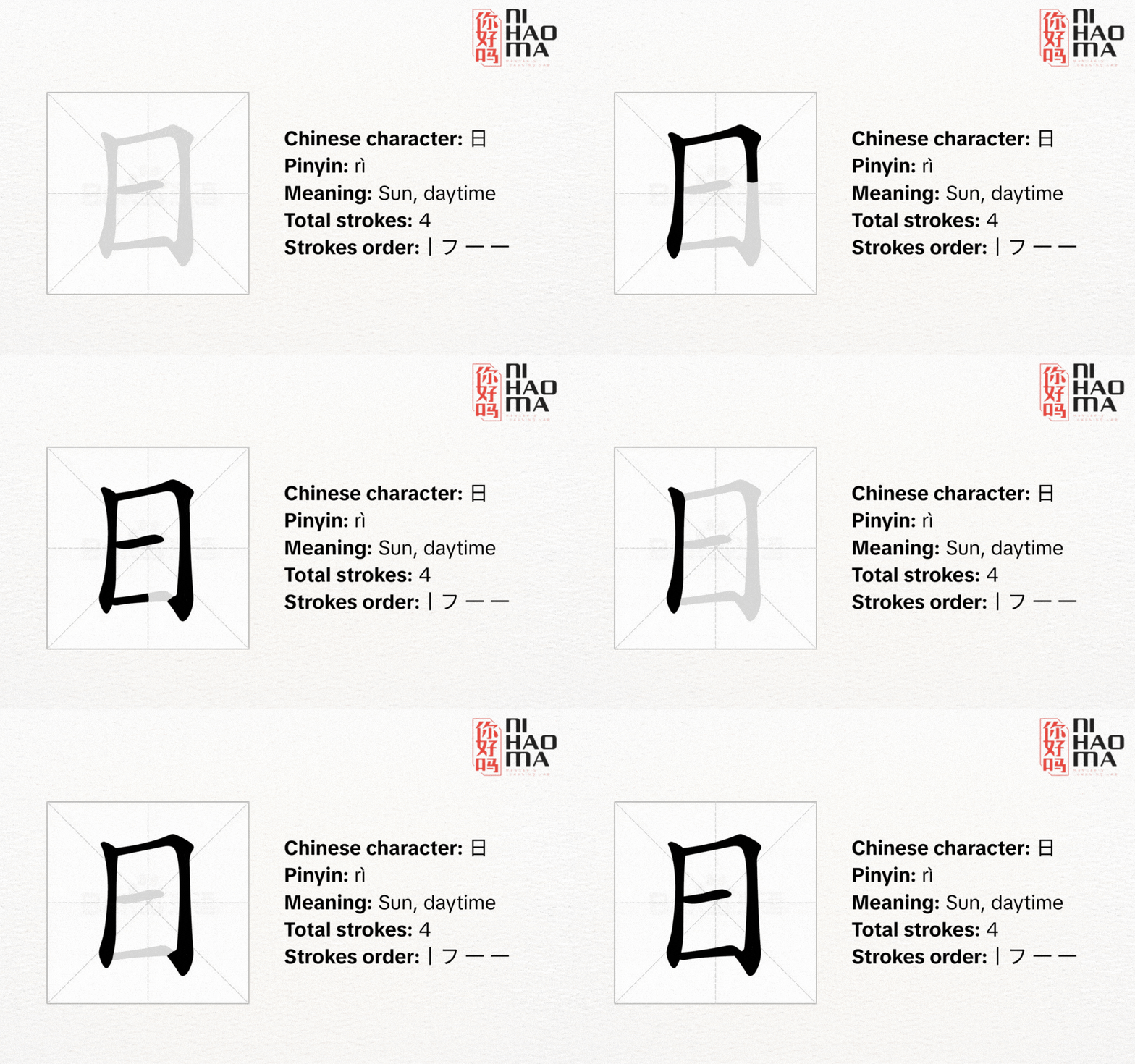
As a radical, 日 can stand alone as an independent character or combine with other radicals to create new characters. When it appears in a character, it often signals meanings related to daytime, time, brightness, or solar movement.
- Character: 日
- Pinyin: rì
- Main meaning: Sun, daytime
- Number of strokes: 4
- Stroke order: 丨フ 一 一
The Origin of the Sun Radical in Chinese
The character 日 originated as a pictograph, representing the shape of the sun in oracle bone inscriptions from the Shang Dynasty. In its earliest form, it appeared as a circle with a dot or a short line inside, symbolizing the sun itself.
Over thousands of years, this rounded shape gradually became more square and angular, making it easier to carve on bronze objects and write with brushes on paper. Curved lines were simplified into straight strokes, eventually forming the upright rectangular shape with a firm horizontal line in the middle that we see today.
In terms of symbolism, the Sun radical represents Yang energy, standing for light and vitality in East Asian culture. As radical 72 in the Kangxi Dictionary, it appears in hundreds of Chinese characters related to time, weather conditions, and natural light phenomena.
How to Write the Sun Radical in Chinese
The Sun radical in Chinese consists of 4 strokes, written in the following order:
| Stroke Order | Stroke | Stroke Name | Writing Description |
| 1 | 丨 | Vertical stroke | Write a vertical line on the left side from top to bottom. |
| 2 | フ | Turning stroke | Starting from the top of the first stroke, write a horizontal line then turn downward. |
| 3 | 一 | Horizontal stroke | Write a horizontal line in the middle, connecting the two vertical sides. |
| 4 | 一 | Horizontal stroke | Write the final horizontal line at the bottom to close the character. |
How to Recognize the Sun Radical in Chinese
To accurately recognize the Sun radical 日, especially when it appears in complex characters, you can rely on three main aspects: position, meaning logic, and comparison with similar radicals. These methods help learners clearly identify radical sun radical and avoid confusion.
1. Recognizing by Position
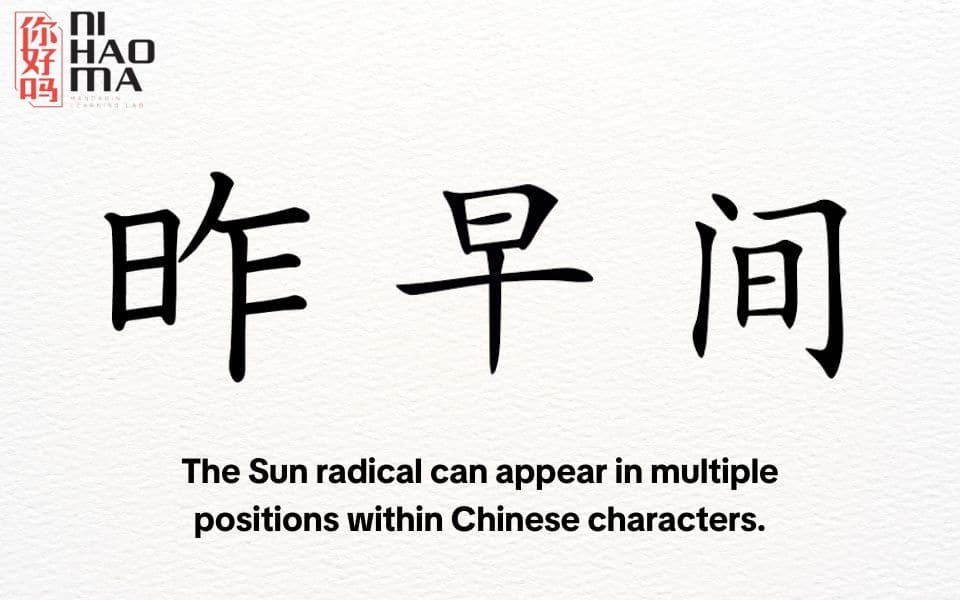
The Sun radical commonly appears in four main positions. Identifying its position helps prevent confusion with similar radicals such as 曰 or 口.
- On the left: In this position, the Sun radical is usually written in a slimmer form. Examples: 昨 (zuó – yesterday), 时 (shí – time), 晚 (wǎn – evening).
- On the top: This position often suggests light shining downward. Examples: 早 (zǎo – early), 星 (xīng – star), 易 (yì – easy/change).
- At the bottom: It often serves as a base element or represents the sun’s movement throughout the day.
Examples: 普 (pǔ – common), 智 (zhì – wisdom), 昏 (hūn – dusk). - In the middle: Less common as an independent radical, but still found in associative characters.
Example: 间 (jiān – space; the sun seen through a door).
2. Recognizing Through Meaning Logic
The Sun radical represents the “solar energy” or the sun. Therefore, characters containing this radical are often related to:
- Time: days, hours, past and future. (Example: 明 – bright / tomorrow)
- Light and brightness: shining, clear. (Examples: 昭 – bright, 晴 – sunny)
- Physical qualities related to sunlight: heat, dryness. (Example: 晒 – to dry in the sun)
3. Distinguishing It from Similar Radicals
Based on the characteristics above, you can use comparison to identify the Sun radical more easily:
| Comparison Feature | Sun Radical (日) | Yue Radical (曰) | Eye Radical (目) | White Radical (白) |
|---|---|---|---|---|
| Original form | Pictograph of the sun | Pictograph of a mouth | Pictograph of an eye | Pictograph of grains / light |
| Key visual feature | One short horizontal line in the middle | One open horizontal line | Two horizontal lines in the middle | One horizontal line with a small dot on top |
| Common meaning | Sun, day, light, time | Say, speak | Eye, look, see | White, clear |
| Typical example | 明 (bright) | 曲 (melody) | 眼 (eye) | 的 (possessive) |
Vocabulary Containing the Sun Radical in Chinese
The Sun radical in Chinese is one of the most common radicals and is closely associated with concepts such as time, light, weather, and daily activities. Below is a list of vocabulary items that contain the Sun radical:
| Chinese Character | Pinyin | Meaning |
|---|---|---|
| 日 | rì | Sun, day |
| 明 | míng | Bright, clear |
| 时 | shí | Time, hour |
| 早 | zǎo | Early |
| 晚 | wǎn | Evening, late |
| 昨 | zuó | Yesterday |
| 今 | jīn | Today |
| 星 | xīng | Star |
| 春 | chūn | Spring |
| 晴 | qíng | Clear, sunny |
| 晴天 | qíngtiān | Sunny day |
| 晶 | jīng | Sparkling |
| 昼 | zhòu | Daytime |
| 晓 | xiǎo | Dawn; to understand |
| 昔 | xī | Long ago |
| 暗 | àn | Dark, dim |
| 景 | jǐng | Scenery, view |
| 暖 | nuǎn | Warm |
| 暑 | shǔ | Hot (summer heat) |
| 晨 | chén | Morning |
| 暮 | mù | Dusk, evening |
| 晕 | yūn | Dizzy |
| 映 | yìng | Reflect |
| 智 | zhì | Wisdom |
| 暂 | zàn | Temporary |
| 曝 | pù | Expose to the sun |
| 曙 | shǔ | Dawn |
| 晃 | huǎng | Shake, sway |
| 昭 | zhāo | Bright, clear |
| 晶体 | jīngtǐ | Crystal |
| 暴 | bào | Violent, intense |
| 曜 | yào | Shine, illuminate |
| 晒 | shài | Sun-dry |
| 晴朗 | qínglǎng | Clear and sunny |
| 暗淡 | àndàn | Dim, gloomy |
| 晕倒 | yūndǎo | Faint |
| 景色 | jǐngsè | Scenery |
| 晨光 | chéngguāng | Morning light |
| 晚上 | wǎnshang | Evening |
| 明天 | míngtiān | Tomorrow |
| 昨天 | zuótiān | Yesterday |
| 今日 | jīnrì | Today |
| 日记 | rìjì | Diary |
| 日常 | rìcháng | Daily routine |
| 日出 | rìchū | Sunrise |
| 日落 | rìluò | Sunset |
| 日光 | rìguāng | Sunlight |
| 日历 | rìlì | Calendar |
| 日夜 | rìyè | Day and night |
| 日子 | rìzi | Days, life |
Sample Dialogues Using Vocabulary with the Sun Radical
The following sample dialogues use vocabulary containing the Sun radical (日), helping learners not only remember character forms but also understand how these words are used in real-life contexts.
Through short, practical conversations about time, weather, and daily routines, learners can naturally and accurately apply vocabulary related to radical 72 in Chinese communication.
Dialogue 1
A: 今天几号?
Jīntiān jǐ hào?
→ What date is it today?
B: 今天是十月十日。
Jīntiān shì shí yuè shí rì.
→ Today is October 10th.
A: 明天你要上班吗?
Míngtiān nǐ yào shàngbān ma?
→ Are you going to work tomorrow?
B: 要,明天是工作日。
Yào, míngtiān shì gōngzuòrì.
→ Yes, tomorrow is a workday.
A: 那我们改天再见吧。
Nà wǒmen gǎi tiān zài jiàn ba.
→ Then let’s meet another day.

Dialogue 2
A: 你的每日生活忙吗?
Nǐ de měirì shēnghuó máng ma?
→ Is your daily life busy?
B: 不太忙,是很普通的日常。
Bú tài máng, shì hěn pǔtōng de rìcháng.
→ Not really, it’s just a normal daily routine.
A: 你每天几点起床?
Nǐ měitiān jǐ diǎn qǐchuáng?
→ What time do you get up every day?
B: 我早日七点起床。
Wǒ zǎorì qī diǎn qǐchuáng.
→ I usually get up early at seven.
A: 生活很规律呢。
Shēnghuó hěn guīlǜ ne.
→ Your life is very well organized.

Dialogue 3
A: 今天是星期几?
Jīntiān shì xīngqī jǐ?
→ What day of the week is it today?
B: 今天是星期五。
Jīntiān shì xīngqī wǔ.
→ Today is Friday.
A: 明天你有时间吗?
Míngtiān nǐ yǒu shíjiān ma?
→ Do you have time tomorrow?
B: 明天有,不过昨天太忙了。
Míngtiān yǒu, búguò zuótiān tài máng le.
→ I do tomorrow, but yesterday was too busy.
A: 那我们明天见吧。
Nà wǒmen míngtiān jiàn ba.
→ Then let’s meet tomorrow.
Conclusion
Through this article by Ni Hao Ma, we hope you now have a clearer understanding of the meaning and usage of the Sun radical in Chinese. Mastering radicals – especially foundational ones like radical 72 – not only makes characters easier to remember but also builds a strong foundation for vocabulary learning, reading comprehension, and accurate writing.
Start with basic radicals such as the Sun radical, practice consistently every day, and you’ll see steady improvement in your Chinese learning journey.