The 王 radical is one of the most recognizable and important components in the Chinese writing system. It appears in a wide range of Chinese characters and vocabulary, especially words related to kings, royalty, precious objects, and valuable materials.
So, what does the character 王 mean? How is it written? And what common Chinese words contain 王? In this article, Ni Hao Ma will explore the 王 radical, its meaning, structure, stroke order, and useful vocabulary to help you understand and remember this Chinese character more effectively.
What Is the 王 Radical in Chinese?
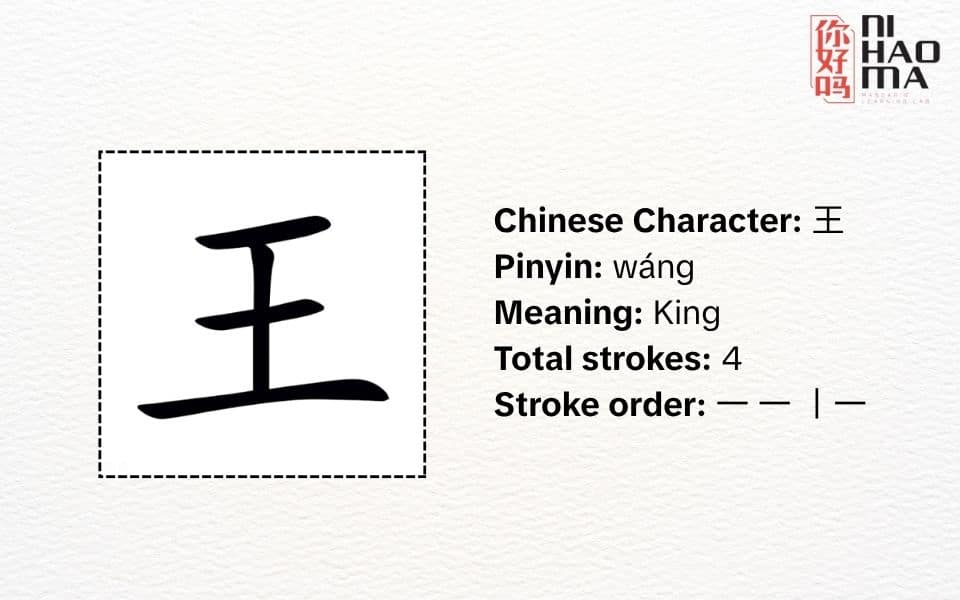
The 王 radical in Chinese (wáng) means “king” or “ruler.” It commonly appears in characters and words associated with kings, power, royalty, jade, precious stones, and valuable objects.
The character 王 consists of three horizontal strokes and one vertical stroke. Traditionally, the three horizontal strokes are interpreted as representing Heaven, humanity, and Earth. The vertical stroke passes through all three, symbolizing the king as a figure who connects Heaven, people, and the Earth.
In ancient times, the characters 王 (king) and 玉 (jade) were originally written in very similar forms, with three horizontal strokes connected by one vertical stroke. Later, a dot was added to 玉 to distinguish it from 王 when the characters were used independently.
However, when 玉 appears as a component on the left side of another Chinese character, the dot is usually omitted for writing convenience, resulting in the form ⺩, which looks almost identical to 王.
For example:
- 珍 (zhēn) – precious; valuable
- 珠 (zhū) – pearl
- 玉石 (yùshí) – jade; precious stone
The Relationship Between the 王 Radical and the 玉 Radical
The 王 radical (王) and the 玉 radical (玉) are two concepts that often confuse Chinese learners because they look very similar. 王 (wáng) means “king” or “ruler,” while 玉 (yù) means “jade” or “precious stone.”
The interesting point is that when 玉 is used as a component on the left side of a Chinese character, it is commonly written as ⺩. This form looks almost identical to 王, so beginners may easily assume that every character containing ⺩ on the left contains the 王 radical.
In the 214 Kangxi radicals, the 96th radical is traditionally classified as 玉 (jade), also associated with the form 王 in radical indexing. This radical category includes the independent character 玉, the independent character 王, and Chinese characters containing the left-side variant ⺩.
It is important to remember that 王 retains its original meaning of “king” when it is used independently or in positions where it functions as 王 itself. When the ⺩ form appears on the left side of another character, however, it is often historically related to 玉, rather than meaning “king.”
How to Write the 王 Radical in Chinese
The character 王 has four strokes. Its basic structure consists of three horizontal strokes crossed by one vertical stroke:
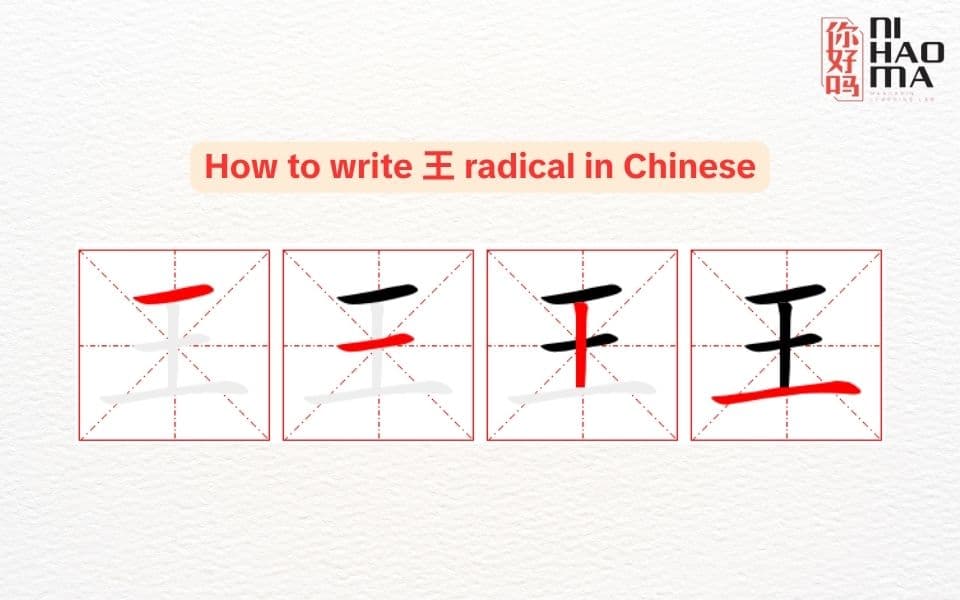
| Stroke Order | Stroke Name | How to Write |
|---|---|---|
| 1 | 一 (Horizontal stroke) | Write a short horizontal stroke at the top. |
| 2 | 一 (Horizontal stroke) | Write the second horizontal stroke in the middle, slightly longer than the first. |
| 3 | 丨 (Vertical stroke) | Write the vertical stroke from the center of the first stroke downward, passing through the second horizontal stroke. |
| 4 | 一 (Horizontal stroke) | Write the final horizontal stroke at the bottom, keeping the three horizontal strokes evenly spaced. |
When practicing 王, pay attention to the balance between the three horizontal strokes and the central vertical stroke. Keeping the strokes evenly spaced will make the character look more balanced and natural.
Chinese Vocabulary Containing the 王 Radical
After understanding the meaning and characteristics of the 王 radical, the next step is to apply it to real Chinese vocabulary.
Learning words that share the same character component can help you recognize Chinese characters more quickly and build connections between related vocabulary. It can also make character learning less dependent on memorization alone.
Below is a selection of commonly encountered and practical Chinese words containing 王 or the related ⺩ component.
| Chinese | Pinyin | Meaning |
|---|---|---|
| 王 | wáng | king; the surname Wang |
| 玩 | wán | to play |
| 班 | bān | class; work shift |
| 珠 | zhū | pearl; bead |
| 珍 | zhēn | precious; to treasure |
| 球 | qiú | ball |
| 理 | lǐ | reason; principle; to manage |
| 琴 | qín | musical instrument; zither |
| 玻璃 | bōli | glass |
| 王子 | wángzǐ | prince |
| 王后 | wánghòu | queen |
| 王国 | wángguó | kingdom |
| 国王 | guówáng | king; monarch |
| 女王 | nǚwáng | queen |
| 玩具 | wánjù | toy |
| 玩笑 | wánxiào | joke |
| 理由 | lǐyóu | reason |
| 理解 | lǐjiě | to understand |
| 理想 | lǐxiǎng | ideal; aspiration |
| 珍珠 | zhēnzhū | pearl |
| 珍贵 | zhēnguì | precious; valuable |
| 珍惜 | zhēnxī | to treasure; cherish |
| 班级 | bānjí | class |
| 球员 | qiúyuán | player; athlete |
| 球队 | qiúduì | sports team |
| 球场 | qiúchǎng | sports field; stadium |
| 足球 | zúqiú | football; soccer |
| 篮球 | lánqiú | basketball |
| 排球 | páiqiú | volleyball |
| 网球 | wǎngqiú | tennis |
| 玩儿 | wánr | to play |
| 理发 | lǐfà | to have one’s hair cut; haircut |
| 理论 | lǐlùn | theory |
| 管理 | guǎnlǐ | to manage; management |
| 经理 | jīnglǐ | manager |
| 心理 | xīnlǐ | psychology; psychological |
| 道理 | dàolǐ | reason; principle |
| 处理 | chǔlǐ | to handle; deal with |
| 物理 | wùlǐ | physics |
| 生理 | shēnglǐ | physiological |
| 料理 | liàolǐ | cooking; cuisine |
| 王室 | wángshì | royal family; royal household |
| 王位 | wángwèi | throne |
| 王宫 | wánggōng | royal palace |
| 王朝 | wángcháo | dynasty |
| 王妃 | wángfēi | princess consort; royal consort |
| 王爷 | wángyé | prince; nobleman |
| 王冠 | wángguān | crown |
| 王权 | wángquán | royal power; sovereignty |
| 王族 | wángzú | royal family; royal clan |
| 王者荣耀 | Wángzhě Róngyào | Honor of Kings |
Example Dialogues Using Vocabulary Related to the 王 Radical
Knowing the meaning of a word is only the first step. To use Chinese naturally, learners need to practice putting new vocabulary into sentences and real-life situations.
When learning vocabulary related to the 王 radical, you can practice through familiar topics such as introducing yourself, visiting historical sites, and discussing royal families.
Dialogue 1
A: 你好,你叫什么名字?
Nǐ hǎo, nǐ jiào shénme míngzi?
Hello, what is your name?
B: 你好,我叫王明。
Nǐ hǎo, wǒ jiào Wáng Míng.
Hello, my name is Wang Ming.
A: 好的,小王,很高兴认识你。
Hǎo de, Xiǎo Wáng, hěn gāoxìng rènshi nǐ.
Okay, Xiao Wang. Nice to meet you.
B: 我也很高兴认识你!
Wǒ yě hěn gāoxìng rènshi nǐ!
Nice to meet you too!
Dialogue 2
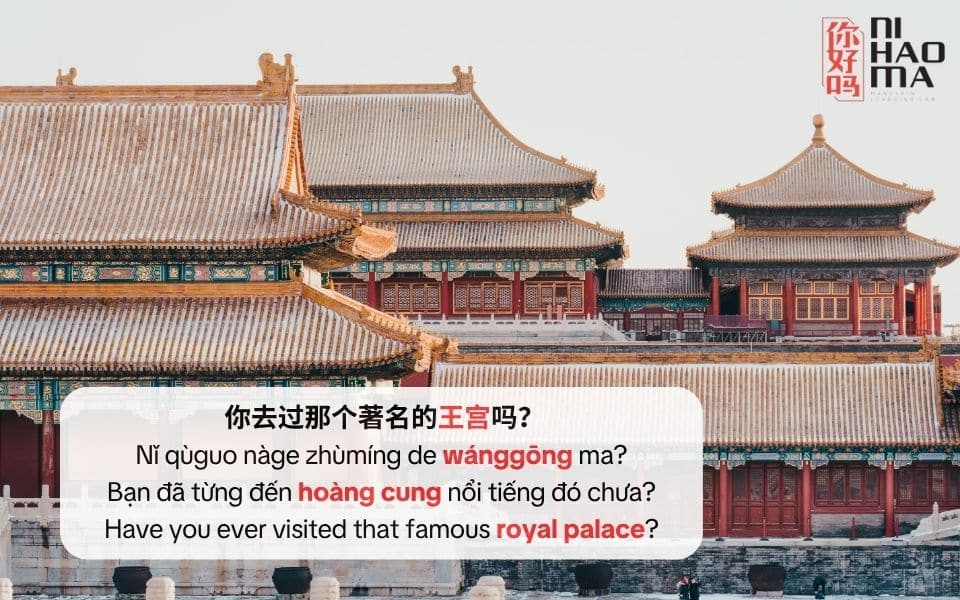
A: 你去过那个著名的王宫吗?
Nǐ qùguo nàge zhùmíng de wánggōng ma?
Have you ever visited that famous royal palace?
B: 去过,王宫真的非常漂亮。
Qùguo, wánggōng zhēn de fēicháng piàoliang.
Yes, I have. The royal palace is really beautiful.
A: 里面还有王室以前使用的东西吗?
Lǐmiàn hái yǒu wángshì yǐqián shǐyòng de dōngxi ma?
Are there still objects that the royal family used in the past?
B: 有,里面有很多家具、衣服,还有王冠。
Yǒu, lǐmiàn yǒu hěn duō jiājù, yīfu, hái yǒu wángguān.
Yes. There are many pieces of furniture, clothes, and even a crown.
Dialogue 3
A: 你对古代王朝的历史感兴趣吗?
Nǐ duì gǔdài wángcháo de lìshǐ gǎn xìngqù ma?
Are you interested in the history of ancient dynasties?
B: 很感兴趣,我特别喜欢了解王室的生活。
Hěn gǎn xìngqù, wǒ tèbié xǐhuan liǎojiě wángshì de shēnghuó.
Very much. I especially enjoy learning about the lives of royal families.
A: 我觉得王室的生活一定和普通人的生活很不一样。
Wǒ juéde wángshì de shēnghuó yídìng hé pǔtōng rén de shēnghuó hěn bù yíyàng.
I think life in a royal family must be very different from that of ordinary people.
B: 是的,特别是在过去,王权和王室在社会中都有很重要的地位。
Shì de, tèbié shì zài guòqù, wángquán hé wángshì zài shèhuì zhōng dōu yǒu hěn zhòngyào de dìwèi.
Yes. Especially in the past, royal power and the royal family held important positions in society.
Conclusion
The 王 radical is more than just a simple component of Chinese characters. Learning 王 provides an interesting way to explore Chinese characters, their meanings, and their historical development.
Understanding the difference between 王 (wáng) and 玉 (yù) is particularly useful because the left-side form ⺩ can look almost identical to 王 in many Chinese characters. Recognizing this distinction can help learners identify characters more accurately and build stronger connections between vocabulary.
If you want to learn Chinese systematically with a clear learning path, easy-to-understand teaching methods, and comprehensive practice across different language skills, explore the Chinese programs at Ni Hao Ma. Combining radicals, vocabulary, grammar, and communication practice in one learning journey can help you build a strong foundation and become more confident using Chinese in real-life situations.