Among the 214 Kangxi radicals, radical 109 (目) plays an important role and appears frequently in both everyday Chinese conversation and written texts. This guide provides a comprehensive overview of radical 109 in Chinese, covering its historical origins, pictographic meaning, stroke order, and practical vocabulary to help learners better understand and remember Chinese characters.
What Is Radical 109 in Chinese?
Radical 109 in Chinese (目 – mù) is the 109th radical among the 214 Kangxi radicals, with the original meaning of “eye.”
From a visual perspective, 目 is a pictographic character that originally represented the shape of an eye. In ancient Chinese scripts, the character had a relatively recognizable representation of the eye and pupil.
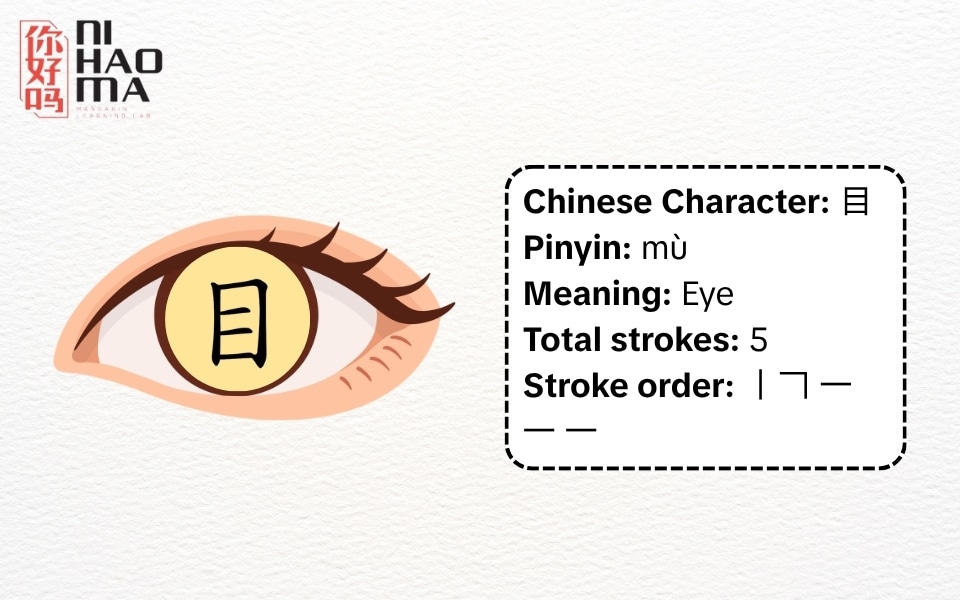
Starting from its original meaning of “eye,” the character 目 gradually developed additional meanings. According to the Kangxi Dictionary, more than 647 Chinese characters contain this radical. Radical 109 appears in many characters associated with vision, observation, and seeing. Over time, its meaning also expanded into various abstract concepts.
For example:
- 眼 (yǎn) – eye
- 睡 (shuì) – to sleep
- 目的 (mùdì) – purpose; objective
This development illustrates an interesting semantic connection: an “eye” is the body part used to direct attention toward something. From this idea, 目 developed into concepts related to something being observed or focused on, eventually giving rise to meanings such as objective, goal, and purpose.
How to Write Radical 109 in Chinese
To write radical 109 accurately and maintain proper Chinese character proportions, learners should follow standard Chinese stroke-order rules. The stroke order for 目 is as follows:
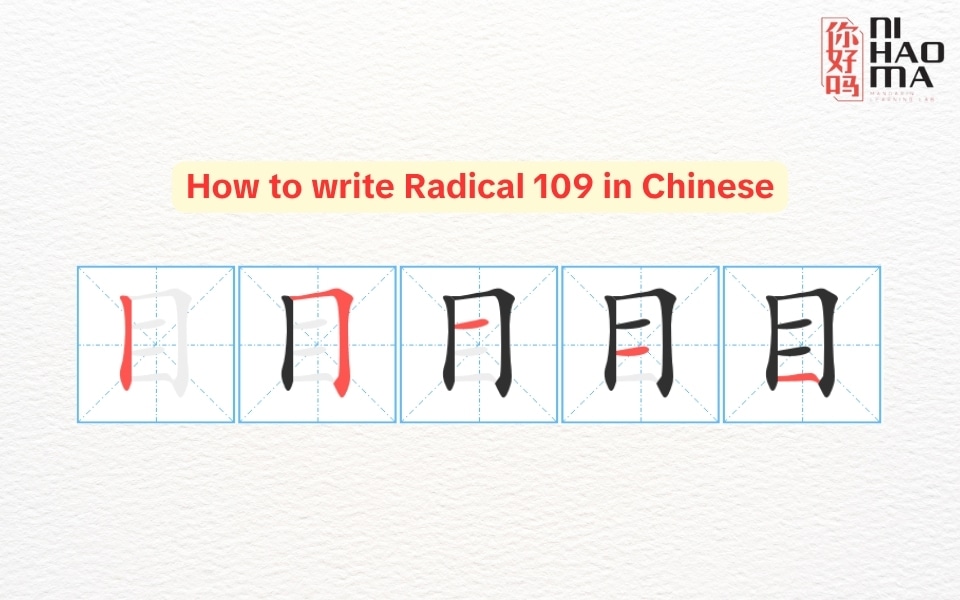
| Stroke Order | Stroke Name | Description |
|---|---|---|
| 1 | Vertical stroke (丨) | Start from the upper-left area and draw a straight vertical line downward to form the left side of the character. |
| 2 | Horizontal turning stroke (𠃍) | Start at the top of the first stroke, move horizontally to the right, then turn downward to form the right side. |
| 3 | Horizontal stroke (一) | Draw a short horizontal stroke inside the character, extending from the left side without closing the character. |
| 4 | Horizontal stroke (一) | Draw the second horizontal stroke inside, keeping an even distance between the two inner strokes. |
| 5 | Horizontal stroke (一) | Draw the final horizontal stroke across the bottom to close the character. |
How to Distinguish Radical 109 from Radical 72 in Chinese
In Chinese, radical 72 日 (rì) and radical 109, 目 (mù) are easy to confuse because both characters look like rectangular shapes with strokes inside. From a historical perspective, both 日 and 目 are pictographic characters, but they originally represented different objects.
The easiest way to distinguish them visually is to look at the number of strokes. 日 has 4 strokes and one horizontal stroke inside, while 目 has 5 strokes and two horizontal strokes inside. A simple way to remember the difference is: 日 has one horizontal stroke inside, while 目 has two.
Common Chinese Vocabulary Containing Radical 109
If you have ever confused Chinese characters with similar shapes, learning vocabulary through radicals can make it easier to recognize and remember characters. Below are some common words containing radical 109 in Chinese, allowing you to see how this radical appears in modern Chinese vocabulary.
| Chinese Character | Pinyin | Meaning |
|---|---|---|
| 看 | kàn | to look; to watch; to read |
| 眼 | yǎn | eye; small opening |
| 盯 | dīng | to stare at |
| 盼 | pàn | to look forward to; to hope |
| 盾 | dùn | shield |
| 眉 | méi | eyebrow |
| 眠 | mián | to sleep; sleep |
| 睡 | shuì | to sleep |
| 盲 | máng | blind; blind-minded |
| 瞩 | zhǔ | to focus attention on |
| 眼睛 | yǎnjing | eyes |
| 目的 | mùdì | purpose; objective |
| 目录 | mùlù | directory; table of contents |
| 目前 | mùqián | currently; at present |
| 睡觉 | shuìjiào | to sleep; go to bed |
| 节目 | jiémù | program; show |
| 互相 | hùxiāng | each other; mutually |
| 盲目 | mángmù | blind; blindly |
| 盯着 | dīngzhe | to stare at; keep looking at |
| 瞩目 | zhǔmù | to attract attention |
| 眉毛 | méimao | eyebrow |
| 科目 | kēmù | subject; school subject |
| 项目 | xiàngmù | project; item |
| 题目 | tímù | title; question; topic |
| 面目 | miànmù | appearance; face |
| 失眠 | shīmián | insomnia |
| 睡眠 | shuìmián | sleep |
| 矛盾 | máodùn | contradiction; conflict |
| 反省 | fǎnxǐng | to reflect on oneself; self-examination |
| 看病 | kànbìng | to see a doctor |
| 看法 | kànfǎ | opinion; point of view |
| 看见 | kànjiàn | to see |
| 眼镜 | yǎnjìng | glasses; eyeglasses |
| 眼光 | yǎnguāng | vision; perspective |
| 眼神 | yǎnshén | look; expression in one’s eyes |
| 眨眼 | zhǎyǎn | to blink; in the blink of an eye |
| 亲睹 | qīndǔ | to witness personally |
| 眼目 | yǎnmù | eyes; informants |
| 眼泪 | yǎnlèi | tears |
| 眼力 | yǎnlì | eyesight; power of observation |
Chinese Dialogues Using Radical 109 in Chinese
Learning Chinese characters in context is an effective way to understand how vocabulary containing radical 109 (目) is naturally used in everyday communication. The following dialogues feature practical vocabulary containing this radical and related characters, helping learners practice pronunciation, meaning and usage at the same time.
Dialogue 1
A: 你的眼睛怎么了?
(Nǐ de yǎnjing zěnme le?)
What happened to your eyes?
B: 我的眼睛有一点儿疼。
(Wǒ de yǎnjing yǒu yìdiǎnr téng.)
My eyes hurt a little.
A: 你是不是看手机看太久了?
(Nǐ shì bú shì kàn shǒujī kàn tài jiǔ le?)
Have you been looking at your phone for too long?
B: 对,我昨天晚上一直看手机。
(Duì, wǒ zuótiān wǎnshang yìzhí kàn shǒujī.)
Yes, I kept looking at my phone last night.
A: 那你应该让眼睛休息一下。
(Nà nǐ yīnggāi ràng yǎnjing xiūxi yíxià.)
Then you should give your eyes a rest.
B: 好的,我以后会注意的。
(Hǎo de, wǒ yǐhòu huì zhùyì de.)
Okay, I’ll pay more attention in the future.

Dialogue 2
A: 你刚才看见小王了吗?
(Nǐ gāngcái kànjiàn Xiǎo Wáng le ma?)
Did you see Xiao Wang just now?
B: 看见了,他刚刚从教室出去。
(Kànjiàn le, tā gānggāng cóng jiàoshì chūqù.)
Yes, he just left the classroom.
A: 他去哪儿了?
(Tā qù nǎr le?)
Where did he go?
B: 我没看清楚,好像去了图书馆。
(Wǒ méi kàn qīngchu, hǎoxiàng qù le túshūguǎn.)
I didn’t see clearly. I think he went to the library.
A: 好的,我去图书馆找他。
(Hǎo de, wǒ qù túshūguǎn zhǎo tā.)
Okay, I’ll look for him at the library.
Dialogue 3
A: 你今晚有什么安排?
(Nǐ jīnwǎn yǒu shénme ānpái?)
What are your plans for tonight?
B: 我想在家看电视节目。
(Wǒ xiǎng zài jiā kàn diànshì jiémù.)
I want to stay home and watch a TV program.
A: 最近有什么好看的节目吗?
(Zuìjìn yǒu shénme hǎokàn de jiémù ma?)
Are there any good programs on recently?
B: 有一个音乐节目很受欢迎。
(Yǒu yí ge yīnyuè jiémù hěn shòu huānyíng.)
There is a music program that is very popular.
A: 节目几点开始?
(Jiémù jǐ diǎn kāishǐ?)
What time does the program start?
B: 八点开始,我们一起看吧。
(Bā diǎn kāishǐ, wǒmen yìqǐ kàn ba.)
It starts at eight. Let’s watch it together.
Conclusion
Mastering radical 109 in Chinese (目) is not simply about memorizing its stroke order. More importantly, understanding its meaning and development can help learners build logical associations when studying the Chinese writing system. Once you understand the core meaning of radical 109, it becomes easier to recognize and remember a wide range of verbs, nouns, and idiomatic expressions containing this radical.
Keep practicing the vocabulary in context, pay attention to stroke order, and stay tune to explore more useful Chinese radicals with Ni Hao Ma!