
When learning Chinese, memorizing individual Hanzi stroke by stroke can quickly become frustrating and make it easy to confuse similar characters. Learning Chinese vocabulary through radicals, however, can help learners understand character structures and remember new words more effectively.
Radical 187 in Chinese is a particularly distinctive pictographic radical. It not only carries strong cultural associations with the horse but also appears as a phonetic or structural component in numerous Chinese characters and high-frequency words used in everyday life.
What Is Radical 187 in Chinese?
Radical 187 in Chinese (马 / 馬 – mǎ) is the 187th radical in the Kangxi Dictionary. Its original meaning is “horse,” and it commonly appears in Chinese characters associated with horses, riding, movement, and speed.
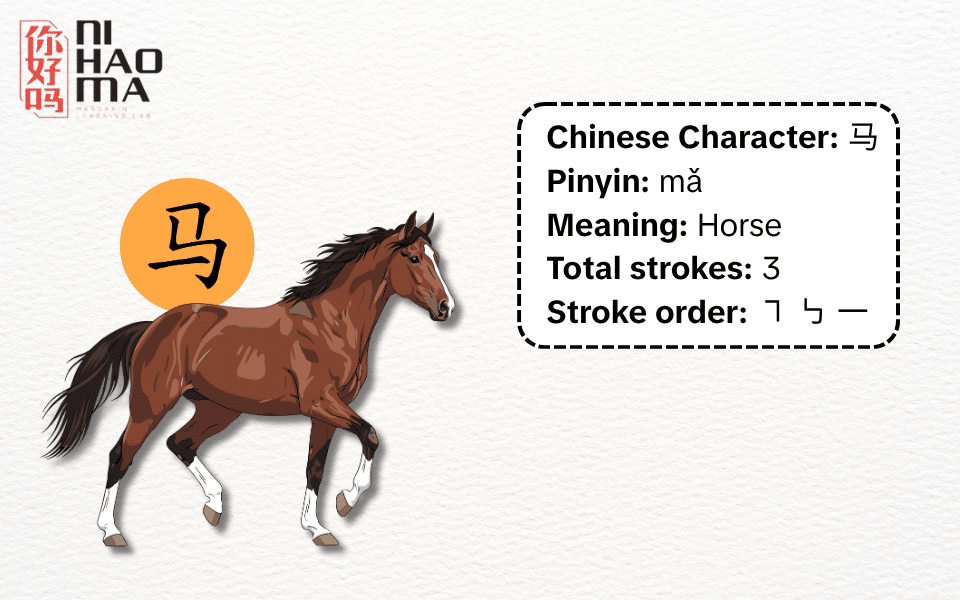
In ancient forms of Chinese writing, 馬 was a pictographic character representing the shape of a horse, including its head, body, mane, and legs. As Chinese characters evolved from ancient scripts into modern Chinese, the traditional form 馬 was simplified to 马. Although its written form changed considerably, its basic meaning, “horse,” remained unchanged.
The original meaning of 马 (mǎ) is “horse.” Throughout Chinese history, horses played an important role in warfare, transportation, logistics, and everyday life. As a result, the image of the horse appears in many Chinese words, idioms, and cultural expressions. Radical 187 can appear independently as a complete character or function as a component in other Chinese characters.
How to Write Radical 187 in Chinese
In simplified Chinese, radical 187 (马) consists of three strokes. Its stroke order is as follows:
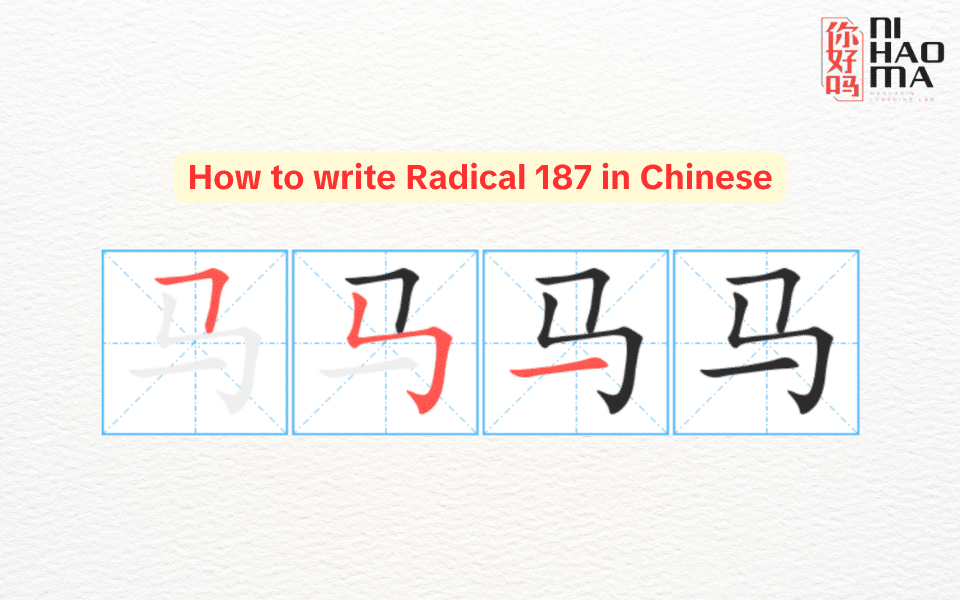
| Stroke Order | Stroke Name | Description |
|---|---|---|
| 1 | ㇕(Horizontal turning stroke) | Write a horizontal stroke, then turn downward at approximately a 90-degree angle. The turned section is about one-third of the character’s height. |
| 2 | ㇉ (Curved hook stroke) | Starting below the first horizontal stroke, write downward, move horizontally, then curve downward and finish with a slight hook toward the left. |
| 3 | 一 (Horizontal stroke) | Place the brush or pen in the lower middle section of the character and draw a horizontal stroke from left to right to complete the character. |
Chinese Vocabulary Containing Radical 187
After learning the meaning and writing of radical 187 (马), learners can expand their vocabulary by studying Chinese characters and words that contain this component. Below are some common examples selected by Ni Hao Ma that can be useful in everyday Chinese:
| Chinese | Pinyin | Meaning |
|---|---|---|
| 马 | mǎ | Horse |
| 骑 | qí | To ride (a motorcycle, bicycle, horse, etc.) |
| 骂 | mà | To scold; to curse |
| 驻 | zhù | To station; to stay |
| 骗 | piàn | To deceive; to cheat |
| 闯 | chuǎng | To rush into; to venture out; to make one’s way |
| 妈妈 | māma | Mother; mom |
| 姨妈 | yímā | Maternal aunt |
| 骑士 | qíshì | Knight; rider |
| 骑兵 | qíbīng | Cavalry |
| 马上 | mǎshàng | Immediately; right away |
| 号码 | hàomǎ | Number; phone number; identification number |
| 密码 | mìmǎ | Password; code |
| 尺码 | chǐmǎ | Size (clothing, shoes, etc.) |
| 经验 | jīngyàn | Experience |
| 实验 | shíyàn | Experiment |
| 检验 | jiǎnyàn | To inspect; to test; to examine |
| 体验 | tǐyàn | Experience; to experience |
| 查验 | cháyàn | To inspect; to verify |
| 验证 | yànzhèng | To verify; to authenticate |
| 码头 | mǎtou | Wharf; dock; pier |
| 蚂蚁 | mǎyǐ | Ant |
| 骗子 | piànzi | Fraudster; scammer |
| 源码 | yuánmǎ | Source code |
| 编码 | biānmǎ | Coding; encoding |
| 数码 | shùmǎ | Digital; digital technology |
| 马路 | mǎlù | Road; street |
| 驻扎 | zhùzhā | To station; to be stationed |
| 闯荡 | chuǎngdàng | To roam; to make one’s way in the world |
| 骄傲 | jiāo’ào | Proud; arrogant |
| 骤然 | zhòurán | Suddenly; abruptly |
| 驯服 | xùnfú | To tame; to domesticate |
| 惊骇 | jīnghài | Terrified; horrified |
| 马虎 | mǎhu | Careless; sloppy |
| 驱逐 | qūzhú | To expel; to drive out |
| 驳回 | bóhuí | To reject; to dismiss |
| 反驳 | fǎnbó | To refute; to rebut |
| 骚动 | sāodòng | Commotion; disturbance |
| 斑马 | bānmǎ | Zebra |
| 河马 | hémǎ | Hippopotamus |
| 海马 | hǎimǎ | Seahorse |
| 骁勇 | xiāoyǒng | Valiant; brave and courageous |
| 骆驼 | luòtuo | Camel |
| 驯鹿 | xùnlù | Reindeer |
| 骡子 | luózi | Mule |
| 驹子 | jūzi | Foal; young horse |
Chinese Idioms Containing Radical 187
Radical 187 in Chinese (马) is one of the recognizable components in Chinese characters and has a strong cultural connection with the history of horses in China. Originating from an ancient pictographic representation of a horse, the character 马 has developed beyond its literal meaning and appears in many Chinese idioms and cultural expressions.
Here are several common Chinese idioms containing 马:
| Idiom | Pinyin | Meaning |
|---|---|---|
| 马到成功 | mǎ dào chéng gōng | To achieve success immediately; to succeed from the very beginning |
| 一马当先 | yī mǎ dāng xiān | To take the lead; to be the first to charge ahead |
| 千军万马 | qiān jūn wàn mǎ | A vast and powerful force; a large-scale army |
| 青梅竹马 | qīng méi zhú mǎ | Childhood sweethearts; close friends who grew up together |
| 塞翁失马 | sài wēng shī mǎ | A setback may turn into a blessing; misfortune and fortune can change unexpectedly |
| 龙马精神 | lóng mǎ jīng shén | Vigorous spirit; abundant energy and vitality |
| 老马识途 | lǎo mǎ shí tú | An experienced person knows the way; experience brings wisdom |
| 指鹿为马 | zhǐ lù wéi mǎ | To call a deer a horse; to deliberately distort the truth |
Sample Dialogues Using Chinese Vocabulary Containing Radical 187
Once you have learned a list of Chinese words containing radical 187, practicing them in real-life contexts can help you remember them more effectively and develop more natural speaking skills. The following dialogues introduce common vocabulary containing 马 and related components in practical conversational situations.
Dialogue 1
A: 你周末有什么计划?
Nǐ zhōumò yǒu shénme jìhuà?
→ What are your plans for the weekend?
B: 我想去马场骑马。
Wǒ xiǎng qù mǎchǎng qí mǎ.
→ I want to go to a horse ranch to ride horses.
A: 你以前骑过马吗?
Nǐ yǐqián qí guò mǎ ma?
→ Have you ever ridden a horse before?
B: 骑过一次,但是还不太熟练。
Qí guò yí cì, dànshì hái bú tài shúliàn.
→ I have ridden one once, but I’m still not very good at it.
A: 没关系,我们可以请教练教我们。
Méi guānxi, wǒmen kěyǐ qǐng jiàoliàn jiāo wǒmen.
→ That’s okay. We can ask a coach to teach us.
Dialogue 2
A: 你每天怎么去上班?
Nǐ měitiān zěnme qù shàngbān?
→ How do you get to work every day?
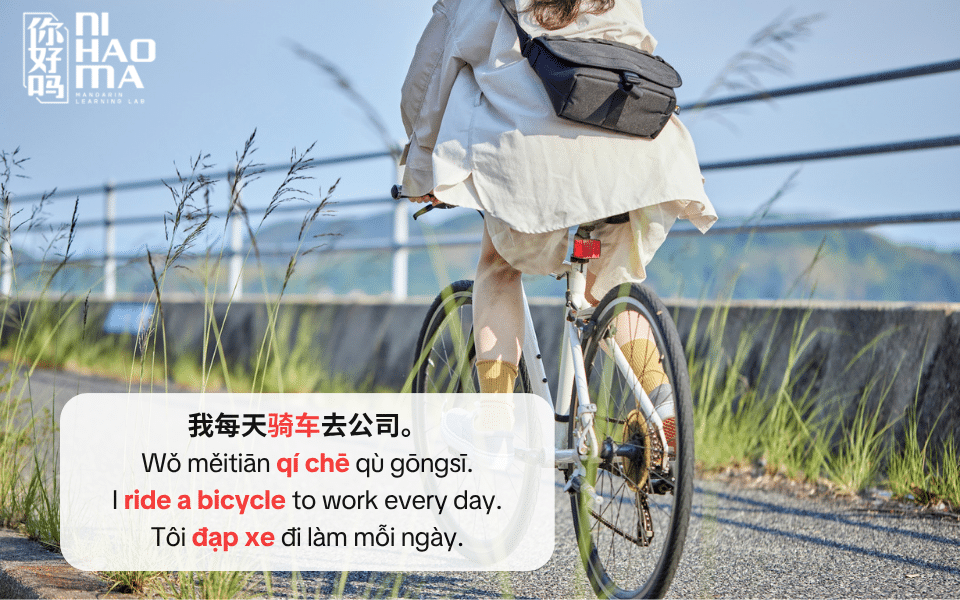
B: 我每天骑车去公司。
Wǒ měitiān qí chē qù gōngsī.
→ I ride a bicycle to work every day.
A: 公司离你家很远吗?
Gōngsī lí nǐ jiā hěn yuǎn ma?
→ Is your company far from your home?
B: 不远,骑车大概二十分钟。
Bù yuǎn, qí chē dàgài èrshí fēnzhōng.
→ Not far. It takes about 20 minutes by bicycle.
Dialogue 3
A: 你的手机怎么打不开?
Nǐ de shǒujī zěnme dǎ bù kāi?
→ Why can’t you unlock your phone?
B: 我忘记密码了。
Wǒ wàngjì mìmǎ le.
→ I forgot my password.
A: 你试过以前常用的密码吗?
Nǐ shì guo yǐqián chángyòng de mìmǎ ma?
→ Have you tried the password you usually used before?
B: 试过了,但是还是不对。
Shì guo le, dànshì háishi bú duì.
→ I have, but it’s still not correct.
A: 那你可以点击“忘记密码”,重新设置。
Nà nǐ kěyǐ diǎnjī “wàngjì mìmǎ”, chóngxīn shèzhì.
→ Then you can click “Forgot Password” and reset it.
Conclusion
Hopefully, this guide has helped you understand the meaning, structure, writing, and vocabulary associated with radical 187 in Chinese. Learning Chinese vocabulary through radicals is a useful foundation for understanding how Hanzi are constructed, strengthening vocabulary retention, and making unfamiliar characters easier to recognize and remember.
How many Chinese words containing radical 187 can you remember now? Save this article for regular review, and continue exploring more fascinating Chinese radicals with Ni Hao Ma to build your Chinese vocabulary and Hanzi knowledge step by step.