
In Chinese, each character is often built from smaller components called radicals, and each radical carries its own meaning. Learning radicals helps students better understand how Chinese characters are formed and makes vocabulary memorization much easier. Radical 13 (冂) is one of the basic Kangxi radicals.
Although it has a simple shape, it appears in many commonly used Chinese characters. So, what is Radical 13 in Chinese, what does it mean, and which vocabulary words contain it? In this article, we’ll explore the writing, meaning, and common Chinese characters that include Radical 13 in detail.
What Is Radical 13 in Chinese?
In the system of 214 Kangxi radicals, Radical 13 (冂 – jiōng) is ranked in the 13th position and functions as an enclosing frame in many Chinese characters.
In terms of structure, Radical 13 is made up of 2 basic strokes: a vertical stroke on the left and a vertical hook stroke on the right. Its shape resembles an open frame at the bottom, which suggests an open space or a broad boundary. According to ancient Chinese references, this radical originally represented a distant area beyond the borders—a place rarely reached by people.
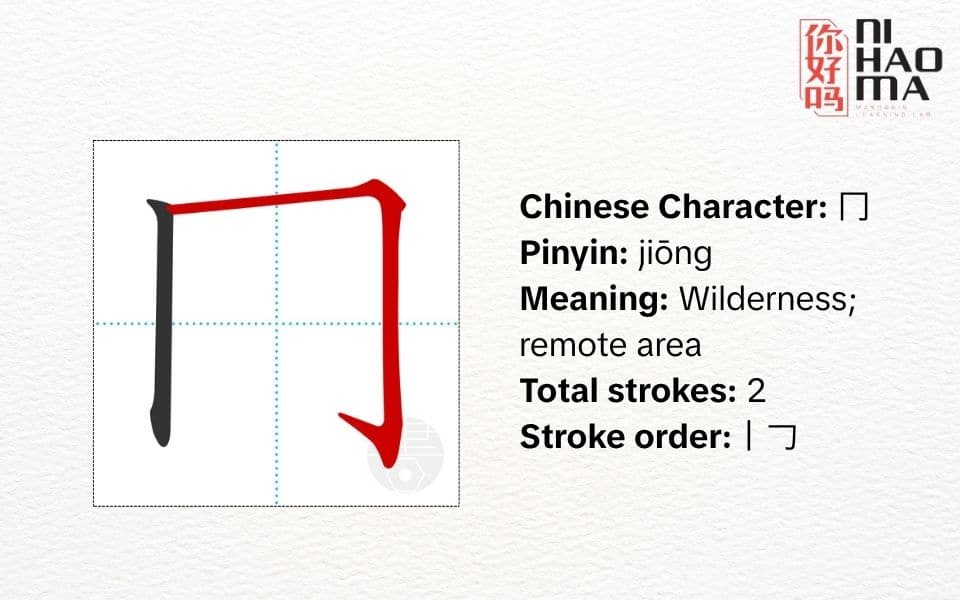
Understanding this symbolic meaning can help learners guess the meaning of characters more effectively. Most Chinese characters containing Radical 13 are related to ideas such as enclosure, boundaries, or defined spaces. Once you grasp the “core meaning” of the radical, you will not only remember characters faster but also gain deeper insight into the visual logic behind Chinese character creation.
Vocabulary Words Containing Radical 13
Learning radical theory is an important foundation, but to truly master Chinese, you need to see how radicals function in real vocabulary. Although Radical 13 has a simple form, it appears in many words ranging from beginner-level Chinese to more advanced vocabulary.
Below is a collection of common vocabulary words that contain Radical 13:
| Vocabulary | Pinyin | Meaning |
|---|---|---|
| 同 | tóng | Same; together |
| 周 | zhōu | Week; around |
| 用 | yòng | To use |
| 内 | nèi | Inside |
| 再 | zài | Again |
| 册 | cè | Book; volume |
| 冈 | gāng | Ridge; low hill |
| 网 | wǎng | Net; network |
| 军 | jūn | Army |
| 南 | nán | South |
| 向 | xiàng | Toward |
| 商 | shāng | Commerce; trade |
| 高 | gāo | Tall; high |
| 京 | jīng | Capital city |
| 同学 | tóngxué | Classmate |
| 同意 | tóngyì | To agree |
| 同事 | tóngshì | Colleague |
| 同样 | tóngyàng | Same |
| 同时 | tóngshí | At the same time |
| 周末 | zhōumò | Weekend |
| 周围 | zhōuwéi | Surroundings |
| 周年 | zhōunián | Anniversary |
| 周到 | zhōudào | Thoughtful |
| 周期 | zhōuqī | Cycle; period |
| 用法 | yòngfǎ | Usage |
| 用心 | yòngxīn | Attentive |
| 用力 | yònglì | To exert force |
| 使用 | shǐyòng | To use |
| 有用 | yǒuyòng | Useful |
| 内外 | nèiwài | Inside and outside |
| 内容 | nèiróng | Content |
| 国内 | guónèi | Domestic; within the country |
| 室内 | shìnèi | Indoors |
| 内心 | nèixīn | Inner thoughts |
| 再见 | zàijiàn | Goodbye |
| 再次 | zàicì | Once again |
| 再说 | zàishuō | Talk later |
| 手册 | shǒucè | Handbook |
| 名册 | míngcè | Name list |
| 军人 | jūnrén | Soldier |
| 军队 | jūnduì | Army |
| 海军 | hǎijūn | Navy |
| 南方 | nánfāng | The South |
| 南京 | Nánjīng | Nanjing |
| 向前 | xiàngqián | Move forward |
| 方向 | fāngxiàng | Direction |
| 一向 | yīxiàng | Always; all along |
| 商店 | shāngdiàn | Shop |
| 商业 | shāngyè | Business; commerce |
| 商人 | shāngrén | Merchant |
| 高兴 | gāoxìng | Happy |
| 高中 | gāozhōng | High school |
| 高级 | gāojí | Advanced |
| 北京 | Běijīng | Beijing |
| 京剧 | jīngjù | Peking opera |
| 上网 | shàngwǎng | Go online |
| 网络 | wǎngluò | Internet; network |
| 网页 | wǎngyè | Web page |
| 网站 | wǎngzhàn | Website |
| 网上 | wǎngshàng | Online |
Sample Dialogues Using Radical 13 Vocabulary
Studying vocabulary lists alone is not enough. The next important step is to place words into real communication contexts. When you see how vocabulary containing Radical 13 works in everyday conversations, you will remember the words more naturally and use them more confidently.
Here are two short sample dialogues to help you practice vocabulary related to Radical 13:
Dialogue 1
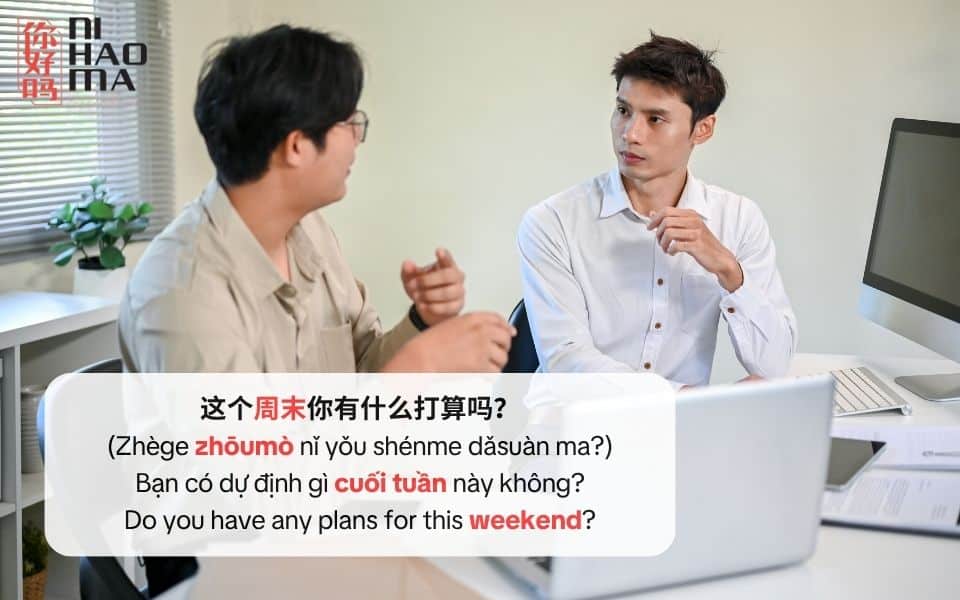
A: 大卫,这个周末你有什么打算吗?
(Dàwèi, zhège zhōumò nǐ yǒu shénme dǎsuàn ma?)
David, do you have any plans for this weekend?
B: 我还没想好,你呢?
(Wǒ hái méi xiǎng hǎo, nǐ ne?)
I haven’t decided yet. What about you?
A: 我想约几个同学一起去爬山。
(Wǒ xiǎng yuē jǐ gè tóngxué yīqǐ qù páshān.)
I want to invite a few classmates to go hiking.
B: 太好了!我非常高兴参加。
(Tài hǎo le! Wǒ fēicháng gāoxìng cānjiā.)
That sounds great! I’d be very happy to join.
A: 那我们就这么定了吧,周六见!
(Nà wǒmen jiù zhème dìng le ba, zhōuliù jiàn!)
Then it’s settled. See you on Saturday!
B: 好的,再见!
(Hǎo de, zàijiàn!)
Okay, goodbye!
Dialogue 2
A: 你看了我发给你的邮件内容吗?
(Nǐ kànle wǒ fā gěi nǐ de yóujiàn nèiróng ma?)
Did you read the content of the email I sent you?
B: 我刚看完,我完全同意你的想法。
(Wǒ gāng kàn wán, wǒ wánquán tóngyì nǐ de xiǎngfǎ.)
I just finished reading it, and I completely agree with your idea.
A: 太好了,我们需要加强内部沟通。
(Tài hǎo le, wǒmen xūyào jiāqiáng nèibù gōutōng.)
That’s great. We need to improve internal communication.
B: 对,明确方向对项目很重要。
(Duì, míngquè fāngxiàng duì xiàngmù hěn zhòngyào.)
Yes, having a clear direction is very important for the project.
A: 那么,请你把计划书重新写一下。
(Nàme, qǐng nǐ bǎ jìhuàshū chóngxīn xiě yīxià.)
Then, please revise the proposal.
B: 没问题,我会尽力而为。
(Méi wèntí, wǒ huì jìnlì ér wéi.)
No problem, I’ll do my best.
Conclusion
Understanding Radical 13 in Chinese is not only helpful for decoding the meaning of many Chinese characters, but it is also a practical way to expand your vocabulary in a more structured and effective manner. The key to learning Chinese is not simply memorizing characters, but combining radical knowledge with regular speaking and practical usage. Once you understand the “root” of Chinese characters, learning becomes much more logical, enjoyable, and efficient.
If you are looking for a structured Chinese learning environment with a clear roadmap and dedicated teachers, consider joining a professional Chinese language center to strengthen all four language skills while gaining deeper insight into Chinese culture and communication. With the right guidance, your Chinese learning journey can become much easier and more rewarding.