
When beginners start learning Chinese, many feel overwhelmed because Chinese characters seem to have too many strokes and can be difficult to memorize. However, once you understand radicals, learning vocabulary becomes much more logical, and guessing the meaning of unfamiliar characters becomes easier.
One of the most common radicals learners encounter is Radical 19 (力). So, what is Radical 19 in Chinese? What does it mean, and which common words contain this radical? If you want to memorize Chinese characters more effectively, this guide will help you understand Radical 19, its meaning, and how to apply it in real-life Chinese learning.
What Is Radical 19 in Chinese?
Radical 19 (力 – lì) is the 19th radical in the Kangxi system of 214 Chinese radicals. Its primary meaning is strength, power, force, or energy.
According to studies of ancient Chinese script, the original form of Radical 19 is believed to represent a plow, a farming tool that required physical effort in ancient agricultural life. Other interpretations suggest that the character resembles a muscular arm lifting a heavy object, symbolizing physical power.
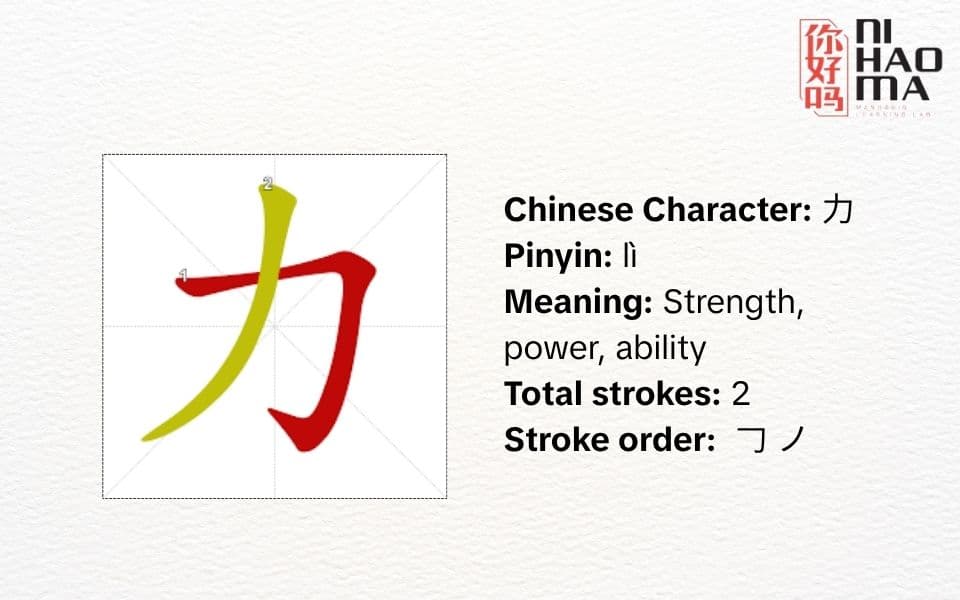
Symbolically, Radical 19 often represents:
- Physical strength
- Working ability
- Effort and perseverance
- Force or powerful influence
When you see Radical 19 in a Chinese character, you can often predict that the character relates to strength, effort, movement, labor, ability, or energetic action.
How to write Radical 19 in Chinese
Radical 19 (力) consists of 2 strokes:
| Stroke Order | Stroke Name | Writing Method |
|---|---|---|
| 1 | Horizontal turning hook (𠃌) | Write horizontally from left to right, then turn downward and finish with a hook to the left |
| 2 | Left-falling stroke (ノ) | Write from upper right to lower left with a slight curve |
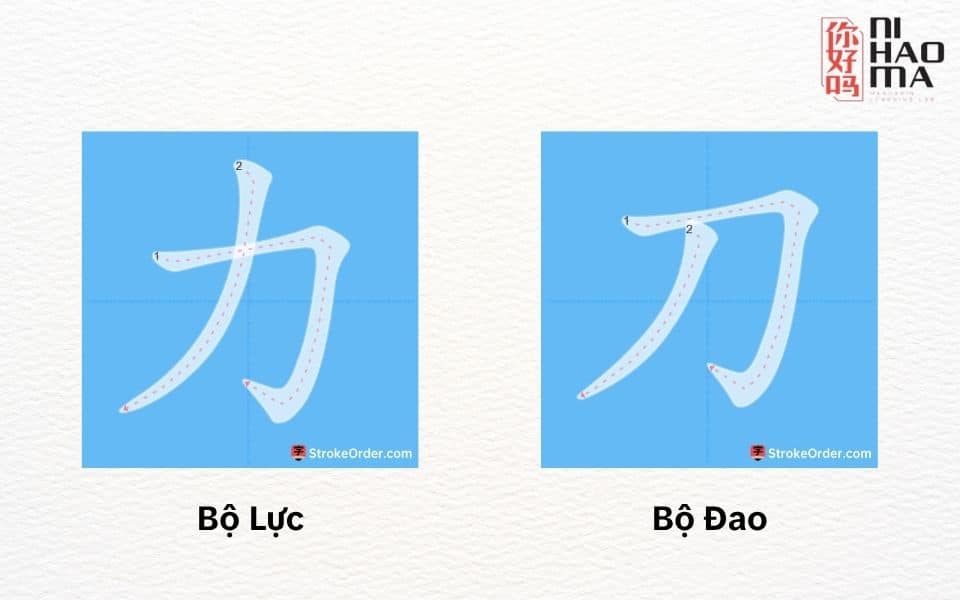
Difference Between the Radical 18 and Radical 19 in Chinese
A common point of confusion for Chinese learners is that Radical 18 (刀) and Radical 19 (力) have very similar shapes. Because of this, many beginners find it difficult to tell them apart. However, if you carefully observe the stroke structure of each radical, you can distinguish them quite easily.
- Radical 18 (刀 – dāo): This is the 18th radical in the system of 214 Kangxi radicals. Its shape originally comes from the image of a knife blade, so Chinese characters containing this radical are often related to cutting, slicing, dividing, or punishment. One important feature is that the left-falling stroke does not cross the top horizontal stroke.
- Radical 19 (力 – lì): This radical is believed to originate from the image of a worker’s muscular arm exerting force. Chinese characters containing Radical 19 are often associated with strength, effort, labor, hard work, and determination. Radical 19 has only one written form: 力, with no alternative variants. A key identifying feature is that the left-falling stroke crosses through the top horizontal stroke.
Vocabulary Containing Radical 19 in Chinese
After understanding the meaning and role of Radical 19, the next step is learning how to apply it in real Chinese vocabulary. Radical 19 appears in many familiar words used in daily communication, education, work, and social life.
| Chinese Character | Pinyin | Meaning |
|---|---|---|
| 力 | lì | Strength, force |
| 办 | bàn | To do, handle, solve |
| 加 | jiā | Add, increase, plus |
| 功 | gōng | Merit, achievement |
| 助 | zhù | Help, assist |
| 务 | wù | Duty, task |
| 动 | dòng | Move, motion |
| 勇 | yǒng | Brave, courageous |
| 劳 | láo | Labor, fatigue |
| 胜 | shèng | Win, overcome |
| 劝 | quàn | Advise, persuade |
| 势 | shì | Power, force, situation |
| 努 | nǔ | Strive, make an effort |
| 励 | lì | Encourage |
| 劣 | liè | Inferior, poor |
| 勃 | bó | Vigorous, flourishing |
| 勉 | miǎn | Make an effort, reluctantly |
| 勘 | kān | Investigate, survey |
| 劫 | jié | Rob, disaster |
| 劾 | hé | Impeach, accuse |
| 努力 | nǔlì | To make an effort |
| 力量 | lìliàng | Strength, power |
| 能力 | nénglì | Ability, capability |
| 压力 | yālì | Pressure, stress |
| 动力 | dònglì | Motivation, driving force |
| 办法 | bànfǎ | Solution, method |
| 办公 | bàngōng | Office work, administration |
| 加班 | jiābān | Work overtime |
| 加油 | jiāyóu | Keep going / Add fuel |
| 成功 | chénggōng | Success |
| 功夫 | gōngfu | Skill, effort, time |
| 帮助 | bāngzhù | Help, assist |
| 助理 | zhùlǐ | Assistant |
| 任务 | rènwù | Task, mission |
| 服务 | fúwù | Service |
| 动作 | dòngzuò | Movement, action |
| 动物 | dòngwù | Animal |
| 勇敢 | yǒnggǎn | Brave |
| 勇气 | yǒngqì | Courage |
| 劳动 | láodòng | Labor |
| 疲劳 | píláo | Fatigue |
| 胜利 | shènglì | Victory |
| 名胜 | míngshèng | Scenic spot |
| 劝告 | quàngào | Advise, warn |
| 形式 | xíngshì | Form, pattern |
| 姿势 | zīshì | Posture |
| 鼓励 | gǔlì | Encourage |
| 奖励 | jiǎnglì | Reward |
| 勉强 | miǎnqiǎng | Reluctantly |
| 功劳 | gōngláo | Contribution, merit |
| 智力 | zhìlì | Intelligence |
| 体力 | tǐlì | Physical strength |
| 潜力 | qiánlì | Potential |
| 脑力 | nǎolì | Brainpower |
| 视力 | shìlì | Vision, eyesight |
| 听力 | tīnglì | Listening ability |
| 毅力 | yìlì | Perseverance |
| 主力 | zhǔlì | Main force |
| 实办 | shíbàn | Carry out, implement |
| 办案 | bàn’àn | Handle a case |
| 加工 | jiāgōng | Process, manufacture |
| 功能 | gōngnéng | Function |
| 功利 | gōnglì | Utilitarian, pragmatic |
| 主动 | zhǔdòng | Take initiative |
| 感动 | gǎndòng | Be moved, touched |
| 劣势 | lièshì | Disadvantage |
| 勤劳 | qínláo | Hardworking |
| 劫持 | jiéchí | Kidnap, hijack |
| 勃勃 | bóbó | Vigorous, energetic |
| 巧克力 | qiǎokèlì | Chocolate |
Sample Chinese Dialogues Using Radical 19 Vocabulary
Learning vocabulary in isolation often leads to quick forgetting because there is no real context. Practicing dialogues helps learners remember words naturally and understand how to use them in everyday situations.
Dialogue 1
A: 考试快到了,我觉得学汉语太难了,压力很大。
(Kǎoshì kuài dào le, wǒ juédé xué Hànyǔ tài nán le, yālì hěn dà.)
The exam is coming soon. I think learning Chinese is really hard, and I feel a lot of pressure.
B: 别担心,只要你努力学习,一定可以考好。
(Bié dān xīn, zhǐyào nǐ nǔlì xuéxí, yīdìng kěyǐ kǎo hǎo.)
Don’t worry. As long as you study hard, you will definitely do well.
A: 但是我现在的口语能力还是不太好。
(Dànshì wǒ xiànzài de kǒuyǔ nénglì háishì bù tài hǎo.)
But my speaking ability is still not very good.
B: 坚持就是动力,我们要互相帮助。
(Jiānchí jiùshì dònglì, wǒmen yào hùxiāng bāngzhù.)
Persistence is motivation. We should help each other.
A: 谢谢你,我会继续加油的!
(Xièxiè nǐ, wǒ huì jìxù jiāyóu de!)
Thank you! I will keep trying!

Dialogue 2
A: 王经理,这个任务很难,你有办法解决吗?
(Wáng jīnglǐ, zhège rènwù hěn nán, nǐ yǒu bànfǎ jiějué ma?)
Manager Wang, this task is difficult. Do you have a solution?
B: 我们需要集合大家的力量来完成它。
(Wǒmen xūyào jíhé dàjiā de lìliàng lái wánchéng tā.)
We need to combine everyone’s strength to complete it.
A: 我担心团队的动力不够。
(Wǒ dānxīn tuánduì de dònglì bùgòu.)
I’m worried that the team lacks motivation.
B: 别怕,我会多鼓励大家,提高工作效果。
(Bié pà, wǒ huì duō gǔlì dàjiā, tígāo gōngzuò xiàoguǒ.)
Don’t worry. I will encourage everyone more and improve work efficiency.
A: 好的,我马上就去办。
(Hǎo de, wǒ mǎshàng jiù qù bàn.)
Okay, I’ll take care of it right away.
Conclusion
As you can see, Radical 19 is one of the most commonly used Chinese radicals in modern Chinese. Learning radicals does more than help you memorize Chinese characters faster – it also allows you to guess the meanings of new words more logically and naturally.
When you combine radical study with real conversation practice, you can improve both your vocabulary and your Chinese communication skills significantly. If you want to build a strong Chinese foundation, mastering Radical 19 is a great step toward understanding how Chinese characters work.