
Learning Chinese can feel overwhelming, especially when you’re faced with thousands of individual characters to memorize. That’s why understanding radicals is such a powerful shortcut. Among them, radical 12 in Chinese – also known as the “Ba” (八, bā) radical – is simple in form but surprisingly rich in meaning.
So, what exactly is radical 12 in Chinese, what does it represent, and which common words include it? Let’s explore together with Ni Hao Ma!
What Is Radical 12 in Chinese?
Radical 12 in Chinese (八 – bā) is the 12th radical in the Kangxi radical system, and its basic meaning is the number “eight.” It is considered one of the simplest Chinese radicals, consisting of just two strokes.
Because of its minimal structure, this radical is often introduced early in Chinese learning. However, despite its simplicity, it carries deeper symbolic meanings that can help learners better understand Chinese characters.
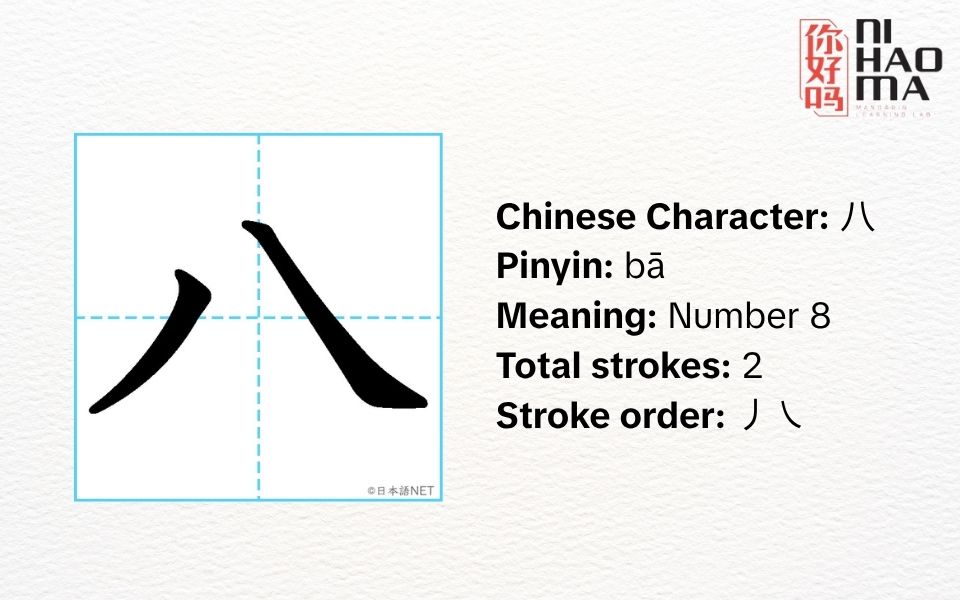
Visually, the radical 八 is written with two strokes that spread outward, resembling two branches opening in opposite directions. This shape is not just aesthetic – it reflects its extended meanings.
In addition to representing the number “eight,” radical 12 in Chinese often conveys the idea of:
- Division or splitting into parts
- Distribution or separation
- Expansion in multiple directions
Understanding this concept can help you guess the meanings of many Chinese characters that include this radical.
Vocabulary with Radical 12 in Chinese
Learning theory alone is not enough – you need to see how it works in real vocabulary. Since radical 12 in Chinese often implies division, separation, or expansion, many characters containing it are related to ideas like classification, public/shared concepts, numbers, or structure.
Below is a curated list of common words that include this radical, from basic to more advanced:
| Chinese Character | Pinyin | Meaning |
|---|---|---|
| 八 | bā | number 8 |
| 分 | fēn | to divide |
| 公 | gōng | public |
| 半 | bàn | half |
| 兰 | lán | orchid |
| 并 | bìng | and, simultaneously |
| 关 | guān | to close, related to |
| 兵 | bīng | soldier |
| 共 | gòng | together, common |
| 兴 | xīng | to prosper |
| 其 | qí | its |
| 具 | jù | tool |
| 典 | diǎn | standard, canon |
| 养 | yǎng | to nurture |
| 兼 | jiān | to hold concurrently |
| 分别 | fēnbié | to distinguish |
| 分开 | fēnkāi | to separate |
| 分数 | fēnshù | score |
| 公司 | gōngsī | company |
| 公共 | gōnggòng | public |
| 公园 | gōngyuán | park |
| 公平 | gōngpíng | fairness |
| 公开 | gōngkāi | public, open |
| 八月 | bāyuè | August |
| 八点 | bādiǎn | 8 o’clock |
| 八方 | bāfāng | all directions |
| 半天 | bàntiān | half a day |
| 半年 | bànnián | half a year |
| 半路 | bànlù | halfway |
| 关心 | guānxīn | to care about |
| 关系 | guānxì | relationship |
| 关闭 | guānbì | to close |
| 兴趣 | xìngqù | interest |
| 兴奋 | xīngfèn | excited |
| 养成 | yǎngchéng | to form (a habit) |
| 养活 | yǎnghuó | to support (someone) |
| 兼顾 | jiāngù | to take into account both |
| 典型 | diǎnxíng | typical |
| 具体 | jùtǐ | specific |
Sample dialogues using radical 12 in Chinese vocabulary
After mastering the vocabulary list, the next important step is putting them into real communication contexts. Practicing through dialogues not only helps you remember words longer but also understand how to use them naturally in daily life.
Dialogue 1
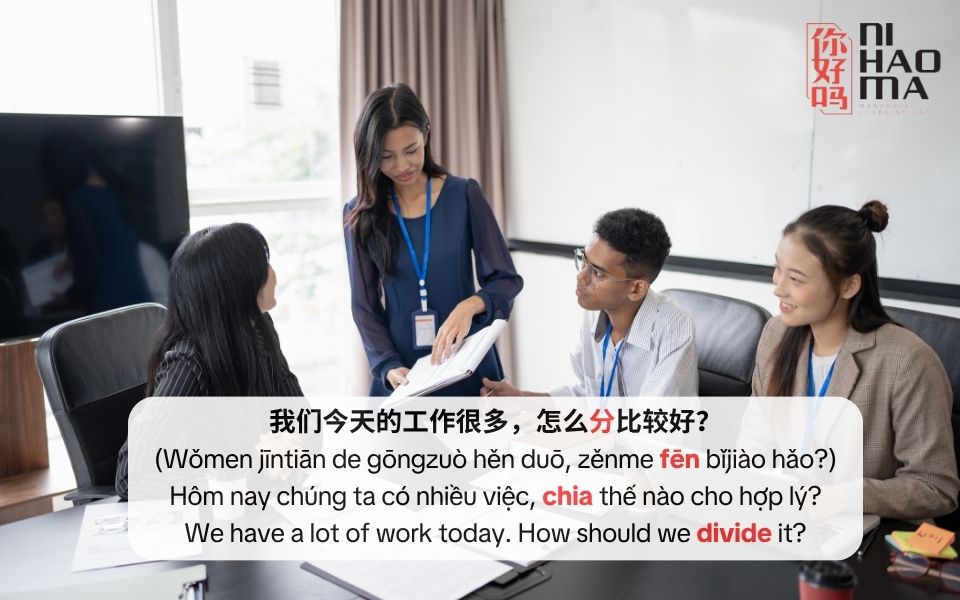
A: 我们今天的工作很多,怎么分比较好?
(Wǒmen jīntiān de gōngzuò hěn duō, zěnme fēn bǐjiào hǎo?)
→ We have a lot of work today. How should we divide it?
B: 我觉得可以分成两部分,你做一半,我做一半。
(Wǒ juéde kěyǐ fēn chéng liǎng bùfen, nǐ zuò yí bàn, wǒ zuò yí bàn.)
→ I think we can split it into two parts. You do half, I do half.
A: 好的,那我们要不要分开做,还是一起做?
(Hǎo de, nà wǒmen yào bú yào fēn kāi zuò, háishì yìqǐ zuò?)
→ Okay, should we work separately or together?
B: 先分开做吧,最后再一起检查。
(Xiān fēn kāi zuò ba, zuìhòu zài yìqǐ jiǎnchá.)
→ Let’s work separately first, then check together at the end.
A: 好主意,这样效率会更高。
(Hǎo zhǔyì, zhèyàng xiàolǜ huì gèng gāo.)
→ Good idea, this will be more efficient.
B: 那我们现在就开始吧!
(Nà wǒmen xiànzài jiù kāishǐ ba!)
→ Then let’s start now!
Dialogue 2
A: 这个公园周末人很多,你觉得呢?
(Zhège gōngyuán zhōumò rén hěn duō, nǐ juéde ne?)
→ This park is very crowded on weekends, what do you think?
B: 是的,因为这是公共场所,大家都可以来。
(Shì de, yīnwèi zhè shì gōnggòng chǎngsuǒ, dàjiā dōu kěyǐ lái.)
→ Yes, because it’s a public place, everyone can come.
A: 不过有些人不太注意卫生。
(Búguò yǒuxiē rén bú tài zhùyì wèishēng.)
→ However, some people don’t pay much attention to hygiene.
B: 对,我们应该保护公共环境。
(Duì, wǒmen yīnggāi bǎohù gōnggòng huánjìng.)
→ Right, we should protect public environments.
A: 下次我们可以带垃圾袋,一起清理一下。
(Xià cì wǒmen kěyǐ dài lājī dài, yìqǐ qīnglǐ yíxià.)
→ Next time we can bring trash bags and clean up a bit.
B: 好啊,这样大家都会更舒服。
(Hǎo a, zhèyàng dàjiā dōu huì gèng shūfu.)
→ Sounds good, everyone will feel more comfortable.
Dialogue 3
A: 你每天几点到公司?
(Nǐ měitiān jǐ diǎn dào gōngsī?)
→ What time do you arrive at the company every day?
B: 我一般八点到公司,有时候会早一点。
(Wǒ yìbān bā diǎn dào gōngsī, yǒu shíhou huì zǎo yìdiǎn.)
→ I usually arrive at 8 o’clock, sometimes a bit earlier.
A: 你们公司大吗?有多少员工?
(Nǐmen gōngsī dà ma? Yǒu duōshǎo yuángōng?)
→ Is your company big? How many employees are there?
B: 不算大,大概有一百多人,是一家公营公司。
(Bú suàn dà, dàgài yǒu yì bǎi duō rén, shì yì jiā gōngyíng gōngsī.)
→ Not very big, about more than 100 people. It’s a state-owned company.
A: 听起来不错,工作环境怎么样?
(Tīng qǐlái búcuò, gōngzuò huánjìng zěnmeyàng?)
→ Sounds good. How is the working environment?
B: 挺好的,同事也很友好。
(Tǐng hǎo de, tóngshì yě hěn yǒuhǎo.)
→ Pretty good, and colleagues are friendly.
Conclusion
Hopefully, through this article, you now clearly understand what the radical 12 in Chinese is, along with its meaning, usage, and common vocabulary containing this radical. To learn Chinese effectively, you should combine theoretical study with regular practice through examples, dialogues, and real-life contexts.
If you are looking for a structured, practical, and easy-to-understand Chinese learning environment, the Ni Hao Ma center is a great choice to help you build a solid foundation and develop your language skills comprehensively. Contact them now for a suitable learning roadmap!