Radical 36 in Chinese is one of the most frequently used Chinese radicals in everyday vocabulary and also carries deep cultural symbolism. So, what exactly is Radical 36 in Chinese? What does it represent, and how can learners apply it in real-life communication? Let’s explore everything you need to know in this guide!
What Is Radical 36 in Chinese?
Radical 36 in Chinese is 夕 (xī), known as the 36th Kangxi Radical among the 214 traditional Chinese radicals. This radical appears very commonly in Chinese characters, especially in words related to time, nighttime, and spatial conditions.
In terms of structure, Radical 36 consists of only three simple strokes. The ancient oracle bone script form of 夕 originally resembled a crescent moon partially hidden from view, symbolizing the transitional moment between day and night. Compared to the radical 月 (yuè) meaning “moon,” Radical 36 lacks one horizontal stroke inside the character, representing the dim and fading light of dusk.
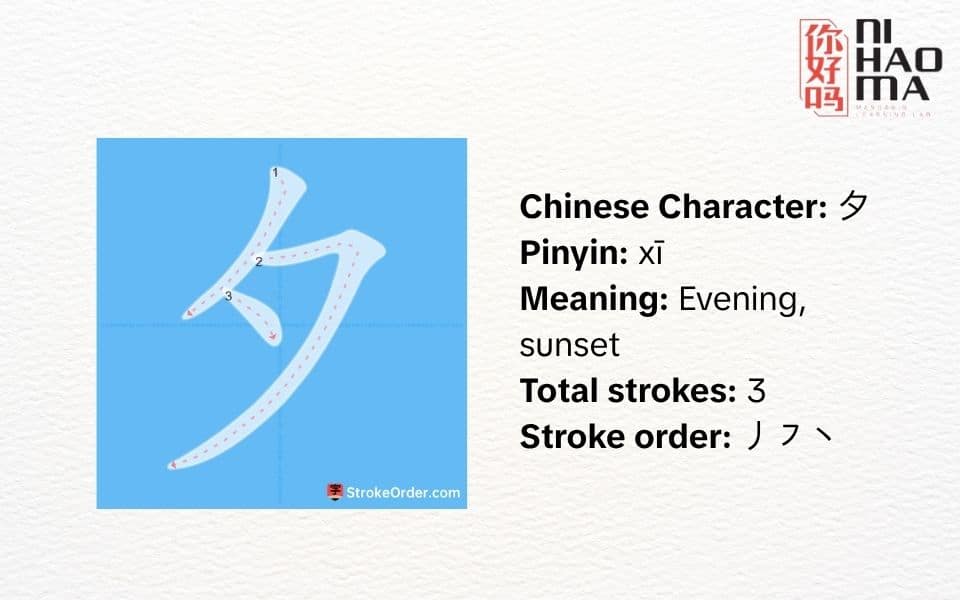
The symbolic meaning of Radical 36 is “evening,” “night,” or “twilight.” Once you understand this core meaning, it becomes much easier to guess the meanings of Chinese characters containing this radical. Most characters with Radical 36 are associated with nighttime activities, rest, dreams, or abstract concepts related to change and transition. Learning the meaning behind the radical is an effective way to memorize Chinese characters logically instead of relying on rote memorization.
How to Write Radical 36 in Chinese
Radical 36 in Chinese contains three strokes and is written in the following order:
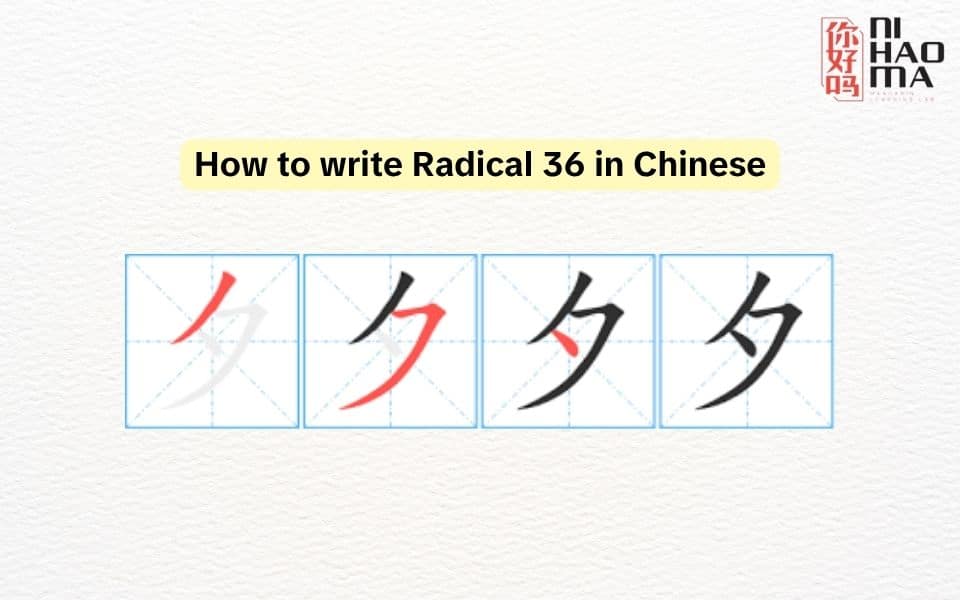
| Stroke Order | Stroke Name | Description |
|---|---|---|
| 1 | 丿 (Left-falling stroke) | Start from the upper-left area and draw a short downward left-falling stroke. |
| 2 | ㇇ (Horizontal turning stroke) | From the middle point of stroke 1, draw a horizontal line to the right, then curve downward into a longer left-falling stroke. |
| 3 | 丶 (Dot stroke) | Add a small dot in the empty space below stroke 1 and inside stroke 2. Note: The final dot should not touch the right side of the character. |
Common Vocabulary Containing Radical 36 in Chinese
Learning radicals without practical vocabulary can quickly become ineffective. One of the fascinating things about Radical 36 in Chinese is that it appears in countless words, from beginner-level HSK vocabulary to advanced academic texts. Mastering these words can significantly expand your Chinese vocabulary.
Below is a collection of common Chinese words containing Radical 36:
| Vocabulary | Pinyin | Meaning |
|---|---|---|
| 夕 | xī | Evening, dusk |
| 外 | wài | Outside |
| 多 | duō | Many, much |
| 夜 | yè | Night |
| 名 | míng | Name, famous |
| 梦 | mèng | Dream |
| 岁 | suì | Age, year of age |
| 歹 | dǎi | Bad, evil |
| 够 | gòu | Enough |
| 移 | yí | To move, shift |
| 舞 | wǔ | Dance |
| 夙 | sù | Early, long-standing |
| 夥 | huǒ | Companion, group |
| 夤 | yín | Late at night |
| 夸 | kuā | To praise, boast |
| 怨 | yuàn | Resentment |
| 夕阳 | xī yáng | Sunset |
| 除夕 | chú xī | Lunar New Year’s Eve |
| 七夕 | qī xī | Qixi Festival |
| 半夜 | bàn yè | Midnight |
| 夜晚 | yè wǎn | Evening, nighttime |
| 夜空 | yè kōng | Night sky |
| 夜市 | yè shì | Night market |
| 夜班 | yè bān | Night shift |
| 夜车 | yè chē | Night train/bus |
| 夜景 | yè jǐng | Night view |
| 夜色 | yè sè | Night scenery, darkness |
| 多少 | duō shǎo | How many, how much |
| 多年 | duō nián | Many years |
| 大多 | dà duō | Mostly, the majority |
| 多么 | duō me | How, so |
| 多余 | duō yú | Unnecessary, extra |
| 多样 | duō yàng | Diverse, various |
| 意外 | yì wài | Unexpected, accident |
| 外国 | wài guó | Foreign country |
| 外面 | wài miàn | Outside |
| 外卖 | wài mài | Takeout food |
| 外语 | wài yǔ | Foreign language |
| 外交 | wài jiāo | Diplomacy |
| 外套 | wài tào | Coat, jacket |
| 外公 | wài gōng | Maternal grandfather |
| 名字 | míng zi | Name |
| 名片 | míng piàn | Business card |
| 名人 | míng rén | Celebrity |
| 名胜 | míng shèng | Scenic attraction |
| 名校 | míng xiào | Prestigious school |
| 梦想 | mèng xiǎng | Dream, aspiration |
| 梦见 | mèng jiàn | To dream about |
| 梦幻 | mèng huàn | Dreamlike, fantasy |
| 岁月 | suì yuè | Passing years |
| 年岁 | nián suì | Age |
| 移动 | yí dòng | Move, mobile |
| 移民 | yí mín | Immigrant, migrate |
| 移植 | yí zhí | Transplant |
| 舞蹈 | wǔ dǎo | Dance |
| 舞台 | wǔ tái | Stage |
| 怨恨 | yuàn hèn | Hatred, resentment |
| 噩梦 | è mèng | Nightmare |
| 鸳鸯 | yuān yāng | Mandarin ducks, loving couple |
Sample Dialogues Using Radical 36 Vocabulary
In language learning, context is essential. To help learners use vocabulary containing Radical 36 naturally, here are some practical Chinese dialogues based on real-life situations.
Dialogue 1
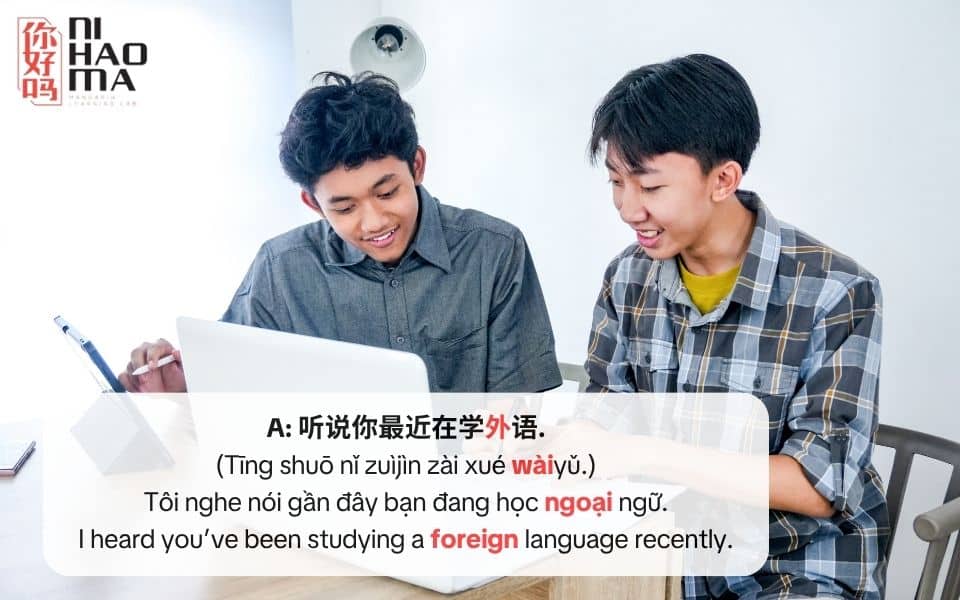
A: 听说你最近在学外语,学得怎么样?
(Tīng shuō nǐ zuìjìn zài xué wàiyǔ, xué dé zěnmeyàng?)
I heard you’ve been studying a foreign language recently. How’s it going?
B: 我在学汉语,觉得汉字有多点儿难。
(Wǒ zài xué hànyǔ, juédé hànzì yǒu duō diǎnr nán.)
I’m learning Chinese, but I think Chinese characters are a bit difficult.
A: 没关系,只要你努力,一定能够学好。
(Méiguānxì, zhǐyào nǐ nǔlì, yīdìng nénggòu xué hǎo.)
It’s okay. As long as you work hard, you can definitely learn it well.
B: 谢谢你的鼓励!我的梦想是去中国留学。
(Xièxiè nǐ de gǔlì! Wǒ de mèngxiǎng shì qù Zhōngguó liúxué.)
Thank you for your encouragement! My dream is to study abroad in China.
A: 太棒了!以后我们可以一起去逛夜市。
(Tài bàngle! Yǐhòu wǒmen kěyǐ yīqǐ qù guàng yèshì.)
That’s wonderful! In the future, we can visit night markets together.
Dialogue 2
A: 今晚是除夕,你打算怎么过?
(Jīn wǎn shì chúxī, nǐ dǎsuàn zěnme guò?)
Tonight is Lunar New Year’s Eve. How are you planning to celebrate?
B: 我想和家人一起吃晚饭,然后看春晚。
(Wǒ xiǎng hé jiārén yīqǐ chī wǎnfàn, ránhòu kàn Chūnwǎn.)
I want to have dinner with my family and then watch the Spring Festival Gala.
A: 你们准备了多少菜?
(Nǐmen zhǔnbèile duōshǎo cài?)
How many dishes did you prepare?
B: 准备了很多,肯定足够大家吃了。
(Zhǔnbèile hěnduō, kěndìng zúgòu dàjiā chīle.)
We prepared a lot, definitely enough for everyone.
A: 祝你和家人过一个快乐的夜晚!
(Zhù nǐ hé jiārén guò yīgè kuàilè de yèwǎn!)
Wish you and your family a wonderful evening!
B: 谢谢,也祝你新年快乐!
(Xièxiè, yě zhù nǐ xīnnián kuàilè!)
Thank you, and Happy New Year to you too!
Conclusion
Understanding and mastering Radical 36 in Chinese is an important stepping stone that brings you closer to achieving fluency in the Chinese language. Through this article, we have explored everything from its definition and symbolic meaning to the practical application of more than 50 vocabulary words in daily life. Remember that learning Chinese is a long-term journey of continuous accumulation, where combining radical theory with real conversational practice will help you improve day by day.
If you are looking for a professional learning environment with a clear roadmap from beginner to advanced levels and experienced teachers to guide you along the way, do not hesitate to contact Ni Hao Ma Chinese Language Center. We are committed to helping you develop all language skills comprehensively and confidently master Chinese in the shortest possible time. Wishing you great success in your studies and hope you achieve your dreams soon!