
Recognizing and understanding the meaning of Chinese radicals is one of the most effective ways to learn Chinese characters. Instead of memorizing each character individually, radicals help you recognize character patterns, remember their forms more quickly, and even infer the meanings of unfamiliar words the first time you encounter them.
In this article, Ni Hao Ma will guide you through radical 140 in Chinese, one of the most frequently used Kangxi radicals in everyday Chinese. From the tea you drink to the vegetables you eat and the flowers you admire, this radical appears in countless commonly used Chinese characters
What Is Radical 140 in Chinese?
Radical 140 (艹 – cǎo) is the 140th radical in the 214 Kangxi Radicals. It originally means grass, plants, and vegetation.
This radical evolved from the ancient form 艸, a pictographic character representing clusters of grass growing close to the ground. Over time, the character was simplified into 艹 when used as a component in compound Chinese characters, making it easier and faster to write.
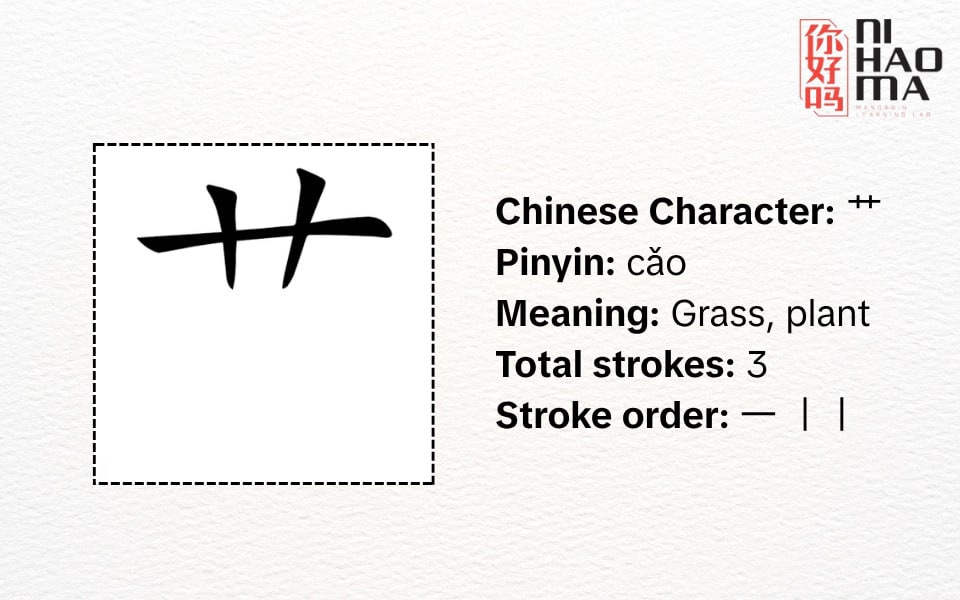
Today, radical 140 is one of the most important and commonly used radicals in Chinese. Whenever you see this radical in a Chinese character, it often indicates that the character is related to plants, flowers, leaves, vegetables, herbs, medicine, or other objects derived from vegetation. Learning this radical makes it much easier to recognize the meanings of many Chinese characters and expand your vocabulary efficiently.
How to Write Radical 140 in Chinese
Radical 140 in Chinese appears in thousands of Chinese characters and consists of only three strokes. Although simple, writing it correctly is essential because it serves as the top component in many commonly used characters.
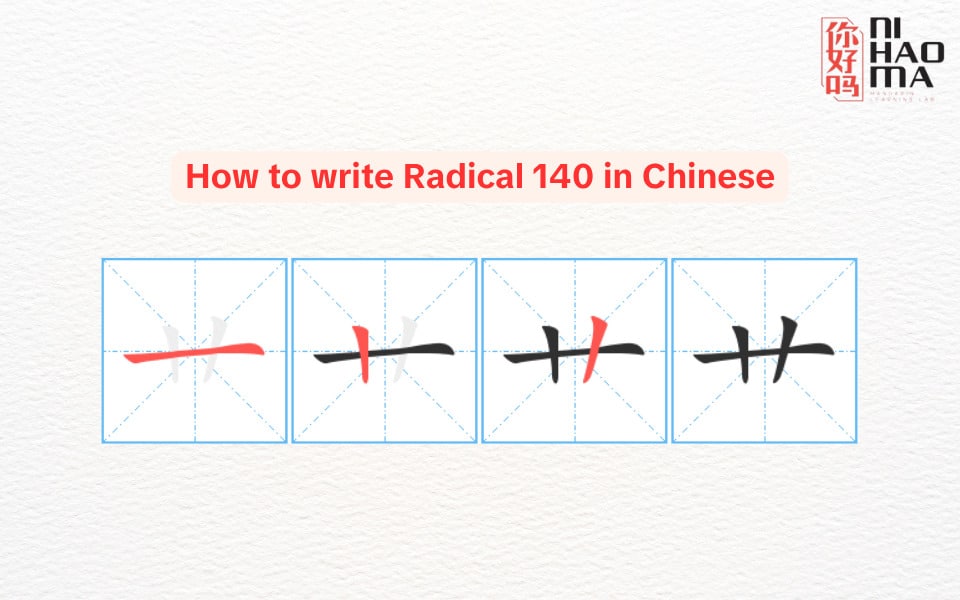
| Stroke Order | Stroke | Writing Instructions |
|---|---|---|
| 1 | 一 (Horizontal stroke) | Draw a horizontal stroke from left to right across the top. |
| 2 | 丨 (Vertical stroke) | Draw a short vertical stroke passing through the horizontal stroke, slightly leaning to the left. |
| 3 | 丨 (Vertical stroke) | Draw another short vertical stroke passing through the horizontal stroke, slightly leaning to the right. |
Common Vocabulary with Radical 140 in Chinese
Instead of memorizing Chinese characters one by one, learning vocabulary by radicals is a more systematic and efficient approach. Most Chinese characters containing radical 140 are associated with plants or concepts derived from vegetation.
Explore the common radical 140 vocabulary below to expand your Chinese vocabulary:
| Chinese | Pinyin | Meaning |
|---|---|---|
| 草 | cǎo | Grass |
| 花 | huā | Flower |
| 叶 | yè | Leaf |
| 兰 | lán | Orchid |
| 菊 | jú | Chrysanthemum |
| 莲 | lián | Lotus; lotus seed |
| 菜 | cài | Vegetable; dish |
| 茶 | chá | Tea |
| 药 | yào | Medicine; medicinal herb |
| 苦 | kǔ | Bitter; hardship |
| 荒 | huāng | Barren; desolate |
| 荣 | róng | Glory; flourishing |
| 茫 | máng | Vast; boundless; hazy |
| 藏 | cáng | To hide; to store |
| 荐 | jiàn | To recommend |
| 节 | jié | Festival; season; joint |
| 苹果 | píngguǒ | Apple |
| 草莓 | cǎoméi | Strawberry |
| 葡萄 | pútao | Grape |
| 菠萝 | bōluó | Pineapple |
| 芒果 | mángguǒ | Mango |
| 香蕉 | xiāngjiāo | Banana |
| 荔枝 | lìzhī | Lychee |
| 菠菜 | bōcài | Spinach |
| 蔬菜 | shūcài | Vegetables |
| 兰花 | lánhuā | Orchid |
| 荷花 | héhuā | Lotus flower |
| 草原 | cǎoyuán | Grassland; prairie |
| 艺术 | yìshù | Art |
| 节日 | jiérì | Festival; holiday |
| 节目 | jiémù | Program; performance |
| 营养 | yíngyǎng | Nutrition |
| 菜单 | càidān | Menu |
| 药店 | yàodiàn | Pharmacy; drugstore |
| 中药 | zhōngyào | Traditional Chinese medicine |
| 英语 | Yīngyǔ | English language |
| 艺人 | yìrén | Artist; entertainer |
| 荣誉 | róngyù | Honor |
Chinese Dialogue Examples Using Radical 140
After learning vocabulary that contains radical 140 (艹), the next step is to practice using these words in real conversations. Applying new vocabulary in everyday communication is one of the most effective ways to reinforce your memory and improve your speaking skills.
The dialogue examples below cover familiar topics such as drinking tea, buying vegetables, and shopping for tea. These common daily-life situations will help you review radical 140 vocabulary while building confidence in practical Chinese conversations.
Dialogue 1
A: 你好,下午有时间吗?我们去喝茶吧。
Nǐ hǎo, xiàwǔ yǒu shíjiān ma? Wǒmen qù hē chá ba.
Hi! Are you free this afternoon? Let’s go have some tea.
B: 好啊!你想去哪家茶馆?
Hǎo a! Nǐ xiǎng qù nǎ jiā cháguǎn?
Sure! Which teahouse would you like to go to?
A: 我听说公园旁边那家茶馆不错。
Wǒ tīngshuō gōngyuán pángbiān nà jiā cháguǎn búcuò.
I heard the teahouse next to the park is really nice.
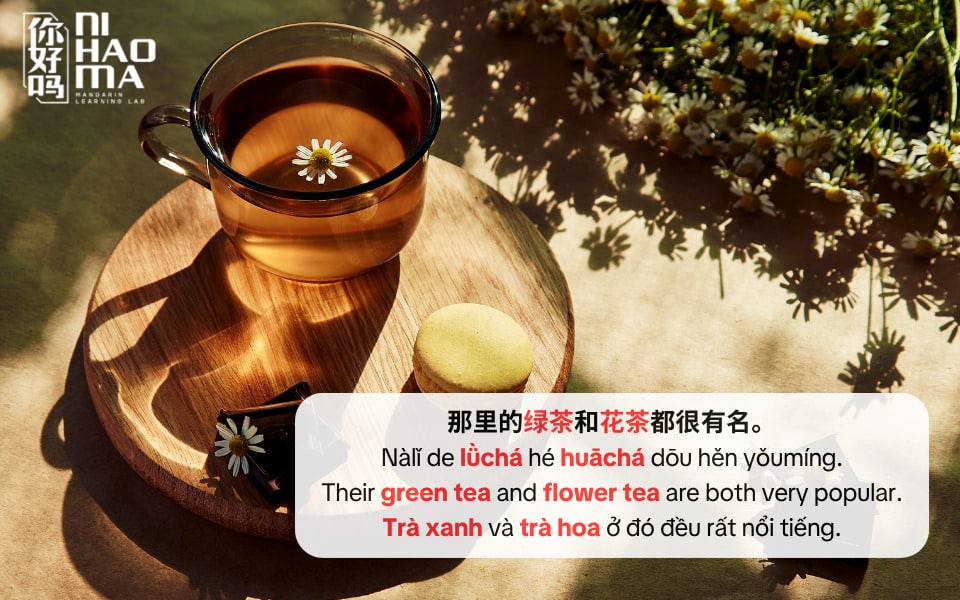
B: 那里的绿茶和花茶都很有名。
Nàlǐ de lǜchá hé huāchá dōu hěn yǒumíng.
Their green tea and flower tea are both very popular.
A: 那我们下午三点见吧。
Nà wǒmen xiàwǔ sān diǎn jiàn ba.
Then let’s meet at 3 p.m.
B: 好,下午见!
Hǎo, xiàwǔ jiàn!
Sounds good. See you this afternoon!
Dialogue 2
A: 今天晚上做什么菜?
Jīntiān wǎnshang zuò shénme cài?
What should we cook for dinner tonight?
B: 我想做一个蔬菜汤,再炒菠菜。
Wǒ xiǎng zuò yí gè shūcài tāng, zài chǎo bōcài.
I’d like to make a vegetable soup and stir-fried spinach.
A: 家里还有白菜吗?
Jiālǐ hái yǒu báicài ma?
Do we still have Chinese cabbage at home?
B: 没有了,我们还要买萝卜和葱。
Méiyǒu le, wǒmen hái yào mǎi luóbo hé cōng.
No, we’re out of it. We also need to buy radishes and green onions.
A: 那顺便买一点水果吧。
Nà shùnbiàn mǎi yìdiǎn shuǐguǒ ba.
Let’s pick up some fruit while we’re there.
B: 好,买一些苹果和葡萄。
Hǎo, mǎi yìxiē píngguǒ hé pútao.
Sure, let’s get some apples and grapes.
Dialogue 3
A: 你好,我想买一点茶送给朋友。
Nǐ hǎo, wǒ xiǎng mǎi yìdiǎn chá sòng gěi péngyou.
Hello, I’d like to buy some tea as a gift for a friend.
B: 您喜欢绿茶还是花茶?
Nín xǐhuān lǜchá háishì huāchá?
Do you prefer green tea or flower tea?
A: 哪一种比较受欢迎?
Nǎ yì zhǒng bǐjiào shòu huānyíng?
Which one is more popular?
B: 这两种都不错,花茶味道比较香,绿茶比较清淡。
Zhè liǎng zhǒng dōu búcuò, huāchá wèidào bǐjiào xiāng, lǜchá bǐjiào qīngdàn.
Both are excellent. Flower tea has a more fragrant aroma, while green tea has a lighter and fresher taste.
A: 那我各买一盒吧。
Nà wǒ gè mǎi yì hé ba.
Then I’ll take one box of each.
B: 好的,谢谢您的光临!
Hǎo de, xièxie nín de guānglín!
Certainly. Thank you for your visit!
Conclusion
Radical 140 in Chinese (艹) is one of the most important and frequently used Chinese radicals. Understanding its meaning, mastering its stroke order, and learning vocabulary built around this radical will not only help you remember Chinese characters more efficiently but also improve your ability to infer the meanings of unfamiliar characters.
We hope this guide has given you a comprehensive understanding of radical 140, including its meaning, origin, writing method, common vocabulary, and practical dialogue examples. Keep practicing writing Chinese characters and reviewing new words regularly to strengthen your Chinese language skills. Ni Hao Ma hopes this article has been helpful, and we look forward to sharing more practical Chinese learning resources with you!