
Radical 164 is one of the most familiar components in Chinese characters, commonly appearing in words related to alcohol, fermentation, and daily life activities. Understanding what radical 164 means and how it functions will help you recognize characters more easily, memorize vocabulary faster, and improve your ability to infer meanings logically and effectively.
What Is Radical 164 in Chinese?
Radical 164 (酉 – yǒu) is the 164th radical among the 214 Kangxi radicals. It frequently appears in vocabulary related to alcoholic beverages, fermentation processes, and activities associated with producing and consuming alcohol.
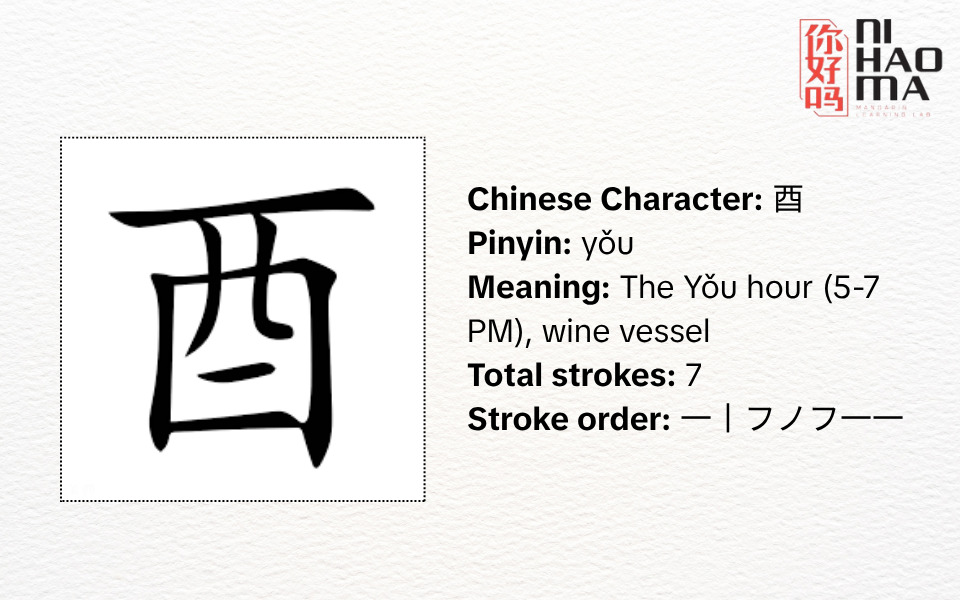
In its earliest form found in oracle bone script, the character 酉 was drawn like a traditional clay wine jar with a narrow neck and a rounded body. The horizontal stroke inside represents fermenting liquid or wine sediment. Over time, this form was simplified and standardized, and today it usually appears on the left side of more complex characters, serving as a semantic indicator.
Beyond its connection to food and drink, radical 164 also plays a role in traditional Chinese culture, particularly in timekeeping and feng shui. It is one of the 12 Earthly Branches, representing the Rooster, associated with the Metal element and the West direction. The “You hour” (5 PM – 7 PM) corresponds to sunset, when chickens return to their coops and people begin to rest.
How to Write Radical 164
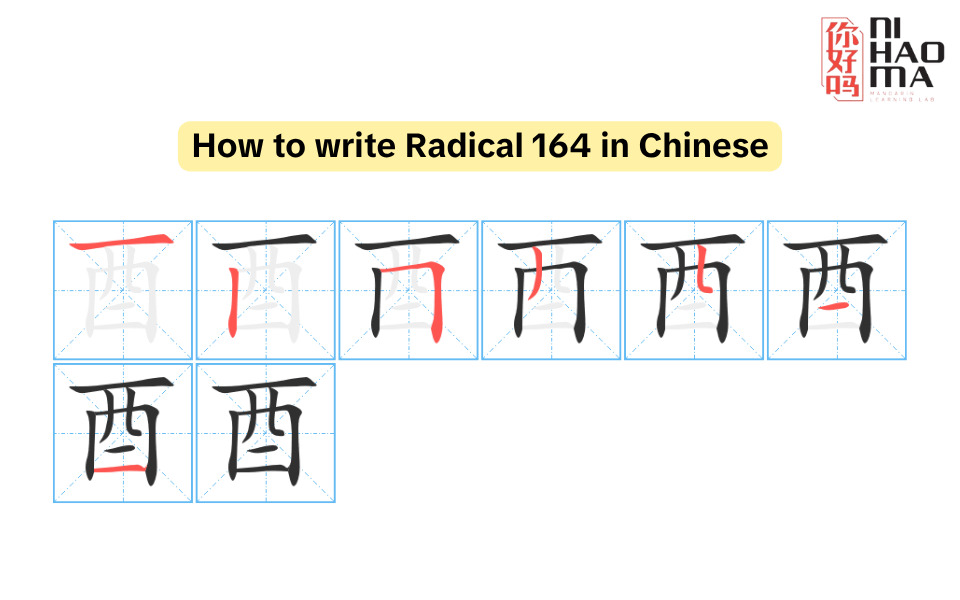
Radical 164 (酉) consists of 7 strokes and follows this stroke order:
| Stroke Order | Stroke | Description |
|---|---|---|
| 1 | 一 | Draw a short horizontal line at the top to define the width |
| 2 | 丨 | Draw a vertical line downward on the left side |
| 3 | フ | Draw a horizontal line to the right, then bend downward to form the right frame |
| 4 | ノ | Draw a left-falling stroke inside the frame |
| 5 | フ | Draw another bent stroke downward to complete the right side |
| 6 | 一 | Draw a short horizontal line in the middle |
| 7 | 一 | Draw the bottom horizontal line to close the character |
Vocabulary with Radical 164
After understanding the meaning and structure of radical 164 (酉), learning vocabulary becomes more systematic and intuitive. Instead of memorizing isolated characters, you can rely on the radical’s meaning to connect and infer new words.
Here are some common vocabulary items containing radical 164:
| Chinese | Pinyin | Meaning |
|---|---|---|
| 酒 | jiǔ | alcohol, wine |
| 醉 | zuì | drunk |
| 酸 | suān | sour |
| 酱 | jiàng | sauce, paste |
| 酥 | sū | crispy |
| 酿 | niàng | to brew |
| 配 | pèi | to match, combine |
| 酌 | zhuó | to pour wine |
| 酉 | yǒu | radical 164; You hour |
| 酵 | jiào | fermentation |
| 酶 | méi | enzyme |
| 酒店 | jiǔ diàn | hotel |
| 酒吧 | jiǔ bā | bar |
| 酒精 | jiǔ jīng | alcohol |
| 酒水 | jiǔ shuǐ | beverages |
| 酒席 | jiǔ xí | banquet |
| 白酒 | bái jiǔ | white liquor |
| 红酒 | hóng jiǔ | red wine |
| 啤酒 | pí jiǔ | beer |
| 香槟 | xiāngbīn | champagne |
| 酸奶 | suān nǎi | yogurt |
| 酸味 | suān wèi | sour taste |
| 酸甜 | suān tián | sweet and sour |
| 酱油 | jiàng yóu | soy sauce |
| 酱料 | jiàng liào | sauce |
| 配合 | pèi hé | to cooperate |
| 配料 | pèi liào | ingredients |
| 配方 | pèi fāng | formula |
| 配音 | pèi yīn | dubbing |
| 配对 | pèi duì | pairing |
| 配偶 | pèi’ǒu | spouse |
| 酬劳 | chóu láo | reward |
| 发酵 | fā jiào | to ferment |
| 酸化 | suān huà | acidification |
| 酷刑 | kù xíng | torture |
| 酸痛 | suān tòng | soreness |
| 酸涩 | suān sè | bitter-sour |
| 酒鬼 | jiǔ guǐ | drunkard |
| 酒量 | jiǔ liàng | alcohol tolerance |
| 清醒 | qīng xǐng | sober |
| 清醇 | qīng chún | mellow, pure |
| 醉心 | zuì xīn | to be fascinated |
| 应酬 | yìng chóu | socializing, entertaining |
Sample Dialogues Using Radical 164 Vocabulary
To effectively remember vocabulary containing radical 164 (酉), it’s important to practice them in real-life contexts. Instead of rote memorization, learning through conversations helps you understand natural usage in daily situations.
Below are sample dialogues using common words with radical 164:
Dialogue 1
A: 你要不要喝点酒?
(Nǐ yào bú yào hē diǎn jiǔ?)
Do you want to drink some alcohol?
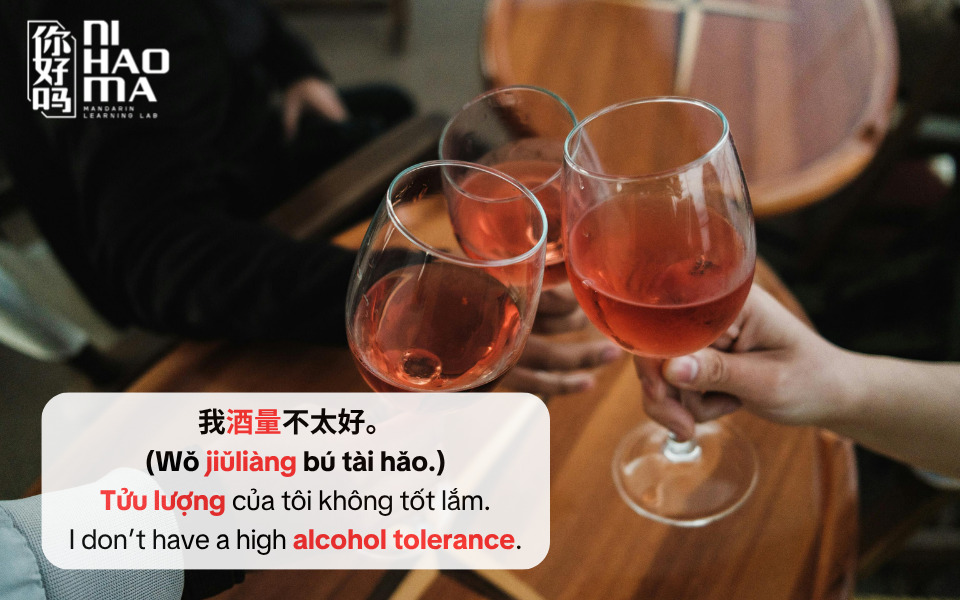
B: 好啊,不过我酒量不太好。
(Hǎo a, búguò wǒ jiǔliàng bú tài hǎo.)
Sure, but I don’t have a high alcohol tolerance.
A: 没关系,少喝一点就好。
(Méi guānxi, shǎo hē yìdiǎn jiù hǎo.)
That’s fine, just drink a little.
B: 上次我喝醉了,很难受。
(Shàng cì wǒ hē zuì le, hěn nánshòu.)
Last time I got drunk and felt terrible.
A: 那你慢慢喝吧。
(Nà nǐ màn man hē ba.)
Then take it slow.
Dialogue 2
A: 这个菜有点酸,你觉得呢?
(Zhège cài yǒudiǎn suān, nǐ juéde ne?)
This dish is a bit sour. What do you think?
B: 我觉得还可以,酸甜味很不错。
(Wǒ juéde hái kěyǐ, suān tián wèi hěn búcuò.)
I think it’s good. The sweet and sour taste is nice.
A: 里面放了很多酱油吗?
(Lǐmiàn fàng le hěn duō jiàngyóu ma?)
Did you add a lot of soy sauce?
B: 对,还加了一点醋。
(Duì, hái jiā le yìdiǎn cù.)
Yes, and a bit of vinegar.
A: 难怪味道这么特别。
(Nánguài wèidào zhème tèbié.)
No wonder it tastes so special.
Dialogue 3
A: 这个项目需要大家好好配合。
(Zhège xiàngmù xūyào dàjiā hǎo hǎo pèihé.)
This project requires good teamwork.
B: 没问题,我们会按计划进行。
(Méi wèntí, wǒmen huì àn jìhuà jìnxíng.)
No problem, we’ll follow the plan.
A: 材料都准备好了吗?
(Cáiliào dōu zhǔnbèi hǎo le ma?)
Are the materials ready?
B: 已经配齐了,可以开始了。
(Yǐjīng pèi qí le, kěyǐ kāishǐ le.)
Yes, everything is prepared. We can start.
A: 那就尽快完成吧。
(Nà jiù jǐnkuài wánchéng ba.)
Let’s finish it as soon as possible.
Conclusion
In summary, radical 164 (酉) may consist of only seven strokes, but it opens up a rich world of vocabulary related to alcohol, taste, fermentation, and daily life. By understanding its meaning and structure, you can recognize characters more easily and learn Chinese more efficiently. Hopefully, this guide by Ni Hao Ma has given you valuable insights into radical 164 and helped build a strong foundation for your Chinese learning journey.