Chinese characters are built from smaller components known as radicals. Once you master the core radicals, you can recognize, understand, and memorize new characters much more easily without relying on rote memorization.
Among the 214 Kangxi Radicals, radical 169 in Chinese is one of the most visually recognizable. It represents the concept of a door or gate and serves as the “gateway” to learning hundreds of commonly used Chinese words from HSK 1 to HSK 6.
In this guide, Ni Hao Ma will walk you through everything you need to know about radical 169, including its meaning, stroke order, writing forms, common vocabulary, and practical conversation examples.
What Is Radical 169 in Chinese?
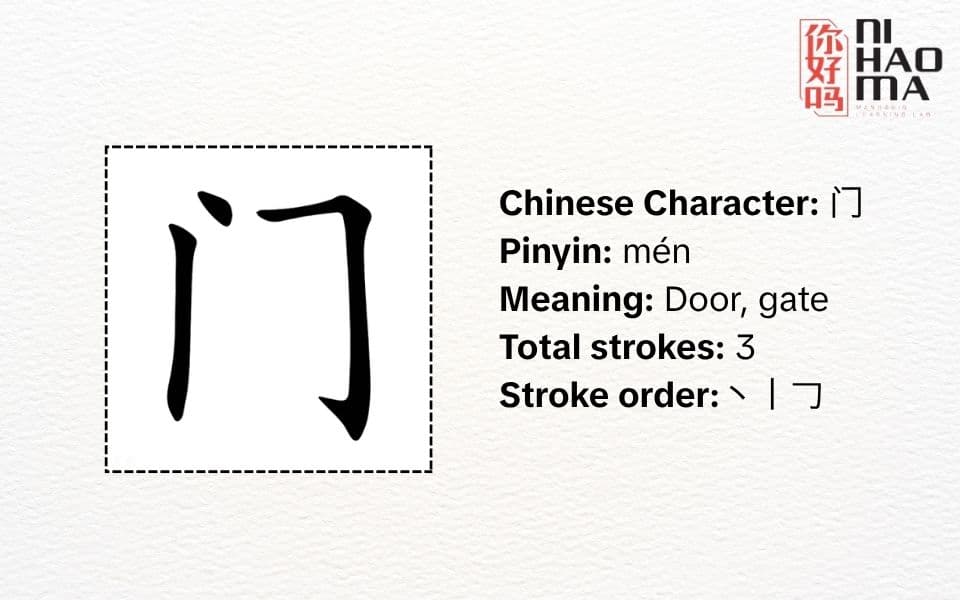
Radical 169 in Chinese (门 – mén) is the 169th radical in the Kangxi Radical system. Its original meaning is door, gate, entrance, or doorway, symbolizing the boundary between the inside and outside of a space.
In Chinese characters, radical 169 is commonly used in characters related to doors, opening and closing, observation, asking questions, or activities that take place inside a room or house. When it appears in a character, it usually serves as the semantic radical, providing learners with a useful clue about the character’s meaning.
Because of this semantic function, whenever you encounter radical 169 in a Chinese character, you can often use logical reasoning to infer its original meaning. Let’s look at several classic examples.
- 问 (wèn – to ask): This character combines 门 (door) and 口 (mouth). It originally depicts someone speaking through a doorway to call or ask the people inside the house, which explains why the character means “to ask.”
- 间 (jiān – room; space; between): This character combines 门 (door) and 日 (sun). It originally illustrated sunlight shining through the gap between two doors, representing a room, an interval, or the space between objects.
- 闭 (bì – to close): This character combines 门 (door) and 才, which originally represented a wooden bar placed across a doorway. The image conveys the action of shutting or blocking a door, giving the character the meaning “to close” or “to shut.”
Read more: What Is Radical 170 in Chinese?
How to Write Radical 169 in Chinese
Radical 169 has two standard written forms: the simplified form (门) and the traditional form (門).
- The simplified form (门) consists of only three strokes, making it much easier for beginners to write and memorize. This version is officially used in Mainland China, as well as in modern Chinese textbooks and HSK examinations.
- The traditional form (門) consists of eight strokes and closely resembles the image of a pair of traditional Chinese doors. Today, this form remains the standard writing system in Taiwan, Hong Kong, and Macau.
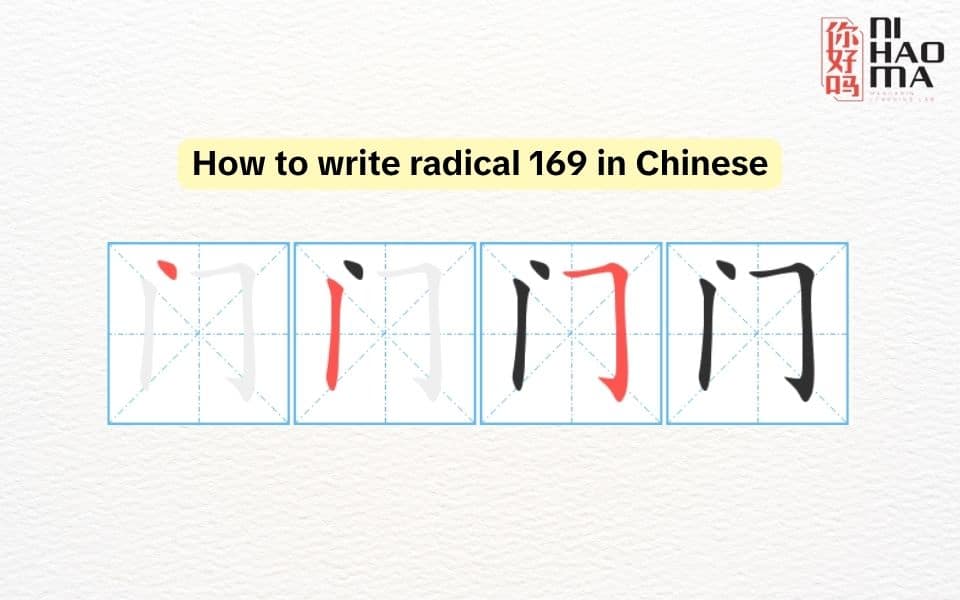
| Stroke | Stroke Name | Writing Instructions |
|---|---|---|
| 1 | Dot (丶) | Write a small dot from the upper left downward. |
| 2 | Vertical turning stroke (丨) | Draw a vertical stroke downward, then turn right to create the outer frame. |
| 3 | Horizontal hook (𠃌) | Draw a short horizontal stroke, turn downward, and finish with a slight inward hook to complete the character 门. |
Common Vocabulary with Radical 169 in Chinese
Many Chinese characters containing radical 169 in Chinese (门) are closely related to doors, entrances, rooms, asking questions, opening and closing, space, and daily activities. Learning vocabulary by radical not only helps you memorize characters more efficiently but also enables you to infer the meanings of unfamiliar words based on their shared semantic component.
Below are some of the most common Chinese characters and words containing radical 169, along with their pinyin and English meanings.
| Chinese Character | Pinyin | Meaning |
|---|---|---|
| 门 | mén | door; gate; entrance |
| 问 | wèn | to ask |
| 间 | jiān / jiàn | room; space; between; interval |
| 们 | men | plural marker for pronouns and people |
| 闭 | bì | to close; to shut |
| 闹 | nào | noisy; lively; to make a disturbance |
| 闪 | shǎn | to flash; lightning; to dodge |
| 闲 | xián | free; idle; leisurely |
| 闯 | chuǎng | to rush in; to charge; to venture |
| 阔 | kuò | broad; wide; wealthy |
| 阐 | chǎn | to explain; to clarify |
| 阂 | hé | barrier; obstruction |
| 闩 | shuān | door bolt; latch |
| 阚 | kàn | to look; to glance |
| 阖 | hé | to close; entire |
| 阋 | xì | conflict; quarrel |
| 阌 | Wén | Wen (a place name) |
| 阕 | què | a stanza of a Chinese lyric; end of a tune |
| 我们 | wǒmen | we; us |
| 房间 | fángjiān | room |
| 问题 | wèntí | question; problem |
| 问答 | wèndá | question and answer |
| 问路 | wènlù | to ask for directions |
| 门口 | ménkǒu | doorway; entrance |
| 时间 | shíjiān | time |
| 中间 | zhōngjiān | middle; center; between |
| 门票 | ménpiào | admission ticket |
| 热闹 | rènao | lively; bustling |
| 请问 | qǐngwèn | excuse me; may I ask… |
| 洗手间 | xǐshǒujiān | restroom; bathroom |
| 专门 | zhuānmén | specialized; specifically |
| 关闭 | guānbì | to close; to shut down |
| 闪电 | shǎndiàn | lightning |
| 阅读 | yuèdú | reading; to read |
| 空闲 | kòngxián | free time; leisure |
| 郁闷 | yùmèn | depressed; frustrated; gloomy |
| 闯荡 | chuǎngdàng | to venture out; to struggle in society |
| 空间 | kōngjiān | space |
| 窍门 | qiàomén | trick; knack; useful tip |
| 门铃 | ménlíng | doorbell |
| 顾问 | gùwèn | consultant; advisor |
| 隔阂 | géhé | misunderstanding; estrangement; barrier |
| 闲聊 | xiánliáo | to chat casually |
| 闷热 | mēnrè | hot and humid; muggy |
| 热门 | rèmén | popular; trending |
| 闭嘴 | bìzuǐ | shut up; keep quiet |
| 闲话 | xiánhuà | gossip; idle talk |
| 出门 | chūmén | to go out; leave home |
Sample Dialogues Using Radical 169 Vocabulary
After learning the vocabulary containing radical 169, the next step is to practice using these words in real-life conversations. Seeing them in context will help you remember their meanings more naturally and improve both your speaking and listening skills.
Below are three everyday dialogue examples featuring commonly used words with radical 169:
Dialogue 1
A: 你怎么一直站在门口,不进去吗?
Nǐ zěnme yìzhí zhàn zài ménkǒu, bù jìnqù ma?
Why are you standing at the doorway? Aren’t you going inside?
B: 我忘了带钥匙,门锁着了,进不了门。
Wǒ wàng le dài yàoshi, mén suǒzhe le, jìn bù liǎo mén.
I forgot my keys. The door is locked, so I can’t get in.
A: 家里没有人吗?
Jiālǐ méiyǒu rén ma?
Isn’t anyone home?
B: 没有,我爸爸妈妈都还没下班。
Méiyǒu, wǒ bàba māma dōu hái méi xiàbān.
No, my parents haven’t gotten off work yet.
A: 那你先来我家坐一会儿吧,我给他们打个电话。
Nà nǐ xiān lái wǒ jiā zuò yíhuìr ba, wǒ gěi tāmen dǎ ge diànhuà.
Then come over to my place and sit for a while. I’ll give them a call.
B: 好啊,谢谢你!以后我出门前一定会检查有没有带钥匙。
Hǎo a, xièxie nǐ! Yǐhòu wǒ chūmén qián yídìng huì jiǎnchá yǒu méiyǒu dài yàoshi.
Sounds good, thank you! From now on, I’ll always check that I have my keys before leaving home.
Dialogue 2
A: 不好意思,我想问一下,这附近有医院吗?
Bù hǎoyìsi, wǒ xiǎng wèn yíxià, zhè fùjìn yǒu yīyuàn ma?
Excuse me, I’d like to ask if there’s a hospital nearby.
B: 有,你是要去门诊还是急诊?
Yǒu, nǐ shì yào qù ménzhěn háishì jízhěn?
Yes. Are you looking for the outpatient clinic or the emergency department?
A: 我只是感冒了,去门诊就可以。
Wǒ zhǐshì gǎnmào le, qù ménzhěn jiù kěyǐ.
I only have a cold, so the outpatient clinic is fine.
B: 那你一直往前走,经过前面那个大门,再右转就到了。
Nà nǐ yìzhí wǎng qián zǒu, jīngguò qiánmiàn nàge dàmén, zài yòuzhuǎn jiù dào le.
Walk straight ahead, pass the large gate in front of you, then turn right. You’ll see it there.
A: 大概需要走多久?
Dàgài xūyào zǒu duōjiǔ?
How long does it take to get there?
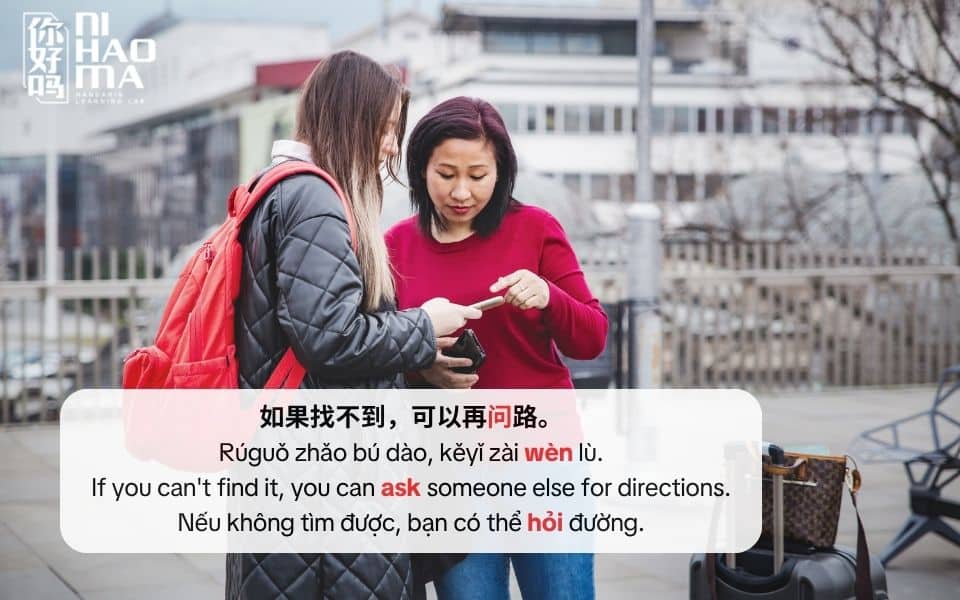
B: 十分钟左右,很近。如果找不到,可以再问路。
Shí fēnzhōng zuǒyòu, hěn jìn. Rúguǒ zhǎo bú dào, kěyǐ zài wènlù.
About ten minutes. It’s quite close. If you can’t find it, you can ask someone else for directions.
A: 太感谢了,祝你今天愉快!
Tài gǎnxiè le, zhù nǐ jīntiān yúkuài!
Thank you so much! Have a wonderful day!
Dialogue 3
A: 咱们周末去市中心玩吧!
Zánmen zhōumò qù shì zhōngxīn wán ba!
Let’s go downtown this weekend!
B: 好啊!我昨天看新闻,说那里最近特别热闹。
Hǎo a! Wǒ zuótiān kàn xīnwén, shuō nàlǐ zuìjìn tèbié rènao.
Sounds great! I watched the news yesterday, and they said the city center has been especially lively lately.
A: 对,很多商店都开了新门店,还有很多活动。
Duì, hěn duō shāngdiàn dōu kāi le xīn méndiàn, hái yǒu hěn duō huódòng.
That’s right. Many stores have opened new branches, and there are lots of events taking place.
B: 那咱们几点出门比较好?
Nà zánmen jǐ diǎn chūmén bǐjiào hǎo?
What time should we leave?
A: 我觉得九点吧,人不会太多。
Wǒ juéde jiǔ diǎn ba, rén bú huì tài duō.
I think 9:00 a.m. would be good. It won’t be too crowded then.
B: 好,到了以后咱们先去吃饭,再去逛街。
Hǎo, dào le yǐhòu zánmen xiān qù chīfàn, zài qù guàngjiē.
Great. Once we get there, let’s have lunch first and then go shopping.
Conclusion
Radical 169 in Chinese is one of the most common and practical Chinese radicals. It frequently appears in characters related to doors, entrances, rooms, space, asking questions, and everyday activities. Understanding its meaning, stroke order, and commonly used vocabulary will not only help you memorize Chinese characters more effectively but also improve your ability to infer the meanings of unfamiliar words while reading or communicating in Chinese.
To master radical 169, combine regular handwriting practice with vocabulary study and real-life conversation exercises. Reviewing the characters consistently and using them in context will strengthen your memory and build confidence in your Chinese language skills. Be sure to explore more articles from Ni Hao Ma to learn the other 214 Kangxi Radicals and expand your Chinese vocabulary in a structured and systematic way.