
Radical 41 is one of the Chinese radicals that appears frequently in everyday vocabulary and Chinese proficiency exams. In this guide, Ni Hao Ma will help you explore Radical 41 (寸) in detail, including its meaning, origin, stroke order, and practical applications. Understanding this radical will strengthen your logical thinking, improve character recognition, and significantly speed up your Chinese character memorization.
What Is Radical 41 in Chinese?
Radical 41 (寸, cùn) is the 41st Kangxi Radical among the traditional 214 Kangxi radicals. It is commonly associated with measurement, limits, precision, and carefulness.
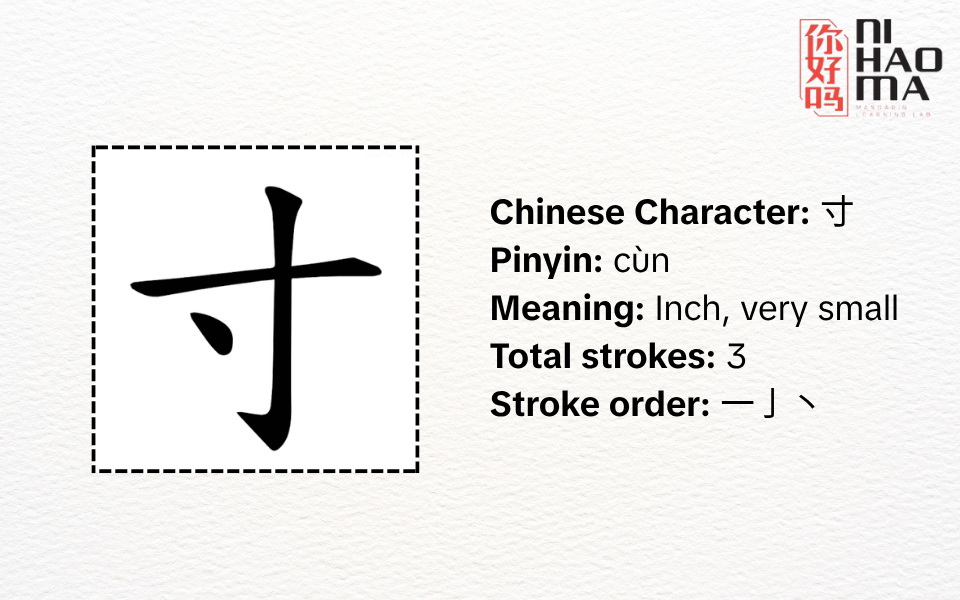
From a historical perspective, the ancient Oracle Bone Script (甲骨文) version of 寸 was a pictographic character depicting a human arm with a small dot beneath the wrist. This dot represented the location of the pulse point (寸口) where traditional Chinese physicians checked a patient’s pulse.
Because of this origin, the original meaning of 寸 was a traditional Chinese unit of length known as a cun, equivalent to one-tenth of a Chinese foot, or approximately 3.33 centimeters in the modern metric system.
When used as a character component, Radical 41 often conveys meanings related to:
- Measurement
- Rules and regulations
- Precision
- Carefulness
- Control and administration
Recognizing this semantic connection makes it easier to understand and remember many Chinese characters built around this radical.
How to Write Radical 41
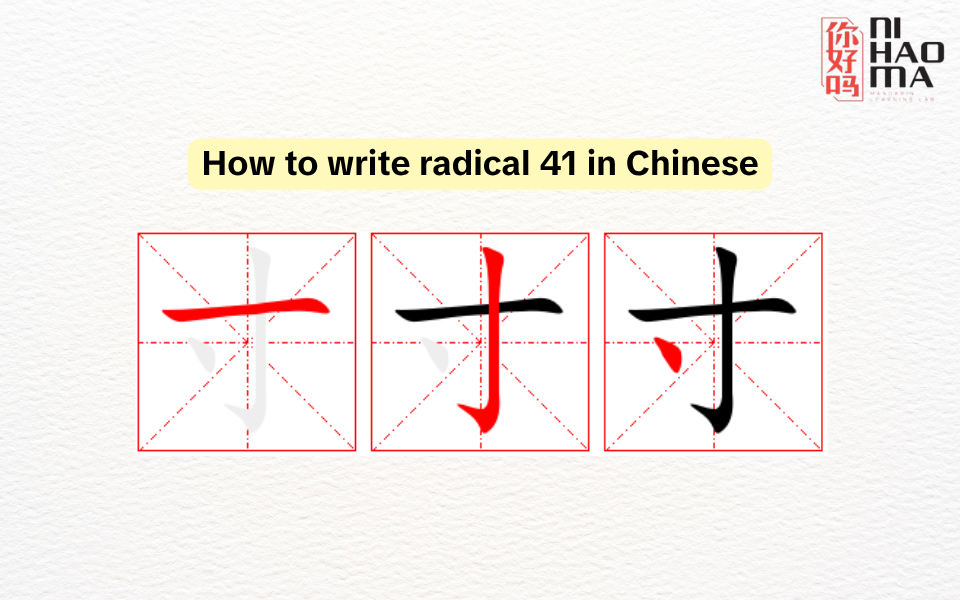
Following the correct stroke order helps improve handwriting while making Chinese characters easier to memorize. Radical 41 (寸) consists of three strokes:
| Stroke Order | Stroke | Writing Instructions |
|---|---|---|
| 1 | 一 (Horizontal stroke) | Draw a short horizontal line from left to right. |
| 2 | 亅 (Vertical hook) | Start near the center of the horizontal stroke, draw downward, then finish with a slight hook to the left. |
| 3 | 丶 (Dot) | Add a small dot on the lower left side of the vertical hook. |
Common Chinese Vocabulary Containing Radical 41
Radical 41 (寸) is not only an independent character but also appears as a component in many frequently used Chinese words. Learning vocabulary grouped by radicals helps learners recognize character structures more efficiently while understanding semantic relationships between words.
Below are some common Chinese words containing Radical 41, covering everyday topics such as communication, education, work, and daily life.
| Chinese | Pinyin | Meaning |
|---|---|---|
| 寸 | cùn | cun (traditional Chinese inch) |
| 对 | duì | correct; pair; toward |
| 村 | cūn | village |
| 付 | fù | to pay; to hand over |
| 时 | shí | time; hour; when |
| 团 | tuán | group; team |
| 守 | shǒu | to guard; protect; observe |
| 寺 | sì | temple |
| 对话 | duìhuà | dialogue; conversation |
| 对面 | duìmiàn | opposite; across from |
| 对不起 | duìbuqǐ | sorry |
| 对方 | duìfāng | the other party |
| 对手 | duìshǒu | opponent |
| 对待 | duìdài | to treat |
| 对抗 | duìkàng | confrontation; resist |
| 对策 | duìcè | countermeasure |
| 对象 | duìxiàng | target; object; partner |
| 对照 | duìzhào | compare; contrast |
| 对付 | duìfu | deal with |
| 导演 | dǎoyǎn | director |
| 辅导 | fǔdǎo | tutor; coach |
| 指导 | zhǐdǎo | guide; instruct |
| 寻找 | xúnzhǎo | search for |
| 尊重 | zūnzhòng | respect |
| 尊敬 | zūnjìng | esteem; honor |
| 封锁 | fēngsuǒ | blockade; lock down |
| 守护 | shǒuhù | protect |
| 付款 | fùkuǎn | make payment |
| 符合 | fúhé | conform to; match |
| 政府 | zhèngfǔ | government |
| 时间 | shíjiān | time |
| 时候 | shíhou | moment; when |
| 时代 | shídài | era |
| 领导 | lǐngdǎo | leader |
| 耐心 | nàixīn | patience |
| 争夺 | zhēngduó | compete for |
| 将来 | jiānglái | future |
| 农村 | nóngcūn | countryside |
| 射击 | shèjī | shooting |
| 团结 | tuánjié | unity |
| 团队 | tuánduì | team |
Practical Chinese Dialogues Using Vocabulary with Radical 41
After learning vocabulary containing Radical 41, practicing through short conversations is one of the most effective ways to reinforce your understanding. The dialogues below are based on familiar everyday situations, allowing you to see how these words are naturally used in context.
Dialogue 1: Asking for Directions
A: 请问,这附近有寺庙吗?
Qǐngwèn, zhè fùjìn yǒu sìmiào ma?
Excuse me, is there a temple nearby?
B: 有,离这里不远,走路大概十分钟。
Yǒu, lí zhèlǐ bú yuǎn, zǒulù dàgài shí fēnzhōng.
Yes. It’s not far from here—about a ten-minute walk.
A: 我第一次来这里,不太熟悉路线。
Wǒ dì yī cì lái zhèlǐ, bú tài shúxī lùxiàn.
It’s my first time here, so I’m not familiar with the area.
B: 你一直往前走,到了红绿灯右转,就能看到那座寺庙。
Nǐ yìzhí wǎng qián zǒu, dàole hónglǜdēng yòuzhuǎn, jiù néng kàndào nà zuò sìmiào.
Go straight ahead and turn right at the traffic light. You’ll see the temple there.
A: 谢谢!那里需要买门票吗?
Xièxie! Nàlǐ xūyào mǎi ménpiào ma?
Thank you! Do I need to buy an entrance ticket?
B: 不用,免费参观,不过要保持安静。
Búyòng, miǎnfèi cānguān, búguò yào bǎochí ānjìng.
No, admission is free, but please keep quiet.

Dialogue 2
A: 我已经完成这份报告了,你能帮我检查一下吗?
Wǒ yǐjīng wánchéng zhè fèn bàogào le, nǐ néng bāng wǒ jiǎnchá yíxià ma?
I’ve finished this report. Could you check it for me?
B: 当然可以,我先看看内容有没有问题。
Dāngrán kěyǐ, wǒ xiān kànkan nèiróng yǒu méiyǒu wèntí.
Of course. Let me review the content first.
A: 数据应该都是对的,我昨天已经核对过了。
Shùjù yīnggāi dōu shì duì de, wǒ zuótiān yǐjīng héduì guò le.
The data should all be correct. I checked everything yesterday.
B: 内容没问题,不过有几个错别字。
Nèiróng méi wèntí, búguò yǒu jǐ gè cuòbiézì.
The content looks good, but there are a few spelling mistakes.
A: 好,我马上修改,谢谢你。
Hǎo, wǒ mǎshàng xiūgǎi, xièxie nǐ.
Okay, I’ll fix them right away. Thanks!
B: 不客气,修改完以后再发给经理吧。
Bú kèqi, xiūgǎi wán yǐhòu zài fā gěi jīnglǐ ba.
You’re welcome. Send it to the manager after you’ve finished editing.
Dialogue 3: Looking for a Phone
A: 你看到我的手机了吗?我一直在寻找它。
Nǐ kàndào wǒ de shǒujī le ma? Wǒ yìzhí zài xúnzhǎo tā.
Have you seen my phone? I’ve been looking for it everywhere.
B: 你最后一次是什么时候用的?
Nǐ zuìhòu yí cì shì shénme shíhou yòng de?
When was the last time you used it?
A: 我刚才在客厅看视频,后来就找不到了。
Wǒ gāngcái zài kètīng kàn shìpín, hòulái jiù zhǎo bú dào le.
I was watching videos in the living room earlier, and then I couldn’t find it.
B: 你先看看沙发下面,我帮你打电话试试。
Nǐ xiān kànkan shāfā xiàmiàn, wǒ bāng nǐ dǎ diànhuà shìshi.
Check under the sofa first. I’ll call your phone.
A: 找到了!原来掉在沙发旁边了。
Zhǎodào le! Yuánlái diào zài shāfā pángbiān le.
Found it! It had fallen beside the sofa.
Conclusion
Although Radical 41 (寸) consists of only three simple strokes, it appears in numerous high-frequency Chinese characters. Mastering its meaning, stroke order, and common vocabulary will help you recognize character structures more easily, expand your vocabulary, and improve long-term retention when learning Chinese.
For the best results, combine several learning methods, including practicing proper stroke order, studying vocabulary by radicals, creating your own example sentences, and using new words in real-life conversations. Regular review within meaningful contexts will make your Chinese vocabulary more natural and memorable.
If you’re looking for a systematic way to learn Chinese, continue exploring Ni Hao Ma‘s complete guides to all 214 Kangxi radicals, practical vocabulary lists, sentence patterns, and grammar lessons. With consistent practice and the right learning resources, mastering Chinese characters becomes much easier than you might think.