
Among the 214 Kangxi radicals, some appear much more frequently than others and make it easier for learners to infer the meanings of unfamiliar Chinese characters. One of the most important of these is Radical 85 in Chinese .
So, what is Radical 85? What does it represent, how is it written, and which Chinese words commonly contain it? In this article, Ni Hao Ma Chinese Language System will guide you through everything you need to know.
What Is Radical 85 in Chinese?
Radical 85 (水, shuǐ) is the 85th radical in the 214 Kangxi radicals. It represents water, including rivers, lakes, seas, liquids, and various states, properties, or activities related to water.
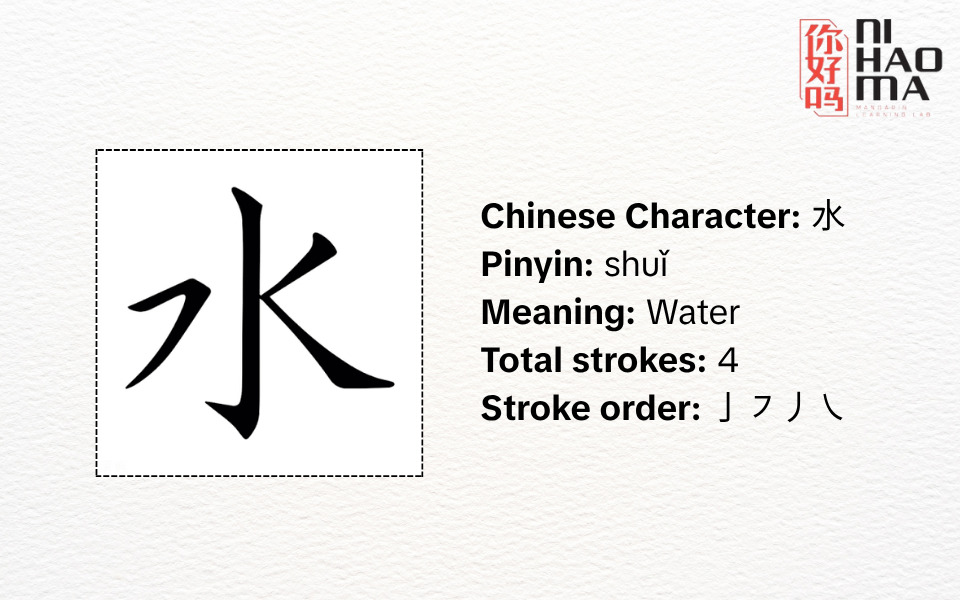
Among all 214 Kangxi radicals, Radical 85 (水/氵) is one of the most frequently used. It not only symbolizes water itself but also extends to concepts associated with water, such as rivers, oceans, lakes, liquids, rain, flowing water, washing, and activities that take place in aquatic environments.
According to the Five Elements (Wu Xing) philosophy, water symbolizes life, adaptability, gentleness, resilience, and the unstoppable power of continuous flow. These symbolic meanings are also reflected in the development of Chinese characters, making Radical 85 one of the most practical and widely used radicals in the Chinese writing system.
Related article: What Is Radical 86 (火) in Chinese?
How to Write Radical 85 in Chinese
Writing Chinese characters in the correct stroke order not only makes your handwriting look balanced and attractive but also helps your brain remember character structures more efficiently. When learning the two forms of Radical 85, pay close attention to the stroke order below.
| Stroke Order | Stroke Name | Writing Direction |
|---|---|---|
| 1 | 亅 (Vertical hook) | Begin with the vertical hook in the center (following the rule of writing the center first, then both sides). |
| 2 | ㇇ (Horizontal-turning stroke) | Write the left horizontal-falling stroke beside the vertical hook. |
| 3 | 丿 (Left-falling stroke) | Add the short left-falling stroke in the upper-right position. |
| 4 | ㇏ (Right-falling stroke) | Finish with the right-falling stroke, extending diagonally downward to the right. |
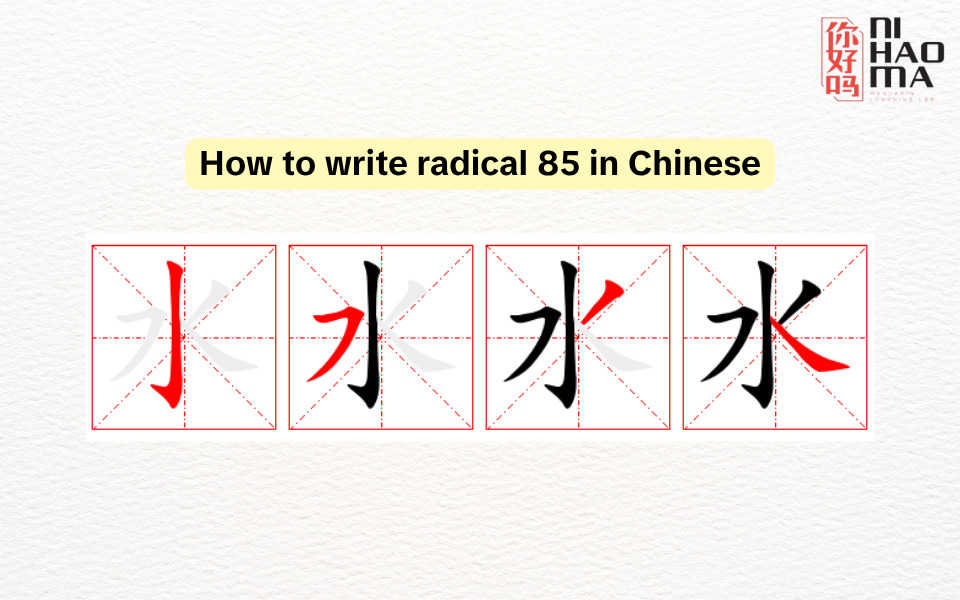
When used as a character component, Radical 85 is simplified into its variant form 氵, commonly known as the three-dot water radical, which always appears on the left side of a character.
This variant consists of two dot strokes and one rising stroke. When writing 氵, the space between the first and second dots is typically smaller than the distance between the second dot and the final rising stroke.
Vocabulary with Radical 85 in Chinese
Once you understand the meaning and stroke order of Radical 85, the next step is to expand your vocabulary through characters that contain this radical. This learning method is widely recommended by Chinese teachers because it not only helps learners retain new words longer but also makes it easier to infer the meanings of unfamiliar characters.
To help you study more effectively, Ni Hao Ma has compiled 60 vocabulary words containing Radical 85, arranged from simple characters to common compound words. These are frequently used in everyday conversations. By combining radical recognition with contextual learning, you can memorize vocabulary more efficiently and build a stronger Chinese foundation.
| Chinese | Pinyin | Meaning |
|---|---|---|
| 水 | shuǐ | water |
| 江 | jiāng | large river |
| 河 | hé | river |
| 海 | hǎi | sea |
| 湖 | hú | lake |
| 洋 | yáng | ocean |
| 池 | chí | pond |
| 液 | yè | liquid |
| 汁 | zhī | juice |
| 汤 | tāng | soup |
| 酒 | jiǔ | alcohol; liquor |
| 泪 | lèi | tears |
| 汗 | hàn | sweat |
| 油 | yóu | oil |
| 汽 | qì | steam |
| 波 | bō | wave |
| 潮 | cháo | tide |
| 洗 | xǐ | to wash |
| 流 | liú | to flow |
| 深 | shēn | deep |
| 浅 | qiǎn | shallow |
| 清 | qīng | clear; clean |
| 满 | mǎn | full |
| 没有 | méiyǒu | not have; there isn’t |
| 江河 | jiānghé | rivers |
| 海洋 | hǎiyáng | ocean |
| 海边 | hǎibiān | seaside |
| 湖水 | húshuǐ | lake water |
| 水果 | shuǐguǒ | fruit |
| 水瓶 | shuǐpíng | water bottle |
| 水杯 | shuǐbēi | drinking cup |
| 热水 | rèshuǐ | hot water |
| 冰水 | bīngshuǐ | ice water |
| 冷水 | lěngshuǐ | cold water |
| 温水 | wēnshuǐ | warm water |
| 果汁 | guǒzhī | fruit juice |
| 汽水 | qìshuǐ | soda |
| 洗手 | xǐshǒu | wash hands |
| 洗脸 | xǐliǎn | wash one’s face |
| 洗澡 | xǐzǎo | take a shower; bathe |
| 洗衣服 | xǐ yīfu | wash clothes |
| 洗手间 | xǐshǒujiān | restroom |
| 游泳 | yóuyǒng | to swim |
| 游乐园 | yóulèyuán | amusement park |
| 污染 | wūrǎn | pollution |
| 海鲜 | hǎixiān | seafood |
| 汉语 | hànyǔ | Chinese language |
| 汽车 | qìchē | automobile |
| 浪漫 | làngmàn | romantic |
| 漂亮 | piàoliang | beautiful |
| 办法 | bànfǎ | method; solution |
| 温和 | wēnhé | gentle; mild |
| 冰激凌 | bīngjīlíng | ice cream |
| 泪水 | lèishuǐ | tears |
Practical Dialogues Using Radical 85 Vocabulary
Instead of memorizing individual words in isolation, try placing them in real-life conversations. This is one of the most effective ways to learn vocabulary because it helps you understand how words are used in context, improves long-term retention, and develops natural speaking skills.
Vocabulary containing Radical 85 appears frequently in daily life—from ordering food and asking for directions to traveling and personal hygiene.
Below are several short conversations featuring common words that contain Radical 85 (水/氵). Each dialogue includes the Chinese text, pinyin, and English translation to help you practice reading, speaking, and understanding vocabulary in authentic situations.
Dialogue 1
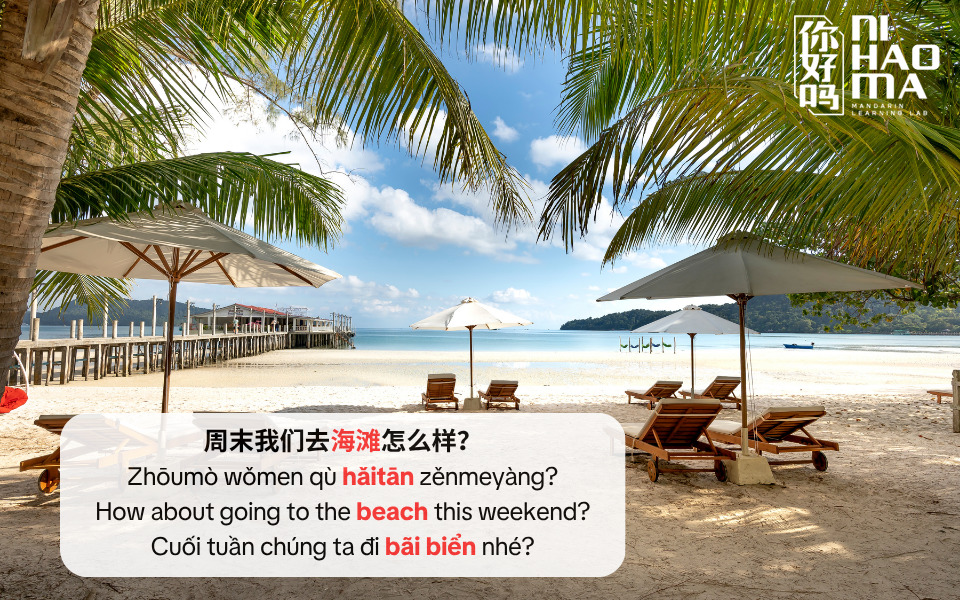
A: 周末我们去海滩怎么样?
Zhōumò wǒmen qù hǎitān zěnmeyàng?
How about going to the beach this weekend?
B: 好啊!我很喜欢看海。
Hǎo a! Wǒ hěn xǐhuān kàn hǎi.
Sounds great! I really love looking at the sea.
A: 那里还有一条河流,可以游泳。
Nàlǐ hái yǒu yì tiáo héliú, kěyǐ yóuyǒng.
There’s also a river there where we can go swimming.
B: 听说还能漂流,一定很好玩。
Tīngshuō hái néng piāoliú, yídìng hěn hǎowán.
I heard we can also go river rafting. That sounds like a lot of fun.
A: 那我们早点出发吧!
Nà wǒmen zǎodiǎn chūfā ba!
Then let’s leave early on Saturday!
Dialogue 2
A: 周末有空吗?我们去海边玩吧。
Zhōumò yǒu kòng ma? Wǒmen qù hǎibiān wán ba.
Are you free this weekend? Let’s go to the seaside.
B: 好啊!听说那个海滩特别漂亮。
Hǎo a! Tīngshuō nàge hǎitān tèbié piàoliang.
Sure! I heard that beach is especially beautiful.
A: 我们还可以游泳、吃海鲜。
Wǒmen hái kěyǐ yóuyǒng, chī hǎixiān.
We can also go swimming and enjoy some seafood.
B: 太好了,我已经很久没看海了。
Tài hǎo le, wǒ yǐjīng hěn jiǔ méi kàn hǎi le.
That’s wonderful. I haven’t seen the ocean in a long time.
A: 那就周六早上出发吧!
Nà jiù zhōuliù zǎoshang chūfā ba!
Great! Let’s leave on Saturday morning.
Dialogue 3
A: 不好意思,请问湖在哪儿?
Bù hǎoyìsi, qǐngwèn hú zài nǎr?
Excuse me, could you tell me where the lake is?
B: 一直往前走,就能看到湖水。
Yìzhí wǎng qián zǒu, jiù néng kàndào húshuǐ.
Walk straight ahead, and you’ll see the lake.
A: 那附近有河流吗?
Nà fùjìn yǒu héliú ma?
Is there a river nearby?
B: 有,不过离这里大概五分钟。
Yǒu, búguò lí zhèlǐ dàgài wǔ fēnzhōng.
Yes, there is. It’s about a five-minute walk from here.
A: 谢谢您的帮助!
Xièxie nín de bāngzhù!
Thank you very much for your help!
Conclusion
As you can see, Radical 85 in Chinese serves as a powerful key to unlocking a wide range of Chinese vocabulary related to nature, water, liquids, and everyday activities. By understanding its symbolic meaning, mastering the correct stroke order, and practicing vocabulary through real-life conversations, you can build a stronger foundation in Chinese while improving both your memory and language skills.
Rather than memorizing individual characters one by one, learning through radicals helps you recognize patterns, infer the meanings of unfamiliar characters, and expand your vocabulary more efficiently. Since Radical 85 appears in many high-frequency words used in daily communication, mastering it is an essential step for every Chinese learner.
Are you struggling to remember Chinese characters or looking for a more effective way to learn Mandarin? Ni Hao Ma offers structured Chinese courses with personalized learning paths designed to help students master vocabulary, speaking, reading, and writing with confidence. Contact us today to find the course that’s right for you!