Among the 214 Kangxi radicals, radical 86 in Chinese is one of the most fundamental and frequently encountered components in everyday Chinese characters. From culinary activities and weather conditions to the complex spectrum of human emotions, this semantic component plays a vital role. But what exactly does radical 86 mean, and how can you master the vast vocabulary associated with it? Let’s explore everything you need to know with Ni Hao Ma in this comprehensive guide!
What is Radical 86 in Chinese?
In the Kangxi dictionary system, radical 86 in Chinese (火 – huǒ) represents fire, light, heat, burning, or energy.
In Chinese life and culture, fire is also a core element of the Wu Xing (Five Elements: Metal, Wood, Water, Fire, Earth), symbolizing vitality, warmth, illumination, and growth. Consequently, many Chinese characters containing radical 86 directly reflect cooking activities, powerful human emotions, or even modern abstract concepts like popularity and viral trends (the “hot” trends of today).
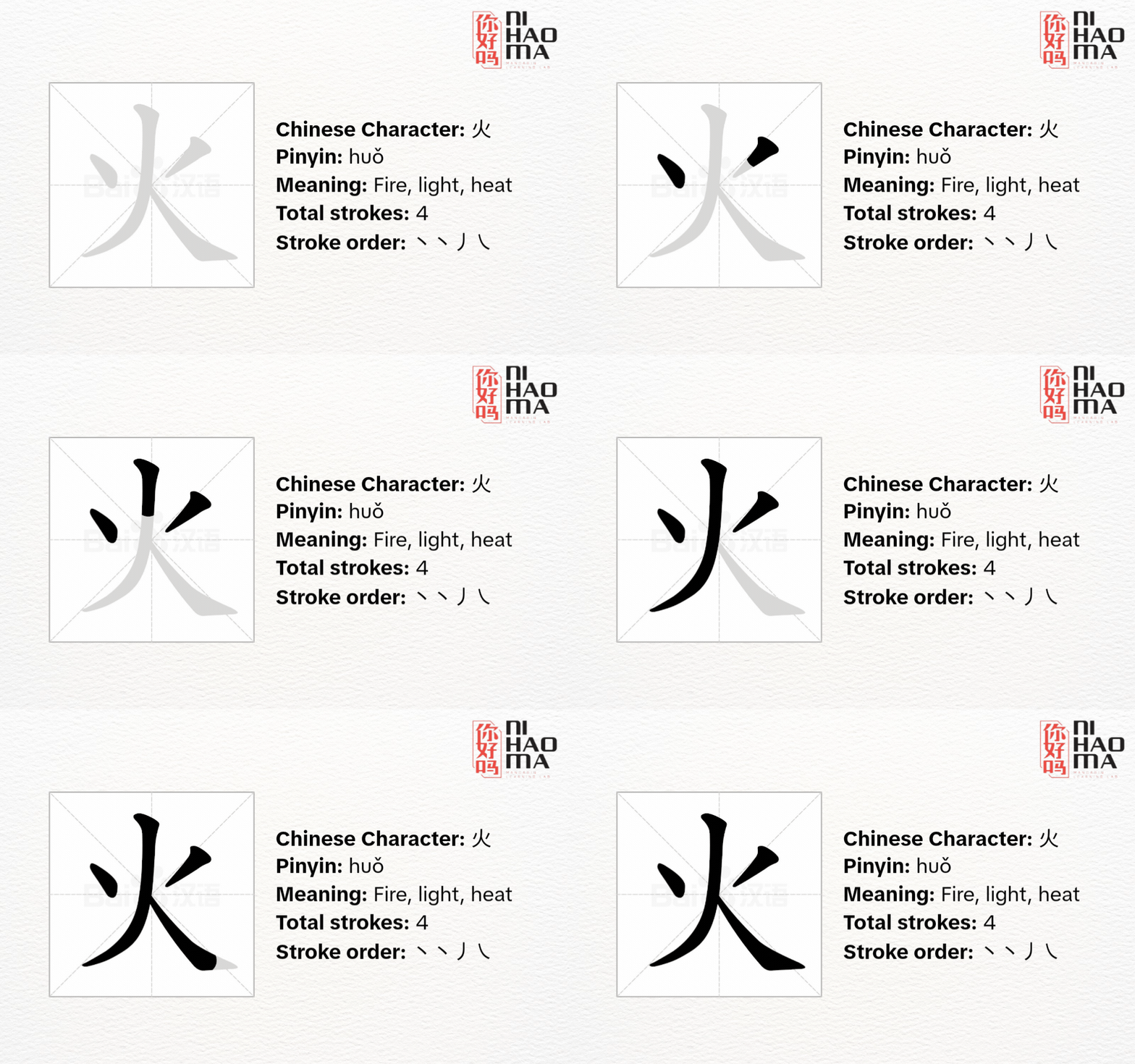
Depending on its position within a character’s structure, radical 86 manifests in two primary visual variants:
- The Stand-Alone/Side Form (火): Consisting of 4 strokes, this form pictorially mimics a blazing bonfire with a central flame and two sparks flying out to the sides. When serving as a radical on the left or top of another character, it retains this shape but narrows slightly to yield space for other components.
- The Bottom Form / “Four Dots” Variant (灬): This variant also consists of 4 horizontal dots placed neatly at the base of a character. Beginners often mistake this form of radical 86 for the water radical (水) or standard brush dots. However, it is actually the flattened, horizontal mutation of fire, signifying heat or thermal energy radiating from below during a cooking or heating process.
How to Write Radical 86 in Chinese
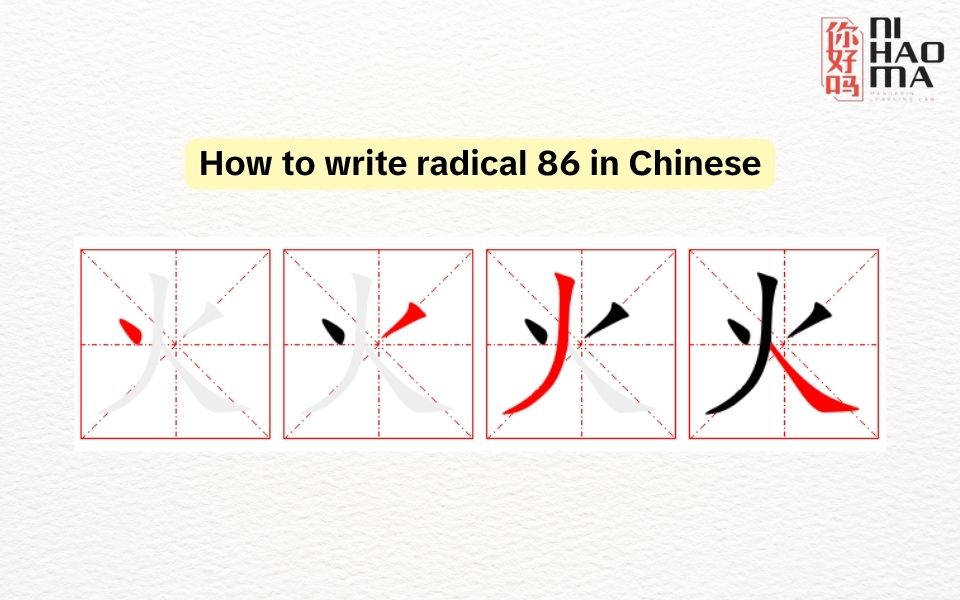
Writing Chinese characters with the correct stroke order not only makes your handwriting look more elegant and balanced, but it also doubles your retention rate. Let’s review the detailed stroke-by-stroke guide for radical 86 below:
| Stroke Order | Stroke Name | Description |
| 1 | Dot (丶) | Write a small dot on the left side, angled slightly downward and to the left. |
| 2 | Dot (丶) | Write another small dot on the right side, balancing the first one. |
| 3 | Throw / Left-Falling (丿) | Draw a long, elegant sweeping stroke from the top down toward the bottom left. |
| 4 | Press / Right-Falling (㇏) | Draw a matching diagonal stroke down toward the right, ending symmetrically with stroke 3. |
Vocabulary Containing Radical 86 in Chinese
To help you build your vocabulary systematically, Ni Hao Ma has curated a list of over 50 of the most common Chinese words featuring radical 86. These essential high-frequency words range from beginner to advanced levels and are deeply integrated into daily conversations:
| Character | Pinyin | Meaning |
| 火 | huǒ | Fire |
| 灯 | dēng | Lamp / Light |
| 灰 | huī | Ash / Gray |
| 炉 | lú | Stove / Furnace |
| 灶 | zào | Cooking stove |
| 炭 | tàn | Charcoal |
| 烟 | yān | Smoke / Cigarette |
| 点 | diǎn | Dot / To light (a fire) / To order (food) |
| 炒 | chǎo | To stir-fry |
| 烧 | shāo | To burn / To cook / To roast |
| 炸 | zhá | To deep-fry |
| 烤 | kǎo | To bake / To roast / To barbecue |
| 热 | rè | Hot |
| 熟 | shú | Cooked / Ripe / Familiar |
| 焦 | jiāo | Burnt / Scorched |
| 然 | rán | Correct / So / Right |
| 照 | zhào | To illuminate / To take a photo |
| 煤 | méi | Coal |
| 烈 | liè | Intense / Fierce |
| 烦 | fán | Annoyed / Vexed |
| 烦脑 | fánnǎo | Worry / Vexation |
| 热水 | rèshuǐ | Hot water |
| 热茶 | rèchá | Hot tea |
| 热饭 | rèfàn | Hot rice / Hot meal |
| 热牛奶 | rè niúnǎi | Hot milk |
| 热狗 | règǒuhot | Hotdog |
| 热情 | rèqíng | Enthusiastic / Warmhearted |
| 热门 | rèmén | Popular / Trending |
| 发烧 | fāshāo | To have a fever |
| 发火 | fāhuǒ | To catch fire / To lose one’s temper |
| 烧烤 | shāokǎo | Barbecue / BBQ |
| 炒饭 | chǎofàn | Fried rice |
| 炒面 | chǎomiàn | Fried noodles |
| 炸鸡 | zhájī | Fried chicken |
| 炸鱼 | zháyū | Fried fish |
| 烤肉 | kǎoròu | Roast meat / Grilled meat |
| 烤鸭 | kǎoyā | Roast duck |
| 烤鱼 | kǎoyú | Grilled fish |
| 火车 | huǒchē | Train |
| 火车站 | huǒchēzhàn | Train station |
| 火锅 | huǒguō | Hotpot |
| 火山 | huǒshān | Volcano |
| 火机 | huǒjī | Lighter |
| 火星 | Huǒxīng | Mars (the planet) |
| 灭火器 | mièhuǒqì | Fire extinguisher |
| 烟花 | yānhuā | Fireworks |
| 烟火 | yānhuǒ | Smoke and fire / Fireworks |
| 灯光 | dēngguāng | Lamp light / Lighting |
| 点心 | diǎnxīn | Dim sum / Pastry |
| 照片 | zhàopiàn | Photo / Picture |
| 灿烂 | cànlàn | Magnificent / Resplendent |
| 黑暗 | hēi’àn | Dark / Darkness |
Daily Conversation Practice with Radical 86 in Chinese
When studying Hanzi (Chinese characters), memorization becomes effortless when you observe vocabulary inside real-world scenarios. Through casual, everyday dialogues about cooking, the weather, or festive holidays, you will encounter words utilizing radical 86 everywhere.
Here are three situational dialogues you can practice to boost your fluency:
Dialogue 1
A: 今天晚上我们吃什么?
Jīntiān wǎnshang wǒmen chī shénme?
What are we having for dinner tonight?
B: 我想炒牛肉,还要烧一个汤。
Wǒ xiǎng chǎo niúròu, hái yào shāo yí gè tāng.
I’d like to stir-fry some beef and make a soup.
A: 锅已经很热了,可以开始炒菜了。
Guō yǐjīng hěn rè le, kěyǐ kāishǐ chǎo cài le.
The pan is already hot. We can start cooking.
B: 好,小心火不要太大。
Hǎo, xiǎoxīn huǒ bú yào tài dà.
Sure. Be careful not to make the fire too strong.
Dialogue 2
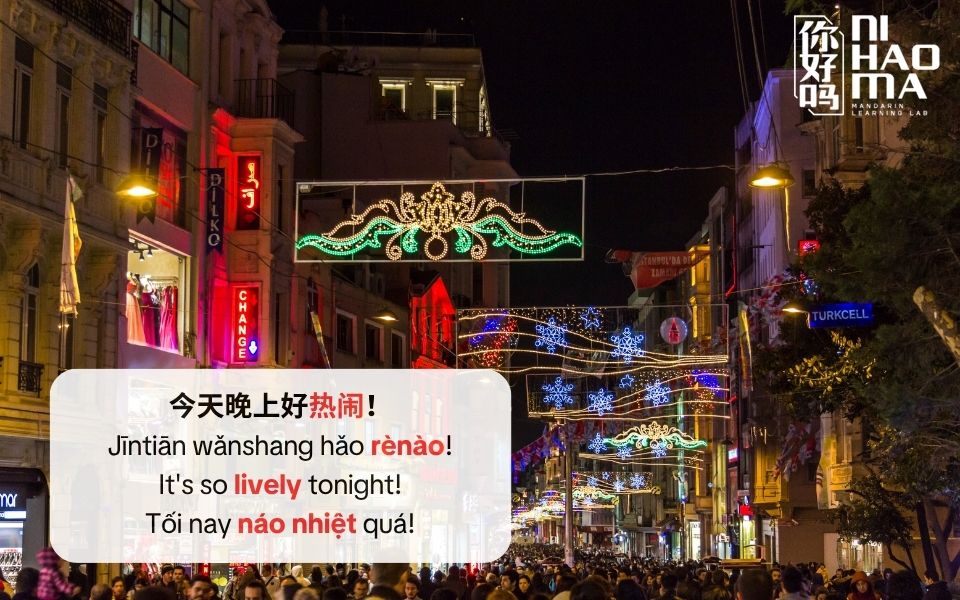
A: 今天晚上好热闹!
Jīntiān wǎnshang hǎo rènào!
It’s so lively tonight!
B: 对啊,到处都是灯,还有很多烟花。
Duì a, dàochù dōu shì dēng, hái yǒu hěnduō yānhuā.
Yes! There are lights everywhere and lots of fireworks.
A: 有人在燃放鞭炮吗?
Yǒurén zài ránfàng biānpào ma?
Are people setting off firecrackers?
B: 是啊,不过现在很多地方已经禁止放炮了。
Shì a, búguò xiànzài hěnduō dìfang yǐjīng jìnzhǐ fàngpào le.
Yes, although many places have banned firecrackers now.
Dialogue 3
A: 今天天气有点冷,我们去吃火锅吧!
Jīntiān tiānqì yǒudiǎn lěng, wǒmen qù chī huǒguō ba!
It’s a little cold today. Let’s have hot pot!
B: 好啊!冬天吃火锅最舒服了。
Hǎo a! Dōngtiān chī huǒguō zuì shūfu le.
Great! Hot pot is perfect for winter.
A: 服务员,请把火开小一点。
Fúwùyuán, qǐng bǎ huǒ kāi xiǎo yìdiǎn.
Excuse me, could you turn the flame down?
B: 汤已经烧开了,可以放牛肉了。
Tāng yǐjīng shāo kāi le, kěyǐ fàng niúròu le.
The soup is boiling now. We can add the beef.
A: 牛肉很容易熟,不要煮太久。
Niúròu hěn róngyì shú, bú yào zhǔ tài jiǔ.
Beef cooks quickly, so don’t leave it in too long.
Conclusion
Mastering radical 86 in Chinese unlocks a vast web of high-frequency Chinese characters tied directly to energy, illumination, heat, and gastronomy. By recognizing this component, you will intuitively decode unfamiliar characters faster, rapidly scale up your vocabulary, and enhance your overall reading comprehension.
To study effectively, combine stroke order practice with themed vocabulary reviews, and construct your own sentences or dialogues using words containing radical 86. Staying consistent with radical-based learning will help you build an ironclad foundation in Chinese characters.
Are you ready to take your Chinese to the next level? Contact Ni Hao Ma today for a personalized learning roadmap and a free trial class! Let’s conquer Chinese together!