
Among the 214 Kangxi radicals, radical 149 in Chinese is one of the most frequently used and practical components you’ll encounter in everyday Chinese. Whether you’re just starting to learn Chinese characters or looking to expand your vocabulary, understanding this radical can make character recognition much easier.
In this guide, you’ll learn what radical 149 is, how to write it correctly, and more than 70 common Chinese words that contain this radical. You’ll also find practical dialogues to help you see how these words are used in real-life conversations.
What Is Radical 149 in Chinese?
Radical 149 (言 – yán) is the 149th radical in the Kangxi Dictionary’s system of 214 Chinese radicals. Its original meaning is speech, language, words, speaking, communication, and verbal expression.
Radical 149 is one of the most common semantic components in Chinese characters. Characters containing this radical are generally related to speaking, communication, language, expressing ideas, reading, writing, or exchanging information.
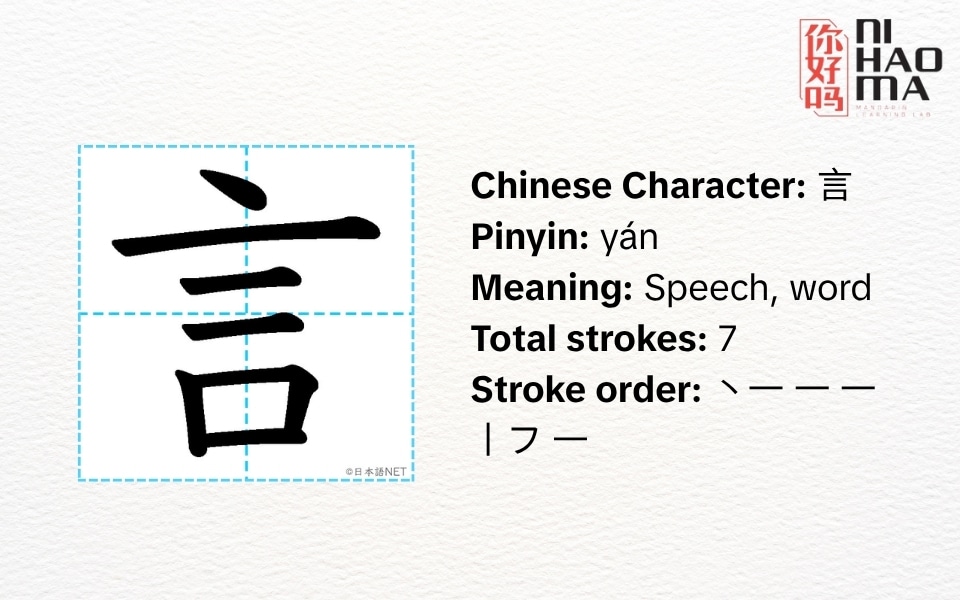
For Chinese learners, mastering radical 149 offers several benefits. It helps you identify the general meaning of unfamiliar characters, recognize vocabulary patterns, and memorize Chinese characters more efficiently. When you see a character containing this radical, you can often infer that its meaning relates to communication, speech, language, discussion, promises, or written texts.
How to Write Radical 149 in Chinese
The traditional form of radical 149 is written as 言, consisting of 7 strokes. Like most Chinese characters, it is written from top to bottom and left to right.
| Stroke order | Stroke | Description |
|---|---|---|
| 1 | Dot (丶) | Place a dot at the top center. |
| 2 | Horizontal (一) | Draw a short horizontal stroke beneath the dot. |
| 3 | Horizontal (一) | Draw a longer horizontal stroke below the second stroke. |
| 4 | Horizontal (一) | Add a third short horizontal stroke, creating three parallel horizontal lines. |
| 5 | Vertical (丨) | Draw a vertical stroke downward on the left side to begin the lower enclosure. |
| 6 | Horizontal turning stroke (𠃍) | Draw a horizontal stroke that turns downward on the right side. |
| 7 | Horizontal (一) | Finish with the bottom horizontal stroke to complete the character. |
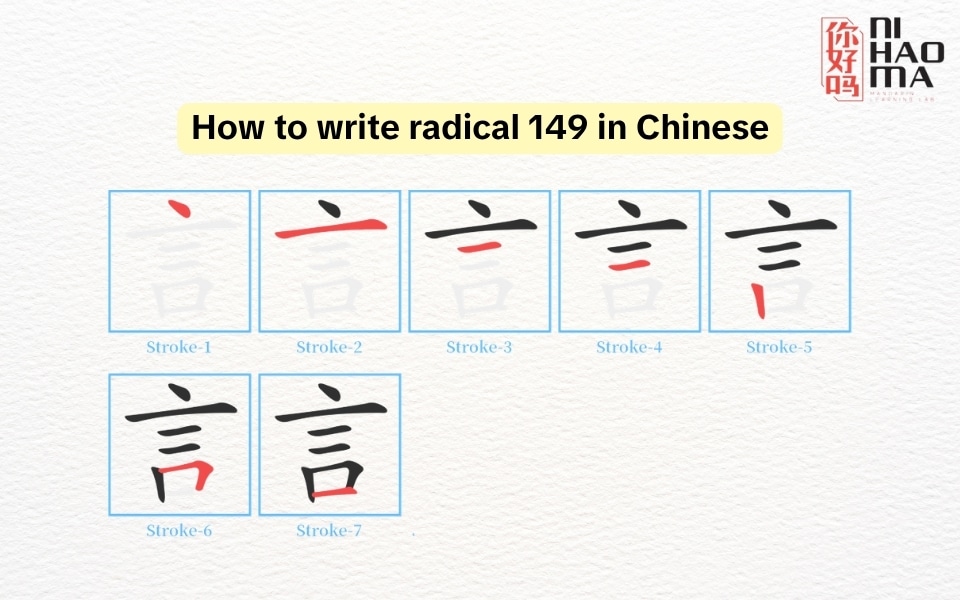
When radical 149 appears as a component on the left side of a simplified Chinese character, it changes from 言 to 讠, which consists of only two strokes: Dot (丶) and right-falling turning stroke (㇊).
Vocabulary Containing Radical 149 in Chinese
Radical 149 appears in a wide range of everyday Chinese vocabulary. Most characters containing this radical are associated with speaking, listening, communication, expressing opinions, reading, writing, or sharing information.
Learning vocabulary by radical is an effective strategy because it allows you to recognize semantic relationships between characters. Instead of memorizing isolated words, you’ll begin to understand how Chinese characters are constructed.
Below are some of the most common vocabulary words containing radical 149, ranging from beginner-level expressions to frequently used words in daily communication.
| Chinese | Pinyin | Meaning |
|---|---|---|
| 说 | shuō | to speak |
| 话 | huà | speech; words |
| 语 | yǔ | language |
| 词 | cí | word; vocabulary |
| 请 | qǐng | please; to invite |
| 讲 | jiǎng | to explain; to speak |
| 谁 | shéi | who |
| 认 | rèn | to recognize |
| 识 | shí | knowledge; to know |
| 让 | ràng | to let; to allow |
| 许 | xǔ | to permit |
| 记 | jì | to remember; to record |
| 计 | jì | to calculate; plan |
| 议 | yì | to discuss |
| 论 | lùn | discussion; theory |
| 谈 | tán | to chat; discuss |
| 诉 | sù | to tell; to accuse |
| 对话 | duìhuà | dialogue |
| 笑话 | xiàohua | joke |
| 汉语 | Hànyǔ | Chinese language |
| 解释 | jiěshì | to explain |
| 证明 | zhèngmíng | to prove |
| 证据 | zhèngjù | evidence |
| 评论 | pínglùn | comment |
| 评价 | píngjià | evaluation |
| 讨论 | tǎolùn | discussion |
| 建议 | jiànyì | suggestion |
| 意见 | yìjiàn | opinion |
| 设计 | shèjì | design |
| 计划 | jìhuà | plan |
| 告诉 | gàosu | to tell |
| 回答 | huídá | to answer |
| 词典 | cídiǎn | dictionary |
| 认识 | rènshi | to know; become acquainted with |
| 记忆 | jìyì | memory |
| 说话 | shuōhuà | to speak |
| 计算 | jìsuàn | to calculate |
| 考试 | kǎoshì | exam |
| 原谅 | yuánliàng | to forgive |
| 保证 | bǎozhèng | to guarantee |
| 调查 | diàochá | investigation |
| 诗人 | shīrén | poet |
| 诚实 | chéngshí | honest |
| 诚信 | chéngxìn | integrity |
| 信息 | xìnxī | information |
| 记者 | jìzhě | journalist |
| 相信 | xiāngxìn | to believe |
| 信用 | xìnyòng | credit; credibility |
| 说服 | shuōfú | to persuade |
| 谢谢 | xièxie | thank you |
| 谅解 | liàngjiě | understanding; forgiveness |
| 谦虚 | qiānxū | modest |
| 谈判 | tánpàn | negotiation |
| 谣言 | yáoyán | rumor |
| 誓言 | shìyán | oath |
| 名言 | míngyán | famous quotation |
| 语言 | yǔyán | language |
| 会谈 | huìtán | formal meeting |
| 发言 | fāyán | to make a speech |
Sample Dialogues Using Vocabulary with Radical 149
After learning vocabulary containing radical 149, the best way to reinforce your memory is to use these words in real-life conversations. Rather than memorizing individual vocabulary items in isolation, practicing through dialogues helps you understand how each word is naturally used in context.
The following conversations include many high-frequency words containing radical 149 which are commonly used in everyday Chinese communication:
Dialogue 1
A: 老师,我想请教您一个问题。
Lǎoshī, wǒ xiǎng qǐngjiào nín yí gè wèntí.
Teacher, I would like to ask you a question.
B: 当然可以,你说吧。
Dāngrán kěyǐ, nǐ shuō ba.
Of course, go ahead.
A: 今天老师讲的语法,我还没有完全理解。
Jīntiān lǎoshī jiǎng de yǔfǎ, wǒ hái méiyǒu wánquán lǐjiě.
I didn’t fully understand the grammar you taught today.
B: 没关系,我再给你解释一次。
Méi guānxi, wǒ zài gěi nǐ jiěshì yí cì.
No problem, I will explain it to you one more time.
A: 谢谢老师,我会认真记下来。
Xièxie lǎoshī, wǒ huì rènzhēn jì xiàlái.
Thank you, teacher. I will take careful notes.
B: 以后有什么问题,都可以告诉我。
Yǐhòu yǒu shénme wèntí, dōu kěyǐ gàosu wǒ.
If you have any questions in the future, just let me know.
Dialogue 2
A: 大家对这个方案有什么意见?
Dàjiā duì zhège fāng’àn yǒu shénme yìjiàn?
Does anyone have any feedback on this proposal?
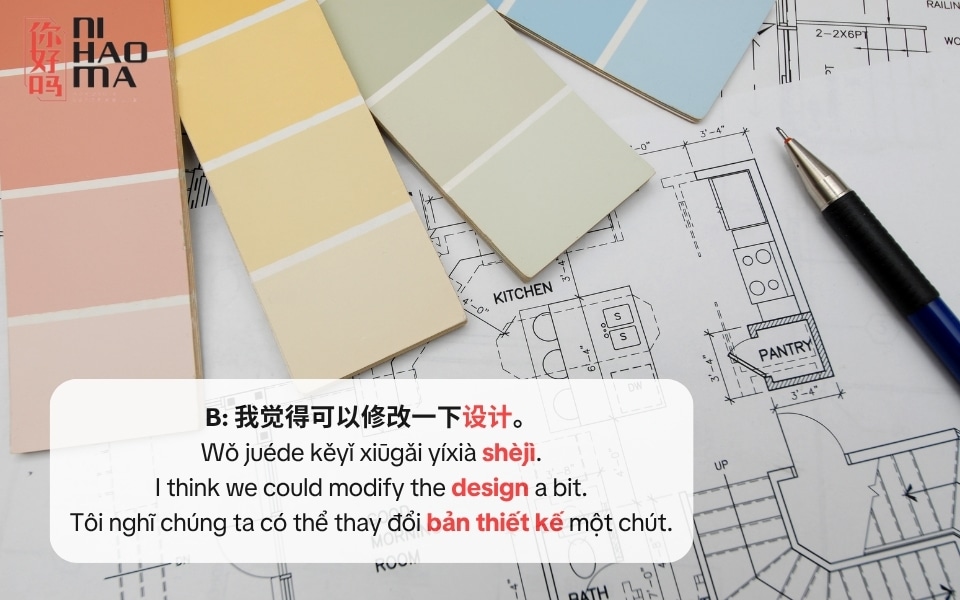
B: 我觉得可以修改一下设计。
Wǒ juéde kěyǐ xiūgǎi yíxià shèjì.
I think we could modify the design a bit.
A: 你的建议很好,请继续说。
Nǐ de jiànyì hěn hǎo, qǐng jìxù shuō.
That’s a great suggestion, please go on.
B: 如果增加一些图片,效果会更好。
Rúguǒ zēngjiā yìxiē túpiàn, xiàoguǒ huì gèng hǎo.
If we add some images, the result will be even better.
A: 好的,我们会讨论你的建议。
Hǎo de, wǒmen huì tǎolùn nǐ de jiànyì.
Alright, we will discuss your suggestion.
B: 谢谢大家的认可。
Xièxie dàjiā de rènkě.
Thank you everyone for your recognition.
Dialogue 3
A: 你看到我昨天发的消息了吗?
Nǐ kàndào wǒ zuótiān fā de xiāoxi le ma?
Did you see the message I sent yesterday?
B: 看到了,不过昨天太忙,还没回复。
Kàndào le, búguò zuótiān tài máng, hái méi huífù.
Yes, I did, but I was too busy yesterday and haven’t replied yet.
A: 没关系,我还以为你没看到。
Méi guānxi, wǒ hái yǐwéi nǐ méi kàndào.
No worries, I thought you hadn’t seen it.
B: 我还给你的照片点赞了,也写了评论。
Wǒ hái gěi nǐ de zhàopiàn diǎnzàn le, yě xiě le pínglùn.
I also liked your photo and left a comment.
A: 真的吗?谢谢你的支持!
Zhēn de ma? Xièxie nǐ de zhīchí!
Really? Thank you for your support!
B: 以后我们多聊天吧!
Yǐhòu wǒmen duō liáotiān ba!
Let’s chat more often from now on!
Summary
The Radical 149 in Chinese is not only one of the 214 essential radicals of Chinese characters but also the “key” to helping learners deeply understand the meaning and formation of many Chinese words. By mastering the meaning, stroke order, and common vocabulary containing the Speech Radical, you will easily retain words longer and enhance your reading comprehension as well as real-life communication skills.
We hope this article from Ni Hao Ma has given you a comprehensive overview of the Speech Radical. Don’t forget to learn vocabulary by topic and apply them to daily conversations for faster memorization. If you want to conquer Chinese systematically, contact our hotline right away for a consultation on the course that best fits your level!