
Radical 75 is one of the most fundamental Chinese radicals and appears in a vast number of commonly used Chinese characters. Understanding its structure, meanings, and how it combines with other components will not only help you write characters correctly but also improve your ability to infer meanings from unfamiliar words. In this article, Ni Hao Ma will guide you through everything you need to know about Radical 75, from its origin and writing order to useful vocabulary and real-life dialogues.
What Is Radical 75 in Chinese?
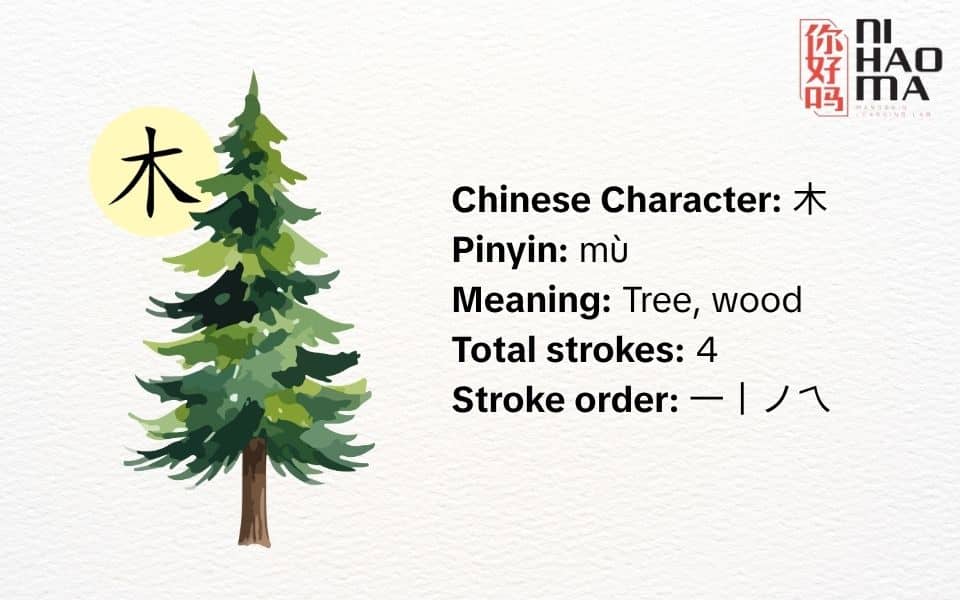
Radical 75 (木 – mù) ranks 75th among the 214 Kangxi radicals. Its original and most common meaning is tree, wood, or woody plants.
In terms of shape, the character 木 is a pictograph representing a tree, with a central trunk, branches extending to both sides, and roots below. As a radical, 木 can stand independently or combine with other components to form new Chinese characters.
As Chinese characters evolved over time, Radical 75 also came to represent objects made of wood, fruits, trees, and broader concepts related to nature. Therefore, when learners encounter a new character containing this radical, they can often infer its meaning more easily and memorize vocabulary more efficiently.
In traditional Chinese philosophy, wood is one of the Five Elements—Metal, Wood, Water, Fire, and Earth. It symbolizes growth, vitality, and continuous development. This symbolic meaning explains why many Chinese characters containing Radical 75 evoke ideas of nature, life, and prosperity.
How to Write Radical 75 in Chinese
To write Chinese characters beautifully and accurately, it is essential to understand the correct stroke order. The writing form of Radical 75 changes slightly depending on whether it appears independently or as a component within a compound character.
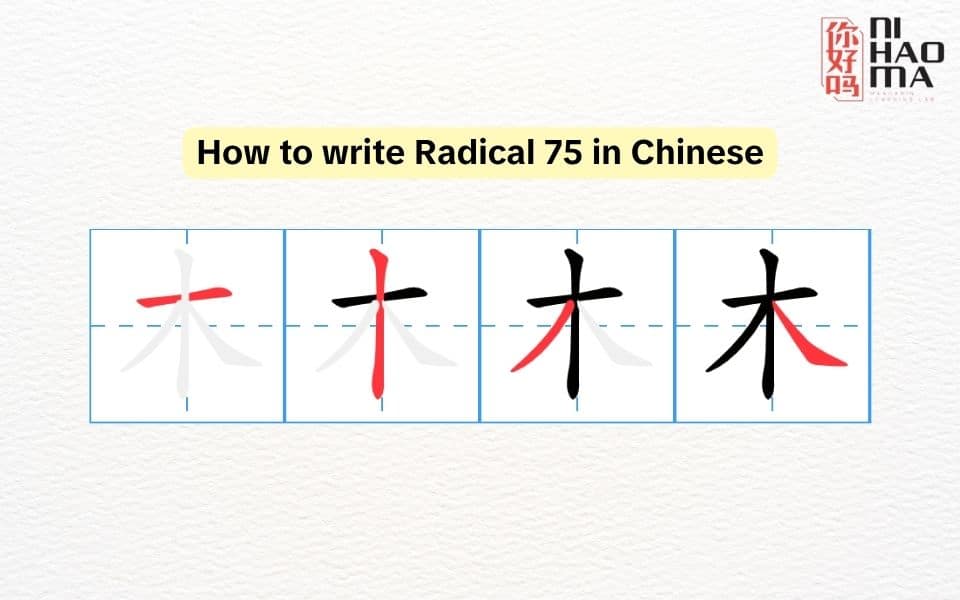
When Radical 75 Appears Independently, the character 木 is written with 4 strokes:
| Stroke Order | Stroke Name | Description |
|---|---|---|
| 1 | Horizontal (一) | Draw a horizontal line from left to right at the top. |
| 2 | Vertical (丨) | Draw a vertical line from top to bottom through the center of the first stroke. |
| 3 | Left-falling (丿) | From the intersection point, draw a diagonal stroke to the lower left. |
| 4 | Right-falling (乀) | From the same intersection point, draw a diagonal stroke to the lower right. |
When Radical 75 appears on the left side of a compound character, its final right-falling stroke (乀) is usually simplified into a dot (丶). This modification creates a more balanced structure and leaves room for the component on the right.
Understanding this transformation is important because many high-frequency Chinese characters use this modified form.
Common Vocabulary Containing Radical 75
To help you expand your vocabulary systematically, here is a list of common Chinese words that contain Radical 75. These words range from beginner to advanced levels and are widely used in everyday life and professional settings.
| Chinese Character | Pinyin | English |
|---|---|---|
| 木 | mù | tree; wood |
| 本 | běn | root; origin; volume (of a book) |
| 未 | wèi | not yet |
| 末 | mò | end; tip |
| 术 | shù | technique; skill; art |
| 机 | jī | machine |
| 杯 | bēi | cup |
| 果 | guǒ | fruit |
| 枝 | zhī | branch |
| 林 | lín | forest |
| 松 | sōng | pine tree |
| 柏 | bǎi | cypress |
| 柳 | liǔ | willow |
| 桃 | táo | peach |
| 李 | lǐ | plum |
| 树 | shù | tree |
| 梅 | méi | plum blossom |
| 梨 | lí | pear |
| 棋 | qí | chess |
| 木头 | mùtou | wood; log |
| 木工 | mùgōng | carpenter |
| 本子 | běnzi | notebook |
| 根本 | gēnběn | fundamental; basic |
| 书本 | shūběn | books |
| 杯子 | bēizi | cup; mug |
| 水果 | shuǐguǒ | fruit |
| 周末 | zhōumò | weekend |
| 苹果 | píngguǒ | apple |
| 果汁 | guǒzhī | fruit juice |
| 森林 | sēnlín | forest |
| 桃子 | táozi | peach |
| 李子 | lǐzi | plum |
| 梨子 | lízi | pear |
| 橘子 | júzi | tangerine |
| 桌子 | zhuōzi | table |
| 椅子 | yǐzi | chair |
| 未来 | wèilái | future |
| 根据 | gēnjù | according to; based on |
| 下棋 | xiàqí | to play chess |
| 桃花 | táohuā | peach blossom |
| 梅花 | méihuā | plum blossom |
| 放松 | fàngsōng | to relax |
| 行李 | xíngli | luggage |
| 起床 | qǐchuáng | to get up |
| 老板 | lǎobǎn | boss; employer |
| 机会 | jīhuì | opportunity |
| 梳子 | shūzi | comb |
| 垃圾桶 | lājītǒng | trash can |
| 棒球 | bàngqiú | baseball |
| 电梯 | diàntī | elevator |
| 标准 | biāozhǔn | standard |
| 学校 | xuéxiào | school |
| 样子 | yàngzi | appearance; shape |
| 检查 | jiǎnchá | to inspect; to check |
| 检验 | jiǎnyàn | to test; examine |
| 光荣 | guāngróng | honor; glory |
| 清楚 | qīngchu | clear; understandable |
| 分析 | fēnxī | to analyze |
| 温柔 | wēnróu | gentle; tender |
| 权利 | quánlì | rights; privileges |
| 模特 | mótè | model |
Sample Dialogues Using Vocabulary with Radical 75
Learning vocabulary in isolation can make it difficult to remember. Seeing words used naturally in conversations is one of the most effective ways to reinforce your understanding of Radical 75 vocabulary.
Dialogue 1
A: 我下个月要搬新家,所以最近一直在买家具。
Wǒ xià gè yuè yào bān xīn jiā, suǒyǐ zuìjìn yìzhí zài mǎi jiājù.
I’m moving to a new home next month, so I’ve been shopping for furniture lately.
B: 真的吗?你已经买了什么?
Zhēn de ma? Nǐ yǐjīng mǎi le shénme?
Really? What have you bought so far?
A: 我买了一张木桌和两把木椅,都是原木颜色的。
Wǒ mǎi le yì zhāng mùzhuō hé liǎng bǎ mùyǐ, dōu shì yuánmù yánsè de.
I bought a wooden table and two wooden chairs. They all have a natural wood finish.
B: 听起来不错。你为什么喜欢木制家具?
Tīng qǐlái búcuò. Nǐ wèishéme xǐhuān mùzhì jiājù?
That sounds great. Why do you like wooden furniture?
A: 因为木制家具看起来很温暖,而且比较环保。
Yīnwèi mùzhì jiājù kàn qǐlái hěn wēnnuǎn, érqiě bǐjiào huánbǎo.
Because wooden furniture gives a warm feeling and is more environmentally friendly.
B: 那等你搬家以后,我去参观一下吧!
Nà děng nǐ bān jiā yǐhòu, wǒ qù cānguān yíxià ba!
Then I’ll come visit your new home after you move in!
A: 当然欢迎!
Dāngrán huānyíng!
Of course! You’re always welcome.

Dialogue 2
A: 今天天气真好,我们去公园走走吧!
Jīntiān tiānqì zhēn hǎo, wǒmen qù gōngyuán zǒuzou ba!
The weather is wonderful today. Let’s go for a walk in the park!
B: 好啊!我听说那个公园里有很多树木和一个小森林。
Hǎo a! Wǒ tīngshuō nàge gōngyuán lǐ yǒu hěn duō shùmù hé yí gè xiǎo sēnlín.
Sure! I heard that park has lots of trees and even a small forest.
A: 这里的空气真新鲜!
Zhèlǐ de kōngqì zhēn xīnxiān!
The air here is so fresh!
B: 是啊,你看,那边有柳树,还有很多松树。
Shì a, nǐ kàn, nàbiān yǒu liǔshù, hái yǒu hěn duō sōngshù.
Yes, look over there! There are willow trees and many pine trees as well.
A: 我平时工作太忙,很少有机会接触大自然。
Wǒ píngshí gōngzuò tài máng, hěn shǎo yǒu jīhuì jiēchù dà zìrán.
I’m usually so busy with work that I rarely have the chance to connect with nature.
B: 那以后我们可以经常一起来这里散步。
Nà yǐhòu wǒmen kěyǐ jīngcháng yìqǐ lái zhèlǐ sànbù.
Then we can come here for walks together more often.
A: 好主意!
Hǎo zhǔyì!
That’s a great idea!
Dialogue 3
A: 今天家里的水果吃完了,我们去超市买一些吧。
Jīntiān jiālǐ de shuǐguǒ chī wán le, wǒmen qù chāoshì mǎi yìxiē ba.
We’ve run out of fruit at home. Let’s go to the supermarket and buy some more.
B: 好啊!妈妈,我想买苹果和桃子。
Hǎo a! Māma, wǒ xiǎng mǎi píngguǒ hé táozi.
Okay! Mom, I’d like to buy apples and peaches.
A: 为什么?
Wèishéme?
Why?
B: 因为苹果很甜,桃子也很好吃。
Yīnwèi píngguǒ hěn tián, táozi yě hěn hǎochī.
Because apples are sweet, and peaches are delicious too.
A: 那再买一些梨子吧,最近天气热,多吃水果对身体好。
Nà zài mǎi yìxiē lízi ba, zuìjìn tiānqì rè, duō chī shuǐguǒ duì shēntǐ hǎo.
Let’s buy some pears too. The weather has been hot lately, and eating more fruit is good for your health.
B: 好!回家以后,我还想喝果汁。
Hǎo! Huí jiā yǐhòu, wǒ hái xiǎng hē guǒzhī.
Okay! When we get home, I’d also like to have some fruit juice.
A: 没问题,妈妈给你做。
Méi wèntí, māma gěi nǐ zuò.
No problem. I’ll make it for you.
Conclusion
Radical 75 (木) is not only one of the most important Chinese radicals but also a gateway to understanding the close relationship between Chinese characters, nature, and everyday life. By learning its meaning, mastering its writing rules, and building vocabulary around it, you can more easily guess the meanings of unfamiliar Chinese characters and develop stronger reading and writing skills.
We hope this guide has helped you gain a deeper understanding of Radical 75 and inspired you to continue exploring Chinese radicals and expanding your vocabulary every day. If you’re looking for a Chinese course that matches your current level, feel free to contact Ni Hao Ma via hotline or social media for personalized support.