When learning Chinese, understanding radicals is one of the most effective ways to memorize Chinese characters, understand their meanings, and recognize vocabulary more quickly. Among the 214 Kangxi radicals, radical 20 in Chinese is an interesting radical associated with the ideas of wrapping, enclosing, and embracing.
So, how is radical 20 in Chinese written, and what are its origins and meanings? Which common Chinese words contain this radical, and how can you use them in everyday communication? Join Ni Hao Ma as we explore its structure, stroke order, and common vocabulary to make learning Chinese easier and more engaging!
What Is Radical 20 in Chinese?
Radical 20 in Chinese (勹 – bāo) is the 20th radical in the 214 Kangxi radicals. It conveys the meanings of “to wrap,” “to enclose,” “to contain,” or “to embrace.”
In terms of its written form, radical 20 is remarkably simple, consisting of just two basic strokes. Its original shape is thought to resemble a person bending forward or hunching over to embrace, protect, or enclose an object in front of them.
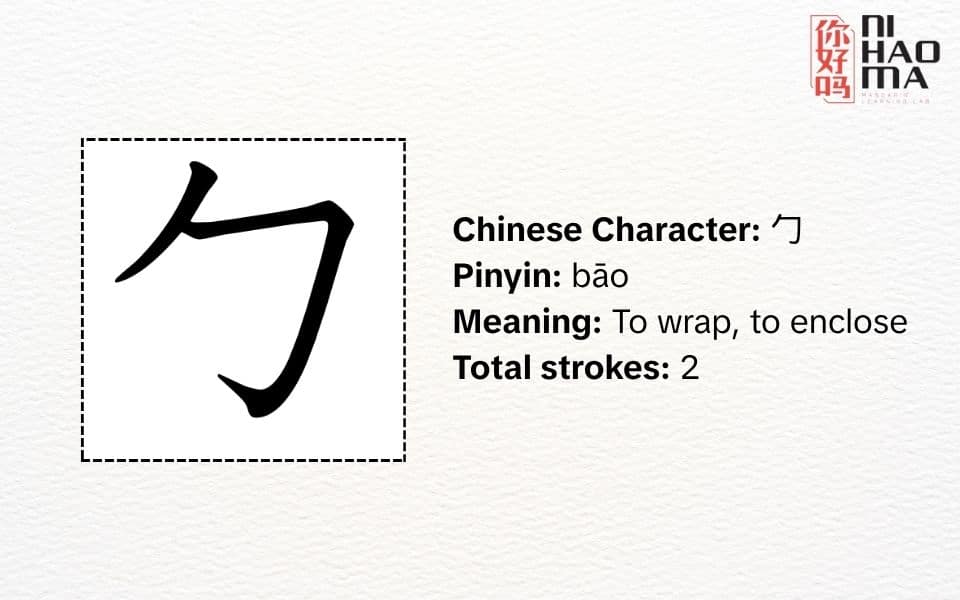
Semantically, the core meanings of this radical are “to wrap,” “to enclose,” “to contain,” and “to hold.” These meanings are closely connected to everyday human activities. Over time, the original meaning has expanded into several broader categories of vocabulary in modern Chinese.
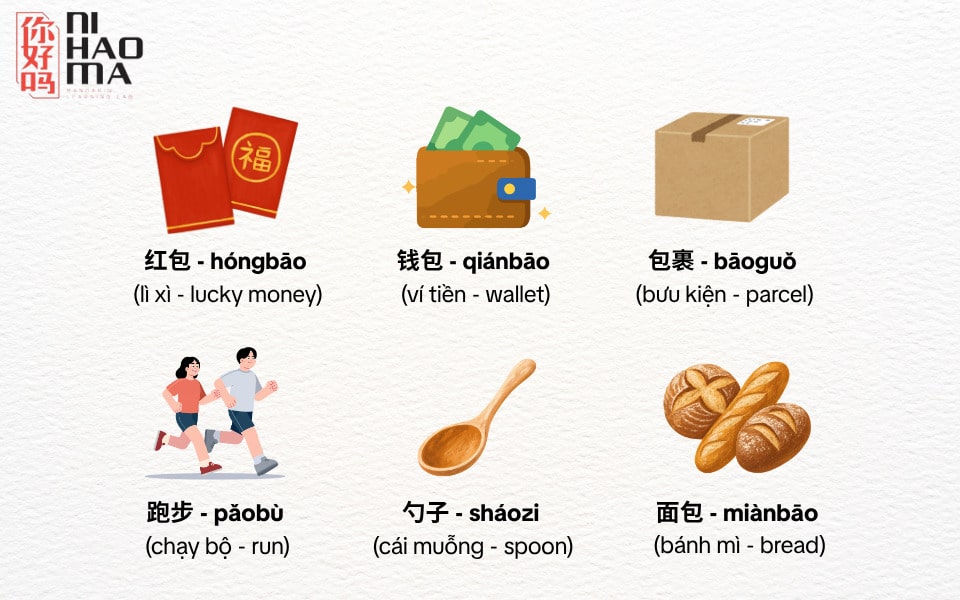
- Words for packaged items and food: Radical 20 is associated with nouns for containers and items used to carry belongings, such as 书包 (shūbāo – schoolbag), 钱包 (qiánbāo – wallet), 背包 (bèibāo – backpack), and 红包 (hóngbāo – red envelope). It also appears in words for food with fillings enclosed inside, such as 包子 (bāozi – steamed stuffed bun) and 面包 (miànbāo – bread).
- Words describing actions and states: This radical appears in vocabulary related to actions and processes, including 包装 (bāozhuāng – to package; packaging), 包扎 (bāozā – to bandage or dress a wound), and 包围 (bāowéi – to surround or encircle).
- Words with abstract and interpersonal meanings: The concept of enclosing or including can extend to more abstract ideas, as seen in 包容 (bāoróng – to be tolerant or accepting) and 包含 (bāohán – to contain or include).
In compound Chinese characters, 勹 can function as an enclosing component that surrounds or partially encloses other elements. It is also important to distinguish this radical from 包 (bāo), the standalone character meaning “to wrap” or “package.”
Several Chinese characters contain the component 包 and have pronunciations that share a similar sound with bāo, although their tones may differ. Examples include 抱 (bào – to hug), 跑 (pǎo – to run), 泡 (pào – to soak or bubble), 饱 (bǎo – full or satisfied), and 胞 (bāo – cell).
How to Write Radical 20 in Chinese
Radical 20, 勹, consists of two strokes. Follow the table below to learn the correct stroke order:
| Stroke Order | Stroke Name | Writing Instructions |
|---|---|---|
| 1 | 丿 (Left-falling stroke) | Begin near the upper-right area and draw a short stroke diagonally downward to the left. |
| 2 | 𠃌 (Horizontal-turning hook) | Start near the middle area of the first stroke, move horizontally to the right, turn downward, and finish with a hook curving slightly upward to the left. |
When practicing radical 20, pay attention to the relationship between the two strokes and the overall enclosing shape. Repeated practice will help you write the radical more naturally and recognize it in other Chinese characters.
Common Chinese Vocabulary Containing Radical 20
After learning the meaning and stroke order of radical 20, the next step is to apply this knowledge to practical Chinese vocabulary. Learning words through radicals can help you recognize Chinese characters more quickly and gain a deeper understanding of how characters are formed.
Below is a list of common Chinese characters and vocabulary items associated with radical 20. Some entries contain 勹 as a radical or structural component, while others contain 包 or related characters that share a similar form or pronunciation. Learning them in context can help you expand your vocabulary and use Chinese more confidently in everyday conversations.
| Chinese | Pinyin | Meaning |
|---|---|---|
| 包 | bāo | To wrap; package; bag |
| 勾 | gōu | Hook; to mark or check |
| 勿 | wù | Do not; must not |
| 匆 | cōng | Hasty; hurried |
| 句 | jù | Sentence; phrase |
| 匀 | yún | Even; uniform |
| 勺 | sháo | Spoon; ladle |
| 饱 | bǎo | Full; satisfied after eating |
| 抱 | bào | To hold; to hug |
| 跑 | pǎo | To run |
| 匍 | pú | To crawl |
| 句子 | jùzi | Sentence |
| 句法 | jùfǎ | Syntax |
| 包子 | bāozi | Steamed stuffed bun |
| 书包 | shūbāo | Schoolbag |
| 面包 | miànbāo | Bread |
| 钱包 | qiánbāo | Wallet |
| 背包 | bèibāo | Backpack |
| 红包 | hóngbāo | Red envelope; lucky money |
| 皮包 | píbāo | Leather bag |
| 包装 | bāozhuāng | To package; packaging |
| 包裹 | bāoguǒ | Parcel; package |
| 包含 | bāohán | To contain; to include |
| 包括 | bāokuò | To include |
| 包围 | bāowéi | To surround; to encircle |
| 包容 | bāoróng | To tolerate; to be accepting |
| 包办 | bāobàn | To take charge of everything |
| 包扎 | bāozā | To bandage; to dress a wound |
| 包车 | bāochē | To charter a vehicle |
| 包场 | bāochǎng | To book an entire venue or screening |
| 包月 | bāoyuè | Monthly package; monthly billing |
| 包年 | bāonián | Annual package; yearly billing |
| 包邮 | bāoyóu | Free shipping |
| 包退 | bāotuì | Guaranteed returns |
| 包换 | bāohuàn | Guaranteed exchanges |
| 包吃 | bāochī | Meals included |
| 包住 | bāozhù | Accommodation included |
| 包工 | bāogōng | To undertake contracted work |
| 包抄 | bāochāo | To outflank; to attack from behind |
| 包庇 | bāobì | To shield or protect someone from blame |
| 包涵 | bāohán | To excuse; to forgive |
| 包揽 | bāolǎn | To take on everything |
| 包赔 | bāopéi | To guarantee compensation |
| 包袱 | bāofu | Bundle; burden (figurative) |
| 包间 | bāojiān | Private room, often in a restaurant |
| 包厢 | bāoxiāng | Private room or booth |
| 包罗 | bāoluó | To encompass; to include a wide range |
| 包租 | bāozū | To rent or lease an entire property |
| 抱歉 | bàoqiàn | Sorry; to apologize |
| 抱怨 | bàoyuàn | To complain |
| 拥抱 | yōngbào | To embrace; to hug |
| 跑步 | pǎobù | To run; running |
| 跑车 | pǎochē | Sports car |
| 跑道 | pǎodào | Running track; runway |
| 泡茶 | pàochá | To brew tea |
| 泡面 | pàomiàn | Instant noodles |
| 吃饱 | chī bǎo | To eat one’s fill |
| 勾结 | gōujié | To collude |
| 勾引 | gōuyǐn | To entice; to seduce |
| 饱和 | bǎohé | Saturation; to become saturated |
| 勺子 | sháozi | Spoon |
Sample Dialogues Using Vocabulary Related to Radical 20
To remember and use vocabulary associated with radical 20 effectively, it is helpful to practice through everyday conversations in addition to studying Chinese characters and their meanings. The following dialogues demonstrate how selected vocabulary items can be used in context while helping you improve your listening, speaking, and conversational fluency.
Dialogue 1
A: 你准备好旅行要带的东西了吗?
Nǐ zhǔnbèi hǎo lǚxíng yào dài de dōngxi le ma?
Have you finished preparing the things you need to take on your trip?
B: 差不多了,我已经把衣服放进背包里了。
Chàbuduō le, wǒ yǐjīng bǎ yīfu fàng jìn bèibāo lǐ le.
Almost. I’ve already put my clothes in my backpack.
A: 你带钱包了吗?我们还要去买一些面包。
Nǐ dài qiánbāo le ma? Wǒmen hái yào qù mǎi yìxiē miànbāo.
Did you bring your wallet? We still need to buy some bread.
B: 带了!我还想买几个包子,留着明天早上吃。
Dài le! Wǒ hái xiǎng mǎi jǐ ge bāozi, liúzhe míngtiān zǎoshang chī.
Yes! I’d also like to buy a few steamed buns to eat tomorrow morning.
A: 好啊。对了,你的书包里还有地方放这些东西吗?
Hǎo a. Duì le, nǐ de shūbāo lǐ hái yǒu dìfang fàng zhèxiē dōngxi ma?
Sounds good. By the way, is there still room in your schoolbag for these things?
B: 有,我把东西整理一下,再把它们包好就行了。
Yǒu, wǒ bǎ dōngxi zhěnglǐ yíxià, zài bǎ tāmen bāo hǎo jiù xíng le.
Yes. I just need to organize everything and wrap the items properly.
Dialogue 2
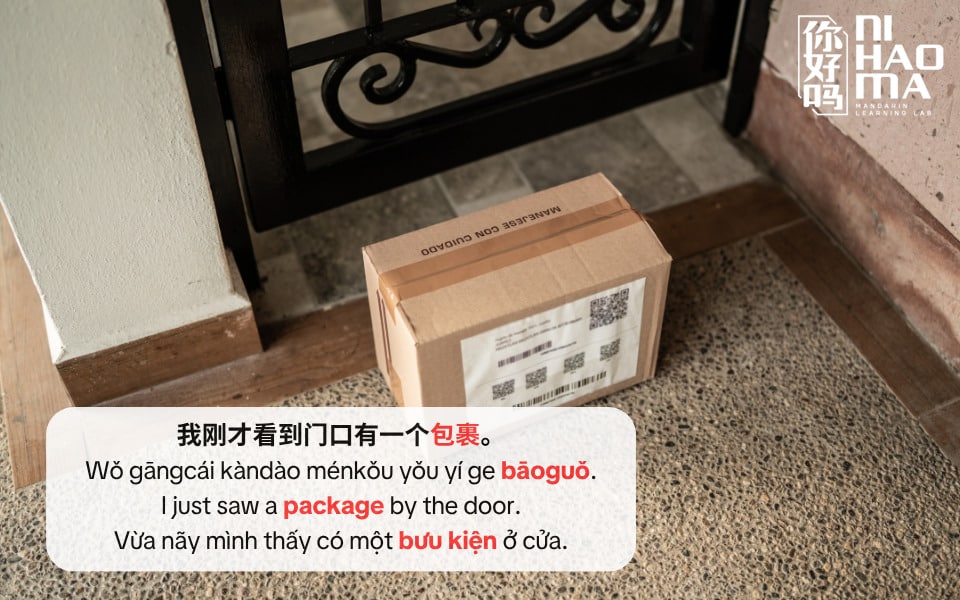
A: 你收到快递了吗?我刚才看到门口有一个包裹。
Nǐ shōudào kuàidì le ma? Wǒ gāngcái kàndào ménkǒu yǒu yí ge bāoguǒ.
Have you received your delivery? I just saw a package by the door.
B: 收到了,谢谢!你能帮我把它打开吗?
Shōudào le, xièxie! Nǐ néng bāng wǒ bǎ tā dǎkāi ma?
Yes, I have. Thanks! Could you help me open it?
A: 没问题。不过,你的手怎么了?好像受伤了。
Méi wèntí. Búguò, nǐ de shǒu zěnme le? Hǎoxiàng shòushāng le.
No problem. But what happened to your hand? It looks like you’ve hurt it.
B: 刚才不小心划伤了,可以帮我包扎一下吗?
Gāngcái bù xiǎoxīn huáshāng le, kěyǐ bāng wǒ bāozā yíxià ma?
I accidentally scratched it earlier. Could you help me bandage it?
A: 可以,我去拿纱布。你先别碰这个包裹。
Kěyǐ, wǒ qù ná shābù. Nǐ xiān bié pèng zhège bāoguǒ.
Of course. I’ll get some gauze. Don’t touch the package for now.
B: 好的,谢谢你。
Hǎo de, xièxie nǐ.
Okay, thank you.
Conclusion
We hope this article has helped you gain a clearer understanding of radical 20 in Chinese, including its meaning, stroke order, and related vocabulary. Learning Chinese characters through radicals can make character recognition easier, expand your vocabulary, and improve your ability to communicate in everyday situations.
Take time to review the vocabulary, practice writing the characters, and create your own example sentences to reinforce what you have learned. Don’t forget to follow the Ni Hao Ma blog for more useful Chinese learning resources and educational tips to support you on your journey toward mastering Chinese!