When you start learning Chinese, familiarizing yourself with Chinese radicals and the structure of Chinese characters is a useful way to recognize characters, understand how vocabulary is formed, and improve reading comprehension. Among these fundamental components, radical 3 in Chinese is worth exploring to help learners distinguish between radicals, individual strokes, and standalone Chinese characters.
So, what is radical 3 in Chinese? What does it mean, and how do you write it correctly? Let’s explore its structure, writing technique, and common Chinese vocabulary with Ni Hao Ma to help you build a stronger foundation in Chinese!
What Is Radical 3 in Chinese?
Radical 3 in Chinese (丶 – zhǔ) is the third radical in the traditional 214 Kangxi radicals system. It consists of just one simple stroke: a dot. This radical is associated with the meaning of a “dot” or “point” and may also be interpreted as a mark indicating an endpoint.
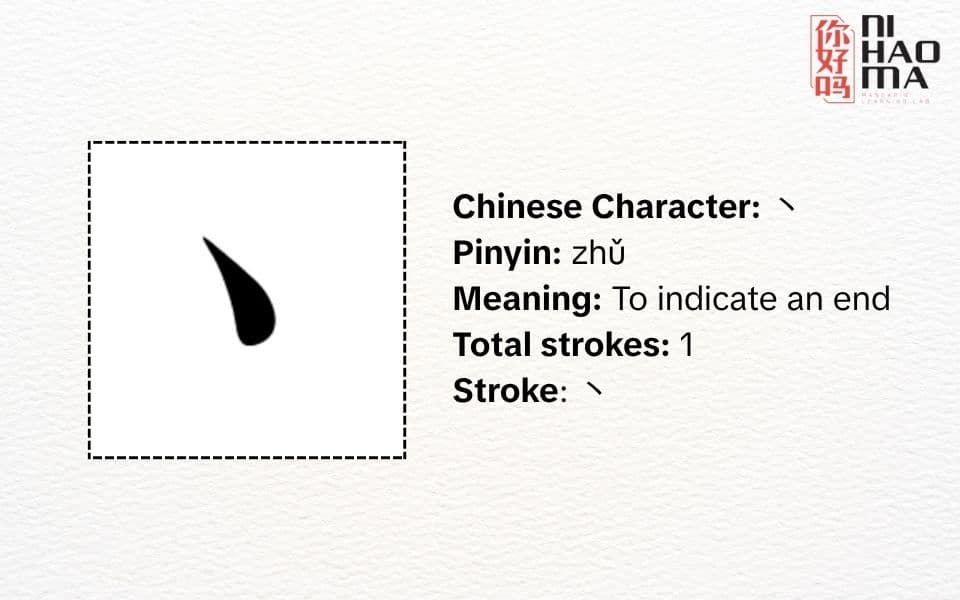
When learning radical 3 in Chinese, pay attention to the shape, writing direction, and position of the dot within each character. It is also important to distinguish between the radical 丶 and the Chinese character 主 (zhǔ). Studying this one-stroke radical alongside handwriting practice and vocabulary learning can help you develop a solid foundation in Chinese characters and recognize them more effectively.
The Difference Between Radical 3 (丶) and the Character 主
The Chinese character 主 (zhǔ) is a standalone character with meanings such as “master,” “principal,” “main,” or “owner,” depending on the context. It consists of five strokes and appears in many common Chinese words and expressions, including 主人 (zhǔrén – host or owner), 主要 (zhǔyào – main or primary), 主动 (zhǔdòng – proactive or active), and 主任 (zhǔrèn – director or department head).
In contrast, radical 3 (丶) is a single dot-shaped stroke used as a component in Chinese characters. Unlike some radicals that can stand alone as meaningful Chinese characters, 丶 generally does not carry an independent lexical meaning when used by itself.
Understanding this distinction will help you identify character components more accurately and avoid confusing a single stroke with a complete Chinese character.
Common Chinese Vocabulary Containing Radical 3
Although it has a simple appearance, radical 3 contributes to the visual structure of many familiar Chinese characters. When studying radical 3 in Chinese, learners should distinguish the radical 丶 from similar-looking dots in other characters and practice recognizing relevant components through practical vocabulary.
| Chinese | Pinyin | Meaning |
|---|---|---|
| 主要 | zhǔyào | Main; principal |
| 主人 | zhǔrén | Host; owner |
| 主意 | zhǔyi | Idea; suggestion |
| 主动 | zhǔdòng | Proactive; take the initiative |
| 主播 | zhǔbō | Streamer; broadcaster |
| 主题 | zhǔtí | Theme; topic |
| 主角 | zhǔjué | Main character; protagonist |
| 主流 | zhǔliú | Mainstream |
| 主打 | zhǔdǎ | To feature; flagship product or service |
| 主控 | zhǔkòng | Main control; primary controller |
| 主张 | zhǔzhāng | Viewpoint; to advocate |
| 主导 | zhǔdǎo | To lead; to dominate |
| 主管 | zhǔguǎn | Manager; supervisor |
| 主考 | zhǔkǎo | Chief examiner |
| 主观 | zhǔguān | Subjective |
| 主旨 | zhǔzhǐ | Main idea; central theme |
| 主顾 | zhǔgù | Regular customer; patron |
| 为难 | wéinán | To make things difficult; to feel embarrassed |
| 为什么 | wèishénme | Why |
| 为人 | wéirén | Conduct; way of dealing with people |
| 为了 | wèile | In order to; for the sake of |
| 作为 | zuòwéi | As; in the capacity of |
| 认为 | rènwéi | To think; to believe |
| 行为 | xíngwéi | Behavior; conduct |
| 成为 | chéngwéi | To become |
| 意义 | yìyì | Meaning; significance |
| 正义 | zhèngyì | Justice; righteousness |
| 义务 | yìwù | Duty; obligation |
| 义工 | yìgōng | Volunteer |
| 定义 | dìngyì | Definition; to define |
| 名义 | míngyì | Name; nominal capacity |
| 同义 | tóngyì | Synonymous; having the same meaning |
| 无义 | wúyì | Meaningless; without righteousness |
| 之前 | zhīqián | Before; previously |
| 之后 | zhīhòu | After; afterward |
| 之中 | zhīzhōng | Among; within |
| 之外 | zhīwài | Outside; beyond |
| 之余 | zhīyú | Apart from; in one’s spare time |
| 之一 | zhīyī | One of |
| 总之 | zǒngzhī | In short; all in all |
| 反之 | fǎnzhī | Conversely; on the other hand |
| 牡丹 | mǔdan | Peony |
| 凡是 | fánshì | Anyone or anything that; all |
| 平凡 | píngfán | Ordinary; commonplace |
| 非凡 | fēifán | Extraordinary; exceptional |
| 凡人 | fánrén | Ordinary person; mortal |
| 主义 | zhǔyì | -ism; doctrine; ideology |
Learning tip: The table includes characters and words associated with the dot-shaped component 丶. However, not every character containing a dot necessarily uses 丶 as its formal radical. For more accurate character analysis, check the radical classification of each individual Chinese character.
Chinese Dialogues Using Radical 3 In Chinese
To remember and use Chinese vocabulary more effectively, learners should combine vocabulary study with practical conversations. The following three dialogues include Chinese characters, pinyin, and English translations to help you practice reading and understand how these words are used in everyday situations.
Dialogue 1
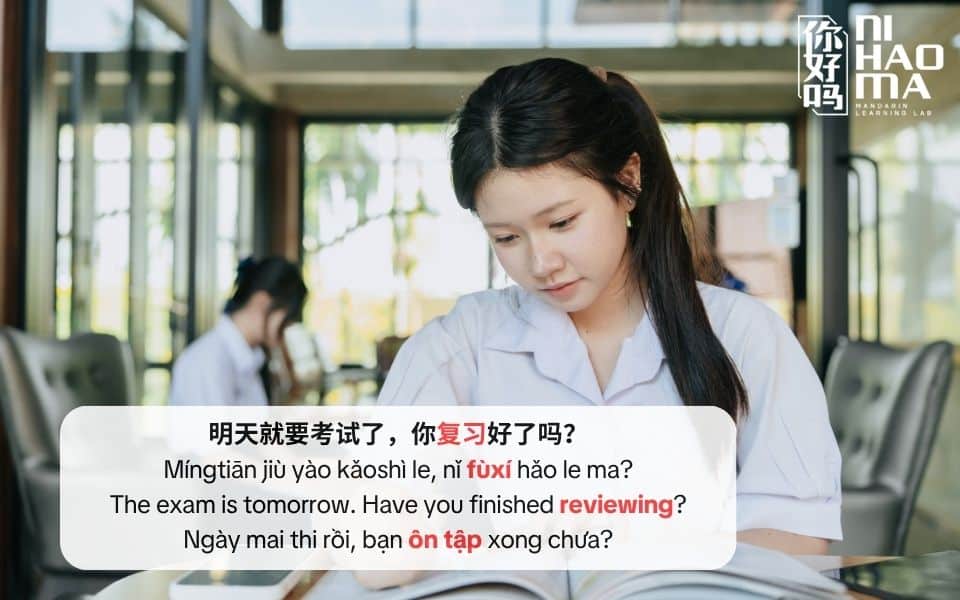
A: 明天就要考试了,你复习好了吗?
Míngtiān jiù yào kǎoshì le, nǐ fùxí hǎo le ma?
The exam is tomorrow. Have you finished reviewing?
B: 还没有,生词太多了,我记不住。
Hái méiyǒu, shēngcí tài duō le, wǒ jì bu zhù.
Not yet. There are too many new words, and I can’t remember them all.
A: 我们一起复习吧,先看老师强调的主要内容。
Wǒmen yìqǐ fùxí ba, xiān kàn lǎoshī qiángdiào de zhǔyào nèiróng.
Let’s review together. First, let’s go over the main points the teacher emphasized.
B: 好主意!那我负责整理生词,你负责整理语法。
Hǎo zhǔyi! Nà wǒ fùzé zhěnglǐ shēngcí, nǐ fùzé zhěnglǐ yǔfǎ.
Good idea! I’ll organize the new vocabulary, and you can organize the grammar.
A: 没问题,复习的时候要注意那些容易写错的字。
Méi wèntí, fùxí de shíhou yào zhùyì nàxiē róngyì xiě cuò de zì.
No problem. When reviewing, pay attention to the characters that are easy to write incorrectly.
B: 好的,希望我们明天都能考个好成绩!
Hǎo de, xīwàng wǒmen míngtiān dōu néng kǎo ge hǎo chéngjì!
All right! I hope we both get good results tomorrow!
Dialogue 2
A: 你找到新工作了吗?
Nǐ zhǎodào xīn gōngzuò le ma?
Have you found a new job?
B: 找到了,我下周一就要去新公司上班。
Zhǎodào le, wǒ xià zhōu yī jiù yào qù xīn gōngsī shàngbān.
Yes! I’m starting at my new company next Monday.
A: 太好了!你主要负责什么工作?
Tài hǎo le! Nǐ zhǔyào fùzé shénme gōngzuò?
That’s great! What will your main responsibilities be?
B: 我主要负责市场推广,还要跟客户沟通。
Wǒ zhǔyào fùzé shìchǎng tuīguǎng, hái yào gēn kèhù gōutōng.
I’ll mainly be responsible for marketing and communicating with clients.
Dialogue 3
A: 你什么时候搬进新公寓?
Nǐ shénme shíhou bān jìn xīn gōngyù?
When are you moving into your new apartment?
B: 我打算这个星期六入住。
Wǒ dǎsuàn zhège xīngqīliù rùzhù.
‘m planning to move in this Saturday.
A: 那边居住环境怎么样?
Nàbiān jūzhù huánjìng zěnmeyàng?
What’s the living environment like there?
B: 很不错,附近有超市和地铁站,生活很方便。
Hěn búcuò, fùjìn yǒu chāoshì hé dìtiězhàn, shēnghuó hěn fāngbiàn.
It’s pretty good. There’s a supermarket and a subway station nearby, so daily life is convenient.
Conclusion
Although radical 3 in Chinese (丶) consists of just one simple dot, it is a useful component to recognize when studying the structure of Chinese characters. By understanding its basic form and distinguishing it from the standalone character, you can develop a clearer understanding of Chinese writing and expand your vocabulary more effectively.
Keep practicing your handwriting, reviewing new words, and using them in everyday conversations to improve your Chinese skills step by step. Follow Ni Hao Ma for more useful guides to Chinese radicals, character structures, and practical vocabulary to make learning Chinese characters easier and more enjoyable!