Among the 214 Kangxi radicals, radical 4 in Chinese is particularly unique. Although it consists of just one stroke, it plays an important role in the structure of Chinese characters and appears in vocabulary ranging from beginner to advanced levels. So, what is radical 4 in Chinese? What does it mean, how is it written, and which common vocabulary words contain it? Let’s explore everything you need to know with Ni Hao Ma in this article!
What Is Radical 4 in Chinese?
Radical 4 in Chinese (丿 – piě) is the fourth radical in the 214 Kangxi radicals. It belongs to the one-stroke radical group and represents the left-falling stroke, one of the eight fundamental strokes used to form Chinese characters.
In terms of pictographic representation and the principles behind Chinese character formation, radical 4 in Chinese resembles a naturally curving movement, suggesting a sense of inclination, separation, or deviation. Although it rarely appears independently as a meaningful word in modern communication, this radical plays an important structural role in Chinese writing. It helps shape the balance of characters and combines with other components to form complete Chinese characters.
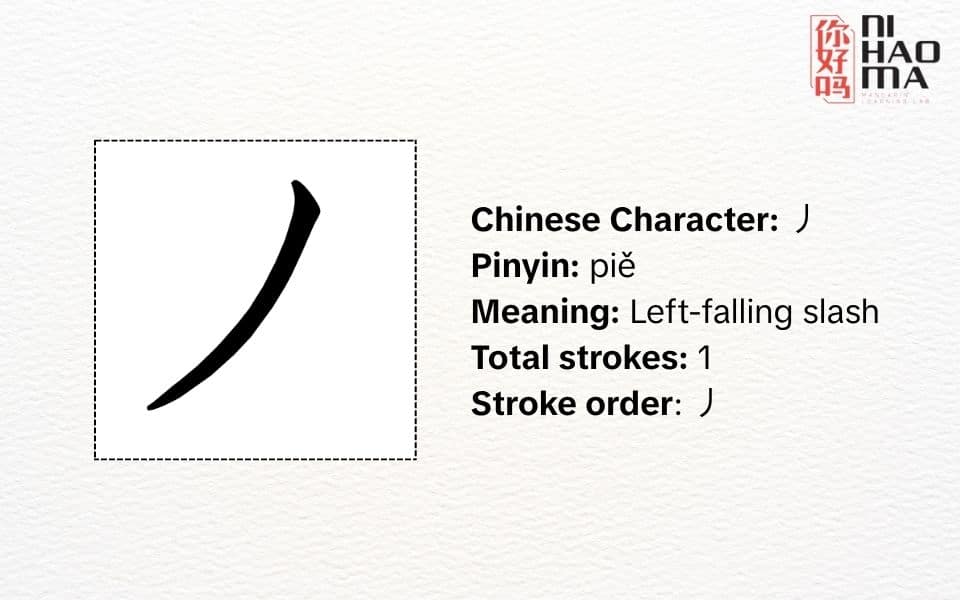
Radical 4 in Chinese consists of just one stroke. Beginners often confuse the Piě radical (丿) with the right-falling stroke (乀). However, they have different writing directions: the left-falling stroke (丿) moves from right to left, while the right-falling stroke (乀) moves from left to right.
See also: What is Radical 3 in Chinese?
Chinese Vocabulary Containing Radical 4
Once you understand the basic structure of radical 4 in Chinese, learning how it appears in actual Chinese vocabulary will help reinforce your knowledge and expand your vocabulary more effectively.
Below is a list of common Chinese characters and vocabulary containing the Piě component, arranged from individual characters featuring the stroke to commonly used compound words in everyday communication.
| Chinese Character | Pinyin | Meaning |
|---|---|---|
| 乂 | yì | To govern; to regulate |
| 乃 | nǎi | Thus; namely; to be |
| 义 | yì | Righteousness; justice |
| 久 | jiǔ | Long; for a long time |
| 么 | me | What; grammatical particle |
| 之 | zhī | Of; it; grammatical particle |
| 乌 | wū | Crow; black |
| 丢 | diū | To lose; to throw away |
| 年 | nián | Year; age |
| 乎 | hū | Modal particle |
| 乏 | fá | Lacking; insufficient |
| 乖 | guāi | Well-behaved; obedient |
| 争 | zhēng | To compete; to fight for |
| 乱 | luàn | Chaotic; disorderly |
| 先 | xiān | Before; first |
| 朱 | zhū | Vermilion; the surname Zhu |
| 竹 | zhú | Bamboo |
| 义务 | yìwù | Duty; obligation |
| 义气 | yìqi | Loyalty; a sense of brotherhood |
| 义工 | yìgōng | Volunteer |
| 久等 | jiǔděng | To wait for a long time |
| 久别 | jiǔbié | To be separated for a long time |
| 久远 | jiǔyuǎn | Ancient; long ago |
| 久留 | jiǔliú | To stay for a long time |
| 久违 | jiǔwéi | Long time no see |
| 之后 | zhīhòu | After; afterwards |
| 之前 | zhīqián | Before; beforehand |
| 之间 | zhījiān | Between; among |
| 之外 | zhīwài | Outside; besides |
| 之内 | zhīnèi | Within; inside |
| 之中 | zhīzhōng | Among; in the middle of |
| 之类 | zhīlèi | This kind of; and so on |
| 乌云 | wūyún | Dark clouds |
| 乌鸦 | wūyā | Crow |
| 乌黑 | wūhēi | Jet-black |
| 乌龟 | wūguī | Turtle; tortoise |
| 丢失 | diūshī | To lose; to misplace |
| 丢掉 | diūdiào | To throw away; to lose |
| 丢脸 | diūliǎn | To lose face |
| 丢人 | diūrén | To be embarrassing; to lose dignity |
| 丢弃 | diūqì | To abandon; to discard |
| 丢下 | diūxià | To leave behind |
| 年龄 | niánlíng | Age |
| 年级 | niánjí | Grade; school year |
| 年代 | niándài | Era; period |
| 年底 | niándǐ | The end of the year |
| 年初 | niánchū | The beginning of the year |
| 年轻 | niánqīng | Young |
| 今年 | jīnnián | This year |
| 明年 | míngnián | Next year |
| 去年 | qùnián | Last year |
| 每年 | měinián | Every year |
| 新年 | xīnnián | New Year |
| 先前 | xiānqián | Previously; before |
| 先生 | xiānsheng | Mr.; gentleman; teacher |
| 先后 | xiānhòu | One after another; in succession |
| 先天 | xiāntiān | Innate; congenital |
| 先行 | xiānxíng | To go ahead; to proceed first |
| 争取 | zhēngqǔ | To strive for; to fight to achieve |
| 争论 | zhēnglùn | To argue; to debate |
| 争议 | zhēngyì | Controversy; disagreement |
| 争吵 | zhēngchǎo | To quarrel; to argue |
| 争先 | zhēngxiān | To compete to be first; to take the lead |
Chinese Dialogues Using Vocabulary Containing Radical 4
To help you use vocabulary containing radical 4 in Chinese more naturally, let’s explore three practical conversations based on everyday situations. These dialogues will help you understand how the vocabulary is used in context while improving your Chinese speaking skills.
Dialogue 1
A: 你最近在忙什么?看起来很快乐!
(Nǐ zuìjìn zài máng shénme? Kàn qǐlái hěn kuàilè!)
What have you been busy with lately? You look really happy!
B: 我每天都在看书和学习汉语,觉得很有意义。
(Wǒ měitiān dōu zài kànshū hé xuéxí Hànyǔ, juéde hěn yǒu yìyì.)
I read books and study Chinese every day. I find it very meaningful.
A: 学习汉语对你来说很重要吗?
(Xuéxí Hànyǔ duì nǐ lái shuō hěn zhòngyào ma?)
Is learning Chinese very important to you?
B: 当然了!它不仅在工作上帮助我,还让我认识了很多新朋友。
(Dāngrán le! Tā bùjǐn zài gōngzuò shàng bāngzhù wǒ, hái ràng wǒ rènshi le hěn duō xīn péngyǒu.)
Of course! It not only helps me at work but also allows me to meet many new friends.
A: 太棒了!祝你每天都学得快乐!
(Tài bàng le! Zhù nǐ měitiān dōu xué de kuàilè!)
That’s wonderful! I hope you enjoy learning every day!

Dialogue 2
A: 周末你打算做什么?要不要和我一起去打乒乓球?
(Zhōumò nǐ dǎsuàn zuò shénme? Yào bú yào hé wǒ yìqǐ qù dǎ pīngpāngqiú?)
What are you planning to do this weekend? Would you like to play table tennis with me?
B: 我不太会打,你打得怎么样?
(Wǒ bú tài huì dǎ, nǐ dǎ de zěnmeyàng?)
I’m not very good at it. How well can you play?
A: 我也是自己学的,打得一般。
(Wǒ yě shì zìjǐ xué de, dǎ de yìbān.)
I taught myself too, so I’m just an average player.
B: 那打一次要多少钱?
(Nà dǎ yí cì yào duōshǎo qián?)
How much does it cost to play once?
A: 不贵,我们每个人只要付二十块人民币。
(Bú guì, wǒmen měi gèrén zhǐyào fù èrshí kuài rénmínbì.)
It’s not expensive. Each of us only needs to pay 20 yuan.
B: 好的,那周末我们一起去吧!
(Hǎo de, nà zhōumò wǒmen yìqǐ qù ba!)
Sounds good! Let’s go together this weekend!
Dialogue 3
A: 请问,去乐园应该乘坐什么交通工具?
(Qǐngwèn, qù lèyuán yīnggāi chéngzuò shénme jiāotōng gōngjù?)
Excuse me, what kind of transportation should I take to get to the amusement park?
B: 你可以乘坐地铁,很方便。
(Nǐ kěyǐ chéngzuò dìtiě, hěn fāngbiàn.)
You can take the subway. It’s very convenient.
A: 好的,但我不知道在哪里买票。
(Hǎo de, dàn wǒ bù zhīdào zài nǎlǐ mǎi piào.)
Okay, but I don’t know where to buy tickets.
B: 你可以用手机扫码,非常快。
(Nǐ kěyǐ yòng shǒujī sǎo mǎ, fēicháng kuài.)
You can scan the QR code with your phone. It’s very quick.
A: 谢谢你!我已经很多年没有来了。
(Xièxie nǐ! Wǒ yǐjīng hěn duō nián méiyǒu lái le.)
Thank you! I haven’t been here for many years.
B: 不客气,祝你玩得开心!
(Bú kèqì, zhù nǐ wán de kāixīn!)
You’re welcome! Have a wonderful time!
Frequently Asked Questions About Radical 4 in Chinese
Radical 4 in Chinese represents a slanting or flowing movement, as well as the idea of separation or inclination. When incorporated into Chinese characters, it rarely carries an independent lexical meaning. Instead, it mainly serves a structural function, helping distinguish and shape the overall form of characters.
The Piě radical (丿) consists of a single left-falling stroke. Depending on the character and writing style, this stroke may appear shorter, longer, more upright, or more horizontal. However, these are variations in the appearance of the stroke rather than separate official forms of the radical.
The Piě stroke (丿) can appear in various positions within Chinese characters, including the upper and left portions of a character. It can also combine with other strokes and components to form complete characters. Its exact position depends on the structure of each character.
Radical 4 (丿) and the ordinary left-falling stroke have the same written shape. The difference lies in their functions. Radical 4 is a Chinese radical used to classify and look up characters in dictionaries, whereas the left-falling stroke is one of the basic strokes used to construct Chinese characters. Therefore, not every character containing a left-falling stroke is classified under radical 4.
Radical 4 belongs to the group of six one-stroke radicals, which form the shortest-stroke category among the 214 Kangxi radicals. Although the Piě radical itself is not always used as an independent component, the left-falling stroke is extremely common in Chinese character construction. It appears in a large number of frequently used Chinese characters.
Conclusion
Although it consists of just one left-falling stroke, radical 4 in Chinese plays an important role in understanding Chinese character structures and developing your vocabulary knowledge. Mastering basic strokes and radicals will make it much easier to recognize, write, and remember Chinese characters as you progress in your language-learning journey.
If you are looking for a structured and engaging way to learn Chinese, the experienced teaching team at Ni Hao Ma is always ready to help you master Chinese characters and develop your language skills. Contact Ni Hao Ma today to discover a learning pathway tailored to your current level and learning goals!