When you first start learning Chinese, memorizing hundreds or even thousands of Chinese characters can sometimes feel overwhelming. However, learning how to analyze Chinese characters through radicals can make the process much easier and more logical.
Radical 48 in Chinese is one of the simplest Chinese radicals, yet it appears in many familiar Chinese characters. So, what exactly is radical 48 in Chinese? What does it mean, and which vocabulary words contain it? Let’s explore everything you need to know with Ni Hao Ma below!
What Is Radical 48 in Chinese?
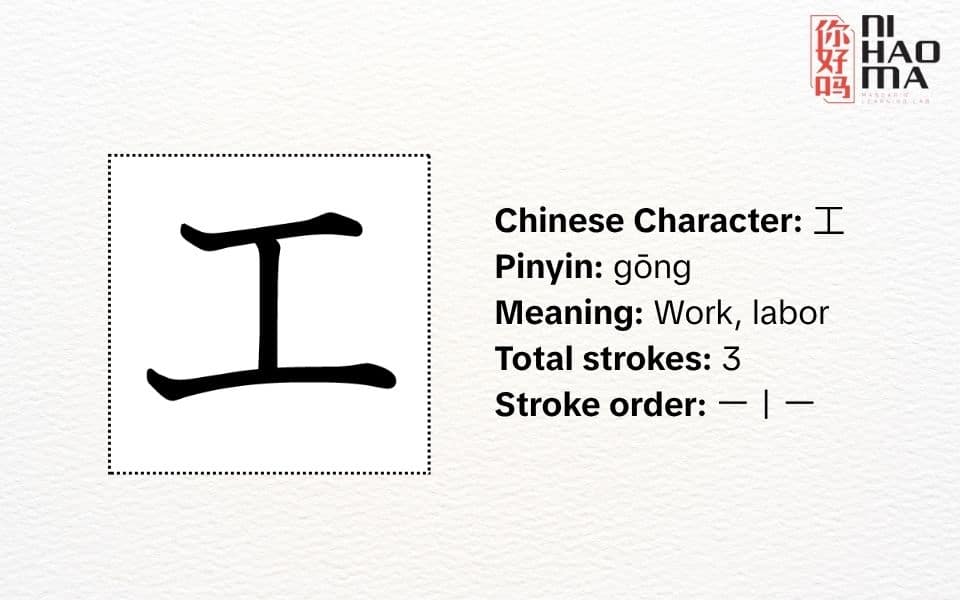
Radical 48 in Chinese (工 – gōng) is the 48th radical among the 214 Kangxi radicals, with a pictographic meaning closely associated with work, tools, and craftsmanship.
The character 工 is believed to have originated from the image of an ancient tool or instrument used for manual work. Over the course of Chinese character development, its original form was gradually simplified into the modern character 工 that we use today.
When used in the structure of Chinese characters, the component 工 can appear in different positions, such as:
- On the left: 江, 红, 虹…
- On the right: 功…
- At the bottom: in some Chinese characters where 工 appears in a lower position.
- In the center or inside: depending on the structure of the individual character.
Radical 48, represented by 工, can function as either a semantic or phonetic component depending on the character. When it contributes meaning, 工 is often associated with work, labor, tools, and craftsmanship. When it functions as a phonetic component, it mainly provides a clue to the pronunciation, often suggesting a sound close to gōng.
How to Write Radical 48 in Chinese
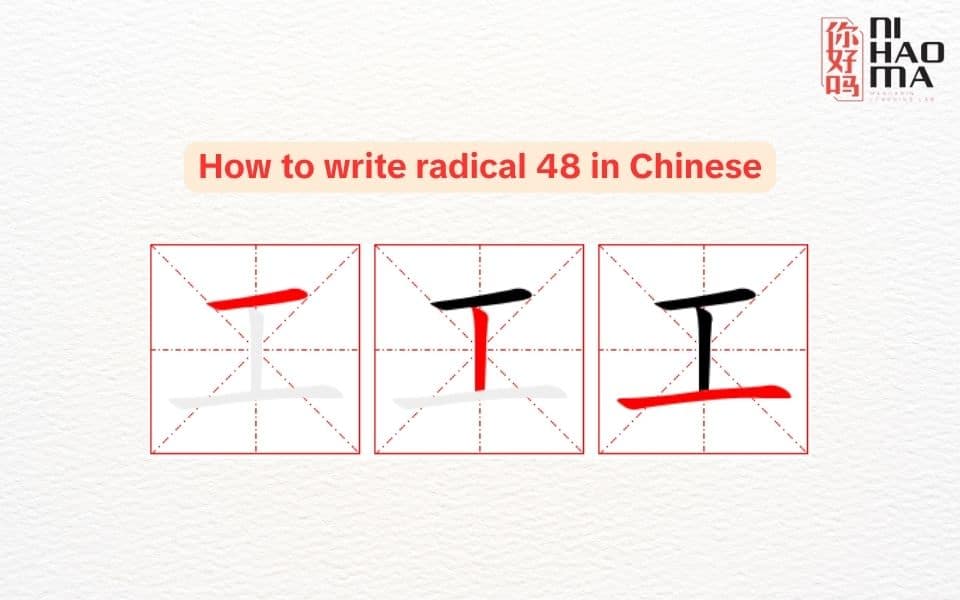
Radical 48 consists of three strokes and is written as follows:
| Stroke Order | Stroke Name | How to Write |
|---|---|---|
| 1 | 一 (Horizontal) | Draw the top horizontal stroke from left to right. |
| 2 | 丨 (Vertical) | Draw the vertical stroke downward through the middle of the first stroke. |
| 3 | 一 (Horizontal) | Draw the bottom horizontal stroke from left to right, connecting to the end of the vertical stroke. |
Distinguishing Radical 48 工 from Radical 32 土 and Radical 33 士
Radical 48 工, radical 32 土, and radical 33 士 all have relatively simple shapes. Each consists of three strokes and combines horizontal and vertical lines, making them easy to confuse when you are first learning Chinese characters. However, by paying close attention to the horizontal strokes, you can easily tell these radicals apart:
| Radical | Character | Key Identification Feature | Basic Meaning |
|---|---|---|---|
| Radical 48 | 工 | The two horizontal strokes are relatively similar in length, with the vertical stroke connecting them. | Work, labor, tools |
| Radical 32 | 土 | The bottom horizontal stroke is generally longer, and the vertical stroke ends at the bottom horizontal stroke. | Earth, soil, land |
| Radical 33 | 士 | The top horizontal stroke is longer than the bottom horizontal stroke. | Scholar, gentleman |
A useful way to remember them is to pay attention to the proportions of the horizontal strokes. This small visual difference can help you recognize 工、土、士 more accurately and avoid confusing them when reading or writing Chinese characters.
Vocabulary Containing Radical 48 in Chinese
The character 工 (gōng) appears in many Chinese characters and vocabulary words related to work, labor, technology, skills, and craftsmanship. It also appears in characters where 工 functions primarily as a phonetic component.
Below is a list of 70 commonly used vocabulary items, arranged from simple single-character words to longer compound words:
| Chinese | Pinyin | Meaning |
|---|---|---|
| 工 | gōng | work; labor |
| 巧 | qiǎo | skillful; clever; coincidental |
| 左 | zuǒ | left; left side |
| 差 | chà | poor; inferior; different |
| 杠 | gàng | carrying pole; horizontal bar |
| 扛 | káng | to carry; to lift |
| 江 | jiāng | river |
| 红 | hóng | red |
| 虹 | hóng | rainbow |
| 空 | kōng | empty; free; sky |
| 控 | kòng | to control |
| 攻 | gōng | to attack |
| 工人 | gōngrén | worker |
| 工厂 | gōngchǎng | factory |
| 工作 | gōngzuò | work; to work |
| 工资 | gōngzī | salary; wages |
| 工具 | gōngjù | tool; instrument |
| 工程 | gōngchéng | project; engineering work |
| 工业 | gōngyè | industry |
| 工地 | gōngdì | construction site |
| 工艺 | gōngyì | craftsmanship; manufacturing technique |
| 工会 | gōnghuì | trade union |
| 工时 | gōngshí | working hours; labor hours |
| 工农 | gōngnóng | workers and peasants |
| 工商 | gōngshāng | industry and commerce |
| 加工 | jiāgōng | to process; to manufacture |
| 成功 | chénggōng | success; to succeed |
| 功夫 | gōngfu | skill; effort; kung fu |
| 功能 | gōngnéng | function; feature |
| 功劳 | gōngláo | contribution; merit |
| 功率 | gōnglǜ | power; power rating |
| 功名 | gōngmíng | fame and official status; achievement |
| 功力 | gōnglì | skill; mastery |
| 攻击 | gōngjī | attack; to attack |
| 巧妙 | qiǎomiào | ingenious; skillful |
| 巧合 | qiǎohé | coincidence |
| 差距 | chājù | gap; difference |
| 杠杆 | gànggǎn | lever |
| 巩固 | gǒnggù | to consolidate; to strengthen |
| 扛住 | kángzhù | to withstand; to hold up |
| 攻击 | gōngjī | attack |
| 攻克 | gōngkè | to conquer; to overcome |
| 差别 | chābié | difference; distinction |
| 红色 | hóngsè | red; red color |
| 红茶 | hóngchá | black tea |
| 红包 | hóngbāo | red envelope |
| 空间 | kōngjiān | space |
| 空气 | kōngqì | air |
| 控制 | kòngzhì | to control |
| 项目 | xiàngmù | project; item |
| 江山 | jiāngshān | country; territory |
| 成功 | chénggōng | success; to succeed |
| 工程师 | gōngchéngshī | engineer |
| 巧克力 | qiǎokèlì | chocolate |
Conversation Examples Using Vocabulary with Radical 48
Learning vocabulary through real-life conversations is an effective way to remember Chinese characters and understand how words are used in context. After becoming familiar with vocabulary containing radical 48, let’s put these words into practice with Ni Hao Ma through situations related to work, study, and everyday communication.
The following conversations use natural expressions to help you review vocabulary containing 工 while also developing your Chinese reading comprehension and conversational skills.
Conversation 1
A: 你最近工作怎么样?
Nǐ zuìjìn gōngzuò zěnmeyàng?
How is your work going recently?
B: 还不错,我已经习惯新公司的工作了。
Hái búcuò, wǒ yǐjīng xíguàn xīn gōngsī de gōngzuò le.
Pretty well. I’ve already gotten used to my new job at the company.
A: 你的工资比以前高吗?
Nǐ de gōngzī bǐ yǐqián gāo ma?
Is your salary higher than before?
B: 高一点,而且公司的福利也不错。
Gāo yìdiǎn, érqiě gōngsī de fúlì yě búcuò.
A little higher, and the company benefits are pretty good too.
A: 那太好了。希望你在新的工作中越来越顺利。
Nà tài hǎo le. Xīwàng nǐ zài xīn de gōngzuò zhōng yuèláiyuè shùnlì.
That’s great. I hope everything goes smoothly in your new job.
B: 谢谢!我也希望自己能取得更大的成功。
Xièxie! Wǒ yě xīwàng zìjǐ néng qǔdé gèng dà de chénggōng.
Thank you! I also hope I can achieve greater success.

Conversation 2
A: 你觉得学习中文最重要的是什么?
Nǐ juéde xuéxí Zhōngwén zuì zhòngyào de shì shénme?
What do you think is the most important thing when learning Chinese?
B: 我觉得坚持和练习很重要。
Wǒ juéde jiānchí hé liànxí hěn zhòngyào.
I think consistency and practice are very important.
A: 你有什么学习技巧吗?
Nǐ yǒu shénme xuéxí jìqiǎo ma?
Do you have any study techniques?
B: 我每天都会复习生词,也会练习说中文。
Wǒ měitiān dōu huì fùxí shēngcí, yě huì liànxí shuō Zhōngwén.
I review new vocabulary every day and also practice speaking Chinese.
A: 难怪你的中文进步这么快。
Nánguài nǐ de Zhōngwén jìnbù zhème kuài.
No wonder your Chinese has improved so quickly.
B: 其实只要努力,慢慢积累,就会成功。
Qíshí zhǐyào nǔlì, mànmàn jīlěi, jiù huì chénggōng.
As long as you work hard and gradually build up your knowledge, you will succeed.
Conversation 3
A: 你为什么买这么多巧克力?
Nǐ wèishénme mǎi zhème duō qiǎokèlì?
Why did you buy so much chocolate?
B: 明天是朋友的生日,我想给她准备一个特别的礼物。
Míngtiān shì péngyou de shēngrì, wǒ xiǎng gěi tā zhǔnbèi yí ge tèbié de lǐwù.
It’s my friend’s birthday tomorrow, and I want to prepare a special gift for her.
A: 她最喜欢什么口味的巧克力?
Tā zuì xǐhuan shénme kǒuwèi de qiǎokèlì?
What flavor of chocolate does she like best?
B: 她喜欢黑巧克力,尤其喜欢手工制作的。
Tā xǐhuan hēi qiǎokèlì, yóuqí xǐhuan shǒugōng zhìzuò de.
She likes dark chocolate, especially handmade chocolate.
A: 手工巧克力是不是需要很多工夫?
Shǒugōng qiǎokèlì shì bú shì xūyào hěn duō gōngfu?
Does handmade chocolate take a lot of effort to make?
B: 是啊,制作过程很复杂。
Shì a, zhìzuò guòchéng hěn fùzá.
Yes, the production process is quite complicated.
Conclusion
We hope this article has helped you understand what radical 48 in Chinese is, what the character 工 (gōng) means, and how it appears in different Chinese characters and vocabulary words.
Instead of trying to memorize Chinese characters mechanically, you can start with familiar radicals such as radical 48, then connect them with related characters and vocabulary. This approach can make Chinese character learning more logical and easier to remember.
Make a habit of practicing stroke order, reading new words aloud, and creating your own sentences. With regular practice, your knowledge of Chinese radicals can gradually develop into practical Chinese language skills.
If you would like to learn more about Chinese radicals and discover effective ways to memorize Chinese characters, continue learning with Ni Hao Ma for more useful and engaging Chinese-learning resources!