
Radical 27 is one of the most frequently encountered components in Chinese characters. It appears in many high-frequency words used in both written Chinese and everyday conversation. In this article, you will learn what radical 27 is, its origin and meaning, how to write it correctly, and common vocabulary that contains this radical.
What Is Radical 27 in Chinese?
In the traditional Kangxi system of 214 Chinese radicals, radical 27 is written as (厂 – chǎng). Historically, this radical originated as a pictograph representing a cliff face or overhanging rock. Over time, its meaning expanded to include ideas such as shelter, buildings, factories and physical structures.
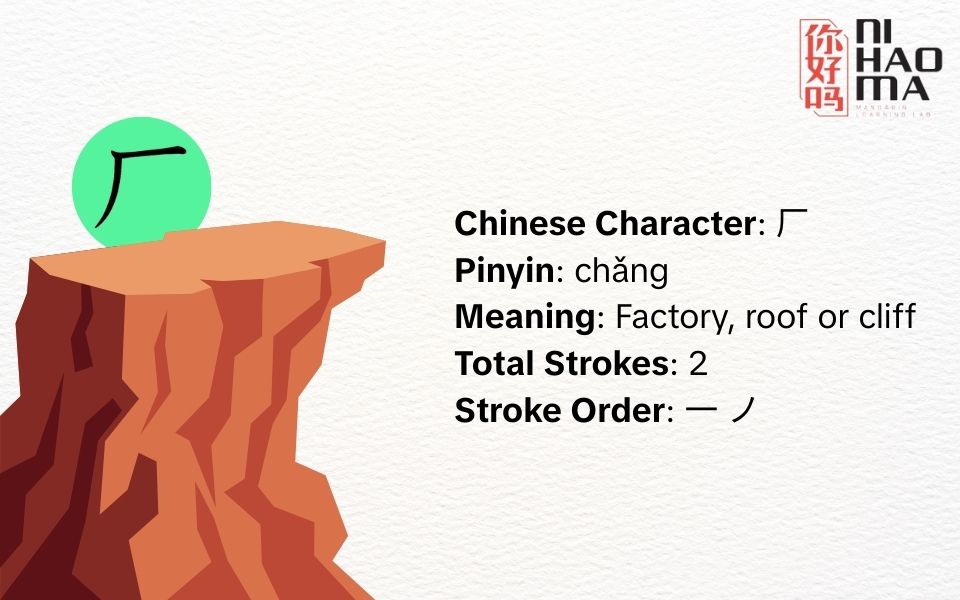
In terms of meaning, when used independently, 厂 (chǎng) is commonly understood as a factory or production workshop. When functioning as radical 27 within other Chinese characters, 厂 often evokes the idea of a sheltered space, architectural structure, or concepts related to production, construction, and physical structures.
As a result, learners can sometimes infer part of a character’s meaning when they encounter radical 27.
- Chinese Character: 厂
- Pinyin: chǎng
- Meaning: Factory, production site; roof or cliff
- Stroke Count: 2
- Stroke Order: 一 ノ
In terms of structure and derived characters, radical 27 serves as an important semantic component in many commonly used characters. A typical example is the character 原 (yuán), which originally described water flowing out from beneath a cliff, carrying the meaning of origin or source. Another example is 压 (yā), which depicts an object being pressed under a cliff, expressing the idea of pressure.
How to Write Radical 27 in Chinese
In terms of form, radical 27 (厂) consists of only two strokes and commonly appears on the left side or at the top of a Chinese character.
Because of its small number of strokes and simple structure, radical 27 is one of the components that Chinese learners usually become familiar with at an early stage. Recognizing radical 27 accurately helps avoid confusion with similar-looking components such as 广.
Distinguishing Radical 27 from Radical 53 in Chinese
In Chinese, radical 27 (厂) and radical 53 (广) look quite similar, which can easily cause confusion for beginners. However, these two components differ clearly in structure, meaning, and usage. Careful observation makes them easy to distinguish.
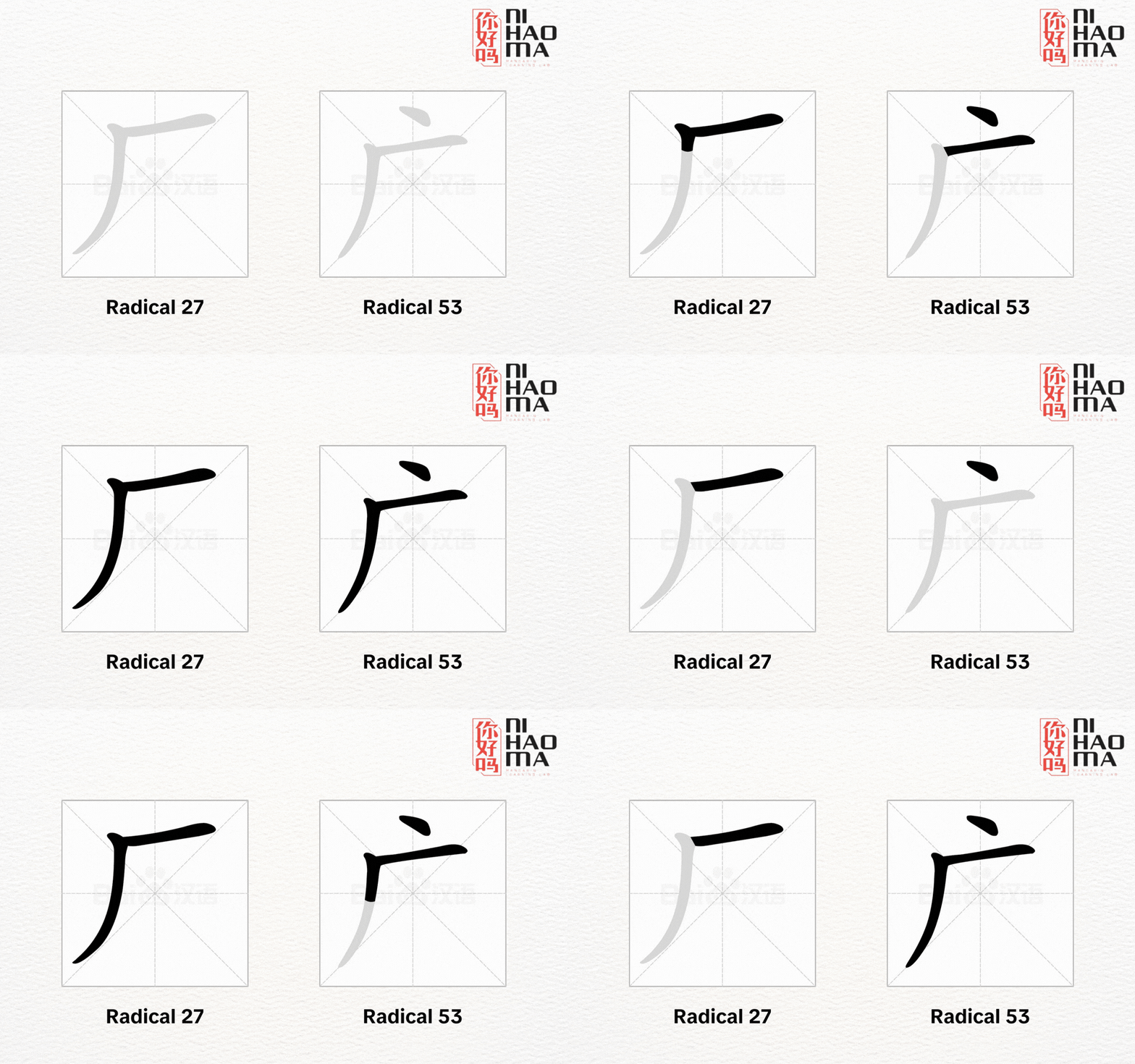
In terms of stroke order, the most noticeable difference is the small dot at the top.
- Radical 53 (广) consists of three strokes. It begins with a dot (丶), followed by a horizontal stroke with a slight turn, and then a long left-falling stroke.
- Radical 27 (厂) has only two strokes and does not include the top dot.
Understanding this structural difference helps learners accurately identify radical 27 and avoid common writing mistakes.
Vocabulary Containing Radical 27 in Chinese
Radical 27 (厂) has a simple structure but appears in a wide range of commonly used Chinese characters. Because of its connection to shelters, buildings, and factories, radical 27 is frequently seen in vocabulary related to daily life, work, and physical structures.
Below is a list of common words containing radical 27:
| Chinese Character | Pinyin | Meaning |
|---|---|---|
| 厂 | chǎng | Factory, plant |
| 历 | lì | To experience; history |
| 厅 | tīng | Hall; large room |
| 压 | yā | To press; pressure |
| 厚 | hòu | Thick; generous |
| 厘 | lí | Li (unit of measurement) |
| 厦 | shà | Large building |
| 厨 | chú | Kitchen |
| 厢 | xiāng | Train carriage; compartment |
| 厩 | jiù | Stable (for horses) |
| 厄 | è | Adversity; misfortune |
| 厉 | lì | Severe; strict |
| 厌 | yàn | To dislike; to detest |
| 崖 | yá | Cliff |
| 厮 | sī | Servant (archaic) |
| 原因 | yuán yīn | Reason; cause |
| 原来 | yuán lái | Originally; it turns out |
| 厂长 | chǎng zhǎng | Factory director |
| 历史 | lì shǐ | History |
| 大厅 | dà tīng | Lobby; main hall |
| 压力 | yā lì | Pressure; stress |
| 深厚 | shēn hòu | Deep; profound |
| 厘米 | lí mǐ | Centimeter |
| 厕所 | cè suǒ | Restroom |
| 大厦 | dà shà | Skyscraper; large building |
| 厨房 | chú fáng | Kitchen |
| 车厢 | chē xiāng | Train carriage |
| 严厉 | yán lì | Strict; severe |
| 讨厌 | tǎo yàn | To hate; annoying |
| 厂家 | chǎng jiā | Manufacturer |
| 经历 | jīng lì | Experience |
| 客厅 | kè tīng | Living room |
| 厨师 | chú shī | Chef |
| 餐厅 | cān tīng | Restaurant; dining hall |
| 血压 | xuè yā | Blood pressure |
| 宽厚 | kuān hòu | Kind; tolerant |
| 厉害 | lì hai | Formidable; impressive |
| 厌烦 | yàn fán | To feel bored; annoyed |
| 历程 | lì chéng | Course; process |
| 压迫 | yā pò | Oppression |
| 厂房 | chǎng fáng | Factory building |
| 历来 | lì lái | Always; throughout |
| 雄厚 | xióng hòu | Strong; abundant |
Sample Dialogues Using Vocabulary with Radical 27
After understanding the concept, meaning, and stroke order of radical 27 (厂), applying related vocabulary in real-life communication helps learners remember words more effectively. Below are several sample dialogues containing vocabulary with radical 27.
Dialogue 1
A: 你在哪儿工作?
(Nǐ zài nǎr gōngzuò?)
Where do you work?
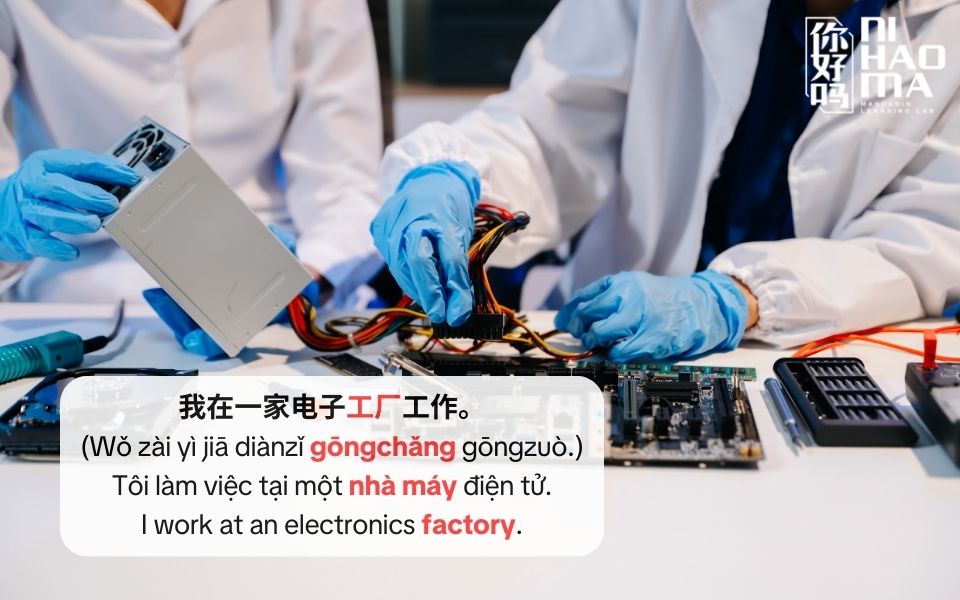
B: 我在一家电子工厂工作。
(Wǒ zài yì jiā diànzǐ gōngchǎng gōngzuò.)
I work at an electronics factory.
A: 工厂离你家远吗?
(Gōngchǎng lí nǐ jiā yuǎn ma?)
Is the factory far from your home?
B: 不太远,坐公交车大概二十分钟。
(Bú tài yuǎn, zuò gōngjiāochē dàgài èrshí fēnzhōng.)
Not very far. It takes about 20 minutes by bus.
Dialogue 2
A: 听说你爸爸在石厂上班?
(Tīngshuō nǐ bàba zài shíchǎng shàngbān?)
I heard your father works at a stone factory, is that right?
B: 对,他在石厂工作很多年了。
(Duì, tā zài shíchǎng gōngzuò hěn duō nián le.)
Yes, he has worked at the stone factory for many years.
A: 石厂的工作辛苦吗?
(Shíchǎng de gōngzuò xīnkǔ ma?)
Is the job at the stone factory hard?
B: 有一点,因为每天都要搬很重的石头。
(Yǒu yìdiǎn, yīnwèi měitiān dōu yào bān hěn zhòng de shítou.)
A little, because he has to carry heavy stones every day.
Dialogue 3
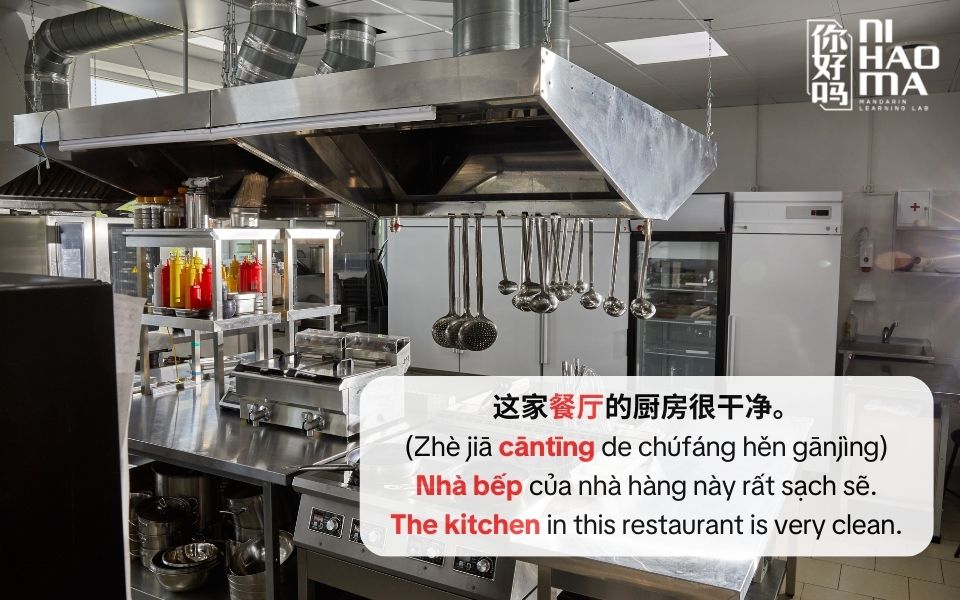
A: 这家餐厅的厨房很干净。
(Zhè jiā cāntīng de chúfáng hěn gānjìng.)
The kitchen in this restaurant is very clean.
B: 是啊,而且厕所也很整洁。
(Shì a, érqiě cèsuǒ yě hěn zhěngjié.)
Yes, and the restroom is also very tidy.
A: 我觉得环境好,顾客才会放心。
(Wǒ juéde huánjìng hǎo, gùkè cái huì fàngxīn.)
I think customers feel comfortable only when the environment is good.
B: 没错,这也是服务质量的一部分。
(Méi cuò, zhè yě shì fúwù zhìliàng de yí bùfen.)
Exactly, that’s also part of service quality.
Conclusion
Radical 27 (厂) is a fundamental Chinese radical that appears in many familiar characters closely related to daily life and work. Understanding the original meaning and semantic function of radical 27 not only helps learners remember characters more effectively but also enables them to infer vocabulary meanings more logically. We hope this article by Ni Hao Ma has provided useful insights into radical 27 in Chinese and supports your continued exploration of Chinese radicals.