When you first start learning Chinese characters, thousands of complex-looking characters can easily feel overwhelming. However, understanding the structure of Chinese radicals can be a “golden key” to decoding meanings and memorizing characters more naturally and systematically.
Among them, radical 42 in Chinese is one of the fundamental radicals that learners are likely to encounter throughout their Chinese vocabulary journey. In this article, Ni Hao Ma explores the meaning and structure of radical 42 in Chinese, along with useful vocabulary and practical conversational examples to help you learn more effectively.
What Is Radical 42 in Chinese?
Radical 42 in Chinese (小 – xiǎo) is the 42nd radical in the traditional Kangxi system of 214 Chinese radicals. It primarily means “small” or “little” and can appear independently or as a component within other Chinese characters.
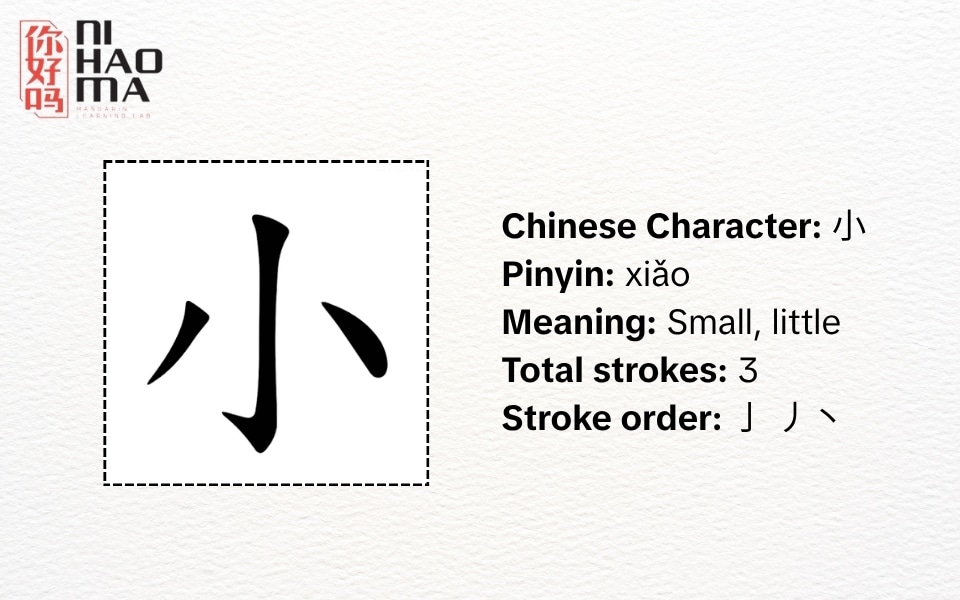
From an etymological perspective, 小 is associated with the idea of smallness or something being divided into smaller parts. From its original meaning of “small,” the character has developed various meanings and uses related to size, quantity, degree, and age.
When learning Chinese characters, recognizing 小 as a radical or structural component can help learners remember characters based on their visual structure rather than memorizing each character individually. However, not every character containing a component that resembles 小 necessarily carries the meaning of “small.”
See also: Radical 41 in Chinese: Meaning and Common Vocabulary
How to Write Radical 42 in Chinese
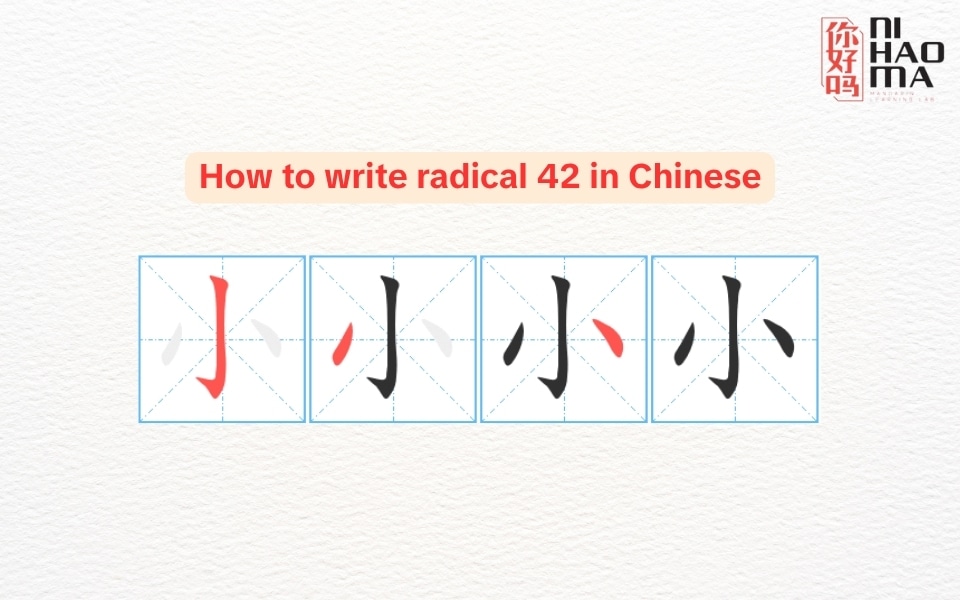
Radical 42 in Chinese, 小, consists of three strokes. It has a balanced structure, with a central vertical hook followed by strokes extending to the left and right. When used as a component in Chinese characters, 小 may also appear in the form ⺌.
The stroke order for 小 is as follows:
| Stroke Order | Stroke Name | Description |
|---|---|---|
| 1 | 亅 (Vertical hook) | Draw a vertical stroke downward and finish with a slight hook toward the left. |
| 2 | 丿 (Left-falling stroke) | Draw a short stroke diagonally downward toward the left. |
| 3 | 丶 (Dot) | Add a small dot toward the lower right to balance the character. |
Writing tip: When practicing 小, keep the vertical hook centered and then add the two side strokes. Maintaining the correct proportions will make the character look balanced and natural.
Vocabulary Containing Radical 42 in Chinese
Recognizing radicals becomes much more effective when combined with learning vocabulary in context. The following words contain characters featuring 小 or related structural components. They are useful examples for helping learners recognize recurring character patterns while expanding their everyday Chinese vocabulary.
| Chinese Character | Pinyin | Meaning |
|---|---|---|
| 少 | shǎo | Few; little; lacking |
| 尘 | chén | Dust |
| 当 | dāng | To serve as; to be; when |
| 光 | guāng | Light |
| 尝 | cháng | To taste; to try |
| 尚 | shàng | Still; to value |
| 削弱 | xuēruò | To weaken |
| 消息 | xiāoxi | News; information |
| 消失 | xiāoshī | To disappear |
| 消费 | xiāofèi | Consumption; to spend |
| 消极 | xiāojí | Negative; passive |
| 消化 | xiāohuà | To digest; digestion |
| 消耗 | xiāohào | To consume; consumption |
| 消防 | xiāofáng | Fire prevention; firefighting |
| 哨兵 | shàobīng | Sentry; guard |
| 哨所 | shàosuǒ | Guard post |
| 光明 | guāngmíng | Bright; light; promising |
| 光亮 | guāngliàng | Bright; luminous |
| 光滑 | guānghuá | Smooth |
| 光彩 | guāngcǎi | Brilliance; splendor |
| 光荣 | guāngróng | Glory; honor |
| 光临 | guānglín | To visit; to grace with one’s presence |
| 时光 | shíguāng | Time; years |
| 月光 | yuèguāng | Moonlight |
| 目光 | mùguāng | Gaze; look |
| 风光 | fēngguāng | Scenery; beautiful landscape |
| 稍等 | shāoděng | Wait a moment |
| 稍后 | shāohòu | Later; in a moment |
| 销售 | xiāoshòu | Sales; to sell |
| 销量 | xiāoliàng | Sales volume |
| 销毁 | xiāohuǐ | To destroy; to dispose of |
| 原因 | yuányīn | Reason; cause |
| 原谅 | yuánliàng | To forgive |
| 原来 | yuánlái | It turns out; originally |
| 高原 | gāoyuán | Plateau |
| 尚且 | shàngqiě | Even; moreover |
| 高尚 | gāoshàng | Noble; lofty |
| 经常 | jīngcháng | Often; frequently |
| 非常 | fēicháng | Very; extremely |
| 爱慕 | àimù | To admire; to adore |
| 羡慕 | xiànmù | To envy; to admire |
| 沙发 | shāfā | Sofa |
| 沙漠 | shāmò | Desert |
| 炒饭 | chǎofàn | Fried rice |
| 吵架 | chǎojià | To argue; to quarrel |
Note: For Chinese character learning, it is important to distinguish between a character that literally contains 小 as a structural component and a word that simply contains the character 小 as an independent character. The presence of a similar-looking component does not necessarily mean that the character derives its meaning directly from the “small” meaning of 小.
Conversation Using Vocabulary Radical 42 in Chinese
Learning radicals becomes much more effective when you combine character recognition with real-life usage. The following conversations use familiar Chinese vocabulary featuring 小 or related structural components, allowing you to review Chinese characters while practicing natural everyday communication.
Conversation 1
A: 你准备好了吗?我们还有半个小时就要出发了。
Nǐ zhǔnbèi hǎo le ma? Wǒmen hái yǒu bàn gè xiǎoshí jiù yào chūfā le.
Are you ready? We’re leaving in half an hour.
B: 快好了,你等我一下。
Kuài hǎo le, nǐ děng wǒ yíxià.
Almost. Give me a minute.
A: 外面好像在下雨,你开车的时候小心一点。
Wàimiàn hǎoxiàng zài xiàyǔ, nǐ kāichē de shíhou xiǎoxīn yìdiǎn.
It looks like it’s raining outside. Be careful when you drive.
B: 放心吧,我会慢一点开的。
Fàngxīn ba, wǒ huì màn yìdiǎn kāi de.
Don’t worry. I’ll drive slowly.
A: 路上如果饿了,我们可以找个地方吃点小吃。
Lùshang rúguǒ è le, wǒmen kěyǐ zhǎo ge dìfang chī diǎn xiǎochī.
If we get hungry on the way, we can find somewhere to grab a snack.
B: 好啊,听起来不错!
Hǎo a, tīng qǐlái búcuò!
Sure, sounds good!
Conversation 2
A: 你看一下这个月的销售数据了吗?
Nǐ kàn yíxià zhège yuè de xiāoshòu shùjù le ma?
Have you looked at this month’s sales data?
B: 看了,整体还不错,但是有几个产品的销量下降了。
Kàn le, zhěngtǐ hái búcuò, dànshì yǒu jǐ ge chǎnpǐn de xiāoliàng xiàjiàng le.
Yes. Overall, it’s pretty good, but sales of a few products have declined.
A: 那我们是不是应该稍微调整一下销售方案?
Nà wǒmen shì bú shì yīnggāi shāowéi tiáozhěng yíxià xiāoshòu fāng’àn?
Should we make some slight adjustments to our sales strategy?
B: 我也这么想,可以先从价格和宣传方式入手。
Wǒ yě zhème xiǎng, kěyǐ xiān cóng jiàgé hé xuānchuán fāngshì rùshǒu.
I think so too. We could start with pricing and our promotional approach.
A: 好,那我下午做一个新的方案给你看看。
Hǎo, nà wǒ xiàwǔ zuò yí ge xīn de fāng’àn gěi nǐ kànkan.
Okay, I’ll prepare a new proposal this afternoon for you to review.
B: 没问题,有需要帮忙的话就告诉我。
Méi wèntí, yǒu xūyào bāngmáng de huà jiù gàosu wǒ.
No problem. Let me know if you need any help.

Conversation 3
A: 你觉得这件衣服怎么样?
Nǐ juéde zhè jiàn yīfu zěnmeyàng?
What do you think of this outfit?
B: 挺好看的,就是价格有点高。
Tǐng hǎokàn de, jiùshì jiàgé yǒudiǎn gāo.
It looks pretty nice, but it’s a little expensive.
A: 我也觉得,我们再看看别的吧。
Wǒ yě juéde, wǒmen zài kànkan bié de ba.
I think so too. Let’s look around a little more.
B: 好,那边好像有一家小店,价格应该便宜一点。
Hǎo, nàbiān hǎoxiàng yǒu yì jiā xiǎodiàn, jiàgé yīnggāi piányi yìdiǎn.
Okay. There seems to be a small shop over there. The prices should be a little cheaper.
A: 走吧,说不定还能买到喜欢的。
Zǒu ba, shuōbudìng hái néng mǎi dào xǐhuan de.
Let’s go. We might find something we like.
B: 好啊,顺便看看有没有打折。
Hǎo a, shùnbiàn kànkan yǒu méiyǒu dǎzhé.
Sure. We can also see if anything is on sale.
Conclusion
Radical 42 in Chinese (小) is the 42nd radical in the traditional system of 214 Kangxi radicals and primarily conveys the meaning of “small” or “little.” It can appear independently as a Chinese character or function as a structural component in other characters.
Learning 小 is useful for understanding Chinese character structure, but learners should avoid assuming that every character containing a similar-looking component directly inherits the meaning “small.” Combining radicals with character etymology, vocabulary, and real-life context is a more reliable way to build strong Chinese literacy.
If you want to develop a solid foundation in Chinese characters, Ni Hao Ma can help you learn radicals systematically while combining character recognition, vocabulary building, and practical conversation. This approach can make learning Chinese characters more intuitive, structured, and memorable.