
When starting to learn Chinese, becoming familiar with Chinese radicals is a useful way to understand the structure of Chinese characters and memorize vocabulary more easily. Among the 214 Kangxi radicals, radical 47 in Chinese has a simple shape and appears in several familiar Chinese characters, vocabulary words, and geographical names.
So, how is this radical written, what does it mean, and which Chinese words contain it? Let’s explore everything you need to know with Ni Hao Ma in this article!
What Is Radical 47 in Chinese?
Radical 47 in Chinese (川 – chuān) is the 47th radical in the traditional system of 214 Kangxi radicals. Its primary meaning is “river” or “stream.” The character 川 consists of three strokes and can function as an independent Chinese character or as a component in other Chinese characters.
Visually, 川 consists of three vertical strokes, resembling streams of water flowing side by side. Its simple shape makes it relatively easy for Chinese beginners to recognize and memorize.
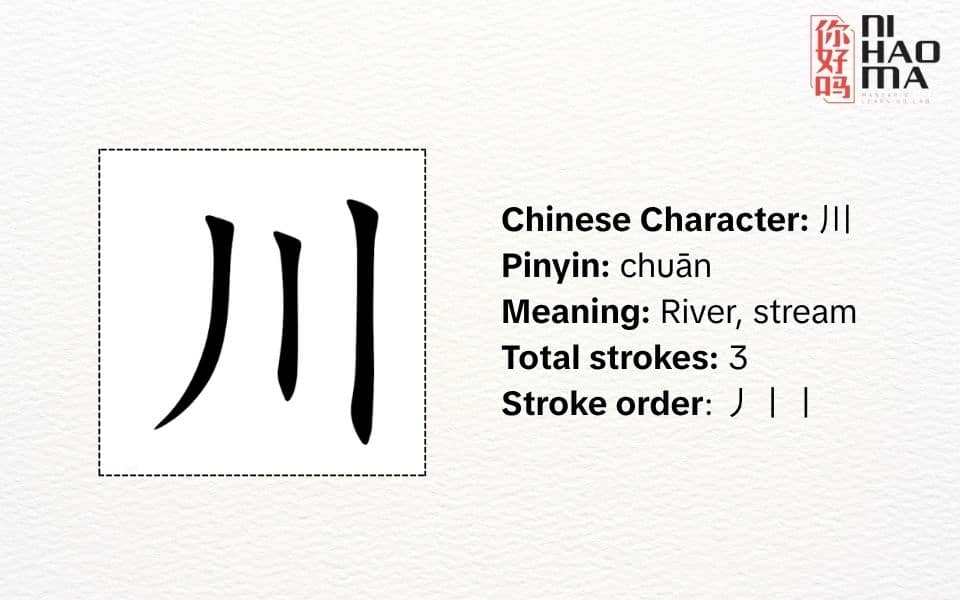
In modern Chinese, 川 appears in several vocabulary words, such as 山川 (shānchuān – mountains and rivers), 河川 (héchuān – rivers and streams), and geographical names such as Sichuan (四川 – Sìchuān). Interestingly, not every Chinese character containing 川 is classified under radical 47 when looking it up in a dictionary.
For example, the character 顺 (shùn – smooth, favorable) contains 川 on its left side, but it is classified under the 页 radical instead. Therefore, when learning Chinese radicals, it is important to distinguish between a component that forms part of a character and the radical used to classify that character in a dictionary.
How to Write Radical 47 in Chinese
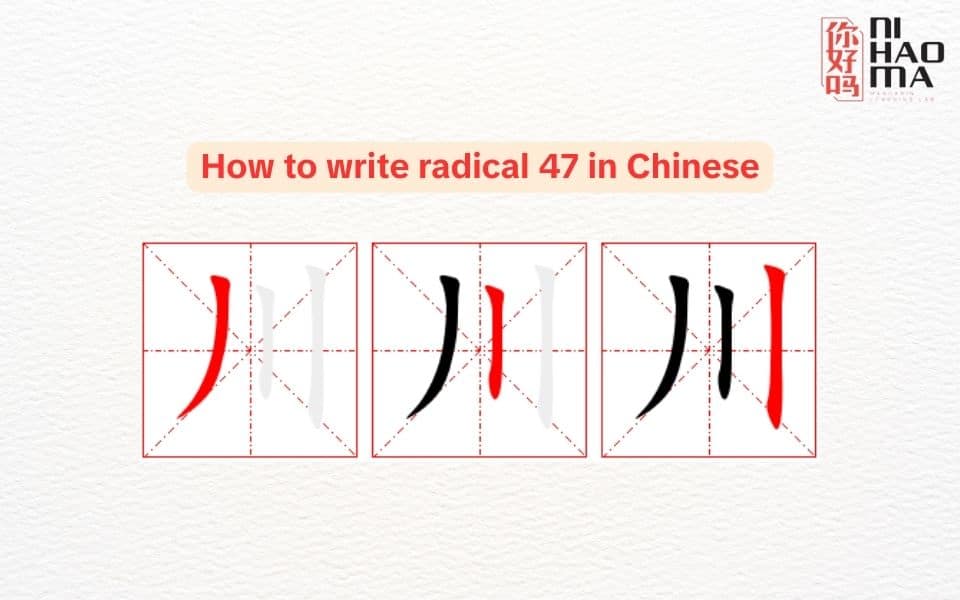
The Chinese radical 川 consists of three strokes:
| Stroke Order | Stroke Type | Writing Instructions |
|---|---|---|
| 1 | 丿 (Left-falling stroke) | Write the first stroke on the left, moving from top to bottom with the lower end slanting to the left. |
| 2 | 丨 (Vertical stroke) | Write a short vertical stroke to the right of the first stroke. |
| 3 | 丨 (Vertical stroke) | Write the final vertical stroke on the right, keeping the spacing between all three strokes relatively even. |
Chinese Vocabulary Containing Radical 47
Learning Chinese vocabulary containing radical 47 will help you understand how Chinese characters are used in real-life contexts while expanding your vocabulary and improving character recognition.
Let’s explore some common Chinese words containing 川 and related character components with Ni Hao Ma. Each entry includes the Chinese characters, pinyin, and English meaning to help you study and apply these words more effectively.
| Chinese Characters | Pinyin | Meaning |
|---|---|---|
| 四川 | Sìchuān | Sichuan |
| 川菜 | chuāncài | Sichuan cuisine |
| 川剧 | chuānjù | Sichuan opera |
| 川话 | chuānhuà | Sichuan dialect |
| 川流 | chuānliú | Flowing streams |
| 山川 | shānchuān | Mountains and rivers |
| 河川 | héchuān | Rivers and streams |
| 冰川 | bīngchuān | Glacier |
| 平川 | píngchuān | Broad, flat plain |
| 川味 | chuānwèi | Sichuan flavor |
| 川渝 | Chuān-Yú | Sichuan and Chongqing |
| 川北 | Chuānběi | Northern Sichuan |
| 川南 | Chuānnán | Southern Sichuan |
| 川西 | Chuānxī | Western Sichuan |
| 川东 | Chuāndōng | Eastern Sichuan |
| 百川 | bǎichuān | Hundreds of rivers |
| 顺利 | shùnlì | Smooth; successful |
| 顺便 | shùnbiàn | By the way; conveniently |
| 顺序 | shùnxù | Order; sequence |
| 顺手 | shùnshǒu | Convenient; within easy reach |
| 顺心 | shùnxīn | Satisfying; to one’s liking |
| 顺路 | shùnlù | On the way; along the route |
| 顺风 | shùnfēng | Favorable wind; with the wind |
| 顺从 | shùncóng | To obey; to comply |
| 顺应 | shùnyìng | To adapt to; to follow |
| 顺畅 | shùnchàng | Smooth; unobstructed |
| 顺口 | shùnkǒu | Easy to say; natural-sounding |
| 顺眼 | shùnyǎn | Pleasant to look at |
| 顺势 | shùnshì | To follow the trend or circumstances |
| 顺境 | shùnjìng | Favorable circumstances |
| 顺差 | shùnchā | Trade surplus |
| 顺产 | shùnchǎn | Vaginal delivery |
| 顺延 | shùnyán | To postpone; to extend a deadline |
| 顺道 | shùndào | To do something along the way |
| 顺耳 | shùněr | Pleasant to hear |
| 顺气 | shùnqì | To relieve frustration; to calm down |
| 顺民 | shùnmín | Submissive subject or citizen |
| 顺水 | shùnshuǐ | With the current; downstream |
| 巡逻 | xúnluó | To patrol |
| 巡查 | xúnchá | To inspect; to patrol |
| 巡视 | xúnshì | To inspect; to make an inspection tour |
| 巡回 | xúnhuí | To tour; to travel around |
| 巡航 | xúnháng | To cruise; to patrol by air or sea |
| 巡演 | xúnyǎn | Touring performance |
| 巡警 | xúnjǐng | Patrol officer |
| 巡夜 | xúnyè | To patrol at night |
| 巡山 | xúnshān | To patrol the mountains |
| 巡游 | xúnyóu | To tour; to parade |
| 巡捕 | xúnbǔ | Police officer in historical contexts |
| 巡抚 | xúnfǔ | Provincial governor in imperial China |
| 巡幸 | xúnxìng | An imperial tour or royal progress |
| 驯服 | xùnfú | To tame; to subdue |
| 驯养 | xùnyǎng | To domesticate; to train animals |
| 驯化 | xùnhuà | To domesticate; to acclimatize |
| 驯良 | xùnliáng | Gentle and docile |
| 驯马 | xùnmǎ | To train horses |
| 驯兽 | xùnshòu | To train animals |
| 驯鹿 | xùnlù | Reindeer |
| 驯顺 | xùnshùn | Docile; obedient |
| 驯熟 | xùnshú | Tamed; accustomed through training |
| 驯导 | xùndǎo | To train; to guide the domestication of animals |
Note: This table includes words containing 川 as a character or component, as well as related words whose characters may be associated with similar visual components. Not every word listed is classified under radical 47 in a Chinese dictionary. For example, 顺 is classified under 页, while 巡 and 驯 are classified under 辵 and 马, respectively. Learning this distinction will help you understand how radicals work in Chinese dictionaries.
Chinese Dialogue Examples Using Vocabulary Related to Radical 47
Knowing the meaning of individual Chinese characters is only the first step. To communicate naturally in Chinese, learners also need to practice using vocabulary in sentences and everyday situations. Seeing a word in context makes it easier to remember its meaning, nuances, and common word combinations.
Below are three short dialogues featuring vocabulary related to 川. The conversations cover familiar situations, including talking about hometowns, enjoying local cuisine, and describing natural scenery.
Dialogue 1
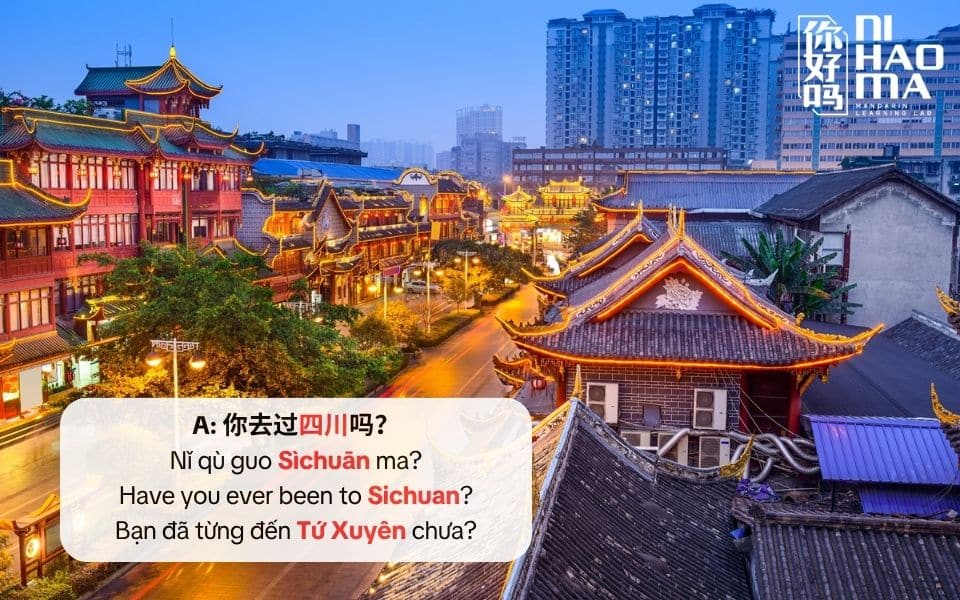
A: 你去过四川吗?
Nǐ qù guo Sìchuān ma?
Have you ever been to Sichuan?
B: 去过一次,那里的风景很美。
Qù guo yí cì, nàli de fēngjǐng hěn měi.
Yes, I’ve been there once. The scenery is beautiful.
A: 我听说那里的川菜特别有名。
Wǒ tīngshuō nàli de chuāncài tèbié yǒumíng.
I’ve heard that Sichuan cuisine is especially famous.
B: 是啊,不过有些菜真的很辣。
Shì a, búguò yǒuxiē cài zhēn de hěn là.
That’s right, but some dishes are really spicy.
A: 那你最喜欢哪道菜?
Nà nǐ zuì xǐhuan nǎ dào cài?
Then, which dish do you like the most?
B: 我最喜欢麻婆豆腐,下次我们一起去吃吧!
Wǒ zuì xǐhuan mápó dòufu, xià cì wǒmen yìqǐ qù chī ba!
I like mapo tofu the most. Let’s go eat it together next time!
Dialogue 2
A: 你周末打算去哪里旅游?
Nǐ zhōumò dǎsuàn qù nǎli lǚyóu?
Where are you planning to travel this weekend?
B: 我想去看看那里的山川。
Wǒ xiǎng qù kànkan nàli de shānchuān.
I’d like to go and see the mountains and rivers there.
A: 听说那边的自然风景很漂亮。
Tīngshuō nàbian de zìrán fēngjǐng hěn piàoliang.
I’ve heard that the natural scenery there is beautiful.
B: 对,我还想拍一些照片。
Duì, wǒ hái xiǎng pāi yìxiē zhàopiàn.
Yes, I’d also like to take some photos.
A: 如果天气好,我们可以沿着河川散步。
Rúguǒ tiānqì hǎo, wǒmen kěyǐ yánzhe héchuān sànbù.
If the weather is nice, we can take a walk along the river.
B: 好主意!我已经开始期待这次旅行了。
Hǎo zhǔyi! Wǒ yǐjīng kāishǐ qīdài zhè cì lǚxíng le.
Great idea! I’m already looking forward to this trip.
Dialogue 3
A: 你知道什么是冰川吗?
Nǐ zhīdào shénme shì bīngchuān ma?
Do you know what a glacier is?
B: 知道,是由冰组成的大块冰体。
Zhīdào, shì yóu bīng zǔchéng de dà kuài bīngtǐ.
Yes. It’s a large mass of ice formed from accumulated ice and snow.
A: 我在一本地理书上看到了这个词。
Wǒ zài yì běn dìlǐ shū shang kàndào le zhège cí.
I saw this word in a geography book.
B: 你对自然地理很感兴趣吗?
Nǐ duì zìrán dìlǐ hěn gǎn xìngqù ma?
Are you very interested in physical geography?
A: 是的,我还想了解河流是怎么形成的。
Shì de, wǒ hái xiǎng liǎojiě héliú shì zěnme xíngchéng de.
Yes. I’d also like to learn how rivers are formed.
B: 那我们可以一起看纪录片,学习更多知识。
Nà wǒmen kěyǐ yìqǐ kàn jìlùpiàn, xuéxí gèng duō zhīshi.
Then we can watch a documentary together and learn more.
Conclusion
In this article, we explored radical 47 in Chinese with Ni Hao Ma, covering its basic meaning, three-stroke writing order, vocabulary examples, and practical dialogue exercises. The radical 川 is associated with rivers and streams and appears in numerous Chinese words related to geography, food, and Chinese culture.
To learn Chinese radicals more effectively, combine character recognition with vocabulary building, handwriting practice, and sentence construction in real-life contexts. Make a habit of reviewing what you learn every day to gradually develop a stronger Chinese vocabulary.
If you’re looking for a structured Chinese learning environment with a clear study path, contact Ni Hao Ma today to discover a course that suits your learning goals!