When you first start learning Chinese, memorizing thousands of Chinese characters can feel overwhelming. One of the basic radicals that learners should become familiar with is Radical 2 in Chinese.
So, what is Radical 2 in Chinese? What does this radical represent, and how can you use vocabulary containing it in everyday communication? Let’s explore these questions in detail with Ni Hao Ma in the article below!
What Is Radical 2 in Chinese?
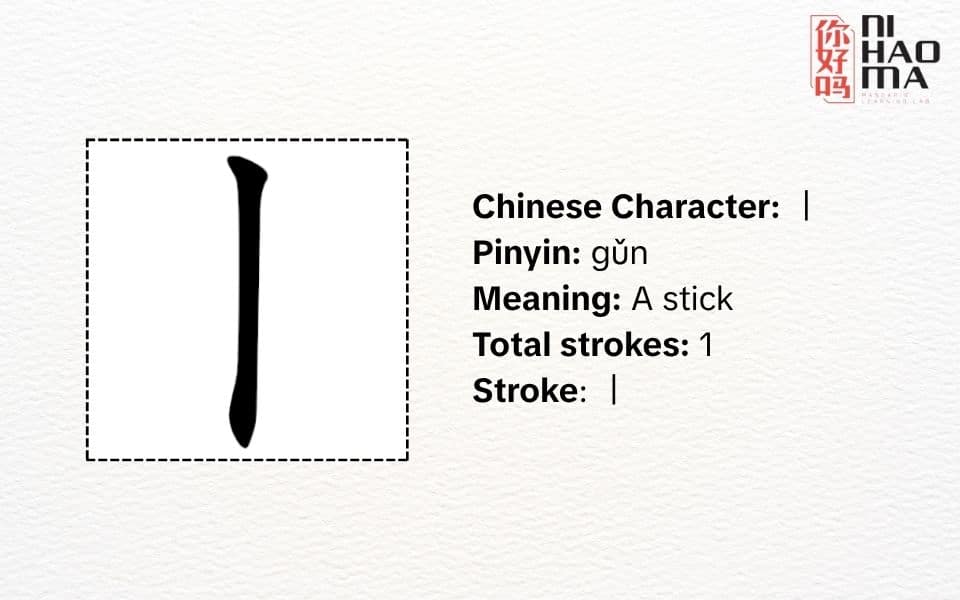
Radical 2 in Chinese (丨- gǔn) is the second radical in the traditional system of 214 Kangxi radicals. It consists of a single vertical stroke and is associated with the meaning of “a stick.”
In terms of its shape, Radical 2 consists of a single vertical stroke drawn from top to bottom. Despite its simple appearance, it can carry several symbolic meanings:
- Connection and continuity: It may represent a line or pathway connecting the top and bottom, or linking two points together.
- A central axis and direction: It can suggest a central line, a point of reference, or a sense of straightness and direction.
When 丨 serves as a radical or a prominent structural component in a Chinese character, it may extend through horizontal strokes or pass through enclosed shapes, as seen in characters such as 中 (zhōng – middle) and 串 (chuàn – to string together). However, not every Chinese character containing a vertical stroke (丨) is classified under Radical 2.
How to Distinguish Radical 2 (丨) from an Ordinary Vertical Stroke
Radical 2 and an ordinary vertical stroke look almost identical. The main difference lies in their roles within Chinese characters rather than in their visual appearance.
For example, in 十 (shí – ten), the vertical stroke intersects a horizontal stroke to form the complete character. In 上 (shàng – above), the vertical stroke combines with other strokes to create a character with its own meaning. However, neither character is classified under Radical 2.
A vertical stroke is one of the basic strokes used to write Chinese characters, whereas 丨 is considered Radical 2 when it serves as a radical. To identify the correct radical of a character, it is best to consult a Chinese dictionary rather than rely solely on the appearance of its strokes.
Chinese Vocabulary Containing Radical 2
To help learners remember new words and apply them in everyday conversations, Ni Hao Ma has compiled a list of two-character Chinese words containing characters that some dictionary systems classify under Radical 2 (丨).
The vocabulary below is selected based on common usage and includes Pinyin pronunciation and English meanings to support your learning. Please note that radical classifications may vary between dictionaries, and not every character containing a vertical stroke belongs to Radical 2.
| Chữ Hán | Pinyin | Ý nghĩa |
| 中间 | zhong jian | Ở giữa, trung tâm |
| 中国 | zhong guo | Trung Quốc |
| 中文 | zhong wen | Tiếng Trung |
| 中心 | zhong xin | Trung tâm |
| 中学 | zhong xue | Trường trung học (Cấp 2, Cấp 3) |
| 中午 | zhong wu | Buổi trưa |
| 中饭 | zhong fan | Cơm trưa |
| 中秋 | zhong qiu | Trung thu |
| 集中 | ji zhong | Tập trung |
| 中介 | zhong jie | Môi giới, trung gian |
| 中立 | zhong li | Trung lập |
| 中意 | zhong yi | Vừa ý, ưng ý, hợp ý |
| 个人 | ge ren | Cá nhân, riêng tư |
| 个性 | ge xing | Cá tính |
| 个体 | ge ti | Cá thể, hộ kinh doanh cá thể |
| 个别 | ge bie | Cá biệt, ngoại lệ, riêng biệt |
| 个子 | ge zi | Vóc dáng, chiều cao |
| 每个 | mei ge | Mỗi một |
| 个展 | ge zhan | Triển lãm cá nhân |
| 丰富 | feng fu | Phong phú, đa dạng |
| 丰盛 | feng sheng | Thịnh soạn (bữa ăn) |
| 丰收 | feng shou | Bội thu, thắng lợi lớn |
| 丰满 | feng man | Đầy đặn |
| 丰硕 | feng shuo | To lớn, rực rỡ (thành quả, kết quả) |
| 羊肉串 | yang rou chuan | Xiên thịt cừu nướng |
| 串通 | chuan tong | Thông đồng, câu kết |
| 串门 | chuan men | Sang nhà người quen chơi, ghé thăm xóm giềng |
| 串联 | chuan lian | Mắc nối tiếp (mạch điện), liên kết |
| 客串 | ke chuan | Diễn viên khách mời (cameo) |
| 丫头 | ya tou | Con gái nhỏ, bé gái (cách gọi thân mật) |
| 脚丫 | jiao ya | Bàn chân, ngón chân |
| 临时 | lin shi | Tạm thời, đột xuất |
| 临床 | lin chuang | Lâm sàng (y học) |
| 临近 | lin jin | Đến gần, cận kề (thời gian, địa điểm) |
| 临走 | lin zou | Sắp đi, trước lúc rời đi |
| 临摹 | lin mo | Tập viết/vẽ theo mẫu (sao chép) |
| 面临 | mian lin | Đối mặt với (khó khăn, thử thách) |
| 光临 | guang lin | Ghé thăm, đến dự (kính ngữ chào khách) |
| 降临 | jiang lin | Buông xuống, giáng xuống (đêm tối, dịp lễ) |
| 中餐 | zhong can | Món ăn Trung / Bữa trưa |
| 中奖 | zhong jiang | Trúng thưởng, trúng vé số |
| 中毒 | zhong du | Ngộ độc, trúng độc |
| 中暑 | zhong shu | Say nắng, trúng nắng |
| 中途 | zhong tu | Dọc đường, giữa chừng |
| 中号 | zhong hao | Size M (kích cỡ vừa) |
| 中指 | zhong zhi | Ngón tay giữa |
| 临排 | lin pai | Xếp hàng tạm thời |
| 临产 | lin chan | Chuyển dạ, sắp sinh |
| 临海 | lin hai | Giáp biển, hướng ra biển |
Chinese Dialogues Using Vocabulary Containing Radical 2
To remember Radical 2 (丨) more effectively, learners should go beyond understanding its meaning and written form and practice using related Chinese vocabulary in real-life situations. The following dialogues help you review useful words, practice sentence construction, and develop more natural Chinese communication skills.
Dialogue 1
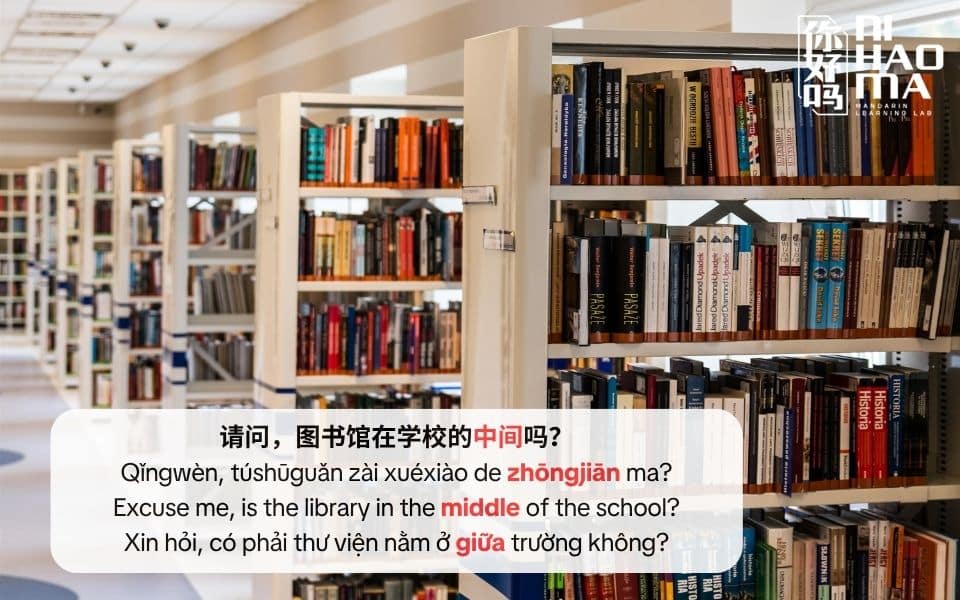
A: 请问,图书馆在学校的中间吗?
Qǐngwèn, túshūguǎn zài xuéxiào de zhōngjiān ma?
Excuse me, is the library in the middle of the school?
B: 是的,在教学楼和食堂中间。
Shì de, zài jiàoxuélóu hé shítáng zhōngjiān.
Yes, it is between the classroom building and the cafeteria.
A: 从这里走过去要多久?
Cóng zhèlǐ zǒu guòqu yào duōjiǔ?
How long does it take to walk there from here?
B: 大概五分钟,很近。
Dàgài wǔ fēnzhōng, hěn jìn.
About five minutes. It’s very close.
A: 太好了,谢谢你!
Tài hǎo le, xièxie nǐ!
That’s great! Thank you!
B: 不客气!
Bú kèqi!
You’re welcome!
Dialogue 2
A: 这个周末你有什么计划?
Zhège zhōumò nǐ yǒu shénme jìhuà?
What are your plans for this weekend?
B: 我想去市中心买东西。
Wǒ xiǎng qù shì zhōngxīn mǎi dōngxi.
I want to go shopping in the city center.
A: 你想买什么?
Nǐ xiǎng mǎi shénme?
What do you want to buy?
B: 我想买几本中文书。
Wǒ xiǎng mǎi jǐ běn Zhōngwén shū.
I want to buy a few Chinese books.
A: 我也想买中文书,可以一起去吗?
Wǒ yě xiǎng mǎi Zhōngwén shū, kěyǐ yìqǐ qù ma?
I want to buy Chinese books too. Can we go together?
B: 当然可以,我们星期六见!
Dāngrán kěyǐ, wǒmen xīngqīliù jiàn!
Of course! See you on Saturday!
Dialogue 3
A: 你觉得中国文化怎么样?
Nǐ juéde Zhōngguó wénhuà zěnmeyàng?
What do you think of Chinese culture?
B: 我觉得中国文化非常丰富。
Wǒ juéde Zhōngguó wénhuà fēicháng fēngfù.
I think Chinese culture is incredibly rich and diverse.
A: 你最喜欢中国文化的什么部分?
Nǐ zuì xǐhuan Zhōngguó wénhuà de shénme bùfen?
What aspect of Chinese culture do you like the most?
B: 我最喜欢中国的传统节日和美食。
Wǒ zuì xǐhuan Zhōngguó de chuántǒng jiérì hé měishí.
I like Chinese traditional festivals and cuisine the most.
A: 是啊,了解这些文化一定很有意思。
Shì a, liǎojiě zhèxiē wénhuà yídìng hěn yǒu yìsi.
That’s true. Learning about these cultural traditions must be really interesting.
Conclusion
Radical 2 in Chinese is one of the basic radicals learners should become familiar with when studying the structure of Chinese characters. By exploring its meaning, written form, and common vocabulary containing related characters, you can gradually improve your ability to recognize Chinese characters and expand your vocabulary.
We hope this guide from Ni Hao Ma makes learning Chinese radicals easier and more effective. Keep practicing your writing, reviewing vocabulary, and applying what you learn in everyday conversations to make steady progress in your Chinese language journey!