
In the Chinese writing system, each radical carries its own meaning and plays an important role in forming characters and helping learners memorize vocabulary. Radical 54 is considered one of the less common Chinese radicals, yet it still appears in several modern Chinese characters. In this article, we will explore what radical 54 is, its meaning, origin, correct stroke order, and how it is used in practice.
What Is Radical 54 in Chinese?
Radical 54 (廴 – yǐn) in Mandarin is the 54th radical among the 214 Kangxi radicals. In terms of meaning, radical 54 symbolizes the idea of extended movement, such as walking a long distance, taking long steps, or something that is drawn out or prolonged rather than sudden or abrupt.
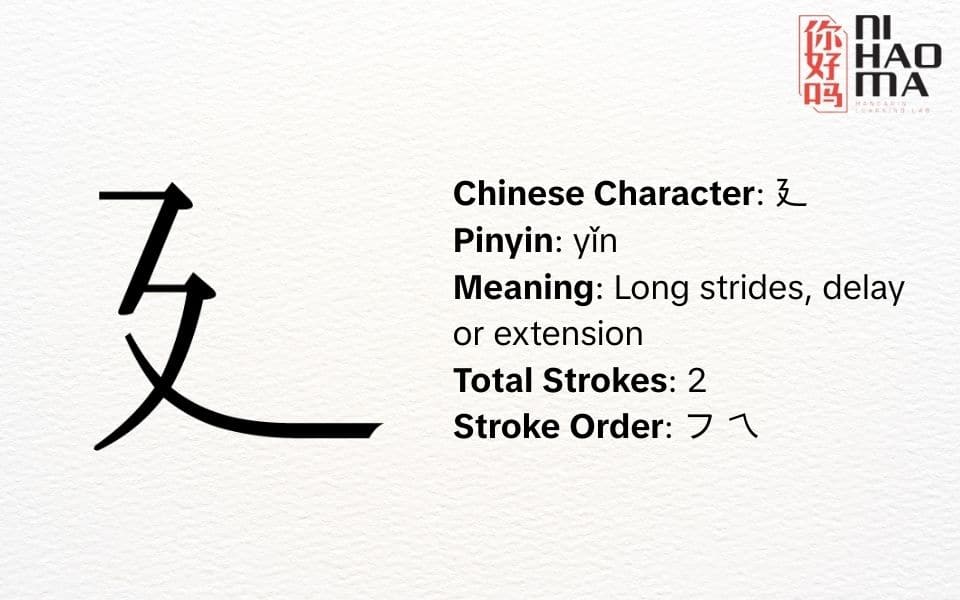
According to Shuowen Jiezi (說文解字) by Xu Shen (the earliest authoritative dictionary of Chinese characters), radical 54 represents the concept of “long walking” or “extended movement.” Its original form was inspired by the image of a person moving forward with elongated steps. Over time, as Chinese characters were standardized, its shape was simplified into the modern form 廴, while its core meaning remained unchanged.
From a semantic perspective, radical 54 does not simply indicate physical movement. It often implies a gradual, continuous, and orderly process. In many Chinese characters, this radical contributes meanings such as “to extend,” “to prolong,” “to increase,” or “to guide.” Once learners understand the fundamental meaning of radical 54, they can more easily infer the meanings of unfamiliar characters in a logical way.
How to Write Radical 54 in Chinese
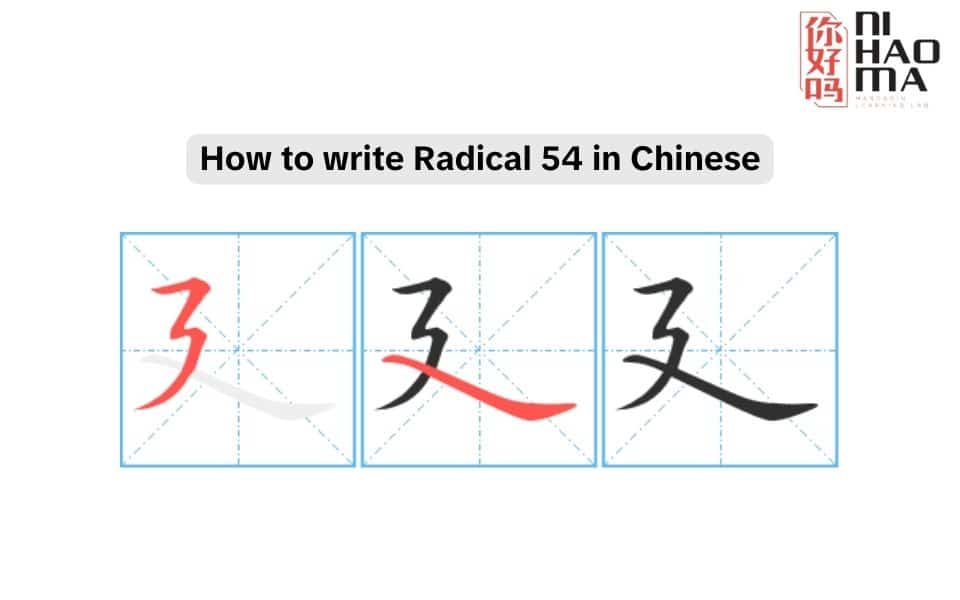
Radical 54 consists of two strokes, written in the following order:
| Stroke Order | Stroke Name | Description |
|---|---|---|
| 1 | ㄣ (Turning stroke) | Start with a short horizontal stroke from left to right, then continue into a double turning stroke. The final part curves slightly, resembling a soft “3” shape. |
| 2 | 乀 (Right-falling stroke) | Draw a long right-falling stroke that crosses through the end of the turning stroke. |
Distinguishing Radical 54 (廴) from Radical 162 (辶)
Confusion between radical 54 (廴) and radical 162 (辶 – chuò) is very common among Chinese learners. This is because the two radicals look similar at the bottom and often appear on the left side of characters.
A quick visual method to tell them apart:
- Radical 54 (廴) has two strokes and features a short turning stroke at the top.
- Radical 162 (辶) has three strokes and includes a dot stroke (丶) at the top.
Recognizing this key difference can help learners avoid mistakes when reading, writing, or analyzing Chinese characters.
Vocabulary Containing Radical 54 in Chinese
After understanding the definition, meaning, and stroke order, learning vocabulary containing radical 54 helps learners gain deeper insight into how this radical is used in real Chinese language contexts. Below is a collection of common Chinese words that contain radical 54, frequently used in daily communication.
| Vocabulary | Pinyin | Meaning |
|---|---|---|
| 建 | jiàn | To build |
| 延 | yán | To extend |
| 延长 | yáncháng | To prolong |
| 延期 | yánqī | To postpone, delay |
| 延续 | yánxù | To continue |
| 延伸 | yánshēn | To extend, expand |
| 推延 | tuīyán | To put off |
| 迁延 | qiānyán | To drag on |
| 延误 | yánwù | To delay |
| 延缓 | yánhuǎn | To slow down |
| 延后 | yánhòu | To move to a later time |
| 延展 | yánzhǎn | To expand in scope |
| 延命 | yánmìng | To prolong life |
| 延时 | yánshí | To extend time |
| 建立 | jiànlì | To establish |
| 建设 | jiànshè | Construction; to develop |
| 建筑 | jiànzhù | Architecture; building |
| 建议 | jiànyì | To suggest |
| 建成 | jiànchéng | To complete construction |
| 建国 | jiànguó | To found a nation |
| 健康 | jiànkāng | Health |
| 建交 | jiànjiāo | To establish diplomatic relations |
| 建制 | jiànzhì | Institutional system |
| 建树 | jiànshù | Achievement |
| 朝廷 | cháotíng | Imperial court |
| 入廷 | rùtíng | To enter the court |
| 廷议 | tíngyì | Court discussion |
| 法廷 | fǎtíng | Court of law |
| 延揽 | yánlǎn | To recruit |
| 延聘 | yánpìn | To invite (to work) |
| 延纳 | yánnà | To accept, admit |
| 延留 | yánliú | To retain |
| 延见 | yánjiàn | To meet later |
| 延接 | yánjiē | To receive or welcome |
| 延宾 | yánbīn | To welcome guests |
| 延引 | yányǐn | To guide |
| 延带 | yándài | To bring along |
| 延传 | yánchuán | To pass on |
Sample Dialogues Using Vocabulary with Radical 54
Learning vocabulary through real-life dialogues is an effective way to understand how words are used in context. Below are three practical dialogues featuring vocabulary that contains radical 54, based on common everyday situations.
Dialogue 1
A: 这个项目可以延长一周吗?
Zhège xiàngmù kěyǐ yáncháng yì zhōu ma?
→ Can this project be extended by one more week?
B: 为什么要延期呢?
Wèishénme yào yánqī ne?
→ Why does it need to be postponed?
A: 因为客户的要求增加了。
Yīnwèi kèhù de yāoqiú zēngjiā le.
→ Because the client’s requirements have increased.
B: 那我们只能顺延时间了。
Nà wǒmen zhǐ néng shùnyán shíjiān le.
→ Then we can only adjust the deadline accordingly.
A: 谢谢您的理解。
Xièxie nín de lǐjiě.
→ Thank you for your understanding.

Dialogue 2
A: 这所学校是什么时候建立的?
Zhè suǒ xuéxiào shì shénme shíhòu jiànlì de?
→ When was this school established?
B: 是在十年前建立的。
Shì zài shí nián qián jiànlì de.
→ It was established ten years ago.
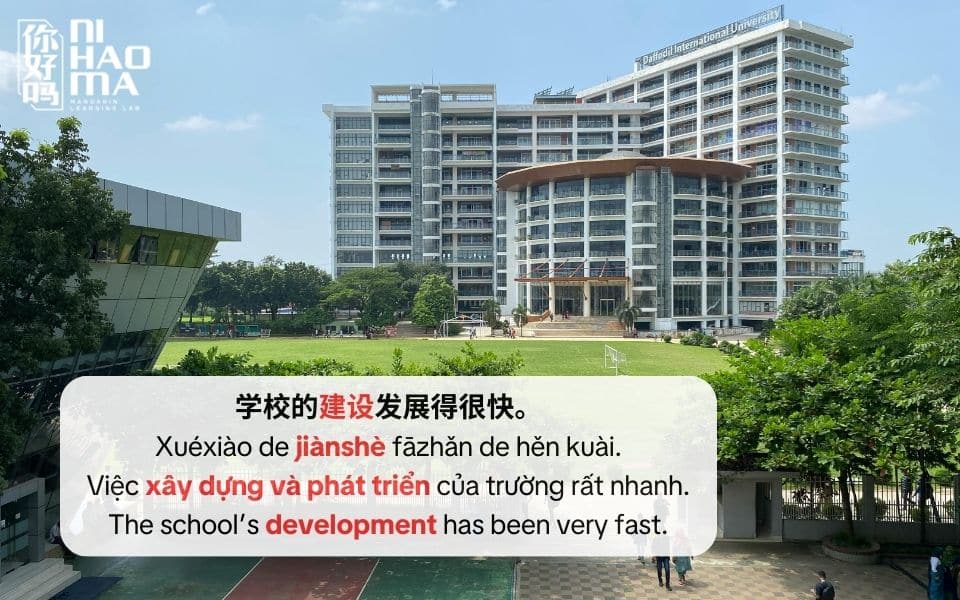
A: 学校的建设发展得很快。
Xuéxiào de jiànshè fāzhǎn de hěn kuài.
→ The school’s development has been very fast.
B: 是的,教学条件不断延伸。
Shì de, jiàoxué tiáojiàn búduàn yánshēn.
→ Yes, the teaching facilities continue to expand.
A: 学生的学习环境越来越好了。
Xuéshēng de xuéxí huánjìng yuèláiyuè hǎo le.
→ The learning environment is getting better and better.
Dialogue 3
A: 我们已经延请专家来公司了。
Wǒmen yǐjīng yánqǐng zhuānjiā lái gōngsī le.
→ We have already invited an expert to the company.
B: 他什么时候到?
Tā shénme shíhòu dào?
→ When will he arrive?
A: 下午三点左右。
Xiàwǔ sān diǎn zuǒyòu.
→ Around three o’clock in the afternoon.
B: 到时候我来延接他。
Dào shíhòu wǒ lái yánjiē tā.
→ I will go and receive him then.
A: 那就麻烦你了。
Nà jiù máfan nǐ le.
→ Thank you for your help.
Conclusion
Although radical 54 is not one of the most frequently used Chinese radicals, it plays an important role in shaping the meanings of many familiar Chinese characters. Learning Chinese characters through radicals helps learners recognize patterns, understand meanings more logically, and improve memorization efficiency. Hope this article by Ni Hao Ma has provided you with a solid foundation to expand your vocabulary and enhance your ability to use Chinese effectively in both learning and daily communication.