Among the 214 radicals in Chinese, Chinese radical 96 (the jade radical) is one of the most fascinating and meaningful. But what does it look like, what is its significance, how is it written, and which common Chinese characters include it? This article explores every aspect of the jade radical in Chinese, helping you strengthen your knowledge of Chinese characters effectively.
What Is the Radical 96 in Chinese?
The jade radical in Chinese (玉 – yù) is radical number 96 in the system of 214 radicals. When standing alone, 玉 means “jade” or “precious stone,” and it frequently appears in words related to gemstones or adjectives that convey beauty, purity, or value.
In oracle bone script, 玉 is believed to depict a string of jade beads, with the dot at the bottom representing the thread holding them together. This reflects the important role of jade in both the spiritual and material life of ancient Chinese society. When used within a Chinese character, it often conveys meanings associated with precious items, value, or positive qualities.
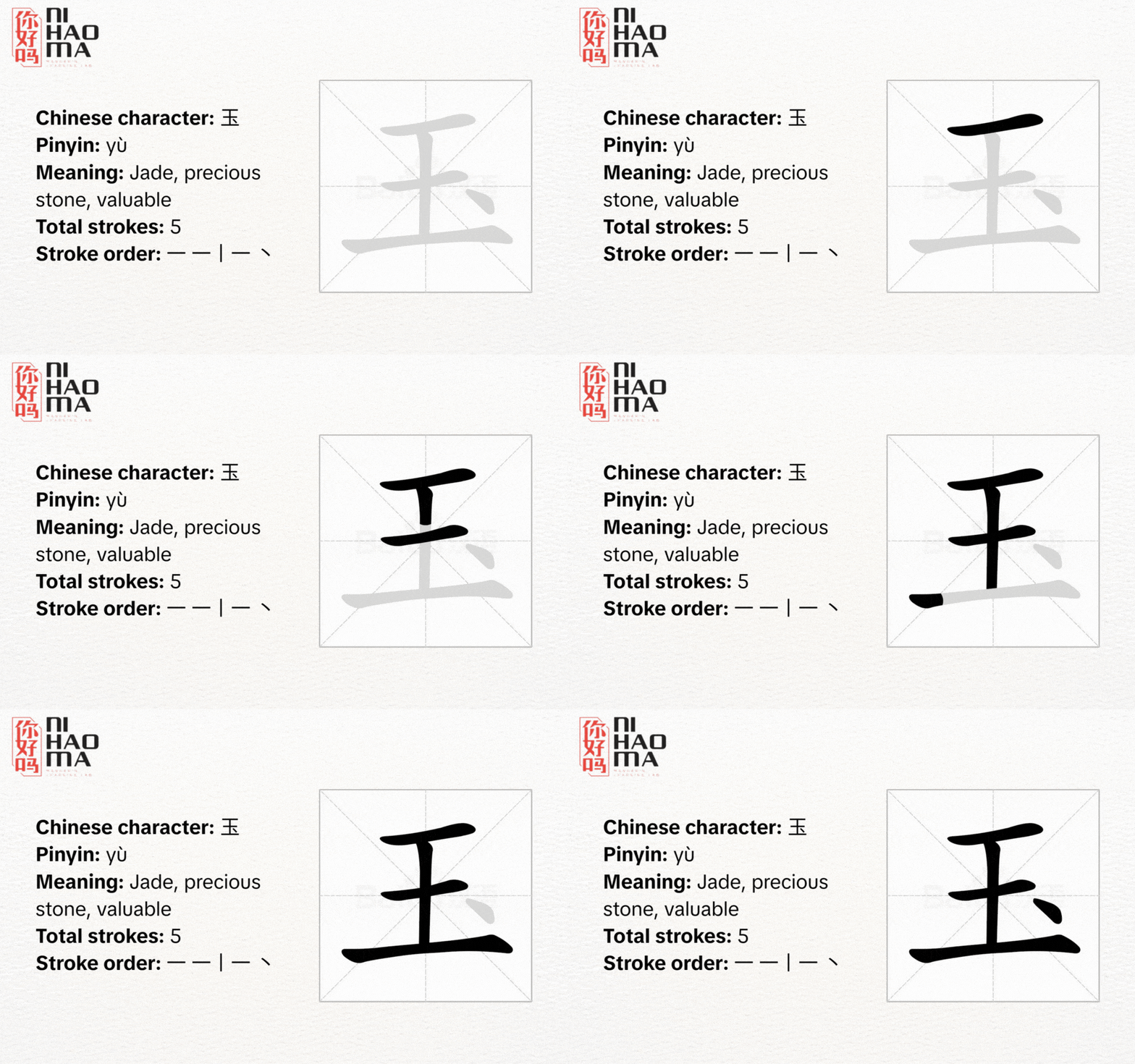
- Character: 玉
- Pinyin: yù
- Meaning: Jade, precious stone, valuable
- Total strokes: 5
- Stroke order: 一 一丨一 丶
How to Write the Radical 96 in Chinese
The radical 96 (玉), when combined with other components, usually appears on the left side or below the character. Here is the standard stroke order:
| Stroke order | Stroke name | Description |
|---|---|---|
| 1 | Horizontal (一) | Draw a long horizontal stroke from left to right. |
| 2 | Horizontal (一) | Draw a shorter horizontal stroke below the first. |
| 3 | Vertical (丨) | Draw a vertical line intersecting the two horizontal strokes. This is the main stem. |
| 4 | Horizontal (一) | Draw a third horizontal stroke below the vertical line, slightly longer than the second. |
| 5 | Dot (丶) | Add a small dot at the bottom right corner – a distinctive feature of the jade radical. |
Distinguishing 王 (wáng) and the Radical 96 (玉)
In Chinese, the character 王 (wáng) and the Chinese radical 96 look similar and can be easily confused. However, there are subtle differences if you pay attention to the number of strokes and the dot.
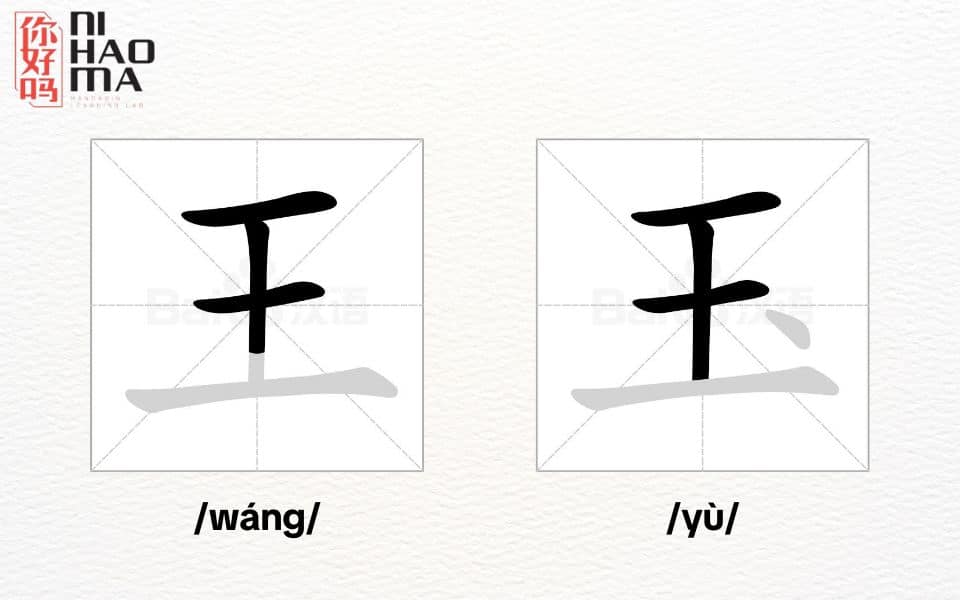
王 (wáng): meaning “king” or used as a surname. It consists of 4 strokes and does not have the dot. In compound characters, 王 can indicate sound or relate to power or greatness.
Examples:
- 王 (wáng) – king
- 旺 (wàng) – prosperous (王 is used phonetically)
- 往 (wǎng) – toward (王 combined with 彳, meaning unrelated to “king”)
玉 (yù) – the jade radical (Chinese radical 96): This is an official radical representing precious items, gemstones, or beautiful qualities. It has 5 strokes and is distinguished by the dot (丶) at the lower right.
Examples:
- 玉 (yù) – jade, precious stone
- 宝玉 (bǎoyù) – treasured jade
- 国 (guó) – nation (the jade radical often appears in other contexts)
In compound characters, the jade radical usually appears on the left as ⺩, which resembles 王 but still indicates meanings related to jade, gemstones, or valuable items. Characters with ⺩ typically carry connotations of beauty, precious materials, or admirable qualities.
You may also be interested in: Comprehensive List of the 214 Chinese Radicals
50 Common Words Containing the Radical 96
Did you know that many Chinese characters related to jewelry, valuable qualities, or beautiful things include the Chinese radical 96? In this article, we will explore 50 common vocabulary words containing the jade radical in Chinese, helping you expand your vocabulary and understand the meanings associated with this fascinating radical.
| No. | Character | Pinyin | Meaning |
|---|---|---|---|
| 1 | 玉 | yù | jade |
| 2 | 珍 | zhēn | precious, rare |
| 3 | 珠 | zhū | pearl, bead |
| 4 | 现 | xiàn | to appear, to emerge |
| 5 | 环 | huán | ring, circle |
| 6 | 球 | qiú | ball, sphere |
| 7 | 玺 | xǐ | imperial seal |
| 8 | 玩 | wán | to play |
| 9 | 班 | bān | class, group, shift |
| 10 | 珀 | pò | amber |
| 11 | 珊 | shān | coral |
| 12 | 宝 | bǎo | treasure, valuable |
| 13 | 琐 | suǒ | trivial, minor |
| 14 | 琳 | lín | beautiful jade, often used in names |
| 15 | 瑙 | nǎo | agate |
| 16 | 琴 | qín | musical instrument with strings |
| 17 | 琢 | zhuó | to carve, to polish |
| 18 | 望 | wàng | to hope, to wish |
| 19 | 全 | quán | whole, complete |
| 20 | 理 | lǐ | to organize, manage |
| 21 | 珍珠 | zhēnzhū | pearl |
| 22 | 玩具 | wánjù | toy |
| 23 | 玛瑙 | mǎnǎo | agate, gemstone |
| 24 | 原理 | yuán lǐ | principle |
| 25 | 足球 | zúqiú | football / soccer |
| 26 | 珍贵 | zhēnguì | precious |
| 27 | 琥珀 | hǔpò | amber |
| 28 | 珠宝 | zhūbǎo | jewelry |
| 29 | 现在 | xiànzài | now, present |
| 30 | 上班 | shàngbān | go to work |
| 31 | 玉佩 | yùpèi | jade pendant |
| 32 | 琉璃 | liúlí | glazed or colored glass |
| 33 | 主要 | zhǔyào | main, primary |
| 34 | 瑰宝 | guībǎo | treasure |
| 35 | 珊瑚 | shānhú | coral |
| 36 | 环境 | huánjìng | environment, surroundings |
| 37 | 整理 | zhěnglǐ | to organize, tidy up |
| 38 | 理智 | lǐzhì | rational, sensible |
| 39 | 国家 | guójiā | country, nation |
| 40 | 理由 | lǐyóu | reason |
| 41 | 琵琶 | pípa | Chinese lute |
| 42 | 希望 | xīwàng | hope |
| 43 | 珍惜 | zhēnxī | to cherish |
| 44 | 玉米 | yùmǐ | corn |
| 45 | 珍品 | zhēnpǐn | valuable item |
| 46 | 玫瑰 | méiguī | rose |
| 47 | 国宝 | guóbǎo | national treasure |
| 48 | 玩笑 | wánxiào | joke, fun |
| 49 | 璀璨 | cuǐcàn | dazzling, brilliant |
| 50 | 全面 | quánmiàn | comprehensive, overall |
Sample Dialogues Using Vocabulary with the Radical 96
Now that we know the jade radical appears in many everyday words and their common meanings, let’s explore some short dialogues containing vocabulary with the jade radical in Chinese. Try to spot the words from the list above in each conversation!
Dialogue 1
A: 好久不见,你最近怎么样?
Hǎojiǔ bú jiàn, nǐ zuìjìn zěnmeyàng?
Long time no see! How have you been recently?
B: 工作有点忙,不过还可以。你呢?
Gōngzuò yǒudiǎn máng, bùguò hái kěyǐ. Nǐ ne?
Work has been a bit busy, but it’s okay. How about you?
A: 我也差不多,时间越来越不够用。
Wǒ yě chàbuduō, shíjiān yuèláiyuè bú gòuyòng.
Same here, I feel like I have less and less free time.
B: 是啊,所以我们更要珍惜休息的机会。
Shì a, suǒyǐ wǒmen gèng yào zhēnxī xiūxí de jīhuì.
Exactly, that’s why we should cherish opportunities to rest.
A: 说得对,下次周末一起出去走走吧。
Shuō de duì, xiàcì zhōumò yìqǐ chūqu zǒuzou ba.
You’re right. Let’s go out together next weekend.
B: 好啊,我很期待!
Hǎo a, wǒ hěn qīdài!
Sure! I’m really looking forward to it.
Dialogue 2
A: 周末你要去哪里?
Zhōumò nǐ yào qù nǎlǐ?
Where are you going this weekend?
B: 我要去给弟弟买玩具,他最近乖得不得了。
Wǒ yào qù gěi dìdi mǎi wánjù, tā zuìjìn guāi de bùdéliǎo.
I’m going to buy toys for my younger brother. He’s been very well-behaved lately.
A: 买什么样的?
Mǎi shénme yàng de?
What kind are you going to buy?
B: 他喜欢汽车模型,最好是那种做得很玲珑的。
Tā xǐhuān qìchē móxíng, zuì hǎo shì nà zhǒng zuò de hěn línglóng de.
He likes car models, preferably ones that are very intricate.
A: 那我们一起去看看吧,我也想给侄子挑一个。
Nà wǒmen yìqǐ qù kànkan ba, wǒ yě xiǎng gěi zhízi tiāo yí gè.
Let’s go together – I also want to pick one for my nephew.
Dialogue 3
A: 下星期是我妈妈的生日,我还没决定买什么呢。
Xià xīngqī shì wǒ māma de shēngrì, wǒ hái méi juédìng mǎi shénme ne.
Next week is my mom’s birthday, and I haven’t decided what to buy yet.
B: 你可以考虑买一条珍珠项链,优雅又耐看。
Nǐ kěyǐ kǎolǜ mǎi yì tiáo zhēnzhū xiàngliàn, yōuyǎ yòu nàikàn.
You could consider buying a pearl necklace—it’s elegant and beautiful.
A: 听起来不错,我妈妈平时也挺喜欢珍珠的。
Tīng qǐlái búcuò, wǒ māma píngshí yě tǐng xǐhuān zhēnzhū de.
Sounds good! My mom usually likes pearls too.
B: 那我们周末一起去商场看看?
Nà wǒmen zhōumò yìqǐ qù shāngchǎng kànkan?
Shall we go check the mall this weekend?
A: 好啊,也顺便一起喝杯咖啡。
Hǎo a, yě shùnbiàn yìqǐ hē bēi kāfēi.
Sure! We can also have a cup of coffee then.
Conclusion
Understanding the Chinese radical 96 helps learners recognize Chinese characters associated with jade, gemstones, jewelry, and concepts of purity, value, and beauty. By mastering its stroke order, pronunciation, and common vocabulary, you can significantly improve your reading and writing skills in Chinese. We hope this article by Ni Hao Ma has provided useful insights, and we look forward to sharing more helpful lessons with you in the future!