In the Chinese writing system, every radical plays an important role in forming characters and suggesting their meanings. Radical 10 in Chinese is one of the simplest radicals in appearance, yet it appears in many commonly used Chinese characters. Learning this radical not only helps learners recognize characters more quickly but also provides a more logical way to memorize and expand Chinese vocabulary.
What Is Radical 10 in Chinese?
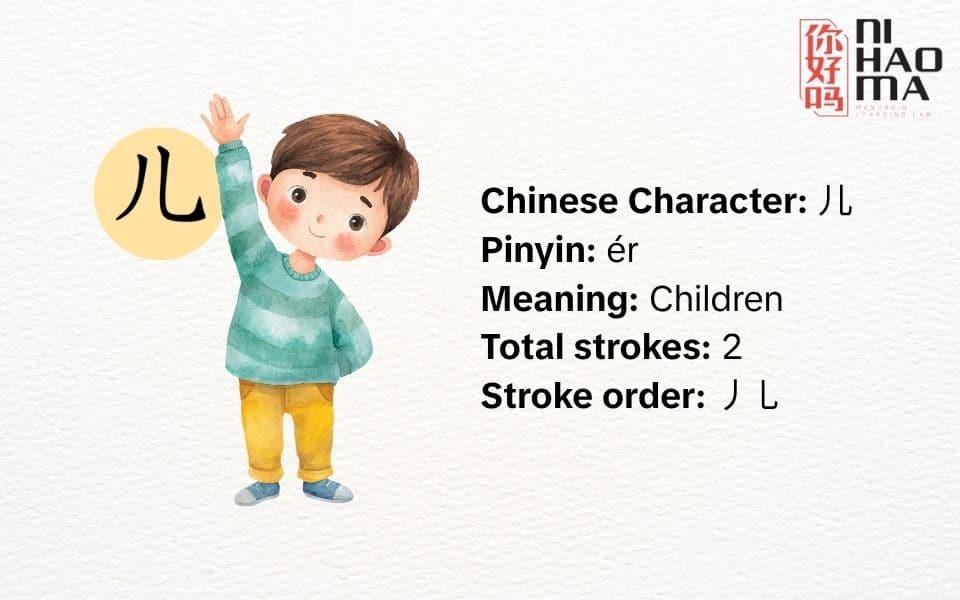
Radical 10 in Chinese is 儿 (ér), the 10th radical in the Kangxi radical system of 214 radicals. It is commonly associated with children, small objects, or things that appear cute and delicate.
Historically, Radical 10 originated from the image of a small child with an undeveloped head shape or tiny legs learning to walk. Over time, the form of the radical was simplified to match the modern Chinese writing system while still preserving its original characteristics.
The original meaning of Radical 10 is closely connected to the concepts of childhood, youthfulness, and smallness. However, when used as part of more complex Chinese characters, its meaning has gradually become broader and more abstract.
In Chinese character structure, Radical 10 often appears at the bottom or on the right side of a character, helping create visual balance. It is also found in many modern Chinese vocabulary words. Some common Chinese characters containing Radical 10 include:
- 儿 (ér): child, son
- 兄 (xiōng): elder brother
- 元 (yuán): original, first
- 先 (xiān): before, first
- 光 (guāng): light
How to Write Radical 10 in Chinese
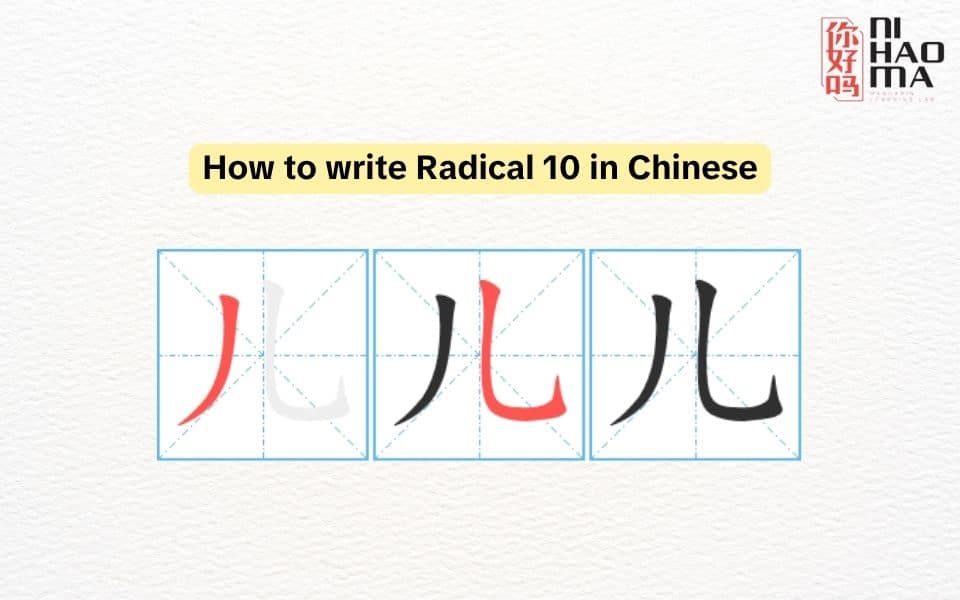
Radical 10 consists of only two basic strokes and is considered one of the easiest Chinese radicals to write. Although simple in appearance, learners should still pay attention to stroke order and balance to write the radical correctly and neatly.
| Stroke Order | Stroke | Description |
|---|---|---|
| 1 | 丿 (left-falling stroke) | Write the left-falling stroke from top to bottom on the left side |
| 2 | 乚 (hook stroke) | Draw a vertical stroke downward, move slightly to the right, then finish with an upward hook |
Vocabulary Words Containing Radical 10
After understanding the meaning and writing method of Radical 10 (儿), learning vocabulary that contains this radical will help you recognize Chinese characters more easily and improve vocabulary retention. Radical 10 commonly appears in words related to people, order, light, actions, and everyday concepts.
Below are some common vocabulary words containing Radical 10, arranged from simple characters to compound words for easier learning and reference.
| Chinese | Pinyin | Meaning |
|---|---|---|
| 儿 | ér | Child |
| 元 | yuán | Original; unit of currency |
| 兄 | xiōng | Elder brother |
| 允 | yǔn | To allow; permit |
| 光 | guāng | Light |
| 先 | xiān | First; before |
| 克 | kè | To overcome |
| 兆 | zhào | Omen; trillion |
| 兇 | xiōng | Fierce; violent |
| 党 | dǎng | Political party |
| 免 | miǎn | Exempt; avoid |
| 兔 | tù | Rabbit |
| 这儿 | zhèr | Here |
| 那儿 | nàr | There |
| 哪儿 | nǎr | Where? |
| 一点儿 | yìdiǎnr | A little; a bit |
| 一会儿 | yíhuìr | A moment; a while |
| 儿子 | érzi | Son |
| 女儿 | nǚ’ér | Daughter |
| 儿童 | értóng | Children |
| 儿女 | érnǚ | Sons and daughters; children |
| 儿科 | érkē | Pediatrics |
| 儿媳 | érxí | Daughter-in-law |
| 儿孙 | érsūn | Children and grandchildren |
| 孤儿 | gū’ér | Orphan |
| 兄弟 | xiōngdì | Brothers |
| 光明 | guāngmíng | Bright; hopeful |
| 光线 | guāngxiàn | Ray of light |
| 光荣 | guāngróng | Glory; honor |
| 先生 | xiānsheng | Mister; teacher; sir |
| 先进 | xiānjìn | Advanced |
| 先锋 | xiānfēng | Pioneer |
| 先后 | xiānhòu | Before and after |
| 元旦 | Yuándàn | New Year’s Day |
| 元气 | yuánqì | Vital energy |
| 元素 | yuánsù | Element |
| 党员 | dǎngyuán | Party member |
| 党派 | dǎngpài | Political faction |
| 免费 | miǎnfèi | Free of charge |
| 免税 | miǎnshuì | Tax-free |
| 克服 | kèfú | To overcome |
| 克制 | kèzhì | To restrain; control oneself |
| 克星 | kèxīng | Nemesis |
| 允许 | yǔnxǔ | To permit; allow |
| 允诺 | yǔnnuò | Promise |
| 兔子 | tùzi | Rabbit |
| 白兔 | báitù | White rabbit |
| 先前 | xiānqián | Previously; before |
| 先天 | xiāntiān | Innate; congenital |
| 元老 | yuánlǎo | Senior statesman; elder |
| 元首 | yuánshǒu | Head of state |
| 光阴 | guāngyīn | Time |
| 祖先 | zǔxiān | Ancestor |
| 玩儿 | wánr | To play |
| 公元 | gōngyuán | Common Era (A.D.) |
| 月光 | yuèguāng | Moonlight |
Sample Dialogues Using Radical 10 Vocabulary
After learning vocabulary containing Radical 10, practicing through real-life conversations can help you remember words more effectively and understand how they are used in daily communication. Below are three simple dialogues featuring common situations and frequently used words containing 儿.
Dialogue 1
A: 你有几个孩子?
(Nǐ yǒu jǐ ge háizi?)
How many children do you have?
B: 我有一个儿子和一个女儿。
(Wǒ yǒu yí ge érzi hé yí ge nǚ’ér.)
I have one son and one daughter.
A: 你儿子今年多大了?
(Nǐ érzi jīnnián duō dà le?)
How old is your son this year?
B: 他五岁了,现在上儿童班。
(Tā wǔ suì le, xiànzài shàng értóng bān.)
He is five years old and attends a children’s class now.
A: 你的女儿一定很可爱。
(Nǐ de nǚ’ér yídìng hěn kě’ài.)
Your daughter must be very cute.
Dialogue 2
A: 老师,请问先进去还是先登记?
(Lǎoshī, qǐngwèn xiān jìnqù háishi xiān dēngjì?)
Teacher, should I go in first or register first?
B: 先登记,然后再进去。
(Xiān dēngjì, ránhòu zài jìnqù.)
Register first, then go inside.
A: 好的,谢谢老师。
(Hǎo de, xièxie lǎoshī.)
Okay, thank you teacher.
B: 你是新学生吗?
(Nǐ shì xīn xuésheng ma?)
Are you a new student?
A: 对,我昨天才来。
(Duì, wǒ zuótiān cái lái.)
Yes, I just arrived yesterday.
B: 那你先去三楼教室吧。
(Nà nǐ xiān qù sānlóu jiàoshì ba.)
Then please go to the classroom on the third floor first.
Dialogue 3
A: 你先去买水果吧。
(Nǐ xiān qù mǎi shuǐguǒ ba.)
Go buy some fruit first.
B: 好,你想吃什么水果?
(Hǎo, nǐ xiǎng chī shénme shuǐguǒ?)
Sure, what fruit would you like to eat?
A: 我想买苹果和桃儿。
(Wǒ xiǎng mǎi píngguǒ hé táor.)
I want to buy apples and peaches.
B: 今天很多水果都很便宜。
(Jīntiān hěn duō shuǐguǒ dōu hěn piányi.)
Many fruits are very cheap today.
A: 那太好了,我们可以买多一点儿。
(Nà tài hǎo le, wǒmen kěyǐ mǎi duō yìdiǎnr.)
That’s great, we can buy a little more.
Conclusion
Radical 10 in Chinese (儿) is one of the most recognizable and frequently used radicals in modern Chinese. Understanding its meaning, stroke order, and related vocabulary can help learners memorize Chinese characters more efficiently while improving reading comprehension and everyday communication skills.
Hopefully, this guide by Ni Hao Ma has provided useful insights into Radical 10 and helped you build a stronger foundation for learning Chinese characters. Be sure to continue exploring other Chinese radicals to expand your vocabulary and deepen your understanding of the Chinese language.